
Week 4 · FinalW
 at Penn State
24–20+4 margin
Pregame 21–29
Game detailsSaturday Index
Loading team intelligenceBringing the latest verified football information into focus.
Big Ten · 2026 · Week 8

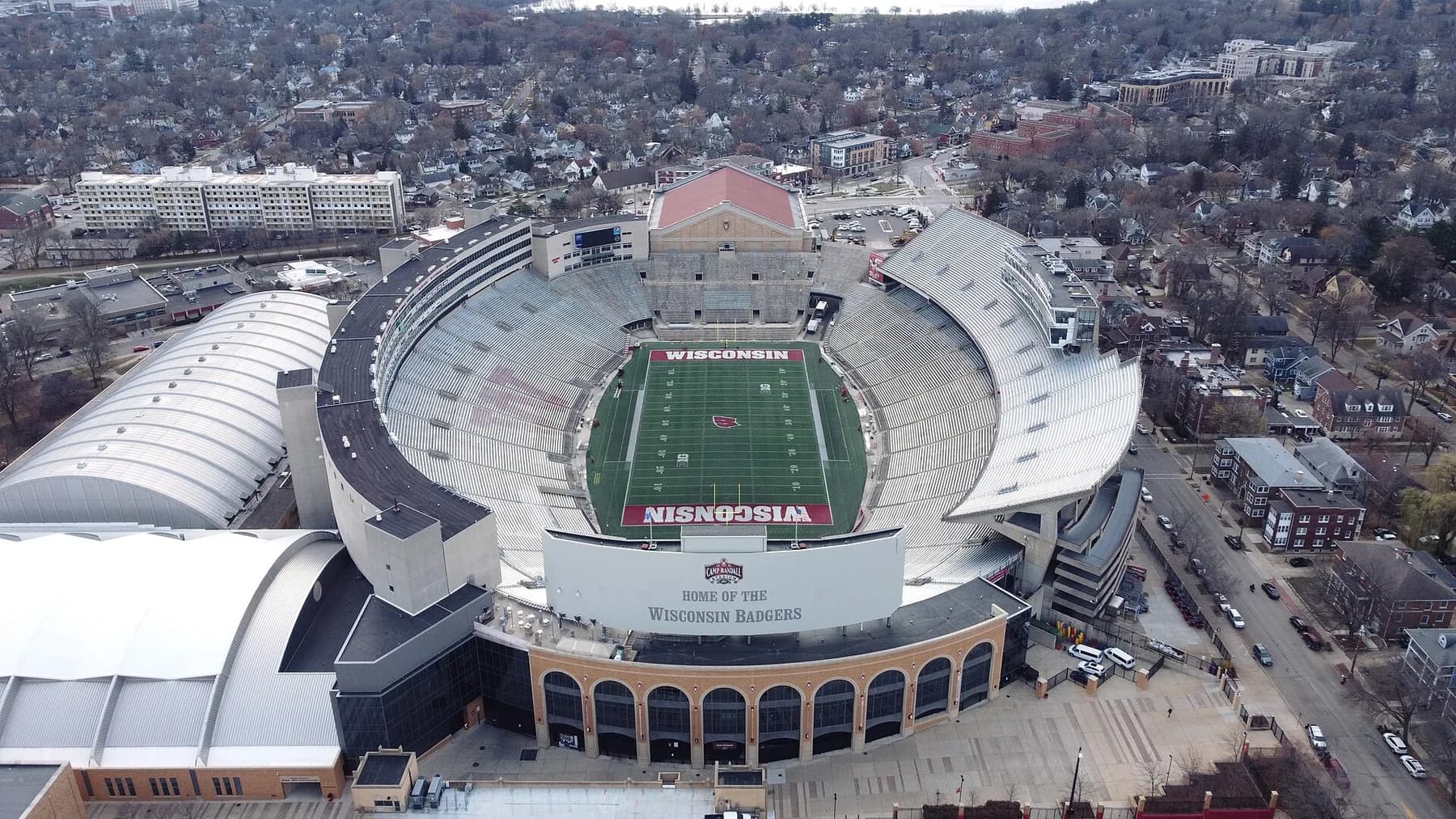
Photo: Lectrician2 · CC BY-SA 4.0 · Cropped for display
Up next · Week 9
Away
On the road at
Saturday, October 31 · Time TBA
The season, taking shape
Final scores show Wisconsin first. Oldest to newest.
at Penn StatePregame 21–29
Game details vs. Michigan State
Pregame 28–19
Game details at UCLA
Pregame 22–26
Original full-season forecast
This forecast retains the original probabilities for the full schedule. It does not update with completed results or this week’s forecast.
2026 results
Current record, team efficiency, player production, and verified results from completed games.
Current record
5-25 wins · 2 lossesThrough 7 completed gamesLoading player usage…
2026 season preview
Colton Joseph gives the Badgers a proven dual-threat quarterback, but their ceiling depends on how quickly a transfer-heavy roster becomes a functioning team.
Wisconsin’s 2026 season will test Luke Fickell’s ability to turn a sweeping rebuild into a coherent football team before the schedule demands one. The spring prospectus counted 34 offseason transfers, roughly one-third of the competitive roster, leaving the Badgers with new options across the depth chart but little margin for a slow merger. Fickell remains in charge, with Jeff Grimes guiding the offense and Mike Tressel the defense. The central question is not whether Wisconsin added talent; it is whether those additions can complement the young returners and establish a dependable identity quickly.
Original season forecast
The original Big Ten forecast, retained alongside current results.
Big Ten projected standing
#10
4-5 projected · 4.0 expected conference wins · #10 of 18.
Preseason baseline
2025 percentiles retained as preseason context; current results and player production lead this page.
2025 FBS percentile scale · 50 is average
Incoming class
National and conference recruiting ranks, confirmed commitments, and the highest-ranked recruits in this class.
Top committed recruits
Wisconsin2026 transfer movement
Incoming and outgoing transfer activity, with rated FBS-to-FBS moves below.
Incoming Transfers
WisconsinOutgoing Transfers
WisconsinSeason schedule
Completed games show final results. Upcoming games use this week’s forecast where available; later games retain their published season outlook.
Detailed football intelligence
The full team identity, offense, defense, and supporting evidence.
Team identity
Last season, Wisconsin tried to lean on the running game; it rarely provided an easy foundation.
Why it matters
Neither offensive unit clearly carried the other, so first-down execution decides whether Wisconsin can stay on plan.
 vs. USC
Pregame 23–28
Game detailsPregame comparisons use preserved published forecasts. Results include wins and losses.
At a glance
Current form leads the outlook.
2026 rates aggregate verified completed-game box scores. EPA is expected points added per play.
| Player | C/ATT | YDS | TD | INT |
|---|---|---|---|---|
| Colton Joseph | 99/173 | 1256 | 11 | 5 |
| Player | CAR | YDS | AVG | TD |
|---|---|---|---|---|
| Colton Joseph | 84 | 365 | 4.3 | 4 |
| Abu Sama III | 51 | 295 | 5.8 | 1 |
| Darrion Dupree | 49 | 215 | 4.4 | 2 |
| Player | REC | YDS | AVG | TD |
|---|---|---|---|---|
| Tyrell Henry | 28 | 343 | 12.3 | 1 |
| Jacob Harris | 16 | 262 | 16.4 | 3 |
| Chris Brooks Jr. | 13 | 227 | 17.5 | 3 |
| Player | TOT | SOLO | TFL | SACK |
|---|---|---|---|---|
| Cooper Catalano | 60 | 31 | 1 | 0 |
| Mason Posa | 52 | 34 | 4.5 | 1.5 |
| Matthew Jung | 44 | 25 | 1 | 0 |
Saturday, October 24 · Camp Randall Stadium
Saturday, October 17 · Rose Bowl
Saturday, October 3 · Camp Randall Stadium
The clearest place to build is quarterback, where Old Dominion transfer Colton Joseph arrives as the established starter. Wisconsin credits him with 2,624 passing yards and 21 touchdown passes in 2025, plus 1,007 rushing yards and 13 scores. His designed runs and improvisation can create explosive plays, rescue broken downs and offer answers on third down. They also make workload management important. Louisville transfer Deuce Adams and true freshman Ryan Hopkins entered camp as the leading backup candidates, a competition carrying added weight given Wisconsin’s recent quarterback injury history.
Joseph’s supporting cast offers variety without a settled hierarchy. Iowa State transfer Abu Sama III leads the backfield on paper, with 240-pound USC transfer Bryan Jackson providing a power complement and TCU transfer Nate Palmer adding depth. A committee could keep Joseph from absorbing excessive designed contact while allowing Grimes to alter the offense’s pace and presentation. Receiver is harder to forecast. Shamar Rigby, Jaylon Domingeaux, Malachi Coleman and Zion Kearney headline a rebuilt group, but Joseph’s vertical ability will translate only if reliable targets emerge and establish timing, separation and clear roles.
The tight ends and offensive line may determine how much flexibility Grimes actually has. Wisconsin’s bio for Bowling Green transfer Jacob Harris credits him with five touchdown catches in 2025, while Ryan Schwendeman supplies an experienced blocking profile alongside returners Grant Stec and Emmett Bork. Wisconsin also restored a fullback designation for Tyler Jansey and freshman walk-on McCoy Smith after the position had been absent from roster listings since 2022. Those pieces point toward heavier formations, backfield variety and protection help rather than a spread-only attack.
Up front, Oklahoma State transfer Austin Kawecki started all 12 games in 2025, 11 at center and one at right guard, and is positioned to stabilize communication. P.J. Wilkins left spring projected at left tackle. At right guard, Emerson Mandell underwent foot surgery and missed the remainder of spring. Fickell said he expected Mandell back for the fall, so the line’s early-camp continuity remains worth watching.
Tressel’s defense has undergone its own interior renovation. Veteran transfers Hammond Russell IV, Junior Poyser, Jacob Anderson and DeNigel Cooper expand the defensive-line rotation, with Poyser bringing 5.5 sacks from an interior alignment at Buffalo in 2025. Wisconsin still needs someone in that room to become disruptive enough to command changes in protection. Torin Pettaway’s departure before fall camp appears unlikely to alter the immediate rotation, but it trims developmental depth from an already transfer-heavy unit.
At linebacker, Jon Jon Kamara and junior-college transfer Taylor Schaefer join young returners Mason Posa and Cooper Catalano as Wisconsin prepares to use more three-linebacker looks. That approach will rise or fall on communication and sound run fits. The secondary added experienced corner Javan Robinson along with Bryce West, Eric Fletcher and Cai Bates, while Marvin Burks Jr. and Carson Van Dinter provide safety options. Stable outside coverage would give Tressel greater freedom to pressure and move hybrid defenders without leaving the back end exposed.
The schedule gives the rebuild an immediate deadline. Wisconsin opens against Notre Dame at Lambeau Field on September 6, then hosts Western Illinois and Eastern Michigan before visiting Penn State on September 26. Another demanding sequence sends the Badgers to UCLA, brings USC to Camp Randall and finishes at Iowa on consecutive listed weekends. The closing run—Rutgers at home, trips to Maryland and Purdue, then Minnesota at Camp Randall—could reward a team that improves over time. But Notre Dame and Penn State arrive before Wisconsin can count on time alone to settle its receiver rotation, offensive line and defensive leadership. The roster shows the shape of Fickell’s plan; the season will reveal how quickly those pieces fit.
This preview is based on the linked public reporting and official program records.
Profile high point
Big-play prevention held the profile's highest percentile position.Profile low point
Passing held the lowest percentile position among the profile's strength measures.



Wisconsin did not have one unit that could carry the whole game plan; big-play creation came closest.
What matters
Even Wisconsin's best unit finished near the national middle last season, leaving no proven strength to build around.
The offense's down-to-down consistency is Wisconsin's biggest concern, and opponents can test it immediately.
What matters
Wisconsin's offensive efficiency ranked near the bottom nationally last season.
Wisconsin is at its best when it can lean on the running game, then keep winning first down because neither the pass nor run can rescue the other; fewer possessions make every empty drive more expensive.
What matters
Wisconsin's run-first structure played at a deliberate pace. Passing finished bottom-tier and rushing finished bottom-tier, without a clear split between them.
Inside the team
Open a section for the football detail and supporting numbers.
The down-to-down question that determines whether the offense can keep both the run and pass available.
Wisconsin must establish a first-down answer before opponents have to defend both the run and pass.
Why it matters
Without one part of the offense forcing an adjustment, opponents can keep the offense in long-yardage and play from a position of strength.
The pace, play selection, and methods this offense uses to stay on schedule.
Wisconsin played at a deliberate pace in 2025.
What matters
Wisconsin worked with fewer possessions than most teams last season.
Wisconsin's prior passing record was bottom-tier.
Why it matters
Wisconsin's offense needs protection, field position, or explosive variance when ordinary dropbacks do not create enough value.
Why it matters
When Wisconsin's run game cannot stay on schedule, protection and passing-down execution carry more of the offense.
Wisconsin's explosive-play results were mixed rather than a defining edge.
Why it matters
A big play can still flip a possession, but last season's results do not make explosiveness something this team can rely on.
How consistently the offense creates manageable situations and the defense prevents them.
Wisconsin's defense was more consistent down to down than its offense.
Why it matters
Wisconsin's success rate shows whether it can sustain drives and get stops without relying on sacks, turnovers, or isolated big plays.
Opponent-adjusted EPA identifies the run game as Wisconsin's stronger offensive unit.
Why it matters
Forcing longer passing situations is the clearest way to move the offense away from its stronger adjusted unit.
Where the defense can create pressure, control the run, and end drives.
Wisconsin's prior defense was weak overall and strongest in run front.
Why it matters
Opponents can use efficient throws to stay out of obvious passing downs; Wisconsin needs its run front to create long-yardage without overloading the box before that plan settles in.
Wisconsin's available disruption measures ranked in the lower national range last season; a charted pressure rate is not available.
Why it matters
Without consistent disruption, Wisconsin's defense must win more snaps through coverage, leverage, and early-down prevention.
Wisconsin's sack production outpaced its broader disruption record.
Why it matters
Wisconsin's disruption can hurry an offense; sacks do more by erasing field position and ending passing downs.
Wisconsin's prior run-defense results were above-average.
Why it matters
If Wisconsin's front cannot control early downs, opponents can keep every offensive option open and protect their passing game.