
Week 5 · FinalL
 at Iowa State
42–45-3 margin
Pregame 23–32
Game detailsSaturday Index
Loading team intelligenceBringing the latest verified football information into focus.
Big 12 · 2026 · Week 8

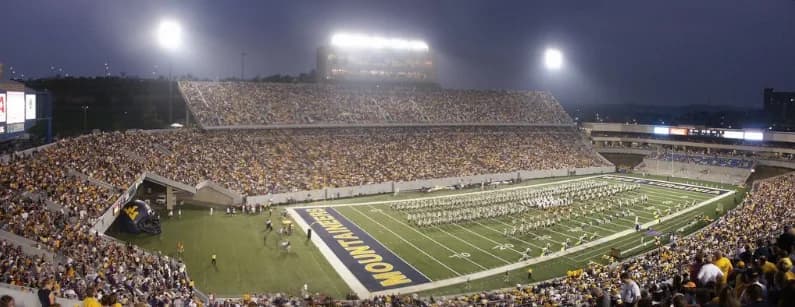
Photo: Al Johnson (www.alandsuejohnson.com) · CC BY-SA 3.0 · Cropped for display
Up next · Week 10
Away
On the road at
Saturday, November 7 · Time TBA
The season, taking shape
Final scores show West Virginia first. Oldest to newest.
at Iowa StatePregame 23–32
Game details vs. Arizona
Pregame 23–34
Game details vs. Cincinnati
Pregame 28–30
Original full-season forecast
This forecast retains the original probabilities for the full schedule. It does not update with completed results or this week’s forecast.
2026 results
Current record, team efficiency, player production, and verified results from completed games.
Current record
5-35 wins · 3 lossesThrough 8 completed gamesLoading player usage…
2026 season preview
A proven feature back and a consequential quarterback competition give West Virginia possibilities. Its progress depends on whether Rich Rodriguez can make a heavily rebuilt roster play faster without sacrificing cohesion.
West Virginia enters the second season of Rich Rodriguez’s return with a straightforward challenge: turn greater athleticism into dependable football. The Mountaineers are coming off a 4-8 season, and late-July projections placed them from tied for seventh to last in the 16-team Big 12. Rodriguez expects substantial improvement, but upgraded talent alone will not deliver it. A heavily reshaped roster must play faster, make fewer mistakes and become cohesive before the schedule begins punishing unresolved problems.
Original season forecast
The original Big 12 forecast, retained alongside current results.
Big 12 projected standing
#13
3-6 projected · 3.2 expected conference wins · #13 of 16.
Preseason baseline
2025 percentiles retained as preseason context; current results and player production lead this page.
2025 FBS percentile scale · 50 is average
Incoming class
National and conference recruiting ranks, confirmed commitments, and the highest-ranked recruits in this class.
Top committed recruits
West Virginia2026 transfer movement
Incoming and outgoing transfer activity, with rated FBS-to-FBS moves below.
Incoming Transfers
West VirginiaOutgoing Transfers
West VirginiaSeason schedule
Completed games show final results. Upcoming games use this week’s forecast where available; later games retain their published season outlook.
Detailed football intelligence
The full team identity, offense, defense, and supporting evidence.
Team identity
Last season, West Virginia tried to lean on the running game; it rarely provided an easy foundation.
Why it matters
Neither offensive unit clearly carried the other, so first-down execution decides whether West Virginia can stay on plan.
 at TCU
Pregame 21–34
Game detailsPregame comparisons use preserved published forecasts. Results include wins and losses.
At a glance
Current form leads the outlook.
2026 rates aggregate verified completed-game box scores. EPA is expected points added per play.
| Player | C/ATT | YDS | TD | INT |
|---|---|---|---|---|
| Michael Hawkins Jr. | 90/159 | 1576 | 11 | 2 |
| Jyron Hughley | 1/1 | 27 | 1 | 0 |
| Scotty Fox Jr. | 2/4 | 27 | 0 | 0 |
| Player | CAR | YDS | AVG | TD |
|---|---|---|---|---|
| Cam Cook | 186 | 923 | 5.0 | 7 |
| Michael Hawkins Jr. | 163 | 836 | 5.1 | 16 |
| Amari Latimer | 40 | 178 | 4.5 | 3 |
| Player | REC | YDS | AVG | TD |
|---|---|---|---|---|
| DJ Epps | 22 | 534 | 24.3 | 5 |
| Prince Strachan | 14 | 275 | 19.6 | 0 |
| Jaden Bray | 12 | 174 | 14.5 | 0 |
| Player | TOT | SOLO | TFL | SACK |
|---|---|---|---|---|
| Isaiah Patterson | 48 | 22 | 4.5 | 2 |
| Geimere Latimer | 39 | 26 | 5 | 2 |
| Ben Cutter | 38 | 18 | 3.5 | 1 |
Saturday, October 24 · Amon G. Carter Stadium
Saturday, October 17 · Milan Puskar Stadium
Saturday, October 10 · Milan Puskar Stadium
The first major decision belongs to Rodriguez at quarterback. Returners Scotty Fox Jr. and Max Brown entered August in competition with Oklahoma transfer Michael Hawkins Jr., and the program’s official account said the winner might remain undisclosed until the opener. Beat reporter Spencer Ripchik framed Fox and Hawkins as the leaders after spring, with Brown still involved. Fox brings five 2025 starts, two wins and a full year in the system; Hawkins offers a higher-profile dual-threat challenge that could expand the designed-quarterback run game. Ripchik reported that Fox looked more comfortable reading pressure and coverage, while Rodriguez praised Hawkins for learning quickly. Both were protected from most live contact, so fall evaluation matters. Fox’s six interceptions as a freshman keep decision-making and ball security central to the choice.
The quarterback will not have to carry the offense alone. Jacksonville State transfer Cam Cook arrived after a 1,600-yard-plus 2025 season and was West Virginia’s lone selection to the conference media’s Preseason All-Big 12 team. Freshman Amari Latimer has been identified as a significant complementary talent. A proven feature back fits Rodriguez’s run-heavy approach: Cook can steady the offense, ease the burden on a new starter and create room for quarterback mobility. But his production depends on the blocking in front of him.
That puts considerable responsibility on an offensive line Rodriguez said had stabilized through personnel additions, returning players and Rick Trickett’s arrival. He also expected freshman Kevin Brown to play immediately. The line must create movement and protect well enough for the quarterback competition to be decided by command rather than survival. Outside, Rodriguez called receiver the room most likely to improve, pointing to a healthy Jaden Bray in late July, productive transfers DJ Epps and John Neider, and holdovers Armoni Weaver-Bomar and Cyrus Traugh. Their ability to stretch the field could keep defenses from crowding Cook and the quarterback run game. Rodriguez also liked the tight ends, although no clear order or defined roles had emerged. USC transfer Prince Strachan’s August status remained uncertain after a spring shoulder injury Rodriguez did not expect to be long term.
The defense carries a different uncertainty. Rodriguez expects a more athletic group, and West Virginia added taller defensive backs after coverage losses in 2025. Coordinator Zac Alley kept the spring package simple before adding more pressure concepts, establishing assignment discipline before complexity. More length can help at the catch point, while greater speed can make pressure more disruptive. But blitzes magnify communication failures as readily as they create negative plays. Progress depends on whether improved physical tools produce reliable execution across the front, linebackers and secondary.
Cohesion is the concern connecting both sides. The spring roster incorporated 37 transfer additions, 36 high-school signees and 11 junior-college additions. That volume may raise the talent ceiling, but it also leaves extensive integration work. Linebacker Ashton Woods, safety Emory Snyder, Antoine Sharp Jr. and kicker Peter Notaro were out after offseason surgeries as of March 3; their August availability was unclear. Those spring absences should not be treated as current unavailability.
The schedule offers a brief runway. Coastal Carolina and UT Martin visit Morgantown before the Sept. 19 neutral-site meeting with Virginia in Charlotte, the first major test. Big 12 play then opens at home against Oklahoma State. Later trips to Iowa State, TCU, Texas Tech and Utah increase the cost of carrying unsettled combinations or communication problems into the heart of the season. The first two home dates offer time to establish the quarterback operation and defensive calls; Virginia and Oklahoma State should begin revealing whether that early work has taken hold.
West Virginia’s season therefore turns less on one breakout candidate than on Rodriguez connecting the roster’s most consequential pieces. The quarterback must run the offense securely, Cook needs blocking that lets his production travel, and the receivers must force defenses to cover the whole field. Alley’s defense must turn athleticism into disciplined speed. If those developments arrive together, the Mountaineers can challenge low external expectations. If cohesion lags behind talent, the Big 12 schedule will expose the gap quickly.
This preview is based on the linked public reporting and official program records.
Profile high point
Pressure held the profile's highest percentile position.Profile low point
Big-play prevention held the lowest percentile position among the profile's strength measures.


Front-seven disruption is what West Virginia can trust most.
Why it matters
The defense has its best route to changing protection rules before coverage must hold; offensive efficiency remains the first counter an opponent should test.
The offense's down-to-down consistency is West Virginia's biggest concern, and opponents can test it immediately.
Why it matters
Opponents can demand long drives and make the offense recover from every empty possession; front-seven disruption has to keep that stress from setting the game plan.
For West Virginia, the cleanest script is to lean on the running game, then keep winning first down because neither the pass nor run can rescue the other; an average pace puts more weight on winning ordinary downs.
What matters
West Virginia's run-first structure played at a balanced pace. Passing finished bottom-tier and rushing finished bottom-tier, without a clear split between them.
Inside the team
Open a section for the football detail and supporting numbers.
The down-to-down question that determines whether the offense can keep both the run and pass available.
West Virginia must establish a first-down answer before opponents have to defend both the run and pass.
Why it matters
Without one part of the offense forcing an adjustment, opponents can keep the offense in long-yardage and play from a position of strength.
The pace, play selection, and methods this offense uses to stay on schedule.
West Virginia played at a balanced pace in 2025.
Why it matters
At that pace, West Virginia cannot count on extra possessions or expect to shorten the game.
West Virginia's prior passing record was bottom-tier.
Why it matters
West Virginia's offense needs protection, field position, or explosive variance when ordinary dropbacks do not create enough value.
Why it matters
When West Virginia's run game cannot stay on schedule, protection and passing-down execution carry more of the offense.
West Virginia's explosive-play results were mixed rather than a defining edge.
Why it matters
A big play can still flip a possession, but last season's results do not make explosiveness something this team can rely on.
How consistently the offense creates manageable situations and the defense prevents them.
West Virginia's defense was more consistent down to down than its offense.
Why it matters
West Virginia's success rate shows whether it can sustain drives and get stops without relying on sacks, turnovers, or isolated big plays.
West Virginia's opponent-adjusted passing and rushing value were closely matched.
Why it matters
When the split is narrow, early-down execution matters more than steering the offense toward one obvious weakness.
Where the defense can create pressure, control the run, and end drives.
West Virginia's prior defense was strong overall and strongest in disruption.
Why it matters
Opponents can use efficient throws to stay out of obvious passing downs; West Virginia needs its disruption to change protection and erase drives with negative plays before that plan settles in.
West Virginia's available disruption measures ranked among the best in the country last season; a charted pressure rate is not available.
Why it matters
Sustained disruption can create negative plays and give West Virginia a better chance to end drives before third down.
West Virginia's disruption regularly finished at the quarterback.
What matters
Both sack production and front-seven disruption cleared the FBS midpoint.
West Virginia's prior run-defense results were top-tier.
Why it matters
A dependable run front can let West Virginia create obvious passing downs without committing extra bodies to the box.