
Week 4 · FinalL
 vs. Minnesota
24–27-3 margin
Pregame 29–21
Game detailsSaturday Index
Loading team intelligenceBringing the latest verified football information into focus.
Big Ten · 2026 · Week 8

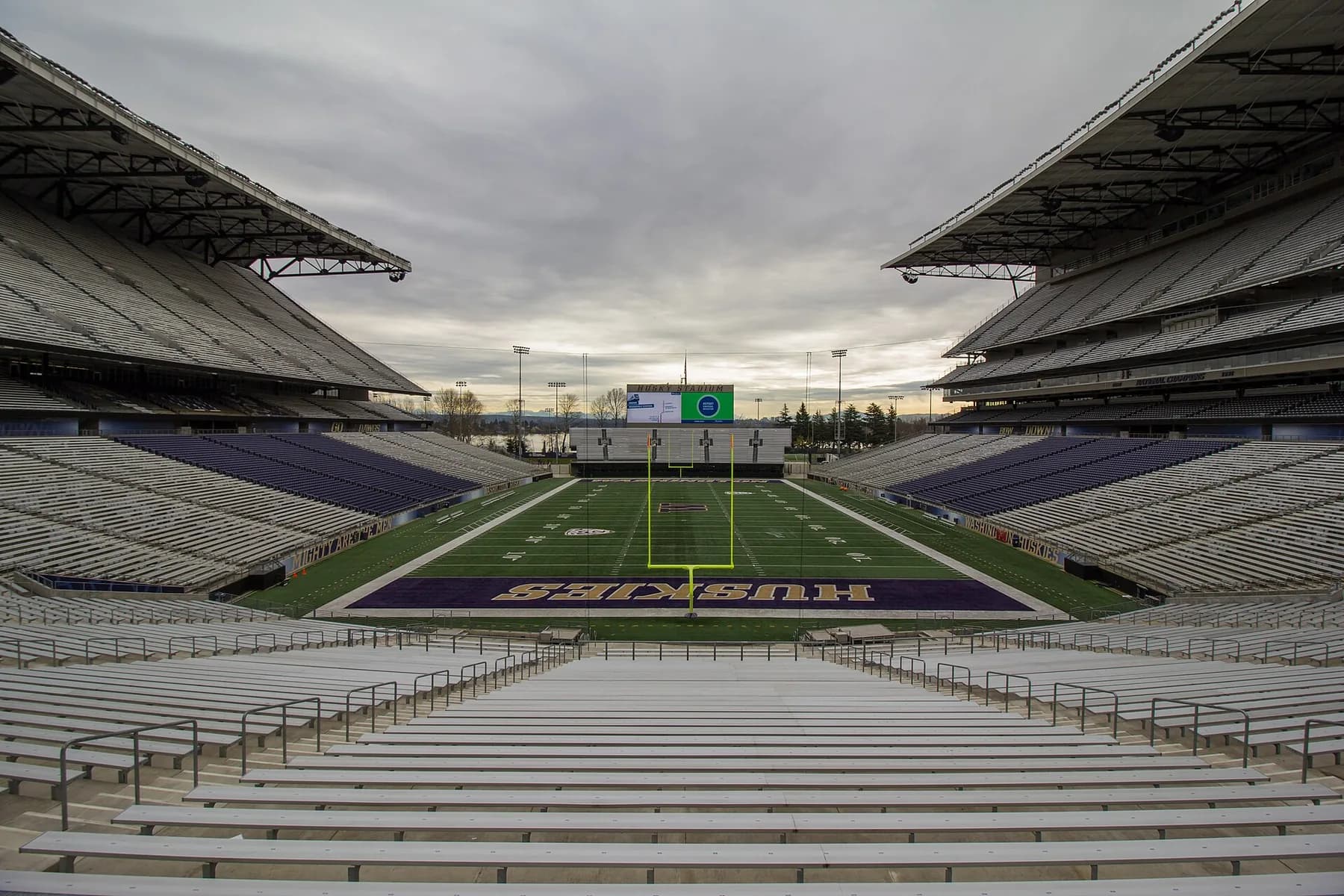
Photo: Atomic Taco · CC BY-SA 2.0 · Cropped for display
Up next · Week 9
Away
On the road at
Saturday, October 31 · Time TBA
The season, taking shape
Final scores show Washington first. Oldest to newest.
vs. MinnesotaPregame 29–21
Game details at USC
Pregame 24–32
Game details vs. Iowa
Pregame 24–23
Game detailsOriginal full-season forecast
This forecast retains the original probabilities for the full schedule. It does not update with completed results or this week’s forecast.
2026 results
Current record, team efficiency, player production, and verified results from completed games.
Current record
4-34 wins · 3 lossesThrough 7 completed gamesLoading player usage…
2026 season preview
Demond Williams Jr. and an established coaching staff anchor the Huskies, whose progress will depend on developing the offensive line and rebuilding the defensive interior.
Washington enters Jedd Fisch’s third season with stability in two places that matter enormously: quarterback and coaching structure. Fisch continues to call the offense, while Ryan Walters returns to direct a defense that established a demanding standard in 2025. That continuity gives the Huskies a dependable foundation, but not a finished team. Running back, offensive line and the defensive interior remain unsettled, making development around Washington’s established leaders the central issue of 2026.
Original season forecast
The original Big Ten forecast, retained alongside current results.
Big Ten projected standing
#7
5-4 projected · 5.2 expected conference wins · #7 of 18.
Preseason baseline
2025 percentiles retained as preseason context; current results and player production lead this page.
2025 FBS percentile scale · 50 is average
Incoming class
National and conference recruiting ranks, confirmed commitments, and the highest-ranked recruits in this class.
Top committed recruits
Washington2026 transfer movement
Incoming and outgoing transfer activity, with rated FBS-to-FBS moves below.
Incoming Transfers
WashingtonOutgoing Transfers
WashingtonSeason schedule
Completed games show final results. Upcoming games use this week’s forecast where available; later games retain their published season outlook.
Detailed football intelligence
The full team identity, offense, defense, and supporting evidence.
Team identity
Last season, Washington tried to stay balanced between the run and pass; the approach consistently kept the offense on schedule.
Why it matters
Neither offensive unit clearly carried the other, so first-down execution decides whether Washington can stay on plan.
 at Purdue
Pregame comparison unavailable
Game detailsPregame comparisons use preserved published forecasts. Results include wins and losses.
At a glance
Current form leads the outlook.
2026 rates aggregate verified completed-game box scores. EPA is expected points added per play.
| Player | C/ATT | YDS | TD | INT |
|---|---|---|---|---|
| Demond Williams Jr. | 116/174 | 1396 | 8 | 3 |
| Elijah Brown | 30/42 | 276 | 4 | 0 |
| Dezmen Roebuck | 1/1 | 5 | 1 | 0 |
| Player | CAR | YDS | AVG | TD |
|---|---|---|---|---|
| Brian Bonner Jr. | 51 | 232 | 4.5 | 0 |
| Demond Williams Jr. | 64 | 183 | 2.9 | 2 |
| Trevion Cooley | 25 | 52 | 2.1 | 0 |
| Player | REC | YDS | AVG | TD |
|---|---|---|---|---|
| Dezmen Roebuck | 43 | 387 | 9.0 | 2 |
| Chris Lawson | 26 | 380 | 14.6 | 2 |
| Baron Naone | 17 | 251 | 14.8 | 2 |
| Player | TOT | SOLO | TFL | SACK |
|---|---|---|---|---|
| Alex McLaughlin | 41 | 26 | 5 | 2.5 |
| Jacob Manu | 34 | 24 | 3.5 | 2.5 |
| Dylan Robinson | 27 | 21 | 1.5 | 0 |
Friday, October 16 · Ross-Ade Stadium
Friday, October 9 · Husky Stadium
Saturday, October 3 · Los Angeles Memorial Coliseum
Demond Williams Jr. is the clearest reason for confidence. He completed 69.5 percent of his passes for 3,065 yards, 25 touchdowns and eight interceptions last season and now enters his third year in Fisch’s system. His experience should help an offense replacing important skill production, though the passing game must establish a new hierarchy. Dezmen Roebuck returns after catching 42 passes for 560 yards and seven touchdowns as a freshman. Rashid Williams worked with the top offense in spring after collarbone and hand injuries limited him to two games in 2025, and tight end Decker DeGraaf brings back 32 catches for 360 yards. Roebuck and DeGraaf offer proven targets; Rashid Williams’ larger role remains promising rather than assured.
The backfield is deeper in candidates than settled roles. Fisch described Quaid Carr as the standout back of spring but stopped short of naming Jonah Coleman’s successor. The competition was incomplete because Jordan Washington missed time with a neck injury, Jayden Limar with an ankle injury and Trey Cooley while rehabilitating an ACL injury. Carr earned a place in the conversation, while Limar and Cooley arrived as veteran additions. Whether one runner separates or the Huskies use a committee will depend on health and fall performance.
Washington faces a similarly consequential evaluation up front. Freshman Kodi Greene worked at left tackle, redshirt freshman Champ Taulealea took first-team snaps at right guard, and Geirean Hatchett shifted to center while Landen Hatchett recovered from a wrist injury. An arm injury then ended Geirean’s spring. Fisch expected both brothers back for fall, but their readiness still must be confirmed. The group has young size and veteran options; it does not yet have an established best five. Its ability to protect Williams and create a functional running game may determine whether the offense’s quarterback advantage translates into consistent production.
Walters’ defense provides a stronger recent baseline. Washington allowed 18.7 points and 100.1 rushing yards per game in 2025, ranking 15th and 11th nationally, and never conceded more than 26 points in a game. Maintaining that level will require a rebuilt interior to mature quickly. Elinneus Davis is the identified returning contributor inside, where 295-pound freshman Derek Colman-Brusa worked beside him in spring and Sacramento State transfer DeSean Watts lined up at nose in five-man fronts. Darin Conley and Kai McClendon add further options, but the room’s Big Ten production remains largely unproven.
Experience behind that front should help. Linebackers Jacob Manu, Xe’ree Alexander and Taariq Al-Uqdah return alongside Zaydrius Rainey-Sale, giving Washington a stabilizing layer behind the new interior. Fisch identified Dylan Robinson and Emmanuel Karnley at corner, Rylon Dillard-Allen and Alex McLaughlin at safety, and Rahshawn Clark at nickel as the expected secondary before spring. That defined back five could allow Walters to vary pressures while the line develops, although spring injuries limited Al-Uqdah and Clark. Freshman edge Ramzak Fruean adds another possibility after producing disruptive spring plays, but his workload will depend on added strength and competition with veterans Jacob Lane, Isaiah Ward and Devin Hyde.
The schedule gives Washington an opening window to sort through those questions, followed by a much less forgiving finish. The Huskies begin with four home games against Washington State, Utah State, Eastern Washington and Minnesota. They then visit USC, host Iowa on a Friday and travel to Purdue on a Friday before a bye. The final five games include trips to Nebraska, Michigan State and Oregon, with Penn State and Indiana visiting Husky Stadium. That sequence concentrates the conference pressure late, when depth, line play and the health of the backfield should be more clearly defined.
Washington’s 2026 case begins with Williams, Fisch and a defense that proved it could control scoring and the run. Roebuck, DeGraaf, the veteran linebackers and an experienced secondary add structure around those anchors. The uncertainty lies closer to the ball: an offensive line still seeking its best combination, a backfield awaiting fuller evaluation and a defensive interior relying on new or inexperienced contributors. If those rooms hold up, Washington has support for its established strengths. Until fall clarifies health and roles, however, the Huskies remain a stable team at the center with meaningful questions at the edges of their foundation.
This preview is based on the linked public reporting and official program records.
Profile high point
The run game held the profile's highest percentile position.Profile low point
Pressure held the lowest percentile position among the profile's strength measures.




The offense's down-to-down consistency is what Washington can trust most.
What matters
Washington's offensive efficiency ranked among the best in the country last season.
Front-seven disruption is Washington's biggest concern, and opponents can test it immediately.
Why it matters
Opponents can trust normal protection and make the defense win without steady negative plays; offensive efficiency has to keep that stress from setting the game plan.
Washington's best path is to stay balanced between the run and pass, then keep both the pass and run available because neither part of the offense has to carry the plan alone; fewer possessions make every empty drive more expensive.
What matters
Washington's balanced structure played at a deliberate pace. Passing finished top-tier and rushing finished top-tier, without a clear split between them.
Inside the team
Open a section for the football detail and supporting numbers.
The down-to-down question that determines whether the offense can keep both the run and pass available.
Opponents have to win first down before Washington can keep both answers available.
Why it matters
Putting Washington behind the chains limits the offense without requiring the defense to guess run or pass.
The pace, play selection, and methods this offense uses to stay on schedule.
Washington played at a deliberate pace in 2025.
What matters
Washington worked with fewer possessions than most teams last season.
Washington's prior passing record was top-tier.
Why it matters
A repeatable pass game can let Washington punish loaded boxes without relying on low-frequency deep completions.
Why it matters
A sustainable run game keeps Washington's play action credible and limits obvious passing situations.
Washington was better at preventing explosive plays than creating them.
Why it matters
The defense can keep a game on schedule, but the offense may need longer drives and more third-down conversions to separate.
How consistently the offense creates manageable situations and the defense prevents them.
Washington won ordinary downs on both sides of the ball.
Why it matters
Washington's success rate shows whether it can sustain drives and get stops without relying on sacks, turnovers, or isolated big plays.
Washington's opponent-adjusted passing and rushing value were closely matched.
Why it matters
When the split is narrow, early-down execution matters more than steering the offense toward one obvious weakness.
Where the defense can create pressure, control the run, and end drives.
Washington's prior defense was above-average overall and strongest in run front.
Why it matters
Opponents can trust normal protection and make coverage hold through the route; Washington needs its run front to create long-yardage without overloading the box before that plan settles in.
Washington's available disruption measures ranked near the bottom nationally last season; a charted pressure rate is not available.
Why it matters
Without consistent disruption, Washington's defense must win more snaps through coverage, leverage, and early-down prevention.
Washington's sack production outpaced its broader disruption record.
Why it matters
Washington's disruption can hurry an offense; sacks do more by erasing field position and ending passing downs.
Washington's prior run-defense results were strong.
Why it matters
A dependable run front can let Washington create obvious passing downs without committing extra bodies to the box.