
Week 4 · FinalW
 at Louisville
30–27+3 margin
Pregame 23–33
Game detailsSaturday Index
Loading team intelligenceBringing the latest verified football information into focus.
ACC · 2026 · Week 8

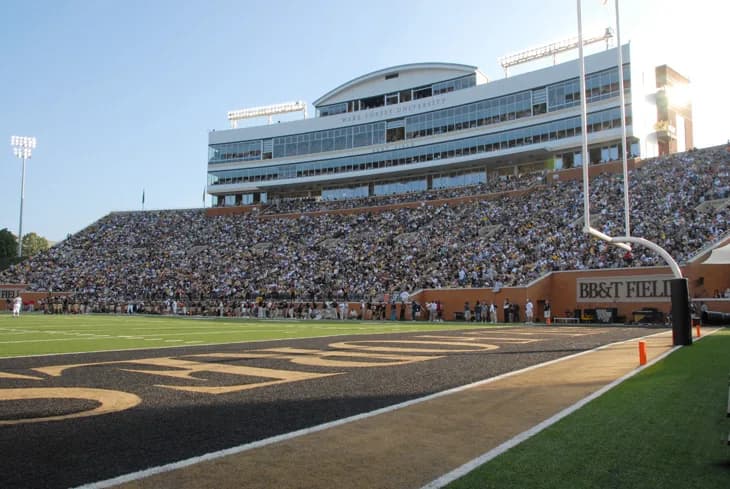
Photo: BobHWS · CC BY-SA 3.0 · Cropped for display
Up next · Week 9
Home
Hosting
Saturday, October 31 · Time TBA
The season, taking shape
Final scores show Wake Forest first. Oldest to newest.
at LouisvillePregame 23–33
Game details vs. Stanford
Pregame 33–22
Game details at NC State
Pregame 29–27
Original full-season forecast
This forecast retains the original probabilities for the full schedule. It does not update with completed results or this week’s forecast.
2026 results
Current record, team efficiency, player production, and verified results from completed games.
Current record
6-16 wins · 1 lossThrough 7 completed gamesLoading player usage…
2026 season preview
Jake Dickert has an established defensive spine and a quarterback reunited with Rob Ezell. How quickly the rebuilt offense settles will define Wake Forest’s response to a demanding September.
Wake Forest enters Jake Dickert’s second season with a clearer identity than it had a year ago. Dickert returns from a nine-win debut with coordinators Rob Ezell, Dan Enos, Scottie Hazelton and Freddie Banks still in place, preserving the language and development plans installed during Year 1. The next step is not simply maintaining that continuity. Dickert said after spring practice that Wake needed to become more physical and cut the penalties that hurt it in 2025. Those priorities frame the season: a more disciplined team must turn familiarity into dependable football, particularly while its offense takes on a new shape.
Original season forecast
The original ACC forecast, retained alongside current results.
ACC projected standing
#13
3-6 projected · 3.2 expected conference wins · #13 of 17.
Preseason baseline
2025 percentiles retained as preseason context; current results and player production lead this page.
2025 FBS percentile scale · 50 is average
Incoming class
National and conference recruiting ranks, confirmed commitments, and the highest-ranked recruits in this class.
Top committed recruits
Wake Forest2026 transfer movement
Incoming and outgoing transfer activity, with rated FBS-to-FBS moves below.
Incoming Transfers
Wake ForestOutgoing Transfers
Wake ForestSeason schedule
Completed games show final results. Upcoming games use this week’s forecast where available; later games retain their published season outlook.
Detailed football intelligence
The full team identity, offense, defense, and supporting evidence.
Team identity
Last season, Wake Forest tried to stay balanced between the run and pass; it rarely provided an easy foundation.
Why it matters
Neither offensive unit clearly carried the other, so first-down execution decides whether Wake Forest can stay on plan.
 at California
Pregame 31–24
Game detailsPregame comparisons use preserved published forecasts. Results include wins and losses.
At a glance
Current form leads the outlook.
2026 rates aggregate verified completed-game box scores. EPA is expected points added per play.
| Player | C/ATT | YDS | TD | INT |
|---|---|---|---|---|
| Giovanni Lopez | 140/207 | 1947 | 17 | 1 |
| Steele Pizzella | 6/9 | 85 | 0 | 0 |
| Player | CAR | YDS | AVG | TD |
|---|---|---|---|---|
| Ty Clark III | 70 | 328 | 4.7 | 4 |
| Deuce Lawrence | 63 | 307 | 4.9 | 3 |
| Giovanni Lopez | 63 | 254 | 4.0 | 6 |
| Player | REC | YDS | AVG | TD |
|---|---|---|---|---|
| Carlos Hernandez | 49 | 720 | 14.7 | 4 |
| Jack Foley | 20 | 373 | 18.6 | 4 |
| Kameran Shanks | 17 | 241 | 14.2 | 1 |
| Player | TOT | SOLO | TFL | SACK |
|---|---|---|---|---|
| Vincent Firenze | 49 | 19 | 4 | 1 |
| Aiden Hall | 46 | 12 | 3 | 0 |
| Frank Cusano | 41 | 11 | 1.5 | 0 |
Saturday, October 17 · California Memorial Stadium
Saturday, October 10 · Carter-Finley Stadium
Saturday, October 3 · Allegacy Federal Credit Union Stadium
Gio Lopez is the natural center of that transition. The redshirt junior arrived after stops at South Alabama and North Carolina, and ESPN reported that he previously played for Ezell at South Alabama. Their shared history should reduce the learning curve and give Wake a foundation for building the offense around Lopez’s dual-threat ability. His place alongside Dickert, Langston Hardy and Davaughn Patterson in Wake’s ACC Kickoff delegation also signals the leadership role the program expects him to occupy, even though Wake had not formally announced a Week 1 starter.
The quarterback room still needs a dependable second option. Redshirt freshman Steele Pizzella made the strongest spring case, throwing a touchdown and running for another in the showcase, while Billy Johnson and two freshmen are also listed on the roster. That competition matters because designed or improvised quarterback runs can expose Lopez to additional contact. Around them, Ty Clark III and Florida transfer KD Daniels give Wake two prominent running-back options, but their workload remains to be sorted out. The offensive line carries the larger structural question: transfers Will Way and John Ohnegian join a mixed group of newcomers and returners, leaving position coach Jared Kaster to find a cohesive five capable of protecting Lopez and giving the running game a reliable base.
Wake also needs its targets to emerge. Freshman Elijah Otenio offered one encouraging glimpse by catching a touchdown from Pizzella in the spring showcase, but one play does not settle the receiving rotation. His early involvement is nevertheless relevant for a program integrating a record 30-player high-school signing class, 20 of whom were listed as midyear enrollees. That class is primarily a long-term roster investment, although the extra spring work gave its youngest members a chance to compete for immediate supporting roles.
The defense has a more established starting point. Wake calls Hardy, a redshirt senior defensive lineman, the returning ACC leader in tackles for loss. His ability to disrupt plays before they develop gives Hazelton a proven pressure source, while Dallas Afalava, Brandon Smiley and 355-pound Sydir Mitchell provide veteran options inside. That combination should allow Wake to vary its front and withstand physical running games without asking one player to handle every interior snap. Hardy is the headliner, but the value of the room lies in pairing his edge production with enough size and experience beside him.
Patterson supplies similar stability in the secondary. A returning defensive leader and ACC Kickoff representative, he gives the back end a familiar voice while transfer Deuce Blades II tries to convert an encouraging spring into a meaningful role. Blades produced a touchdown-saving interception in the showcase, an early indication that he can help. RuShaun Tongue could deepen the group after a shoulder injury ended his 2025 season in the second game. Wake reported in June that Tongue had worked through the physical recovery and was preparing for 2026, though that update stopped short of confirming his availability for the opener.
Connor Calvert gives Wake another potential advantage in games decided at the margins. He made a 57-yard field goal in the spring showcase after hitting a game-winning 50-yarder against SMU in 2025, demonstrated range that can change fourth-down decisions when an offense stalls near midfield. That may become especially useful during an opening stretch that moves quickly from setup to examination. Wake hosts Akron on Sept. 3 and visits Purdue on Sept. 12 before welcoming 2025 national finalist Miami for a nationally televised Friday game on Sept. 18. A trip to Louisville follows eight days later.
The pressure does not disappear after September. Stanford visits before consecutive trips to NC State and California, and the final month includes back-to-back road games at SMU and Georgia Tech before Duke comes to Winston-Salem. Wake’s route through that schedule depends less on a sweeping transformation than on whether its most important pieces fit quickly. Lopez and Ezell bring familiarity, Hardy and Patterson anchor the defense, and Calvert offers proven range. If the line coalesces, the skill-position roles become clear and Dickert’s emphasis on physicality and discipline carries into Saturdays, Wake will have the balance to support its defensive core rather than lean on it.
This preview is based on the linked public reporting and official program records.
Profile high point
Big-play creation held the profile's highest percentile position.Profile low point
Passing held the lowest percentile position among the profile's strength measures.



Big-play creation is what Wake Forest can trust most.
Why it matters
The offense has its best route to changing field position without requiring flawless drive efficiency; offensive efficiency remains the first counter an opponent should test.
The first place to test Wake Forest is the offense's down-to-down consistency, especially on ordinary early downs; big-play creation has to keep the game on plan.
What matters
Wake Forest's offensive efficiency ranked in the lower national range last season.
For Wake Forest, the cleanest script is to stay balanced between the run and pass, then keep winning first down because neither the pass nor run can rescue the other; extra possessions give that plan time to build.
What matters
Wake Forest's balanced structure played at a fast pace. Passing finished weak and rushing finished weak, without a clear split between them.
Inside the team
Open a section for the football detail and supporting numbers.
The down-to-down question that determines whether the offense can keep both the run and pass available.
Wake Forest must establish a first-down answer before opponents have to defend both the run and pass.
Why it matters
Without one part of the offense forcing an adjustment, opponents can keep the offense in long-yardage and play from a position of strength.
The pace, play selection, and methods this offense uses to stay on schedule.
Wake Forest played at a fast pace in 2025.
Why it matters
More possessions give Wake Forest's strengths additional chances to build, but they also leave more time to recover from mistakes.
Wake Forest's prior passing record was weak.
Why it matters
Wake Forest's offense needs protection, field position, or explosive variance when ordinary dropbacks do not create enough value.
Why it matters
When Wake Forest's run game cannot stay on schedule, protection and passing-down execution carry more of the offense.
Wake Forest both created and limited explosive plays at a strong prior-season level.
Why it matters
That combination can change a game without forcing the offense to trade efficiency for low-percentage shots.
How consistently the offense creates manageable situations and the defense prevents them.
Wake Forest's defense was more consistent down to down than its offense.
Why it matters
Wake Forest's success rate shows whether it can sustain drives and get stops without relying on sacks, turnovers, or isolated big plays.
Wake Forest's opponent-adjusted passing and rushing value were closely matched.
Why it matters
When the split is narrow, early-down execution matters more than steering the offense toward one obvious weakness.
Where the defense can create pressure, control the run, and end drives.
Wake Forest's prior defense was top-tier overall, with no clear separation among its main units.
Why it matters
That balance makes it harder for an offense to choose one automatic target; the defense still has to win early downs before any unit can dictate the offensive options.
Wake Forest's available disruption measures ranked among the best in the country last season; a charted pressure rate is not available.
Why it matters
Sustained disruption can create negative plays and give Wake Forest a better chance to end drives before third down.
Wake Forest's disruption regularly finished at the quarterback.
What matters
Both sack production and front-seven disruption cleared the FBS midpoint.
Why it matters
A dependable run front can let Wake Forest create obvious passing downs without committing extra bodies to the box.