
Week 5 · FinalL
 at Florida State
7–38-31 margin
Pregame 27–26
Game detailsSaturday Index
Loading team intelligenceBringing the latest verified football information into focus.
ACC · 2026 · Week 8

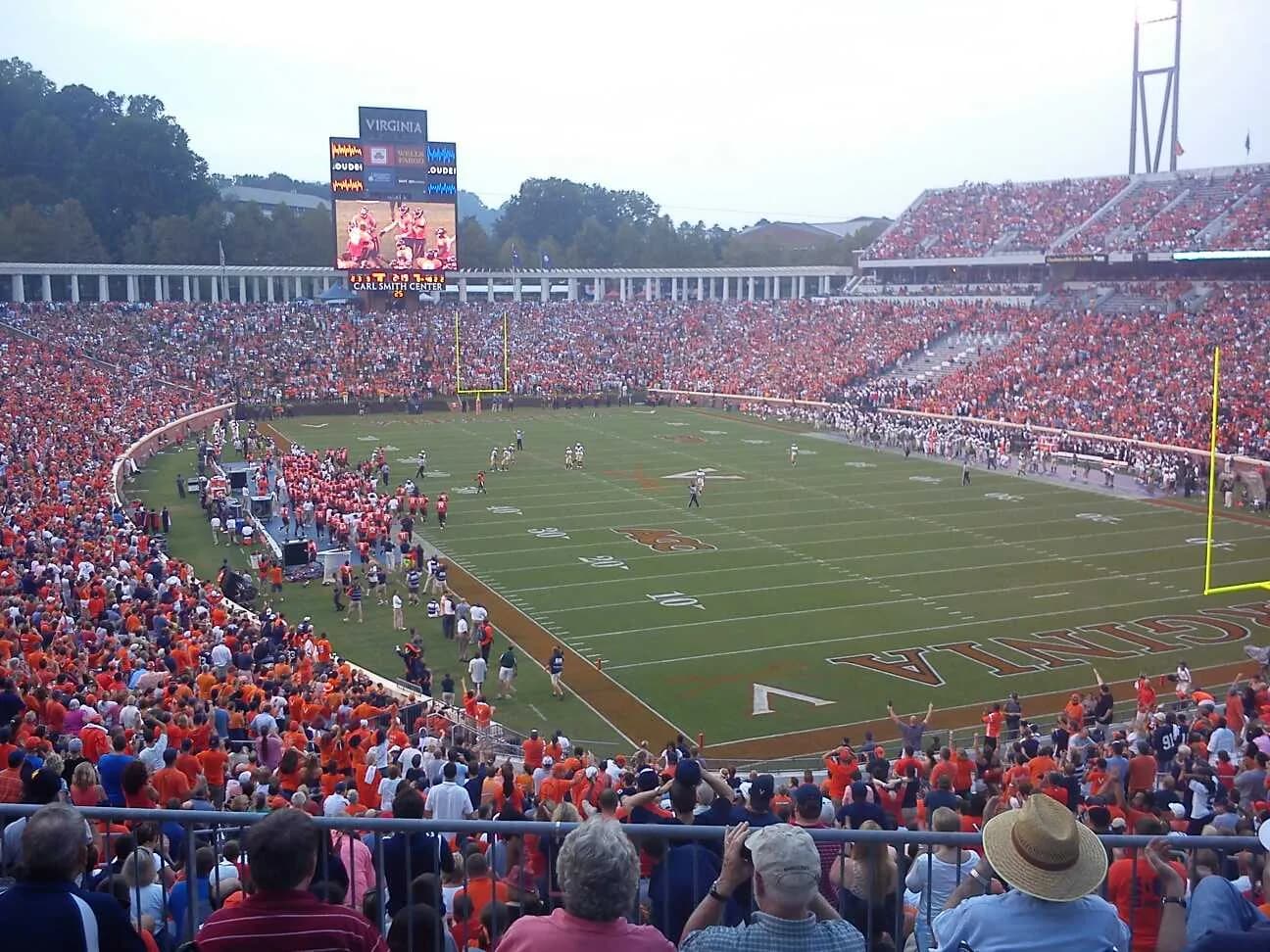
Photo: Mak7912 · CC BY-SA 3.0 · Cropped for display
Up next · Week 9
Away
On the road at
Saturday, October 31 · Time TBA
The season, taking shape
Final scores show Virginia first. Oldest to newest.
at Florida StatePregame 27–26
Game details vs. Syracuse
Pregame 31–21
Game details at SMU
Pregame 21–32
Original full-season forecast
This forecast retains the original probabilities for the full schedule. It does not update with completed results or this week’s forecast.
2026 results
Current record, team efficiency, player production, and verified results from completed games.
Current record
4-44 wins · 4 lossesThrough 8 completed gamesLoading player usage…
2026 season preview
An experienced offensive line gives Virginia a foundation, but a new quarterback, rebuilt skill positions and Kam Robinson’s recovery will shape how quickly Tony Elliott’s remade roster comes together.
Virginia enters 2026 at an inflection point for Tony Elliott. His fifth season begins with the same coordinators—Des Kitchings on offense and John Rudzinski on defense—but with 46 newcomers charged with extending the standard of an 11-win 2025 season. That contrast defines the Cavaliers: the schemes and expectations are established, while many of the players carrying them are new. Virginia’s season will turn on whether Elliott’s continuity can accelerate that transition before the roster’s rebuilt areas are exposed.
Original season forecast
The original ACC forecast, retained alongside current results.
ACC projected standing
#8
5-4 projected · 4.7 expected conference wins · #8 of 17.
Preseason baseline
2025 percentiles retained as preseason context; current results and player production lead this page.
2025 FBS percentile scale · 50 is average
Incoming class
National and conference recruiting ranks, confirmed commitments, and the highest-ranked recruits in this class.
Top committed recruits
Virginia2026 transfer movement
Incoming and outgoing transfer activity, with rated FBS-to-FBS moves below.
Incoming Transfers
VirginiaOutgoing Transfers
VirginiaSeason schedule
Completed games show final results. Upcoming games use this week’s forecast where available; later games retain their published season outlook.
Detailed football intelligence
The full team identity, offense, defense, and supporting evidence.
Team identity
Last season, Virginia tried to stay balanced between the run and pass; the results were uneven when the offense tried to live that way.
Why it matters
The run game was Virginia's steadier way to stay ahead of the chains; opponents have to win early fits without handing away play action.
 vs. Duke
Pregame 25–24
Game detailsPregame comparisons use preserved published forecasts. Results include wins and losses.
At a glance
Current form leads the outlook.
2026 rates aggregate verified completed-game box scores. EPA is expected points added per play.
| Player | C/ATT | YDS | TD | INT |
|---|---|---|---|---|
| Beau Pribula | 119/183 | 1375 | 13 | 2 |
| Eli Holstein | 12/18 | 180 | 3 | 0 |
| Cole Geer | 3/7 | 45 | 1 | 0 |
| Player | CAR | YDS | AVG | TD |
|---|---|---|---|---|
| Jekail Middlebrook | 105 | 513 | 4.9 | 4 |
| Xay Davis | 50 | 235 | 4.7 | 2 |
| Beau Pribula | 89 | 188 | 2.1 | 2 |
| Player | REC | YDS | AVG | TD |
|---|---|---|---|---|
| Dashawn Martin | 17 | 253 | 14.9 | 5 |
| Kameron Courtney | 18 | 204 | 11.3 | 2 |
| Rico Flores | 12 | 158 | 13.2 | 1 |
| Player | TOT | SOLO | TFL | SACK |
|---|---|---|---|---|
| Jacobie Henderson | 40 | 20 | 0.5 | 0 |
| Maddox Marcellus | 38 | 18 | 3.5 | 0 |
| Fisher Camac | 33 | 11 | 4.5 | 2 |
Friday, October 23 · Scott Stadium
Saturday, October 17 · Gerald J. Ford Stadium
Saturday, October 10 · Scott Stadium
Beau Pribula entered late-July camp atop the quarterback depth chart after transferring from Missouri, with Eli Holstein and returning sophomore Cole Geer as the principal alternatives. Pribula’s power-running ability gives Kitchings a way to preserve the quarterback-run element, but the larger task is replacing Chandler Morris’s production and late-game command. The competition had not been declared finished when camp opened, so Pribula is the leader rather than an unquestioned answer. The most useful support sits directly in front of him: tackles McKale Boley and Monroe Mills, guards Noah Josey and Makilan Thomas, and center Drake Metcalf form an unusually experienced projected five. Boley has 36 career starts and Josey 43, giving Virginia a credible run-first foundation while a new passer settles in.
The skill positions ask Kitchings to build function before flash. Middle Tennessee transfer Jekail Middlebrook took the first running-back rep at the start of camp after producing 1,228 all-purpose yards in 2025, the earliest separation in a six-back room replacing All-ACC workhorse J’Mari Taylor. At receiver, Kameron Courtney is the only returner among Virginia’s five 2025 wideouts with at least 16 catches; the other returning receivers combined for 10. That shortage of proven production could narrow the passing game, particularly on obvious passing downs. Tight end offers one possible bridge. Converted receiver Dakota Twitty returns healthy after missing 2025, and the staff calls the position the core of the offense. His receiving background can create matchups, but the room also must replace Sage Ennis’s blocking reliability; transfer Lukas Ungar was limited in spring.
The scale of the rebuild makes leadership as important as talent. Virginia signed 29 transfers and 14 high-school players, and 34 newcomers arrived for spring. The transfers brought 22,953 prior college snaps, supplying experience without eliminating the work of learning new language, assignments and teammates. Boley, linebacker Kam Robinson and Pribula represented the program at ACC Kickoff; Boley and Robinson, in particular, are responsible for carrying the returning standard into a group with many new voices. For Elliott, the advantage is that neither the offensive nor defensive teaching structure has changed. The test is how quickly experience from elsewhere becomes dependable execution at Virginia.
Defensively, the most urgent reconstruction is up front. Virginia must replace Jahmeer Carter, Daniel Rickert and Mitchell Melton, leaving edge Fisher Camac and interior lineman Jason Hammond as prominent returning pieces. Their job is larger than generating pressure: the line must occupy and defeat blocks so a talented linebacker level can run cleanly to the ball. Robinson is the centerpiece of that level after finishing as runner-up for 2025 ACC Defensive Player of the Year, but he is rehabilitating the ACL tear that ended his season in November. His availability for the NC State opener remained unclear at ACC Kickoff. If he needs more time, the rebuilt line’s ability to protect the second level becomes even more important.
The secondary should give Rudzinski more options. Elliott said Virginia reached the end of spring with substantially fewer questions there than a year earlier after adding experienced transfers including Brandyn Hillman and Donavon Platt. More numbers and experience can support competition, matchup-based personnel and greater flexibility behind the reconstructed front. The staff had not named a settled starting five, but that is a narrower concern than last year’s broader shortage of answers. The room does not need every role fixed early; it does need communication to develop quickly enough to prevent a new front and a reshuffled back end from compounding one another’s mistakes.
The schedule allows almost no private rehearsal. Virginia opens at Scott Stadium against NC State on Aug. 29, putting the new quarterback, rebuilt receiving corps and Robinson’s recovery status into an ACC game immediately. Norfolk State follows before a neutral-site meeting with West Virginia and a home date with Delaware. October raises the travel pressure with trips to Florida State and SMU around home games against Syracuse and Duke, followed by a visit to Wake Forest. California and North Carolina then come to Charlottesville before the regular season closes at Virginia Tech. The opener rewards fast integration; the road-heavy middle and rivalry finish make a prolonged adjustment period costly.
Virginia’s clearest path is not mystery. Elliott has continuity on the sideline, a veteran offensive line and experienced transfers across the roster. Those strengths can support a physical offense and buy time for the quarterback and receivers to establish a workable hierarchy. The pressure points are equally direct: replacing proven skill production, rebuilding the defensive line and navigating Robinson’s recovery. If Boley’s group controls games and the newcomers settle quickly, Virginia can preserve the identity behind its 2025 breakthrough. If protection, timing or front-seven structure frays, the schedule will expose it early. This season is Elliott’s test of whether continuity can make sweeping change look coherent.
This preview is based on the linked public reporting and official program records.
Profile high point
Down-to-down defense held the profile's highest percentile position.Profile low point
Passing held the lowest percentile position among the profile's strength measures.


The defense's control of ordinary downs is what Virginia can trust most.
Why it matters
That unit is the most credible foundation for making opponents string together clean drives; passing efficiency remains the first counter an opponent should test.
The passing game is the concern opponents should keep testing while the defense's control of ordinary downs tries to steady Virginia.
What matters
Virginia's passing efficiency finished below the national average last season.
Virginia's best path is to stay balanced between the run and pass, then let the run game finish drives; extra possessions give that plan time to build.
Why it matters
Virginia's clean script is to stay ahead with early-down runs, draw an extra defender into the box, and then use play action; defenses will try to force obvious passing downs. At a faster pace, an early-down advantage gets more chances to build.
Inside the team
Open a section for the football detail and supporting numbers.
The down-to-down question that determines whether the offense can keep both the run and pass available.
Opponents have to keep Virginia's run game from turning first down into second-and-manageable.
Why it matters
If Virginia stays on schedule on the ground, the offense keeps more answers available.
The pace, play selection, and methods this offense uses to stay on schedule.
Virginia played at a fast pace in 2025.
Why it matters
More possessions give Virginia's strengths additional chances to build, but they also leave more time to recover from mistakes.
Virginia's prior passing record was below-average.
Why it matters
Virginia's offense needs protection, field position, or explosive variance when ordinary dropbacks do not create enough value.
Virginia's prior rushing record was above-average.
Why it matters
A sustainable run game keeps Virginia's play action credible and limits obvious passing situations.
Virginia both created and limited explosive plays at a strong prior-season level.
Why it matters
That combination can change a game without forcing the offense to trade efficiency for low-percentage shots.
How consistently the offense creates manageable situations and the defense prevents them.
Virginia's defense was more consistent down to down than its offense.
Why it matters
Virginia's success rate shows whether it can sustain drives and get stops without relying on sacks, turnovers, or isolated big plays.
Opponent-adjusted EPA identifies the run game as Virginia's stronger offensive unit.
Why it matters
Forcing longer passing situations is the clearest way to move the offense away from its stronger adjusted unit.
Where the defense can create pressure, control the run, and end drives.
Virginia's prior defense was top-tier overall and strongest in pass defense.
Why it matters
Opponents can start by leaning on base protection rules until the rush forces an adjustment, though that unit still finished above-average. Virginia's pass defense can still tighten throwing windows, so the offense has to prove the opening will hold up.
Virginia's available disruption measures finished above the national average last season; a charted pressure rate is not available.
Why it matters
Sustained disruption can create negative plays and give Virginia a better chance to end drives before third down.
Virginia's sack and disruption results were above-average.
Why it matters
Virginia's disruption can hurry an offense; sacks do more by erasing field position and ending passing downs.
Virginia's prior run-defense results were strong.
Why it matters
A dependable run front can let Virginia create obvious passing downs without committing extra bodies to the box.