
Week 5 · FinalL
 at Georgia
14–38-24 margin
Pregame 17–34
Game detailsSaturday Index
Loading team intelligenceBringing the latest verified football information into focus.
SEC · 2026 · Week 8

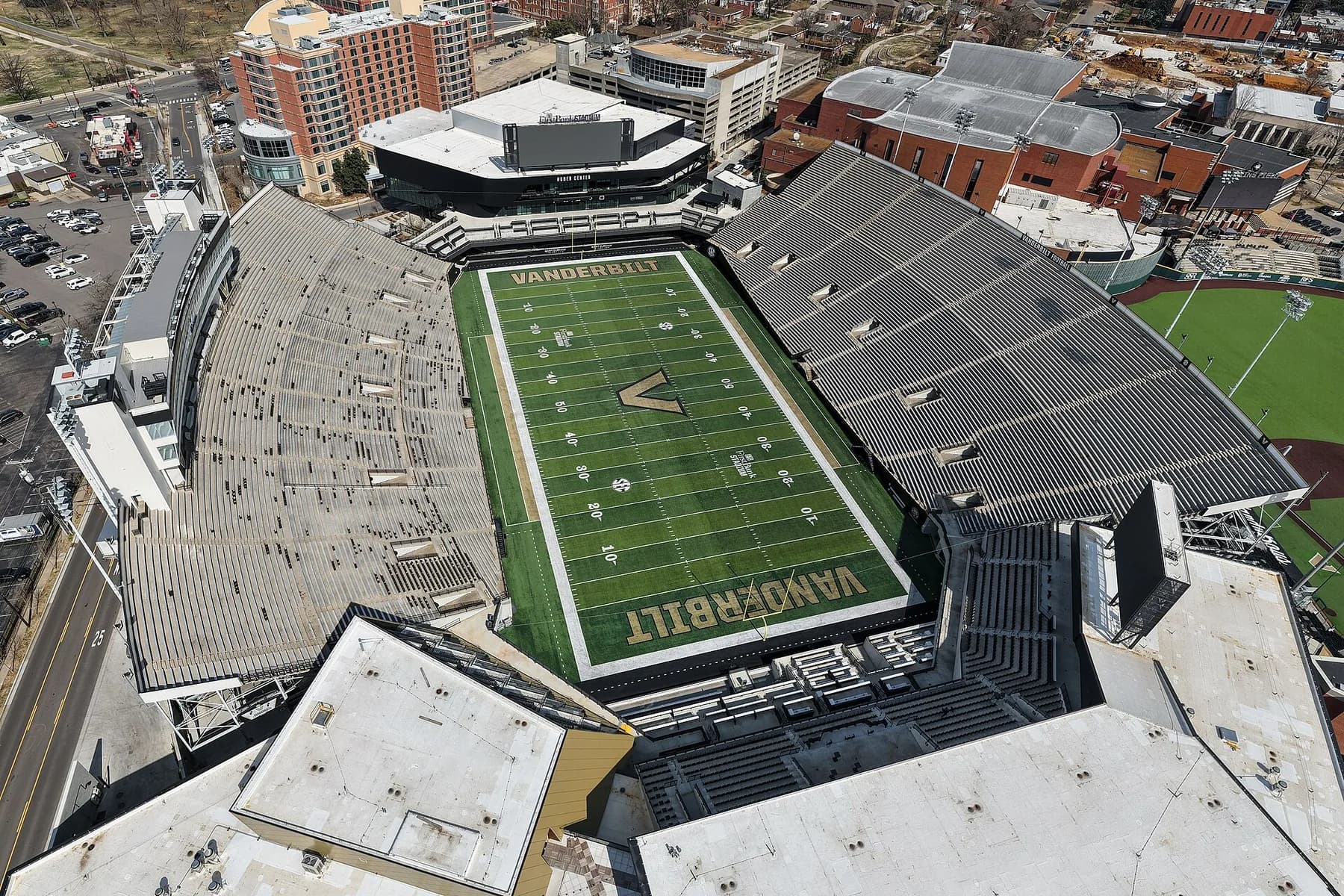
Photo: Quintin Soloviev · CC BY 4.0 · Cropped for display
Up next · Week 10
Away
On the road at
Saturday, November 7 · Time TBA
The season, taking shape
Final scores show Vanderbilt first. Oldest to newest.
at GeorgiaPregame 17–34
Game details vs. Ole Miss
Pregame 25–30
Game details vs. Arkansas
Pregame 30–22
Original full-season forecast
This forecast retains the original probabilities for the full schedule. It does not update with completed results or this week’s forecast.
2026 results
Current record, team efficiency, player production, and verified results from completed games.
Current record
3-53 wins · 5 lossesThrough 8 completed gamesLoading player usage…
2026 season preview
Vanderbilt enters 2026 with continuity on the sideline but reinvention ahead on offense. Clark Lea remains in charge, with Tim Beck coordinating the offense and Steve Gregory leading the defense alongside co-coordinator and linebackers coach Nick Lezynski. That familiarity should help a roster incorporating transfers, yet it cannot answer the season’s defining question: how Vanderbilt replaces Diego Pavia without asking another quarterback to imitate him. Lea’s most consequential job is to shape an offense around the winner of an unsettled competition and have it functioning before the schedule turns sharply upward.
Original season forecast
The original SEC forecast, retained alongside current results.
SEC projected standing
#9
5-4 projected · 4.9 expected conference wins · #9 of 16.
Preseason baseline
2025 percentiles retained as preseason context; current results and player production lead this page.
2025 FBS percentile scale · 50 is average
Incoming class
National and conference recruiting ranks, confirmed commitments, and the highest-ranked recruits in this class.
Top committed recruits
Vanderbilt2026 transfer movement
Incoming and outgoing transfer activity, with rated FBS-to-FBS moves below.
Incoming Transfers
VanderbiltOutgoing Transfers
VanderbiltSeason schedule
Completed games show final results. Upcoming games use this week’s forecast where available; later games retain their published season outlook.
Detailed football intelligence
The full team identity, offense, defense, and supporting evidence.
Team identity
Last season, Vanderbilt tried to lean on the passing game; the approach consistently kept the offense on schedule.
Why it matters
Neither offensive unit clearly carried the other, so first-down execution decides whether Vanderbilt can stay on plan.
 at Kentucky
Pregame 24–29
Game detailsPregame comparisons use preserved published forecasts. Results include wins and losses.
At a glance
Current form leads the outlook.
2026 rates aggregate verified completed-game box scores. EPA is expected points added per play.
| Player | C/ATT | YDS | TD | INT |
|---|---|---|---|---|
| Jared Curtis | 128/197 | 1489 | 8 | 8 |
| Blaze Berlowitz | 28/53 | 386 | 1 | 1 |
| Whit Muschamp | 2/2 | 18 | 0 | 0 |
| Player | CAR | YDS | AVG | TD |
|---|---|---|---|---|
| Sedrick Alexander | 64 | 274 | 4.3 | 5 |
| Makhilyn Young | 55 | 214 | 3.9 | 2 |
| Jared Curtis | 63 | 150 | 2.4 | 2 |
| Player | REC | YDS | AVG | TD |
|---|---|---|---|---|
| Junior Sherrill | 49 | 706 | 14.4 | 4 |
| Ja'Cory Thomas | 15 | 230 | 15.3 | 2 |
| Tristen Brown | 15 | 176 | 11.7 | 0 |
| Player | TOT | SOLO | TFL | SACK |
|---|---|---|---|---|
| C.J. Heard | 62 | 43 | 4 | 3 |
| Nicholas Rinaldi | 52 | 26 | 5 | 3 |
| Bryan Longwell | 51 | 28 | 3 | 1 |
Saturday, October 24 · Kroger Field
Saturday, October 17 · FirstBank Stadium
Saturday, October 10 · FirstBank Stadium
Five-star freshman Jared Curtis and third-year Commodore Blaze Berlowitz carried that competition into fall camp. Lea said at SEC Media Days that he might not select a starter before the opener and could retain situational roles for both. Joey Dwyer’s spring assessment showed why the decision is not a simple choice between upside and security. Curtis displayed high-end arm talent and creativity but remained inconsistent in his processing and operation. Berlowitz knew Beck’s system better, but questions about his decisions and ball security persisted. Vanderbilt’s priorities—command, rhythm and sound decision-making—suggest that the job will go to the quarterback who can run this offense reliably, not the one who most resembles Pavia.
The supporting cast gives Beck several ways to reduce that quarterback burden. Running back Sedrick Alexander entered the year with more than 1,500 career rushing yards after a 115-yard, three-touchdown performance at Tennessee. He and receiver Junior Sherrill represented Vanderbilt at SEC Media Days, underscoring their importance to the transition. Tight end may require a shared solution after Stowers’ departure: Dwyer projected Cole Spence and East Carolina transfer Jayvontay Conner as the principal receiving options, while former quarterback Walter Taylor continued developing as a blocker. Reliable production from Alexander and the middle-of-field targets could keep the new quarterback out of obvious passing situations.
That plan depends on an offensive line whose first five was still taking shape. North Dakota State transfer Beau Johnson arrived after starting every game for the Bison in 2025, giving Vanderbilt an experienced candidate for an immediate role. Returner Cade McConnell and veteran transfers Kevo Wesley and Gunner Givens are also part of a large group. The challenge is less about collecting options than establishing a combination that can communicate, protect and create a dependable rushing surface. With the quarterback decision unresolved, early line cohesion would give the offense one fewer variable to manage.
Vanderbilt’s defense has more established leadership through the middle. Graham Baakko projected Bryan Longwell and Nick Rinaldi at linebacker, with Bryce Cowan next, and reported that Longwell had assumed the command role after Langston Patterson’s departure. At safety, Baakko projected returning starter CJ Heard beside Clemson transfer Ricardo Jones. Heard started all 13 games for Vanderbilt, while Jones arrived after leading the ACC in interceptions in 2025. If that pairing holds, Gregory would have experience, communication and demonstrated ball production behind a transitioning offense that may occasionally need favorable field position or an extra possession.
The front carries both continuity and uncertainty. Sixth-year edge Miles Capers returns with 8.5 career sacks, including a career-best 4.5 in 2025. Baakko projected Iowa transfer Brian Allen Jr. opposite him, with Mason Carter and Boston College transfer Edwin Kolenge providing additional options. Inside, Yilanan “Issa” Ouattara is targeting a major role after missing the 2025 season with injury, though his game readiness remains unclear. Vanderbilt needs that collection of veterans, transfers and developing players to turn pressure into disruption. Special teams could supply another margin: Brock Taylor and Justin Dewers made spring-game field goals of 51 and 52 yards, respectively.
The schedule offers a short opening runway. Vanderbilt hosts Austin Peay on September 5, Delaware on September 12 and NC State on September 19 before beginning SEC play at Auburn and then Georgia. Those first three games are the practical window for the staff to clarify quarterback usage, settle the offensive line and integrate new contributors. Once conference play begins, Vanderbilt faces nine consecutive SEC opponents, including home dates with Ole Miss and Arkansas followed by a trip to Kentucky. Prolonged experimentation would carry a much higher cost in that stretch.
The closing sequence—Alabama at home, Florida on the road and Tennessee at home—places an additional premium on durable answers established earlier. Vanderbilt’s strongest foundation is Lea’s continuity, supported by Alexander’s experience, Longwell’s command and a potentially productive Heard-Jones safety pairing. Its ceiling will depend on whether the quarterback can operate efficiently, the offensive line can stabilize and the pass rush can support the secondary. The 2026 Commodores do not need to reproduce the previous offense. They need to identify what their new quarterback does best, protect it and build a team sturdy enough to carry that identity through the SEC schedule.
This preview is based on the linked public reporting and official program records.
Profile high point
Passing held the profile's highest percentile position.Profile low point
Big-play prevention held the lowest percentile position among the profile's strength measures.


The offense's down-to-down consistency is what Vanderbilt can trust most.
What matters
Vanderbilt's offensive efficiency ranked among the best in the country last season.
Vanderbilt did not show one unit opponents could treat as an automatic target; the defense's control of ordinary downs is only the first place to look.
What matters
Vanderbilt's lowest-rated unit still finished near the national middle last season, so opponents do not have an obvious weakness to attack.
For Vanderbilt, the cleanest script is to lean on the passing game, then keep both the pass and run available because neither part of the offense has to carry the plan alone; fewer possessions make every empty drive more expensive.
What matters
Vanderbilt's pass-leaning structure played at a deliberate pace. Passing finished top-tier and rushing finished top-tier, without a clear split between them.
Inside the team
Open a section for the football detail and supporting numbers.
The down-to-down question that determines whether the offense can keep both the run and pass available.
Opponents have to win first down before Vanderbilt can keep both answers available.
Why it matters
Putting Vanderbilt behind the chains limits the offense without requiring the defense to guess run or pass.
The pace, play selection, and methods this offense uses to stay on schedule.
Vanderbilt played at a deliberate pace in 2025.
What matters
Vanderbilt worked with fewer possessions than most teams last season.
Vanderbilt's prior passing record was top-tier.
Why it matters
A repeatable pass game can let Vanderbilt punish loaded boxes without relying on low-frequency deep completions.
Why it matters
A sustainable run game keeps Vanderbilt's play action credible and limits obvious passing situations.
Vanderbilt's explosive-play upside came with real defensive volatility.
Why it matters
That mix can produce fast scoring swings in either direction and makes missed tackles or coverage busts especially expensive.
How consistently the offense creates manageable situations and the defense prevents them.
Vanderbilt's offense was more consistent down to down than its defense.
Why it matters
Vanderbilt's success rate shows whether it can sustain drives and get stops without relying on sacks, turnovers, or isolated big plays.
Vanderbilt's opponent-adjusted passing and rushing value were closely matched.
Why it matters
When the split is narrow, early-down execution matters more than steering the offense toward one obvious weakness.
Where the defense can create pressure, control the run, and end drives.
Vanderbilt's prior defense was middle-of-the-pack overall and strongest in disruption.
Why it matters
Opponents can use efficient throws to stay out of obvious passing downs; Vanderbilt needs its disruption to change protection and erase drives with negative plays before that plan settles in.
Vanderbilt's available disruption measures ranked in a strong national range last season; a charted pressure rate is not available.
Why it matters
Sustained disruption can create negative plays and give Vanderbilt a better chance to end drives before third down.
Vanderbilt's disruption regularly finished at the quarterback.
What matters
Both sack production and front-seven disruption cleared the FBS midpoint.
Vanderbilt's prior run-defense results were strong.
Why it matters
A dependable run front can let Vanderbilt create obvious passing downs without committing extra bodies to the box.