
Week 4 · FinalW
 at Iowa State
31–17+14 margin
Pregame 31–20
Game detailsSaturday Index
Loading team intelligenceBringing the latest verified football information into focus.
Big 12 · 2026 · Week 8

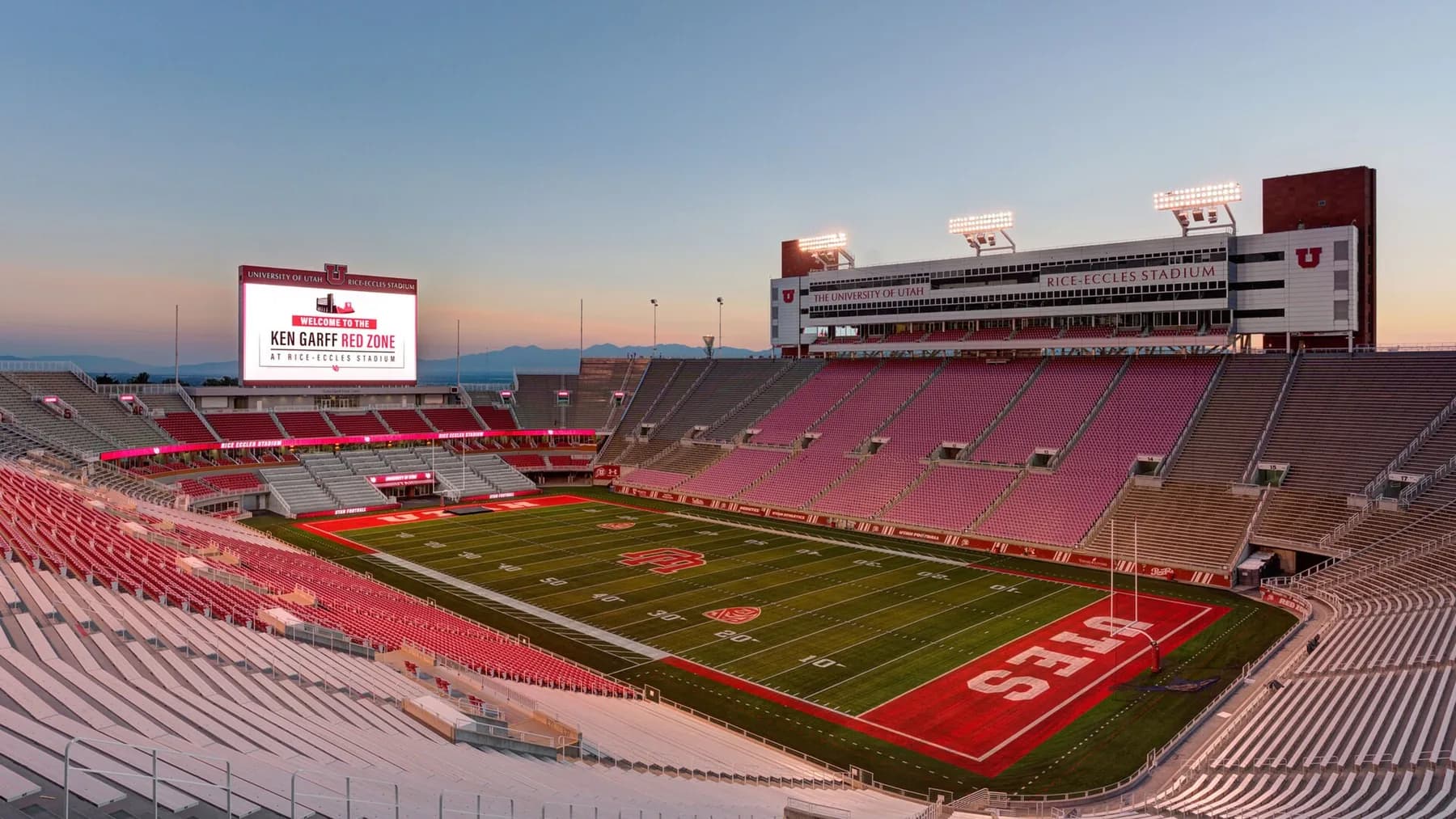
Photo: Kuleralsen · CC BY-SA 4.0 · Cropped for display
Up next · Week 9
Away
On the road at
Saturday, October 31 · Time TBA
The season, taking shape
Final scores show Utah first. Oldest to newest.
at Iowa StatePregame 31–20
Game details vs. Kansas
Pregame comparison unavailable
Game details at Colorado
Pregame 34–17
Game detailsOriginal full-season forecast
This forecast retains the original probabilities for the full schedule. It does not update with completed results or this week’s forecast.
2026 results
Current record, team efficiency, player production, and verified results from completed games.
Current record
7-07 wins · 0 lossesThrough 7 completed gamesLoading player usage…
2026 season preview
Devon Dampier gives Morgan Scalley an established quarterback, but Utah’s first season under its new head coach may turn on two entirely rebuilt lines.
Utah begins 2026 with a new head coach and a familiar football dilemma: its best-known players can raise the ceiling, but its rebuilt lines may set the floor. Morgan Scalley takes over after an 11-win season with Devon Dampier at quarterback, Wayshawn Parker in the backfield and veteran leadership at linebacker and safety. Yet Utah must replace every 2025 starter on both lines. How quickly those groups become functional units will shape everything around them.
Scalley is preserving Utah’s defensive lineage while making consequential changes elsewhere. Kevin McGiven, who coordinated Utah State’s offense in 2025, now directs a unit expected to use varied formations, shifts and motion while retaining familiar RPO and quarterback-run concepts. Colton Swan assumes control of the defense. Scalley’s stated defensive identity—relentless, smart, nasty and ballhawks—supplies continuity, but the Utes still have to reproduce that standard with a new coordinator and substantial personnel turnover.
Original season forecast
The original Big 12 forecast, retained alongside current results.
Big 12 projected standing
#2
7-2 projected · 6.6 expected conference wins · #2 of 16.
Preseason baseline
2025 percentiles retained as preseason context; current results and player production lead this page.
2025 FBS percentile scale · 50 is average
Incoming class
National and conference recruiting ranks, confirmed commitments, and the highest-ranked recruits in this class.
Top committed recruits
Utah2026 transfer movement
Incoming and outgoing transfer activity, with rated FBS-to-FBS moves below.
Incoming Transfers
UtahOutgoing Transfers
UtahSeason schedule
Completed games show final results. Upcoming games use this week’s forecast where available; later games retain their published season outlook.
Detailed football intelligence
The full team identity, offense, defense, and supporting evidence.
Team identity
Last season, Utah tried to lean on the running game; the approach consistently kept the offense on schedule.
Why it matters
The run game was Utah's steadier way to stay ahead of the chains; opponents have to win early fits without handing away play action.
 vs. Houston
Pregame 32–22
Game detailsPregame comparisons use preserved published forecasts. Results include wins and losses.
At a glance
Current form leads the outlook.
2026 rates aggregate verified completed-game box scores. EPA is expected points added per play.
| Player | C/ATT | YDS | TD | INT |
|---|---|---|---|---|
| Devon Dampier | 118/172 | 1412 | 15 | 4 |
| Byrd Ficklin | 10/18 | 186 | 2 | 0 |
| Player | CAR | YDS | AVG | TD |
|---|---|---|---|---|
| Wayshawn Parker | 89 | 597 | 6.7 | 7 |
| Devon Dampier | 59 | 199 | 3.4 | 3 |
| Byrd Ficklin | 22 | 152 | 6.9 | 1 |
| Player | REC | YDS | AVG | TD |
|---|---|---|---|---|
| Braden Pegan | 32 | 422 | 13.2 | 6 |
| Creed Whittemore | 15 | 253 | 16.9 | 0 |
| Ricky Johnson | 16 | 233 | 14.6 | 1 |
| Player | TOT | SOLO | TFL | SACK |
|---|---|---|---|---|
| Trey Reynolds | 35 | 21 | 3 | 0 |
| Johnathan Hall | 28 | 16 | 1 | 1 |
| Jackson Bennee | 24 | 15 | 0 | 0 |
Saturday, October 24 · Rice-Eccles Stadium
Saturday, October 17 · Folsom Field
Saturday, October 10 · Rice-Eccles Stadium
Dampier is the clearest reason for optimism. Joe Coles reported that he is healthy after surgery for a sports hernia, one of two injuries that limited him in 2025. Even while managing the hernia and an ankle problem, Dampier passed for 2,490 yards, rushed for 835 and accounted for 34 touchdowns. McGiven’s approach should preserve the quarterback’s running threat while giving him more ways to diagnose defenses before the snap. The challenge is expanding the passing game without overloading a quarterback whose recent health and new protection remain connected concerns.
Parker gives that offense another established centerpiece after rushing for 981 yards at 6.58 per carry. Coaches have expanded his receiving role, which could punish defenses for focusing too heavily on Dampier’s legs. Utah also added Braden Pegan, Kyri Shoels and Ricky Johnson to a receiver group that returns Creed Whittemore, Larry Simmons and Tobias Merriweather. Scalley has called it potentially his best Utah receiver room, though the pecking order is still forming. At tight end, Noah Bennee left spring as the reported favorite for the top role, but the group has not yet produced an established featured target.
The offensive line is the pivotal variable. Utah is replacing all five starters, including first-round tackles Spencer Fano and Caleb Lomu, from a group that powered record rushing production. The likely replacements are largely upperclassmen with reserve experience, joined by Montana State transfer Cedric Jefferson, while Solatoa Moea’i and freshman Kelvin Obot were reported in a guard competition. Individual experience helps, but line play depends on five players communicating and moving together. Until that combination settles, Utah cannot assume last season’s protection or rushing efficiency will carry over.
Scalley faces a parallel reconstruction on defense, where every starting lineman also departed. Karson Kaufusi and Pupu Sepulona are expected to take larger interior roles, with Jireh Moe, Lance Holtzclaw and Kash Dillon among the options around them. That front must address the run-defense slippage Utah experienced late in 2025. Behind it, Johnathan Hall offers an important stabilizer after leading the team with 67 tackles. His command of the defense, supplemented by Trey Reynolds’ starting experience and Cyrus Polu’s promising spring, could help the Utes absorb mistakes while the front develops.
The secondary has a more settled foundation at safety than at cornerback. Jackson Bennee, a healthy Rabbit Evans and Nate Ritchie give Utah experienced safety options, while Scooby Davis and transfers Elijah Reed, James Chenault and Nick Brown are part of a less certain cornerback competition. That imbalance matters: reliable safety play can organize the back end and limit damaging errors, but it cannot replace dependable coverage on the outside. The final line combinations, cornerback rotation and tight-end hierarchy remain among the defining questions of fall camp.
The schedule gives Utah an initial runway and then raises the stakes. Idaho, Arkansas and Utah State visit Rice-Eccles Stadium before the Big 12 opener at Iowa State, giving the reconstructed units three home games to develop. Utah later hosts Kansas and Houston around a trip to Colorado, then visits Cincinnati before BYU arrives Nov. 7. Road games at Arizona and TCU follow before the home finale against West Virginia. That closing sequence will test depth and cohesion. If the lines stabilize, Dampier, Parker, Hall and the veteran safeties give Scalley a credible core. If they do not, Utah’s strengths will spend too much of the season compensating for its foundations.
This preview is based on the linked public reporting and official program records.
Profile high point
The run game held the profile's highest percentile position.Profile low point
Big-play prevention held the lowest percentile position among the profile's strength measures.




The run game is what Utah can trust most.
Why it matters
The offense has its best route to favorable third downs and a credible play-action menu; explosive-play creation remains the first counter an opponent should test.
Utah did not show one unit opponents could treat as an automatic target; big-play creation is only the first place to look.
What matters
Utah's lowest-rated unit still finished above the national average last season, so opponents do not have an obvious weakness to attack.
For Utah, the cleanest script is to use the running game to control early downs and finish drives; fewer possessions make every empty drive more expensive.
What matters
Utah's run-first structure played at a deliberate pace. The run game finished top-tier, while the pass game finished top-tier.
Inside the team
Open a section for the football detail and supporting numbers.
The down-to-down question that determines whether the offense can keep both the run and pass available.
Opponents have to keep Utah's run game from turning first down into second-and-manageable.
Why it matters
If Utah stays on schedule on the ground, the offense keeps more answers available.
The pace, play selection, and methods this offense uses to stay on schedule.
Utah played at a deliberate pace in 2025.
What matters
Utah worked with fewer possessions than most teams last season.
Utah's prior passing record was top-tier.
Why it matters
A repeatable pass game can let Utah punish loaded boxes without relying on low-frequency deep completions.
Why it matters
A sustainable run game keeps Utah's play action credible and limits obvious passing situations.
Utah's explosive-play results were mixed rather than a defining edge.
Why it matters
A big play can still flip a possession, but last season's results do not make explosiveness something this team can rely on.
How consistently the offense creates manageable situations and the defense prevents them.
Utah won ordinary downs on both sides of the ball.
Why it matters
Utah's success rate shows whether it can sustain drives and get stops without relying on sacks, turnovers, or isolated big plays.
Opponent-adjusted EPA identifies the run game as Utah's stronger offensive unit.
Why it matters
Forcing longer passing situations is the clearest way to move the offense away from its stronger adjusted unit.
Where the defense can create pressure, control the run, and end drives.
Utah's prior defense was strong overall and strongest in pass defense.
Why it matters
Opponents can test the fits early enough to keep every offensive option open; Utah needs its pass defense to tighten throwing windows before that plan settles in.
Utah's available disruption measures finished above the national average last season; a charted pressure rate is not available.
Why it matters
Sustained disruption can create negative plays and give Utah a better chance to end drives before third down.
Utah's disruption regularly finished at the quarterback.
What matters
Both sack production and front-seven disruption cleared the FBS midpoint.
Utah's prior run-defense results were below-average.
Why it matters
If Utah's front cannot control early downs, opponents can keep every offensive option open and protect their passing game.