
Week 4 · FinalL
 vs. Oregon
27–41-14 margin
Pregame 26–31
Game detailsSaturday Index
Loading team intelligenceBringing the latest verified football information into focus.
Big Ten · 2026 · Week 8

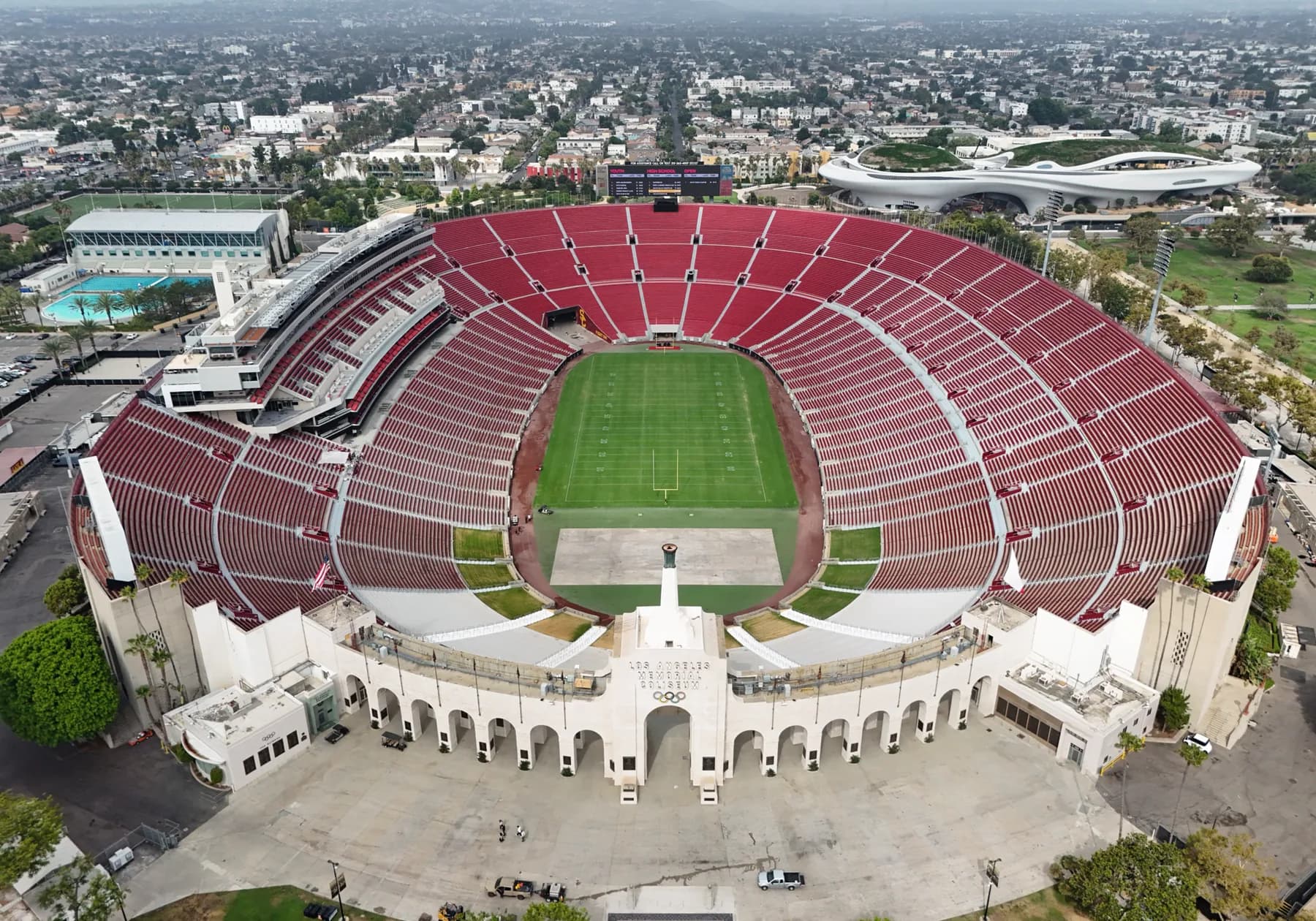
Photo: Quintin Soloviev · CC BY 4.0 · Cropped for display
Up next · Week 9
Home
Hosting
Saturday, October 31 · Time TBA
The season, taking shape
Final scores show USC first. Oldest to newest.
vs. OregonPregame 26–31
Game details vs. Washington
Pregame 32–24
Game details at Penn State
Pregame 28–26
Game detailsOriginal full-season forecast
This forecast retains the original probabilities for the full schedule. It does not update with completed results or this week’s forecast.
2026 results
Current record, team efficiency, player production, and verified results from completed games.
Current record
6-26 wins · 2 lossesThrough 8 completed gamesLoading player usage…
2026 season preview
Jayden Maiava and a veteran offensive core give USC stability, but receiver development and Gary Patterson’s defensive transition will shape the Trojans’ season.
USC enters 2026 with Lincoln Riley facing a roster-building test that cuts across both sides of the ball. The offense has continuity where it matters most: Jayden Maiava at quarterback, both leading rushers and all five starting offensive linemen. The defense has proven production up front but must absorb Gary Patterson’s evolved, multiple 4-2-5. USC’s season will turn on whether those veteran strengths can support the thinner areas—especially a young receiving corps and a secondary sorting through health and roles—before the schedule’s sharpest stretch arrives.
Original season forecast
The original Big Ten forecast, retained alongside current results.
Big Ten projected standing
#4
6-3 projected · 5.9 expected conference wins · #4 of 18.
Preseason baseline
2025 percentiles retained as preseason context; current results and player production lead this page.
2025 FBS percentile scale · 50 is average
Incoming class
National and conference recruiting ranks, confirmed commitments, and the highest-ranked recruits in this class.
Top committed recruits
USC2026 transfer movement
Incoming and outgoing transfer activity, with rated FBS-to-FBS moves below.
Incoming Transfers
USCOutgoing Transfers
USCSeason schedule
Completed games show final results. Upcoming games use this week’s forecast where available; later games retain their published season outlook.
Detailed football intelligence
The full team identity, offense, defense, and supporting evidence.
Team identity
Last season, USC tried to stay balanced between the run and pass; the approach consistently kept the offense on schedule.
Why it matters
The passing game was USC's more dependable way to stay ahead of the chains; opponents have to interrupt that rhythm without giving the run an easy box.
 at Wisconsin
Pregame 28–23
Game detailsPregame comparisons use preserved published forecasts. Results include wins and losses.
At a glance
Current form leads the outlook.
2026 rates aggregate verified completed-game box scores. EPA is expected points added per play.
| Player | C/ATT | YDS | TD | INT |
|---|---|---|---|---|
| Jayden Maiava | 183/274 | 2303 | 19 | 5 |
| Jonas Williams | 12/14 | 126 | 0 | 1 |
| Player | CAR | YDS | AVG | TD |
|---|---|---|---|---|
| King Miller | 125 | 603 | 4.8 | 4 |
| Waymond Jordan | 63 | 287 | 4.6 | 2 |
| Shahn Alston | 24 | 120 | 5.0 | 1 |
| Player | REC | YDS | AVG | TD |
|---|---|---|---|---|
| Kayden Dixon-Wyatt | 32 | 443 | 13.8 | 4 |
| Trent Mosley | 27 | 411 | 15.2 | 5 |
| Zach Williams | 20 | 329 | 16.4 | 1 |
| Player | TOT | SOLO | TFL | SACK |
|---|---|---|---|---|
| Christian Pierce | 44 | 29 | 0 | 0 |
| Deven Bryant | 44 | 28 | 0 | 0 |
| Desman Stephens II | 36 | 22 | 3.5 | 0.5 |
Saturday, October 24 · Camp Randall Stadium
Saturday, October 10 · Beaver Stadium
Saturday, October 3 · Los Angeles Memorial Coliseum
Maiava gives Riley something more valuable than intrigue: a known starter. He started all 13 games in 2025, completing 65.8 percent of his passes for 3,711 yards, 24 touchdowns and 10 interceptions. USC says he led the nation with a 91.2 QBR, and his selection for Big Ten preseason honors reflects how highly he is regarded entering the fall. With 31 career starts, Maiava can provide steady distribution and leadership while new targets find their places. USC’s public roster also includes Sam Huard at quarterback, but Maiava returns as the established starter.
The supporting structure should let Riley and offensive coordinator Luke Huard avoid placing the entire burden on the passing game. Waymond Jordan and King Miller, USC’s two leading rushers from last season, both return. So do Elijah Paige, Tobias Raymond, Kilian O’Connor, Alani Noa and Justin Tauanuu, giving the offensive line 76 combined career starts. USC’s spring outlook credited that unit with allowing one sack per game in 2025. Experienced protection and a proven two-back base should give Riley multiple ways to sustain the offense while the receiving rotation develops.
Receiver remains the pivotal offensive room. Ryan Kartje of the Los Angeles Times reported that top returning wideout Tanook Hines missed spring and opened fall camp sidelined after an undisclosed offseason procedure. Riley described the issue as not overly serious and expected Hines back for the opener, but the lost practice time matters for his timing with Maiava. NC State transfer Terrell Anderson arrives after catching 39 passes for 629 yards and five touchdowns in 2025, making him the most accomplished newcomer in a young group. Tight ends Carson Tabaracci, Tucker Ashcraft, Josiah Jefferson and Mark Bowman offer another solution: their range of experience could help USC vary formations and create dependable intermediate targets.
Patterson has the larger schematic transition. He has described his defense as an updated version of his 4-2-5, retaining successful elements from 2025 while adding concepts and adjustments. Its split-field man and zone possibilities can complicate a quarterback’s reads, but only if USC communicates cleanly enough to disguise and exchange assignments. That makes installation more than a preseason talking point. How quickly the back seven handles Patterson’s multiplicity could determine whether the defense complements USC’s veteran offense or spends the early season catching up.
The front gives Patterson a credible foundation. USC returns its top three sack producers, led by Kameryn Crawford’s 5.5 sacks and Braylan Shelby’s 4.5, and Penn State transfer Zuriah Fisher adds to the edge rotation. Jahkeem Stewart may be the consequential player inside after recording 7.5 tackles for loss while playing the 2025 season through a foot stress fracture. USC’s spring outlook described Stewart as healthy and ready to return. If that form carries into the season, his interior disruption could make Patterson’s pressures and coverage disguises more effective.
There is experience behind that front, though the combinations still need definition. Leading tackler Desman Stephens II returns after an 89-tackle season. Washington transfer Deven Bryant brings 10 starts and 62 tackles from 2025, while Jadyn Walker made five starts for USC. At corner, USC expects Prophet Brown and Chasen Johnson back from season-ending injuries and returns 11-game starter Marcelles Williams. Transfers Jontez Williams and Carrington Pierce expand the competition. Patterson has options; his task is turning them into a dependable linebacker pairing and corner rotation for a coverage-diverse system.
The schedule allows USC to begin with three home games against San José State, Fresno State and Louisiana before traveling to Rutgers. The pressure rises from there: Oregon and Washington visit the Coliseum on consecutive weekends, followed by a trip to Penn State. Later, USC goes to Wisconsin before hosting Ohio State. The closing listed stretch includes a trip to Indiana, a home game against Maryland and the rivalry finale at UCLA. That sequence places a premium on early growth. Maiava, the line and the backfield provide USC with a stable floor, but receiver cohesion and Patterson’s installation will decide how well the Trojans handle the season’s most demanding turns.
This preview is based on the linked public reporting and official program records.
Profile high point
Passing held the profile's highest percentile position.Profile low point
Down-to-down defense held the lowest percentile position among the profile's strength measures.



The passing game is what USC can trust most.
Why it matters
The opening plan has its best answer when opponents crowd the box or force obvious throwing situations; defensive control remains the first counter an opponent should test.
The defense's control of ordinary downs is the concern opponents should keep testing while the passing game tries to steady USC.
What matters
USC's defensive control finished below the national average last season.
For USC, the cleanest script is to stay balanced between the run and pass, then let the passing game finish drives; fewer possessions make every empty drive more expensive.
Why it matters
USC's clean script uses efficient early throws to stay ahead of the sticks; defenses will attack protection and route timing before the full passing menu opens. In a slower game, one empty drive or failed early-down series carries extra weight.
Inside the team
Open a section for the football detail and supporting numbers.
The down-to-down question that determines whether the offense can keep both the run and pass available.
Opponents have to break USC's passing rhythm before it owns early downs.
Why it matters
If USC keeps finding routine completions, the defense cannot load the box or turn the rush loose.
The pace, play selection, and methods this offense uses to stay on schedule.
USC played at a deliberate pace in 2025.
What matters
USC worked with fewer possessions than most teams last season.
USC's prior passing record was top-tier.
Why it matters
A repeatable pass game can let USC punish loaded boxes without relying on low-frequency deep completions.
USC's prior rushing record was strong.
Why it matters
A sustainable run game keeps USC's play action credible and limits obvious passing situations.
USC both created and limited explosive plays at a strong prior-season level.
Why it matters
That combination can change a game without forcing the offense to trade efficiency for low-percentage shots.
How consistently the offense creates manageable situations and the defense prevents them.
USC's offense was more consistent down to down than its defense.
Why it matters
USC's success rate shows whether it can sustain drives and get stops without relying on sacks, turnovers, or isolated big plays.
Opponent-adjusted EPA identifies the pass game as USC's stronger offensive unit.
Why it matters
If an opponent removes the first passing answer, the run game's lower adjusted value becomes the key counter to test.
Where the defense can create pressure, control the run, and end drives.
USC's prior defense was below-average overall and strongest in disruption.
Why it matters
Opponents can test the fits early enough to keep every offensive option open; USC needs its disruption to change protection and erase drives with negative plays before that plan settles in.
USC's available disruption measures finished above the national average last season; a charted pressure rate is not available.
Why it matters
Sustained disruption can create negative plays and give USC a better chance to end drives before third down.
USC's disruption regularly finished at the quarterback.
What matters
Both sack production and front-seven disruption cleared the FBS midpoint.
USC's prior run-defense results were bottom-tier.
Why it matters
If USC's front cannot control early downs, opponents can keep every offensive option open and protect their passing game.