Week 4 · FinalL
 at Miami (OH)
21–24-3 margin
Pregame 31–24
Game detailsSaturday Index
Loading team intelligenceBringing the latest verified football information into focus.
FBS Independents · 2026 · Week 8

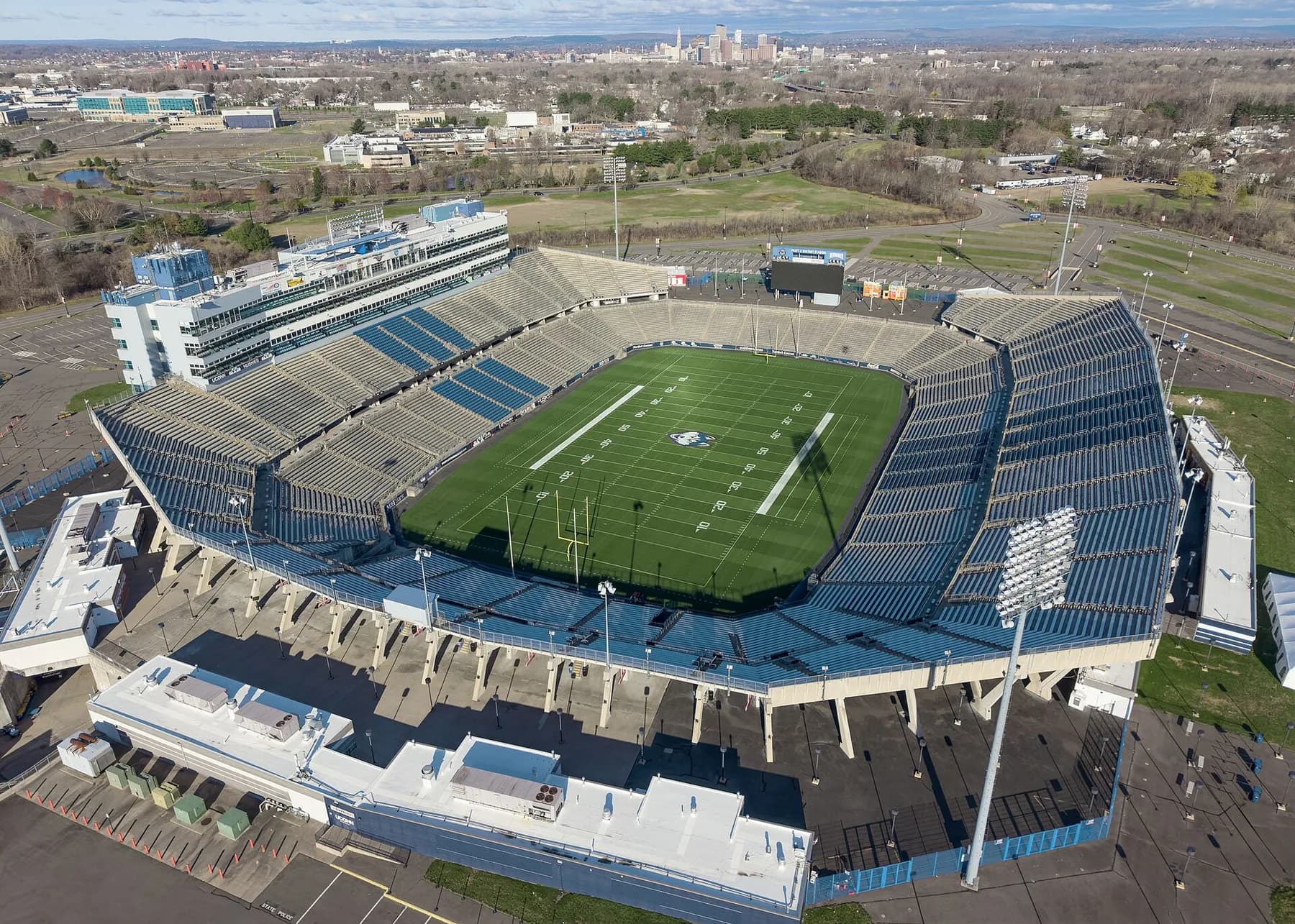
Photo: Quintin Soloviev · CC BY 4.0 · Cropped for display
Up next · Week 9
Away
On the road at
Saturday, October 31 · 3:00 PM EDT
The season, taking shape
Final scores show UConn first. Oldest to newest.
at Miami (OH)Pregame 31–24
Game details vs. Syracuse
Pregame 29–24
Game details at Temple
Pregame 28–27
Game detailsOriginal full-season forecast
This forecast retains the original probabilities for the full schedule. It does not update with completed results or this week’s forecast.
2026 results
Current record, team efficiency, player production, and verified results from completed games.
Current record
4-34 wins · 3 lossesThrough 7 completed gamesLoading player usage…
Preseason baseline
2025 percentiles retained as preseason context; current results and player production lead this page.
2025 FBS percentile scale · 50 is average
Incoming class
National and conference recruiting ranks, confirmed commitments, and the highest-ranked recruits in this class.
Top committed recruits
UConn2026 transfer movement
Incoming and outgoing transfer activity, with rated FBS-to-FBS moves below.
Incoming Transfers
UConnOutgoing Transfers
UConnSeason schedule
Completed games show final results. Upcoming games use this week’s forecast where available; later games retain their published season outlook.
Detailed football intelligence
The full team identity, offense, defense, and supporting evidence.
Team identity
Last season, UConn tried to lean on the passing game; the approach consistently kept the offense on schedule.
Why it matters
The passing game was UConn's more dependable way to stay ahead of the chains; opponents have to interrupt that rhythm without giving the run an easy box.
 vs. Massachusetts
Pregame 37–17
Game detailsPregame comparisons use preserved published forecasts. Results include wins and losses.
At a glance
Current form leads the outlook.
2026 rates aggregate verified completed-game box scores. EPA is expected points added per play.
| Player | C/ATT | YDS | TD | INT |
|---|---|---|---|---|
| Kalieb Osborne | 112/182 | 1594 | 12 | 2 |
| Tucker McDonald | 9/11 | 118 | 1 | 1 |
| Player | CAR | YDS | AVG | TD |
|---|---|---|---|---|
| Cyncir Bowers | 80 | 564 | 7.0 | 7 |
| Kalieb Osborne | 81 | 320 | 4.0 | 7 |
| Trey Cornist | 40 | 247 | 6.2 | 3 |
| Player | REC | YDS | AVG | TD |
|---|---|---|---|---|
| Shamar Porter | 14 | 265 | 18.9 | 3 |
| Jediyah Willoughby | 14 | 260 | 18.6 | 2 |
| Ryder Treadway | 15 | 219 | 14.6 | 0 |
| Player | TOT | SOLO | TFL | SACK |
|---|---|---|---|---|
| Hayden Pegg | 47 | 22 | 2 | 1 |
| K'Von Sherman | 46 | 22 | 8 | 3.5 |
| John Lista | 43 | 18 | 3.5 | 1 |
Friday, October 23 · Pratt & Whitney Stadium
Saturday, October 10 · Lincoln Financial Field
Saturday, October 3 · Pratt & Whitney Stadium
Profile high point
Passing held the profile's highest percentile position.Profile low point
Down-to-down defense held the lowest percentile position among the profile's strength measures.




The passing game is what UConn can trust most.
Why it matters
The opening plan has its best answer when opponents crowd the box or force obvious throwing situations; defensive control remains the first counter an opponent should test.
The defense's control of ordinary downs is UConn's biggest concern, and opponents can test it immediately.
What matters
UConn's defensive control ranked near the bottom nationally last season.
For UConn, the cleanest script is to use the passing game to stay on schedule and finish drives; an average pace puts more weight on winning ordinary downs.
What matters
UConn's pass-first structure played at a balanced pace. The pass game finished top-tier, while the run game finished strong.
Inside the team
Open a section for the football detail and supporting numbers.
The down-to-down question that determines whether the offense can keep both the run and pass available.
Opponents have to break UConn's passing rhythm before it owns early downs.
Why it matters
If UConn keeps finding routine completions, the defense cannot load the box or turn the rush loose.
The pace, play selection, and methods this offense uses to stay on schedule.
UConn played at a balanced pace in 2025.
Why it matters
At that pace, UConn cannot count on extra possessions or expect to shorten the game.
UConn's prior passing record was top-tier.
Why it matters
A repeatable pass game can let UConn punish loaded boxes without relying on low-frequency deep completions.
UConn's prior rushing record was strong.
Why it matters
A sustainable run game keeps UConn's play action credible and limits obvious passing situations.
UConn both created and limited explosive plays at a strong prior-season level.
Why it matters
That combination can change a game without forcing the offense to trade efficiency for low-percentage shots.
How consistently the offense creates manageable situations and the defense prevents them.
UConn's offense was more consistent down to down than its defense.
Why it matters
UConn's success rate shows whether it can sustain drives and get stops without relying on sacks, turnovers, or isolated big plays.
Opponent-adjusted EPA identifies the pass game as UConn's stronger offensive unit.
Why it matters
If an opponent removes the first passing answer, the run game's lower adjusted value becomes the key counter to test.
Where the defense can create pressure, control the run, and end drives.
UConn's prior defense was bottom-tier overall and strongest in disruption.
Why it matters
Opponents can test the fits early enough to keep every offensive option open; UConn needs its disruption to change protection and erase drives with negative plays before that plan settles in.
UConn's available disruption measures finished below the national average last season; a charted pressure rate is not available.
Why it matters
Without consistent disruption, UConn's defense must win more snaps through coverage, leverage, and early-down prevention.
UConn's sack production outpaced its broader disruption record.
Why it matters
UConn's disruption can hurry an offense; sacks do more by erasing field position and ending passing downs.
UConn's prior run-defense results were bottom-tier.
Why it matters
If UConn's front cannot control early downs, opponents can keep every offensive option open and protect their passing game.