
Week 4 · FinalW
 vs. TCU
21–13+8 margin
Pregame 24–27
Game detailsSaturday Index
Loading team intelligenceBringing the latest verified football information into focus.
Big 12 · 2026 · Week 8

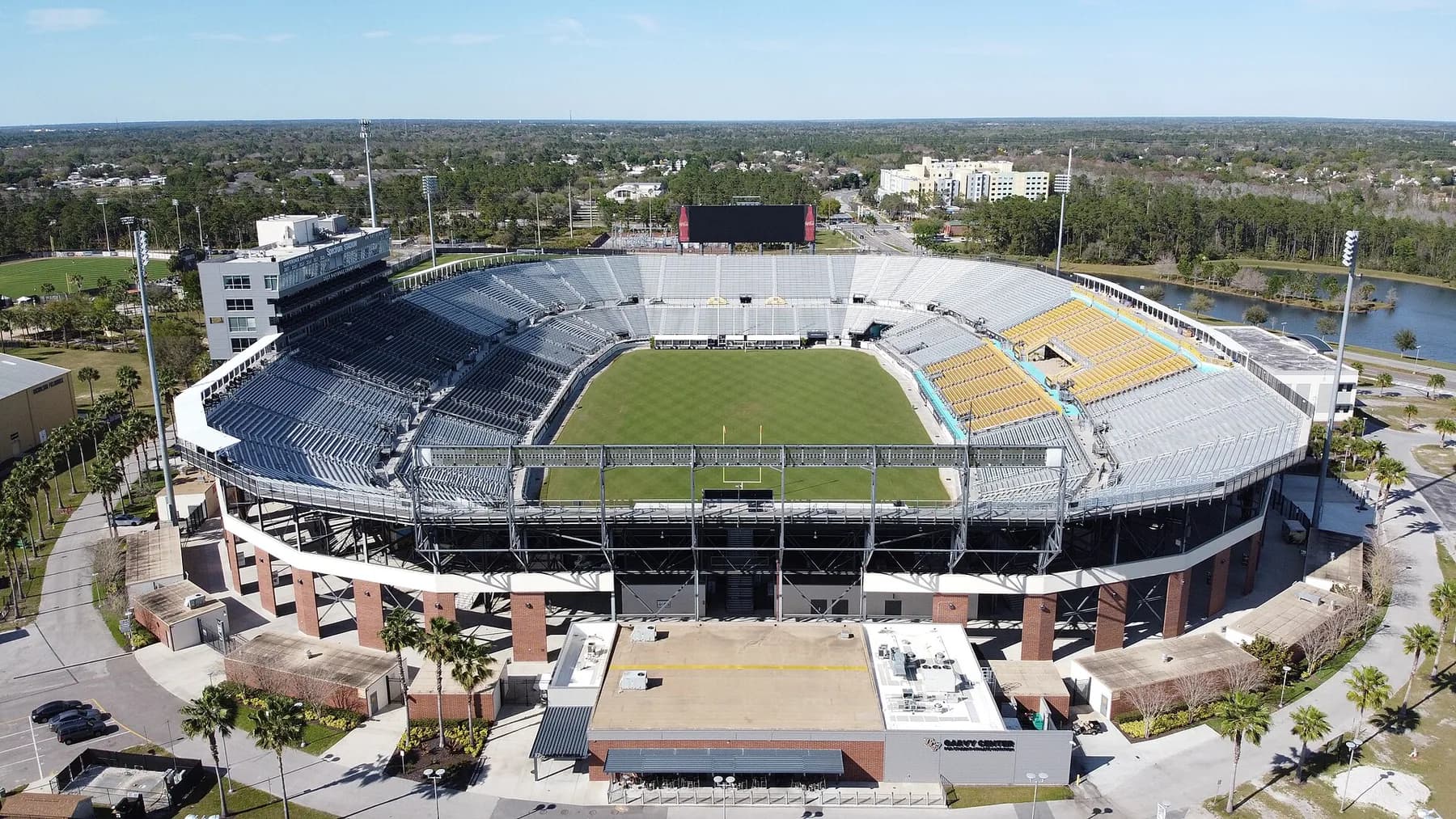
Photo: Adam53Rick · CC BY-SA 4.0 · Cropped for display
Up next · Week 9
Home
Hosting
Friday, October 30 · 7:30 PM EDT
The season, taking shape
Final scores show UCF first. Oldest to newest.
vs. TCUPregame 24–27
Game details at Houston
Pregame 21–31
Game details at Oklahoma State
Pregame 27–25
Game detailsOriginal full-season forecast
This forecast retains the original probabilities for the full schedule. It does not update with completed results or this week’s forecast.
2026 results
Current record, team efficiency, player production, and verified results from completed games.
Current record
4-34 wins · 3 lossesThrough 7 completed gamesLoading player usage…
2026 season preview
Alonza Barnett III gives Scott Frost a proven dual-threat quarterback, but a rebuilt roster must come together quickly before a demanding opening stretch of Big 12 play.
UCF enters 2026 with a clear centerpiece and a complicated construction project. Scott Frost has Alonza Barnett III at quarterback, experienced leaders at each level of the defense and continuity among his primary coordinators. He also has a roster extensively reshaped through the transfer portal. The defining issue is not whether the Knights added talent across enough positions. It is whether Frost can make those pieces function together before the schedule begins applying real pressure.
Original season forecast
The original Big 12 forecast, retained alongside current results.
Big 12 projected standing
#12
4-5 projected · 3.6 expected conference wins · #12 of 16.
Preseason baseline
2025 percentiles retained as preseason context; current results and player production lead this page.
2025 FBS percentile scale · 50 is average
Incoming class
National and conference recruiting ranks, confirmed commitments, and the highest-ranked recruits in this class.
Top committed recruits
UCF2026 transfer movement
Incoming and outgoing transfer activity, with rated FBS-to-FBS moves below.
Incoming Transfers
UCFOutgoing Transfers
UCFSeason schedule
Completed games show final results. Upcoming games use this week’s forecast where available; later games retain their published season outlook.
Detailed football intelligence
The full team identity, offense, defense, and supporting evidence.
Team identity
Last season, UCF tried to lean on the passing game; it rarely provided an easy foundation.
Why it matters
Neither offensive unit clearly carried the other, so first-down execution decides whether UCF can stay on plan.
 vs. BYU
Pregame 18–29
Game detailsPregame comparisons use preserved published forecasts. Results include wins and losses.
At a glance
Current form leads the outlook.
2026 rates aggregate verified completed-game box scores. EPA is expected points added per play.
| Player | C/ATT | YDS | TD | INT |
|---|---|---|---|---|
| Keyone Jenkins | 82/115 | 780 | 8 | 3 |
| Alonza Barnett | 31/49 | 344 | 2 | 1 |
| Kaleb Annett | 2/3 | 6 | 0 | 0 |
| Player | CAR | YDS | AVG | TD |
|---|---|---|---|---|
| Duke Watson | 70 | 483 | 6.9 | 3 |
| Taevion Swint | 32 | 162 | 5.1 | 2 |
| Landen Chambers | 26 | 139 | 5.3 | 3 |
| Player | REC | YDS | AVG | TD |
|---|---|---|---|---|
| Joshua Derry | 28 | 304 | 10.9 | 2 |
| Waden Charles | 15 | 195 | 13.0 | 2 |
| Ric'Darious Farmer | 13 | 147 | 11.3 | 0 |
| Player | TOT | SOLO | TFL | SACK |
|---|---|---|---|---|
| Tackett Curtis | 39 | 18 | 3 | 1 |
| Demari Henderson | 30 | 19 | 2 | 1 |
| Jahleel Culbreath | 30 | 18 | 1.5 | 0.5 |
Saturday, October 24 · FBC Mortgage Stadium
Saturday, October 10 · Boone Pickens Stadium
Saturday, October 3 · TDECU Stadium
That challenge gives Frost’s second season a sharper standard than simple roster improvement. He told Sons of UCF that offseason decisions emphasized toughness and alignment after the 2025 team failed to finish several close games. The staff structure should help: Steve Cooper continues to coordinate the offense, while Alex Grinch coordinates the defense and coaches the safeties. UCF also began its 15-practice spring with 97 of 100 players present in Orlando, giving a transfer-heavy group broad exposure to the systems it must carry into the fall. The next step is turning familiarity into execution, particularly when games tighten late.
Barnett is the best reason to believe the offense can accelerate that process. UCF has identified the James Madison transfer as QB1 after a 2025 season in which he passed for 2,806 yards and 23 touchdowns while adding 589 rushing yards and 15 scores. That production fits an offense capable of using the quarterback run to force defenses to account for an extra ball carrier. Barnett took few visible live reps during spring, however. Quarterbacks coach McKenzie Milton called the limitation protective and said Barnett remained involved through meetings, side throwing and leadership work. Barnett expected to participate in summer activities, but his fall workload had not yet been established. His ability to build timing with a rebuilt offense will be central from the opening month.
The supporting cast offers options without an obvious pecking order. Running backs coach Jimmy Beal said no runner separated during spring. Duke Watson brings slashing explosiveness, Landen Chambers offers downhill power, Agyeman Addae supplies familiarity with the system and Taevion Swint was working back from a 2025 meniscus tear. That mix points toward specialized roles as UCF replaces the production of Myles Montgomery and Jaden Nixon. Up front, Preston Cushman is the stabilizer after starting all 12 games and leading UCF linemen with 753 snaps in 2025. His experience carries added weight beside four incoming transfer linemen and in front of a quarterback who missed valuable live spring work.
The defense has a sturdier returning spine. Linebacker Lewis Carter led UCF with 92 tackles last season and gives Grinch a proven producer and communicator in the middle. Tackett Curtis and Jahleel Culbreath joined returners Phil Picciotti and Jayden Jennings in a room with the experience and speed to support an aggressive approach. Inside, RJ Jackson Jr. and Horace Lockett headline a group reinforced by Brad Gurley Jr., Josh Schell and Thomas Collins. Position coach Kenny Martin has emphasized pursuit and disruptive physicality, and the deeper rotation could help UCF withstand the demands of Big 12 run defense. Lockett was still transitioning back from a 2025 injury during spring, leaving his eventual workload uncertain.
Jayden Bellamy gives the secondary its strongest reference point. He led UCF with eight pass breakups in 2025, when the Knights allowed 185.1 passing yards per game, their lowest figure since 2001. Six transfer defensive backs must be incorporated, but Bellamy provides proven coverage ability around which Grinch can organize the group. UCF’s choice of Barnett, Cushman, Carter and Bellamy to accompany Frost at Big 12 Media Days was telling: quarterback, offensive line, linebacker and secondary are represented by the players expected to form the public leadership spine of this rebuilt team.
The schedule will test that leadership early. UCF opens at home against Bethune-Cookman, travels to Pittsburgh and returns for Georgia State before Big 12 play begins against TCU in Orlando. Frost has identified the ensuing run—TCU at home, followed by trips to Houston and Oklahoma State—as potentially season-defining. That sequence leaves little room for the offense to spend September searching for chemistry. Later home games against BYU, Baylor, Arizona State and Iowa State are balanced by trips to Kansas and Colorado, keeping depth and cohesion relevant deep into November.
UCF’s 2026 case begins with Barnett’s dual-threat production, Cushman’s reliability and defensive leadership from Carter and Bellamy. Its outcome will depend on how quickly new combinations settle around them, whether the running backs establish useful roles and whether the rebuilt lines hold up when conference play arrives. Frost wanted a tougher, more aligned roster after last season’s close-game failures. The opening Big 12 stretch will provide the first meaningful answer—not only about the newcomers, but about whether UCF has become the connected team its coach set out to build.
This preview is based on the linked public reporting and official program records.
Profile high point
Big-play prevention held the profile's highest percentile position.Profile low point
The run game held the lowest percentile position among the profile's strength measures.




Big-play creation is what UCF can trust most.
Why it matters
The offense has its best route to changing field position without requiring flawless drive efficiency; rushing structure remains the first counter an opponent should test.
The first place to test UCF is the run game, especially on ordinary early downs; big-play creation has to keep the game on plan.
What matters
UCF's rushing structure ranked in the lower national range last season.
For UCF, the cleanest script is to lean on the passing game, then keep winning first down because neither the pass nor run can rescue the other; fewer possessions make every empty drive more expensive.
What matters
UCF's pass-leaning structure played at a deliberate pace. Passing finished weak and rushing finished weak, without a clear split between them.
Inside the team
Open a section for the football detail and supporting numbers.
The down-to-down question that determines whether the offense can keep both the run and pass available.
UCF must establish a first-down answer before opponents have to defend both the run and pass.
Why it matters
Without one part of the offense forcing an adjustment, opponents can keep the offense in long-yardage and play from a position of strength.
The pace, play selection, and methods this offense uses to stay on schedule.
UCF played at a deliberate pace in 2025.
What matters
UCF worked with fewer possessions than most teams last season.
UCF's prior passing record was weak.
Why it matters
UCF's offense needs protection, field position, or explosive variance when ordinary dropbacks do not create enough value.
Why it matters
When UCF's run game cannot stay on schedule, protection and passing-down execution carry more of the offense.
UCF both created and limited explosive plays at a strong prior-season level.
Why it matters
That combination can change a game without forcing the offense to trade efficiency for low-percentage shots.
How consistently the offense creates manageable situations and the defense prevents them.
UCF's down-to-down results were weak overall.
Why it matters
UCF's success rate shows whether it can sustain drives and get stops without relying on sacks, turnovers, or isolated big plays.
Opponent-adjusted EPA identifies the run game as UCF's stronger offensive unit.
Why it matters
Forcing longer passing situations is the clearest way to move the offense away from its stronger adjusted unit.
Where the defense can create pressure, control the run, and end drives.
UCF's prior defense was middle-of-the-pack overall and strongest in pass defense.
Why it matters
Opponents can test the fits early enough to keep every offensive option open; UCF needs its pass defense to tighten throwing windows before that plan settles in.
UCF's available disruption measures finished above the national average last season; a charted pressure rate is not available.
Why it matters
Sustained disruption can create negative plays and give UCF a better chance to end drives before third down.
UCF's sack and disruption results were above-average.
Why it matters
UCF's disruption can hurry an offense; sacks do more by erasing field position and ending passing downs.
UCF's prior run-defense results were weak.
Why it matters
If UCF's front cannot control early downs, opponents can keep every offensive option open and protect their passing game.