
Week 4 · FinalW
 vs. Sam Houston
49–14+35 margin
Pregame 50–6
Game detailsSaturday Index
Loading team intelligenceBringing the latest verified football information into focus.
Up next · Week 9
Home
Hosting
Saturday, October 31 · Time TBA
The season, taking shape
Final scores show Texas Tech first. Oldest to newest.
vs. Sam HoustonPregame 50–6
Game details at Colorado
Pregame 36–16
Game details vs. Arizona State
Pregame 36–15
Original full-season forecast
This forecast retains the original probabilities for the full schedule. It does not update with completed results or this week’s forecast.
At a glance
Current form leads the outlook.
2026 results
Current record, team efficiency, player production, and verified results from completed games.
Current record
6-16 wins · 1 lossThrough 7 completed gamesLoading player usage…

2026 season preview
The Red Raiders retain a proven offensive structure and veteran leaders, but quarterback play and a rebuilt defensive front will determine whether they remain atop the Big 12.
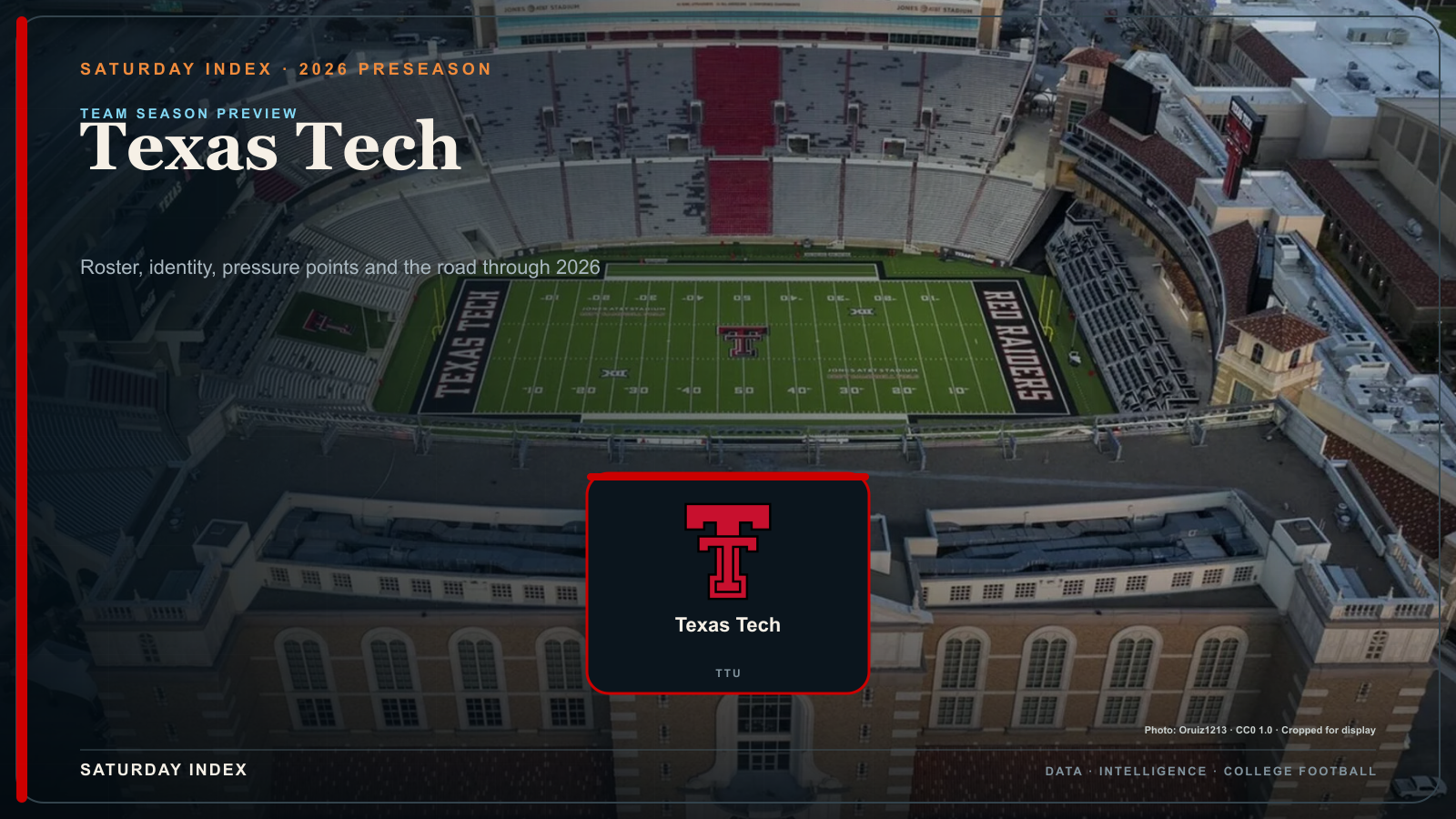
Texas Tech enters 2026 with a different assignment for Joey McGuire. After a school-record 12 wins, the program’s first Big 12 championship and its first College Football Playoff appearance, the Red Raiders no longer need to prove they can reach the top of the conference. They have to show they can stay there. Only Oklahoma and Baylor have repeated as Big 12 champions, according to Texas Tech, and McGuire’s challenge is to carry a championship standard through significant turnover at quarterback and across the defensive front seven.
Original season forecast
The original Big 12 forecast, retained alongside current results.
Big 12 projected standing
#1
9-0 projected · 8.3 expected conference wins · conference favorite.
Preseason baseline
2025 percentiles retained as preseason context; current results and player production lead this page.
2025 FBS percentile scale · 50 is average
Incoming class
National and conference recruiting ranks, confirmed commitments, and the highest-ranked recruits in this class.
Top committed recruits
Texas Tech2026 transfer movement
Incoming and outgoing transfer activity, with rated FBS-to-FBS moves below.
Incoming Transfers
Texas TechOutgoing Transfers
Texas TechSeason schedule
Completed games show final results. Upcoming games use this week’s forecast where available; later games retain their published season outlook.
Detailed football intelligence
The full team identity, offense, defense, and supporting evidence.
Team identity
Last season, Texas Tech tried to lean on the passing game; the approach gave the offense a dependable starting point.
Why it matters
The passing game was Texas Tech's more dependable way to stay ahead of the chains; opponents have to interrupt that rhythm without giving the run an easy box.
 at Cincinnati
Pregame 36–19
Game detailsPregame comparisons use preserved published forecasts. Results include wins and losses.
2026 rates aggregate verified completed-game box scores. EPA is expected points added per play.
| Player | C/ATT | YDS | TD | INT |
|---|---|---|---|---|
| Will Hammond | 98/141 | 1077 | 5 | 4 |
| Thomas Castellanos | 3/4 | 45 | 2 | 0 |
| Player | CAR | YDS | AVG | TD |
|---|---|---|---|---|
| J'Koby Williams | 67 | 476 | 7.1 | 4 |
| Cameron Dickey | 40 | 175 | 4.4 | 3 |
| Quinten Joyner | 41 | 167 | 4.1 | 2 |
| Player | REC | YDS | AVG | TD |
|---|---|---|---|---|
| Kenny Johnson | 20 | 305 | 15.3 | 0 |
| Coy Eakin | 16 | 178 | 11.1 | 3 |
| J'Koby Williams | 18 | 131 | 7.3 | 0 |
| Player | TOT | SOLO | TFL | SACK |
|---|---|---|---|---|
| Austin Romaine | 35 | 20 | 3 | 0.5 |
| Ben Roberts | 27 | 19 | 4.5 | 0 |
| Malik Esquerra | 25 | 20 | 0 | 0 |
Saturday, October 24 · Nippert Stadium
Saturday, October 17 · Jones AT&T Stadium
Saturday, October 3 · Folsom Field
Continuity on the coaching staff gives him a useful starting point. Texas Tech lists Mack Leftwich as offensive coordinator and quarterbacks coach, Shiel Wood as defensive coordinator and inside-linebackers coach, and Rob Greene as co-defensive coordinator and safeties coach. Keeping that structure matters because the Red Raiders can teach new players within established systems rather than asking a reshaped roster to learn a new identity. The question is whether familiar schemes can speed up the development of unfamiliar combinations.
The quarterback competition will shape everything Leftwich does. The roster retrieved Aug. 3 lists Will Hammond, Tulsa transfer Kirk Francis, Holden Phillips, Lloyd Jones III and freshman Stephen Cannon. Hammond and Francis are the two listed quarterbacks with meaningful college-game context, but no starter has been established. Whoever replaces Behren Morton inherits a system that averaged 39.4 points and 461.4 yards per game in Leftwich’s first Texas Tech season, produced 93 gains of at least 20 yards and became the Big 12’s only offense with both 3,500 passing yards and 2,500 rushing yards. The framework works; the new quarterback must operate it without turning transition into limitation.
Texas Tech can reduce that burden by leaning on Cameron Dickey and J’Koby Williams. Leftwich’s official profile says both topped 800 rushing yards in 2025, with Dickey producing 1,124 yards and a Big 12-leading 14 rushing touchdowns. Mike Craven also reported that left tackle Howard Sampson, center Sheridan Wilson and right guard Jacob Ponton return after starting in 2025. That combination gives the Red Raiders proven ball carriers, experience at the protection’s two most important communication points and a credible way to keep the offense on schedule while the passing game settles.
Tight end Terrance Carter Jr., a preseason All-Big 12 selection, can become an important matchup target for the new quarterback. Receiver Coy Eakin supplies another veteran presence, while additions Donte Lee Jr., Kenny Johnson and Jalen Jones enter a receiving room whose rotation is still taking shape. Carter and Eakin were among the six seniors McGuire brought to Big 12 Media Days, joining Wilson, defensive tackle A.J. Holmes Jr., linebacker Ben Roberts and cornerback Brice Pollock. That group forms a leadership spine across nearly every position affected by transition.
The more demanding reconstruction belongs to Wood and Greene. Craven reported that Texas Tech lost David Bailey, Romello Height, Lee Hunter and Jacob Rodriguez from the championship team, stripping proven players from the edge, interior line and linebacker level. Holmes is the established defensive-tackle anchor, and Craven identified Wake Forest transfer Mateen Ibirogba as the leading reinforcement inside. Their ability to disrupt from the middle will be especially important while a new edge rotation develops; without interior pressure, the changes up front could place more strain on every level behind them.
Texas Tech has recognizable answers at linebacker and cornerback. Craven described Roberts as the leader of the linebacker room and Kansas State transfer Austin Romaine as the expected successor to Rodriguez; both later made Phil Steele’s preseason first-team All-Big 12 list. Pollock, an official preseason All-Big 12 choice, gives the secondary a coverage cornerstone and senior leader. Transfers and newcomers were added throughout the defense, including corner Davin Martin and edge players Trey White and Adam Trick, but preseason recognition cannot substitute for cohesion. The defense’s ceiling depends on how quickly those additions fit around Holmes, Roberts, Romaine and Pollock.
The schedule gives McGuire time to establish those combinations, then steadily increases the pressure. Texas Tech opens at home against Abilene Christian, travels to Oregon State and returns to Lubbock for Houston. The Red Raiders avoid BYU, Utah and Kansas State during the regular season, but road games at Colorado and Cincinnati test them before a demanding November that includes trips to Oklahoma State and Baylor followed by TCU at home. It is a workable path for a defending champion, which makes early quarterback growth and defensive cohesion all the more consequential. Texas Tech has enough proven structure to remain in the Big 12 race; whether it can defend the title will be decided by how quickly McGuire turns a collection of veteran anchors and new pieces into one dependable team.
This preview is based on the linked public reporting and official program records.
Profile high point
Down-to-down defense held the profile's highest percentile position.Profile low point
The run game held the lowest percentile position among the profile's strength measures, not a below-average mark.



The defense's control of ordinary downs is what Texas Tech can trust most.
Why it matters
That unit is the most credible foundation for making opponents string together clean drives; rushing structure remains the first counter an opponent should test.
Texas Tech did not show one unit opponents could treat as an automatic target; the run game is only the first place to look.
What matters
Texas Tech's lowest-rated unit still finished near the national middle last season, so opponents do not have an obvious weakness to attack.
Texas Tech is at its best when it can use the passing game to stay on schedule and finish drives; an average pace puts more weight on winning ordinary downs.
What matters
Texas Tech's pass-leaning structure played at a balanced pace. The pass game finished strong, while the run game finished middle-of-the-pack.
Inside the team
Open a section for the football detail and supporting numbers.
The down-to-down question that determines whether the offense can keep both the run and pass available.
Opponents have to break Texas Tech's passing rhythm before it owns early downs.
Why it matters
If Texas Tech keeps finding routine completions, the defense cannot load the box or turn the rush loose.
The pace, play selection, and methods this offense uses to stay on schedule.
Texas Tech played at a balanced pace in 2025.
Why it matters
At that pace, Texas Tech cannot count on extra possessions or expect to shorten the game.
Texas Tech's prior passing record was strong.
Why it matters
A repeatable pass game can let Texas Tech punish loaded boxes without relying on low-frequency deep completions.
Texas Tech's prior rushing record was middle-of-the-pack.
Why it matters
When Texas Tech's run game cannot stay on schedule, protection and passing-down execution carry more of the offense.
Texas Tech both created and limited explosive plays at a strong prior-season level.
Why it matters
That combination can change a game without forcing the offense to trade efficiency for low-percentage shots.
How consistently the offense creates manageable situations and the defense prevents them.
Texas Tech's defense was more consistent down to down than its offense.
Why it matters
Texas Tech's success rate shows whether it can sustain drives and get stops without relying on sacks, turnovers, or isolated big plays.
Opponent-adjusted EPA identifies the pass game as Texas Tech's stronger offensive unit.
Why it matters
If an opponent removes the first passing answer, the run game's lower adjusted value becomes the key counter to test.
Where the defense can create pressure, control the run, and end drives.
Texas Tech's prior defense was top-tier overall, with no clear separation among its main units.
Why it matters
That balance makes it harder for an offense to choose one automatic target; the defense still has to win early downs before any unit can dictate the offensive options.
Texas Tech's available disruption measures ranked among the best in the country last season; a charted pressure rate is not available.
Why it matters
Sustained disruption can create negative plays and give Texas Tech a better chance to end drives before third down.
Texas Tech's disruption regularly finished at the quarterback.
What matters
Both sack production and front-seven disruption cleared the FBS midpoint.
Why it matters
A dependable run front can let Texas Tech create obvious passing downs without committing extra bodies to the box.