Week 4 · FinalW
 at Tennessee
20–17+3 margin
Pregame 28–27
Game detailsSaturday Index
Loading team intelligenceBringing the latest verified football information into focus.
SEC · 2026 · Week 8

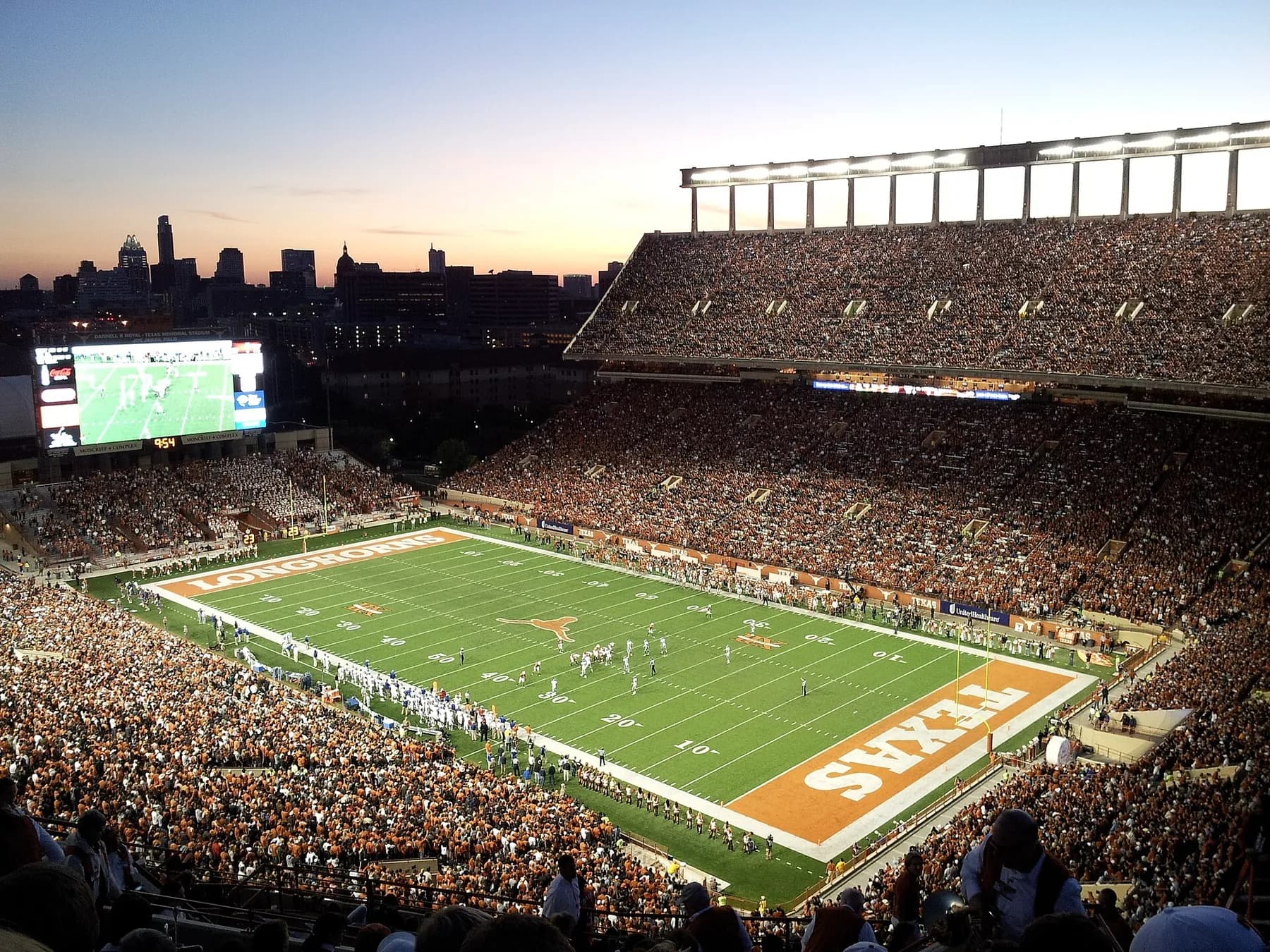
Photo: Brint03 · CC BY-SA 3.0 · Cropped for display
Up next · Week 9
Home
Hosting
Saturday, October 31 · Time TBA
The season, taking shape
Final scores show Texas first. Oldest to newest.
at TennesseePregame 28–27
Game details vs. Oklahoma
Pregame 25–20
Game details vs. Florida
Pregame 32–19
Game detailsOriginal full-season forecast
This forecast retains the original probabilities for the full schedule. It does not update with completed results or this week’s forecast.
2026 results
Current record, team efficiency, player production, and verified results from completed games.
Current record
5-25 wins · 2 lossesThrough 7 completed gamesLoading player usage…
2026 season preview
Arch Manning leads a nationally recognized core, but Steve Sarkisian must settle the offensive line and integrate a reorganized defense before a schedule built to expose weak links.
Texas enters 2026 with a familiar source of belief: Steve Sarkisian has an experienced quarterback, premium talent at several decisive positions and a program coming off a 10-3 season that included three top-10 wins, according to the school. Walter Camp placed a national-best five Longhorns on its preseason All-America teams: Arch Manning, Trevor Goosby, Rasheem Biles and Colin Simmons on the first team, with Cam Coleman on the second. But after 22 incoming and 28 outgoing transfers, the defining question is whether Sarkisian can turn a star-heavy roster into a connected team quickly enough for the schedule ahead.
Original season forecast
The original SEC forecast, retained alongside current results.
SEC projected standing
#5
6-3 projected · 5.7 expected conference wins · #5 of 16.
Preseason baseline
2025 percentiles retained as preseason context; current results and player production lead this page.
2025 FBS percentile scale · 50 is average
Incoming class
National and conference recruiting ranks, confirmed commitments, and the highest-ranked recruits in this class.
Top committed recruits
Texas2026 transfer movement
Incoming and outgoing transfer activity, with rated FBS-to-FBS moves below.
Incoming Transfers
TexasOutgoing Transfers
TexasSeason schedule
Completed games show final results. Upcoming games use this week’s forecast where available; later games retain their published season outlook.
Detailed football intelligence
The full team identity, offense, defense, and supporting evidence.
Team identity
Last season, Texas tried to lean on the passing game; too many drives still went off schedule.
Why it matters
Neither offensive unit clearly carried the other, so first-down execution decides whether Texas can stay on plan.
 vs. Ole Miss
Pregame 28–26
Game detailsPregame comparisons use preserved published forecasts. Results include wins and losses.
At a glance
Current form leads the outlook.
2026 rates aggregate verified completed-game box scores. EPA is expected points added per play.
| Player | C/ATT | YDS | TD | INT |
|---|---|---|---|---|
| Arch Manning | 108/164 | 1347 | 10 | 7 |
| Karle Lacey Jr. | 6/7 | 55 | 0 | 0 |
| Player | CAR | YDS | AVG | TD |
|---|---|---|---|---|
| Raleek Brown | 74 | 381 | 5.1 | 5 |
| Daylan Smothers | 55 | 235 | 4.3 | 2 |
| Derrek Cooper | 17 | 54 | 3.2 | 0 |
| Player | REC | YDS | AVG | TD |
|---|---|---|---|---|
| Ryan Wingo | 31 | 434 | 14.0 | 4 |
| Emmett Mosley V | 18 | 295 | 16.4 | 0 |
| Cam Coleman | 16 | 275 | 17.2 | 4 |
| Player | TOT | SOLO | TFL | SACK |
|---|---|---|---|---|
| Jelani McDonald | 51 | 25 | 2 | 0 |
| Rasheem Biles | 49 | 24 | 5.5 | 1 |
| Justin Cryer | 41 | 15 | 1 | 0 |
Saturday, October 24 · DKR-Texas Memorial Stadium
Saturday, October 17 · DKR-Texas Memorial Stadium
Saturday, October 10 · Cotton Bowl
Manning gives that project a sturdy center. The junior returns after starting Texas’s 2025 season, and official recaps credit him with 389 passing yards and six total touchdowns against Arkansas and 221 passing yards with two scores in the Citrus Bowl. His mobility expands Sarkisian’s option and red-zone menu, allowing the quarterback to create answers when protection or spacing breaks down. That experience matters because the offense around him is being rearranged; Texas can ask Manning to elevate a new combination of players without asking him to learn the job at the same time.
Ryan Wingo supplies continuity at receiver, while Auburn transfer Cam Coleman arrives with 56 catches for 708 yards and five touchdowns in 2025. Coleman’s SEC production gives Manning an established boundary target and should make it harder for defenses to tilt coverage toward Wingo. The distribution behind them is less clear. Transfers Raleek Brown and Hollywood Smothers join the running-back room, while veteran Michigan State transfer Michael Masunas enters a tight-end group with Nick Townsend, Emaree Winston and Will Randle. Those additions create options, but Sarkisian still has to determine who earns the crucial carries, underneath targets and situational snaps.
The offensive line is the clearest hinge. Goosby started all 13 games at left tackle last season and earned first-team All-SEC honors, giving Manning a proven blind-side protector. Texas also retains Brandon Baker, Jaydon Chatman and Melvin Siani, but the combinations at the other four positions still have to take shape. That work will influence nearly everything Sarkisian wants to do: the time available for deeper routes to Coleman and Wingo, the credibility of the running game and the offense’s ability to stay on schedule against SEC fronts. Skill talent raises the ceiling; blocking cohesion will determine how consistently Texas can reach it.
Defense brings both a proven centerpiece and a new chain of command. Texas replaced Pete Kwiatkowski with Will Muschamp, who returns to Austin as a veteran head coach and former Longhorns coordinator. Johnny Nansen is also listed as a defensive coordinator, and Blake Gideon returns as defensive passing-game coordinator and secondary coach after coordinating Georgia Tech in 2025. Their immediate task is to make responsibilities and communication as reliable as the individual talent. Simmons, who led the SEC with 12 sacks in 2025, can drive the pass rush, while Hero Kanu and Justus Terry must provide enough interior resistance to keep offenses from devoting extra protection to him.
Biles offers a productive answer at linebacker after Anthony Hill Jr.’s departure for the NFL. The Pitt transfer recorded 101 tackles and 17 tackles for loss last season and joins returners Ty’Anthony Smith and Justin Cryer. Five-star freshman Tyler Atkinson could add another athletic dimension, although the size of his initial role remains uncertain. The secondary presents a similar challenge: Jelani McDonald, Derek Williams Jr., Kobe Black, Kade Phillips and Xavier Filsaime return, with Graceson Littleton and Bo Mascoe also receiving preseason recognition from Dave Campbell’s. Gideon must convert those choices into dependable cornerback, safety and nickel combinations after NFL losses.
There will be little time for a prolonged adjustment. Texas opens at home against Texas State before Ohio State visits in Week 2, giving the rebuilt lineup an immediate national test. UTSA follows, then SEC play begins at Tennessee. Oklahoma awaits at the Cotton Bowl in October before Texas returns home for consecutive conference games against Florida, Ole Miss and Mississippi State. That middle stretch offers geographic stability, but it also leaves opponents with repeated chances to attack any offensive-line, coverage or communication problem that remains unresolved.
The final month shifts the pressure to depth and durability. Texas visits Missouri and LSU, hosts Arkansas and closes at Texas A&M, concentrating three demanding road environments in November. The Longhorns have the premium pieces to carry national ambitions: Manning at quarterback, Goosby protecting him, Coleman and Wingo outside, Simmons off the edge and Biles in the middle. Whether they fulfill those ambitions will depend less on collecting more names than on the supporting structure becoming trustworthy. Personnel roles, health, availability and kickoff details can still change before Week 1, but the central challenge is already clear: Sarkisian must make a heavily remade team function as one before the schedule finds its seams.
This preview is based on the linked public reporting and official program records.
Profile high point
Big-play creation held the profile's highest percentile position.Profile low point
The run game held the lowest percentile position among the profile's strength measures.




Big-play creation is what Texas can trust most.
Why it matters
The offense has its best route to changing field position without requiring flawless drive efficiency; rushing structure remains the first counter an opponent should test.
The run game is the concern opponents should keep testing while big-play creation tries to steady Texas.
What matters
Texas's rushing structure finished below the national average last season.
Texas is at its best when it can lean on the passing game, then keep winning first down because neither the pass nor run clearly carries the other; an average pace puts more weight on winning ordinary downs.
What matters
Texas's pass-leaning structure played at a balanced pace. Passing finished middle-of-the-pack and rushing finished below-average, without a clear split between them.
Inside the team
Open a section for the football detail and supporting numbers.
The down-to-down question that determines whether the offense can keep both the run and pass available.
Texas needs first-down execution before either the run or pass can demand extra attention.
Why it matters
Until that happens, opponents can play the situation rather than sell out to stop one identity.
The pace, play selection, and methods this offense uses to stay on schedule.
Texas played at a balanced pace in 2025.
Why it matters
At that pace, Texas cannot count on extra possessions or expect to shorten the game.
Texas's prior passing record was middle-of-the-pack.
Why it matters
Texas's offense needs protection, field position, or explosive variance when ordinary dropbacks do not create enough value.
Texas's prior rushing record was below-average.
Why it matters
When Texas's run game cannot stay on schedule, protection and passing-down execution carry more of the offense.
Texas both created and limited explosive plays at a strong prior-season level.
Why it matters
That combination can change a game without forcing the offense to trade efficiency for low-percentage shots.
How consistently the offense creates manageable situations and the defense prevents them.
Texas's defense was more consistent down to down than its offense.
Why it matters
Texas's success rate shows whether it can sustain drives and get stops without relying on sacks, turnovers, or isolated big plays.
Opponent-adjusted EPA identifies the pass game as Texas's stronger offensive unit.
Why it matters
If an opponent removes the first passing answer, the run game's lower adjusted value becomes the key counter to test.
Where the defense can create pressure, control the run, and end drives.
Texas's prior defense was strong overall and strongest in disruption.
Why it matters
Opponents can start by using routine throws to stay out of obvious passing downs, though that unit still finished strong. Texas's disruption can still create negative plays and end drives, so the offense has to prove the opening will hold up.
Texas's available disruption measures ranked among the best in the country last season; a charted pressure rate is not available.
Why it matters
Sustained disruption can create negative plays and give Texas a better chance to end drives before third down.
Texas's disruption regularly finished at the quarterback.
What matters
Both sack production and front-seven disruption cleared the FBS midpoint.
Texas's prior run-defense results were strong.
Why it matters
A dependable run front can let Texas create obvious passing downs without committing extra bodies to the box.