Week 5 · FinalW
 vs. Auburn
24–14+10 margin
Pregame 31–24
Game detailsSaturday Index
Loading team intelligenceBringing the latest verified football information into focus.
SEC · 2026 · Week 8

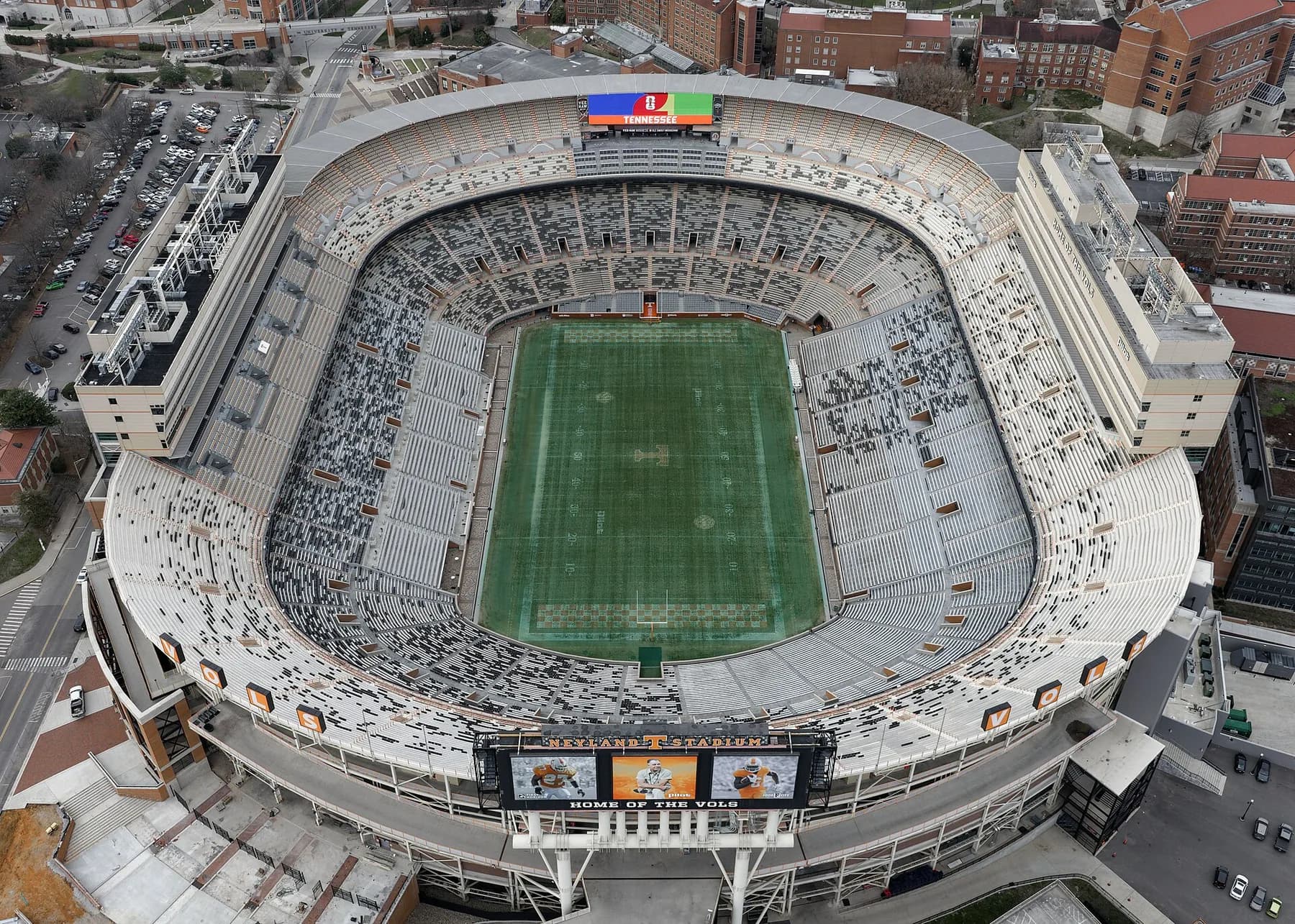
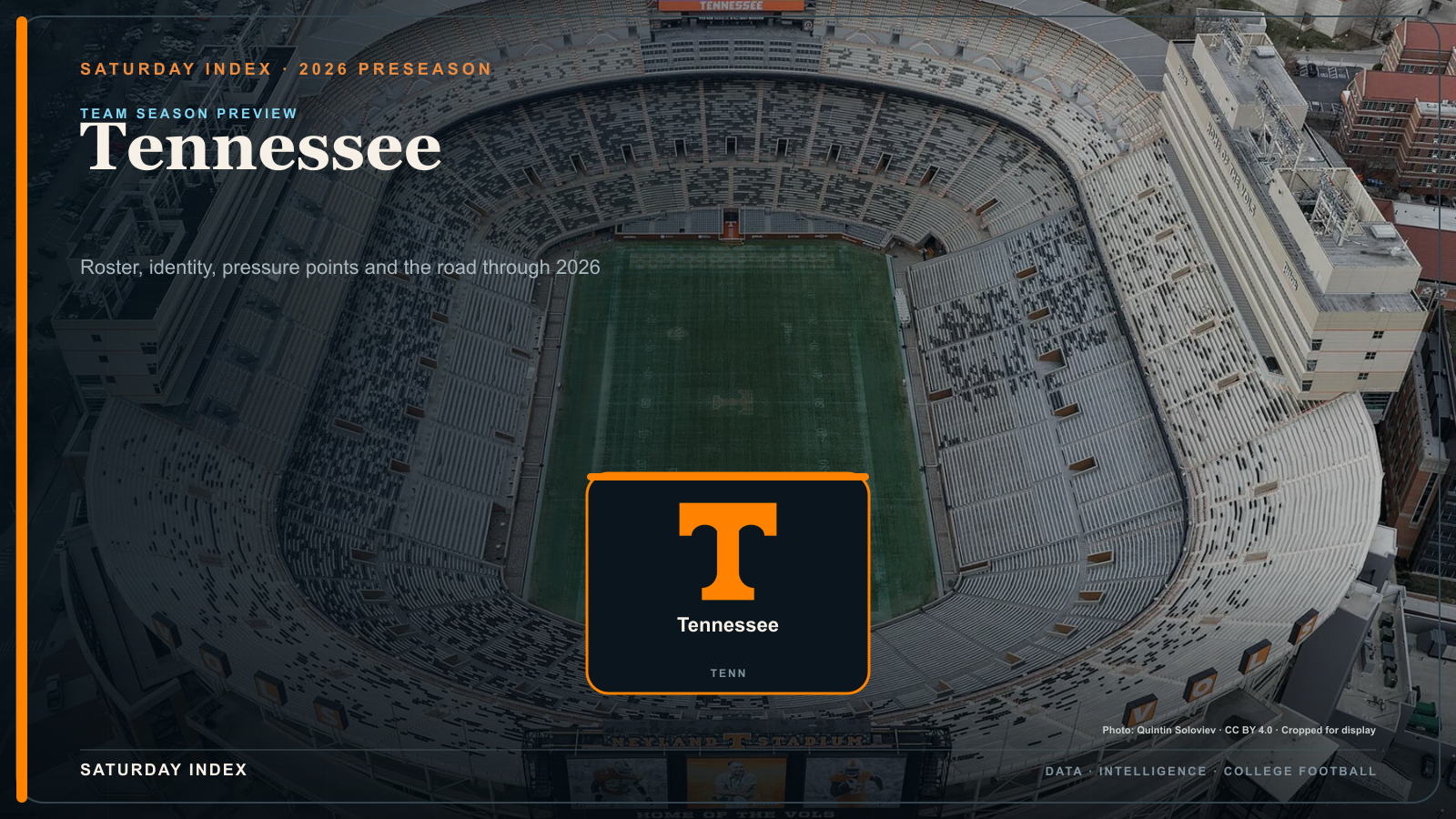
Photo: Quintin Soloviev · CC BY 4.0 · Cropped for display
Up next · Week 10
Home
Hosting
Saturday, November 7 · Time TBA
The season, taking shape
Final scores show Tennessee first. Oldest to newest.
vs. AuburnPregame 31–24
Game details at Arkansas
Pregame 32–20
Game details vs. Alabama
Pregame 22–30
Game detailsOriginal full-season forecast
This forecast retains the original probabilities for the full schedule. It does not update with completed results or this week’s forecast.
2026 results
Current record, team efficiency, player production, and verified results from completed games.
Current record
6-26 wins · 2 lossesThrough 8 completed gamesLoading player usage…
2026 season preview
Josh Heupel must develop a new quarterback while Jim Knowles installs a multiple defense ahead of Tennessee’s first nine-game SEC schedule.
Tennessee enters 2026 with Josh Heupel’s offensive identity intact, but the season’s shape depends on whether two major transitions settle quickly. The Volunteers entered August without a starting quarterback, while Jim Knowles is installing a multiple defense that asks players to communicate and adjust rather than live in one static coverage. Heupel has support around both projects. The question is whether that support can become reliable before Tennessee’s schedule begins applying real pressure.
Original season forecast
The original SEC forecast, retained alongside current results.
SEC projected standing
#7
5-4 projected · 5.2 expected conference wins · #7 of 16.
Preseason baseline
2025 percentiles retained as preseason context; current results and player production lead this page.
2025 FBS percentile scale · 50 is average
Incoming class
National and conference recruiting ranks, confirmed commitments, and the highest-ranked recruits in this class.
Top committed recruits
Tennessee2026 transfer movement
Incoming and outgoing transfer activity, with rated FBS-to-FBS moves below.
Incoming Transfers
TennesseeOutgoing Transfers
TennesseeSeason schedule
Completed games show final results. Upcoming games use this week’s forecast where available; later games retain their published season outlook.
Detailed football intelligence
The full team identity, offense, defense, and supporting evidence.
Team identity
Last season, Tennessee tried to stay balanced between the run and pass; the approach consistently kept the offense on schedule.
Why it matters
Neither offensive unit clearly carried the other, so first-down execution decides whether Tennessee can stay on plan.
 at South Carolina
Pregame 27–25
Game detailsPregame comparisons use preserved published forecasts. Results include wins and losses.
At a glance
Current form leads the outlook.
2026 rates aggregate verified completed-game box scores. EPA is expected points added per play.
| Player | C/ATT | YDS | TD | INT |
|---|---|---|---|---|
| George MacIntyre | 69/103 | 728 | 2 | 3 |
| Faizon Brandon | 61/101 | 697 | 7 | 1 |
| Ryan Staub | 3/3 | 27 | 0 | 0 |
| Player | CAR | YDS | AVG | TD |
|---|---|---|---|---|
| DeSean Bishop | 170 | 953 | 5.6 | 11 |
| Daune Morris | 61 | 349 | 5.7 | 2 |
| Faizon Brandon | 53 | 130 | 2.5 | 3 |
| Player | REC | YDS | AVG | TD |
|---|---|---|---|---|
| Mike Matthews | 34 | 528 | 15.5 | 3 |
| Braylon Staley | 32 | 259 | 8.1 | 2 |
| Dasaahn Brame | 14 | 181 | 12.9 | 0 |
| Player | TOT | SOLO | TFL | SACK |
|---|---|---|---|---|
| Amare Campbell | 52 | 31 | 8 | 3 |
| Arion Carter | 46 | 25 | 5 | 2 |
| TJ Metcalf | 45 | 24 | 0 | 0 |
Saturday, October 24 · Williams-Brice Stadium
Saturday, October 17 · Neyland Stadium
Saturday, October 10 · Razorback Stadium
George MacIntyre, true freshman Faizon Brandon and Colorado transfer Ryan Staub remained in the quarterback competition entering August. Joey Aguilar is not an option after a Tennessee judge denied his request for an injunction granting another season of eligibility, removing the productive 2025 starter from the picture. Heupel has said the winner must prove himself in front of teammates, a telling standard for the player charged with controlling tempo and making quick reads. Experience alone will not resolve the competition; trust and command must be earned.
Offensive coordinator Joey Halzle has defined the job through fast processing, assertive play and ball security. He cited MacIntyre’s improved urgency, Brandon’s college-ready frame and Staub’s passing feel as distinct strengths. That leaves Tennessee choosing among different developmental profiles, not an obvious incumbent. Whoever wins must preserve the offense’s vertical aggression without turning uncertainty into turnovers. Until one candidate does that in games, quarterback remains the clearest variable in Tennessee’s season.
The receiving corps gives the new quarterback a useful cushion. Receivers coach Kelsey Pope said Radarious Jackson and Travis Smith Jr. made substantial second-year gains in physical development and tempo, while Mike Matthews and Braylon Staley emerged as leaders. Freshman TK Keys impressed with his preparation. At tight end, Alec Abeln said Ethan Davis had answered earlier questions about in-line physicality and DaSaahn Brame had advanced as a blocker; Trent Thomas and Luca Wolf add depth. If those gains carry into the fall, Tennessee can help its quarterback with spacing, protection and sturdier run-game answers rather than asking him to carry the offense immediately.
Knowles inherits a defense with some built-in help. Assistants Anthony Poindexter, Andrew Jackson and Derek Jones have worked with him before, which should ease installation, but the coverage menu still requires players to master new calls and assignments. Linebacker may be the stabilizing room: returners Arion Carter, Edwin Spillman and Jeremiah Telander are joined by Penn State transfer Amare Campbell, whose previous season under Knowles gives teammates an on-field guide. Carter worked through an undisclosed injury in spring and remained engaged in preparation, according to William Inge, but his current clearance was not established entering August. His availability remains one of the defense’s most important unknowns.
The front and secondary will determine how adventurous Knowles can be. Jackson described speed from Chaz Coleman and power from Mariyon Dye and Tyree Weathersby at LEO, with Xavier Gilliam showing interior pass-rush ability in spring. Those differing body types create options, though rush-lane discipline still must develop. Behind them, Tennessee has rebuilt around returning safety Edrees Farooq and Freshman All-American corner Ty Redmond. Poindexter has stressed that the safeties make extensive calls, making communication and transfer integration central to avoiding coverage busts. On special teams, Cooper Ranvier made all three pressure kicks in the Orange & White Game, but Tennessee had not confirmed its kicking or punting roles entering fall.
The schedule gives Tennessee three September games to develop before conference play: Furman at home on September 5, a trip to Georgia Tech on September 12 and Kennesaw State at home on September 19. Texas visits Neyland Stadium on September 26 to open a nine-game SEC slate. Auburn, Alabama, Kentucky and LSU also come to Knoxville, while Tennessee travels to Arkansas, South Carolina, Texas A&M and Vanderbilt. The late run at Texas A&M, home against LSU and at Vanderbilt places a premium on depth and cohesion after the accumulated strain of the season.
That makes Tennessee’s 2026 case straightforward but unresolved. Heupel has promising support for an inexperienced quarterback, and Knowles has familiar coaches plus a deep linebacker group to anchor a complicated transition. Yet the most consequential answers remain unsettled: who commands the offense, whether Carter is available, how quickly the secondary communicates and who secures the specialist jobs. Tennessee’s ceiling will be shaped not by the number of new options, but by how quickly the Volunteers turn them into dependable roles before Texas arrives and the SEC schedule removes the margin for prolonged experimentation.
This preview is based on the linked public reporting and official program records.
Profile high point
Big-play prevention held the profile's highest percentile position.Profile low point
Down-to-down defense held the lowest percentile position among the profile's strength measures, not a below-average mark.



The offense's down-to-down consistency is what Tennessee can trust most.
What matters
Tennessee's offensive efficiency ranked among the best in the country last season.
Tennessee did not show one unit opponents could treat as an automatic target; the defense's control of ordinary downs is only the first place to look.
What matters
Tennessee's lowest-rated unit still finished near the national middle last season, so opponents do not have an obvious weakness to attack.
Tennessee is at its best when it can stay balanced between the run and pass, then keep both the pass and run available because neither part of the offense has to carry the plan alone; an average pace puts more weight on winning ordinary downs.
What matters
Tennessee's balanced structure played at a balanced pace. Passing finished top-tier and rushing finished top-tier, without a clear split between them.
Inside the team
Open a section for the football detail and supporting numbers.
The down-to-down question that determines whether the offense can keep both the run and pass available.
Opponents have to win first down before Tennessee can keep both answers available.
Why it matters
Putting Tennessee behind the chains limits the offense without requiring the defense to guess run or pass.
The pace, play selection, and methods this offense uses to stay on schedule.
Tennessee played at a balanced pace in 2025.
Why it matters
At that pace, Tennessee cannot count on extra possessions or expect to shorten the game.
Tennessee's prior passing record was top-tier.
Why it matters
A repeatable pass game can let Tennessee punish loaded boxes without relying on low-frequency deep completions.
Why it matters
A sustainable run game keeps Tennessee's play action credible and limits obvious passing situations.
Tennessee's explosive-play results were mixed rather than a defining edge.
Why it matters
A big play can still flip a possession, but last season's results do not make explosiveness something this team can rely on.
How consistently the offense creates manageable situations and the defense prevents them.
Tennessee's offense was more consistent down to down than its defense.
Why it matters
Tennessee's success rate shows whether it can sustain drives and get stops without relying on sacks, turnovers, or isolated big plays.
Tennessee's opponent-adjusted passing and rushing value were closely matched.
Why it matters
When the split is narrow, early-down execution matters more than steering the offense toward one obvious weakness.
Where the defense can create pressure, control the run, and end drives.
Tennessee's prior defense was middle-of-the-pack overall and strongest in disruption.
Why it matters
Opponents can test the fits early enough to keep every offensive option open; Tennessee needs its disruption to change protection and erase drives with negative plays before that plan settles in.
Why it matters
Sustained disruption can create negative plays and give Tennessee a better chance to end drives before third down.
Tennessee's disruption regularly finished at the quarterback.
What matters
Both sack production and front-seven disruption cleared the FBS midpoint.
Tennessee's prior run-defense results were weak.
Why it matters
If Tennessee's front cannot control early downs, opponents can keep every offensive option open and protect their passing game.