Week 4 · FinalL
 at UCF
13–21-8 margin
Pregame 27–24
Game detailsSaturday Index
Loading team intelligenceBringing the latest verified football information into focus.
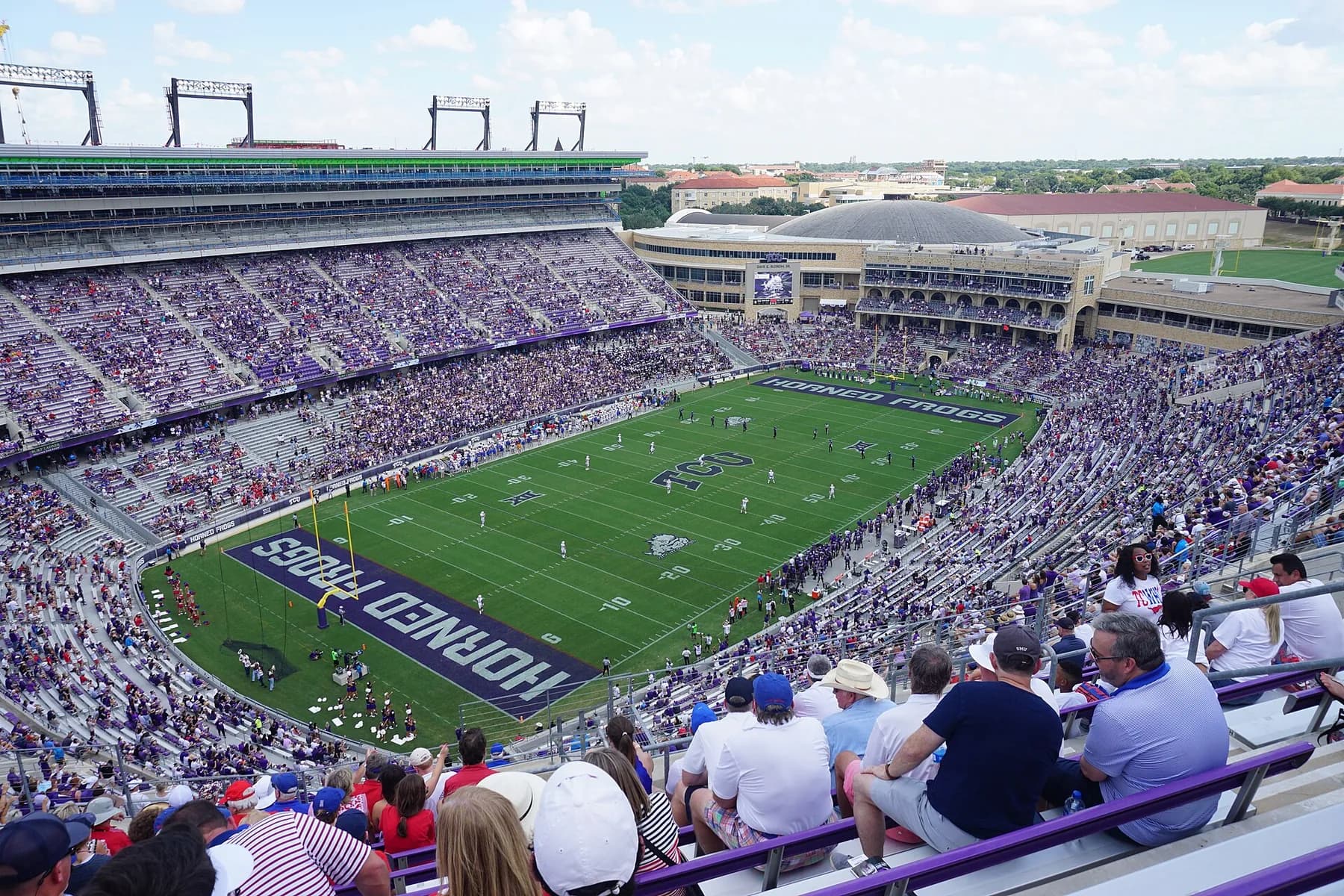
Big 12 · 2026 · Week 8
Photo: Michael Barera · CC BY-SA 4.0 · Cropped for display
Up next · Week 9
Home
Hosting
Saturday, October 31 · Time TBA
The season, taking shape
Final scores show TCU first. Oldest to newest.
at UCFPregame 27–24
Game details vs. BYU
Pregame 22–28
Game details at Baylor
Pregame 24–27
Game detailsOriginal full-season forecast
This forecast retains the original probabilities for the full schedule. It does not update with completed results or this week’s forecast.
2026 results
Current record, team efficiency, player production, and verified results from completed games.
Current record
3-43 wins · 4 lossesThrough 7 completed gamesLoading player usage…
2026 season preview
TCU’s 2026 season will turn on whether Sonny Dykes can make the offense less wasteful without stripping away its ability to create through the air. The Horned Frogs won nine games in 2025, yet averaged 3.92 yards per rush, ranked 14th in Big 12 rushing offense and threw a league-high 15 interceptions. Under offensive coordinators Gordon Sammis and A. J. Ricker, the intended correction is straightforward: run more efficiently, stay ahead of the chains and protect the ball. That would ease the quarterback transition and give Andy Avalos’ defense better circumstances.
Original season forecast
The original Big 12 forecast, retained alongside current results.
Big 12 projected standing
#9
4-5 projected · 3.9 expected conference wins · #9 of 16.
Preseason baseline
2025 percentiles retained as preseason context; current results and player production lead this page.
2025 FBS percentile scale · 50 is average
Incoming class
National and conference recruiting ranks, confirmed commitments, and the highest-ranked recruits in this class.
Top committed recruits
TCU2026 transfer movement
Incoming and outgoing transfer activity, with rated FBS-to-FBS moves below.
Incoming Transfers
TCUOutgoing Transfers
TCUSeason schedule
Completed games show final results. Upcoming games use this week’s forecast where available; later games retain their published season outlook.
Detailed football intelligence
The full team identity, offense, defense, and supporting evidence.
Team identity
Last season, TCU tried to lean on the passing game; the approach gave the offense a dependable starting point.
Why it matters
The passing game was TCU's more dependable way to stay ahead of the chains; opponents have to interrupt that rhythm without giving the run an easy box.
 vs. West Virginia
Pregame 34–21
Game detailsPregame comparisons use preserved published forecasts. Results include wins and losses.
At a glance
Current form leads the outlook.
2026 rates aggregate verified completed-game box scores. EPA is expected points added per play.
| Player | C/ATT | YDS | TD | INT |
|---|---|---|---|---|
| Jaden Craig | 141/211 | 1729 | 8 | 5 |
| Player | CAR | YDS | AVG | TD |
|---|---|---|---|---|
| Jeremy Payne | 64 | 343 | 5.4 | 1 |
| Jon Denman | 44 | 148 | 3.4 | 2 |
| Landon Walker | 8 | 57 | 7.1 | 0 |
| Player | REC | YDS | AVG | TD |
|---|---|---|---|---|
| Kari Ashley | 30 | 423 | 14.1 | 3 |
| Jordan Dwyer | 21 | 363 | 17.3 | 0 |
| Ed Small | 31 | 350 | 11.3 | 1 |
| Player | TOT | SOLO | TFL | SACK |
|---|---|---|---|---|
| Hudson Hooper | 34 | 21 | 2 | 0 |
| Jamel Johnson | 33 | 21 | 2.5 | 1 |
| Max Carroll | 25 | 11 | 1.5 | 0 |
Saturday, October 24 · Amon G. Carter Stadium
Saturday, October 17 · McLane Stadium
Saturday, October 3 · Amon G. Carter Stadium
Harvard graduate transfer Jaden Craig is positioned to replace Josh Hoover. Craig left Harvard with program records of 6,074 passing yards and 52 touchdown passes, with only 12 interceptions in 714 attempts. His experience and ball security fit an offense trying to reduce wasted possessions, although Big 12 pressure will present a different test. The current roster also includes redshirt freshmen Adam Schobel and David Potter and freshmen Jayden Maples and Jack Daulton. Those are developmental options, but the listed group does not provide an established veteran fallback if Craig struggles or becomes unavailable.
The most direct way to support Craig is to make Jeremy Payne central to the offense. Payne closed 2025 with consecutive 100-yard games and scored the winning touchdown in the Alamo Bowl, giving TCU a credible lead back for its efficiency push. Jon Denman is the most proven returning complement, though he missed spring practice while recovering from labrum surgery and was projected to return in the fall. Division II transfer Landon Walker offers another option, with his adjustment to Big 12 competition still ahead. The rotation’s depth will depend partly on Denman’s recovery and Walker’s transition.
Craig also inherits a proven primary target in Jordan Dwyer, who caught 54 passes for 730 yards and seven touchdowns in 2025. Major Everhart, sophomore Ed Small and transfer Jeremy Scott broaden the receiving group. Tight end requires a collective solution after the departure of DJ Rogers and his 34 catches: Kari Ashley, Ka’Morreun Pimpton, Lafayette Kaiuway and Mason Peterson offer different strengths, but none has been established as a complete replacement. Up front, veteran left tackle Ben Taylor-Whitfield and guard Cade Bennett anchor a deep group, with Cooper Powers projected at center. Dykes has described Taylor-Whitfield, who has more than 20 career starts and 1,800 snaps, as a potential all-conference and NFL-caliber tackle. Cohesion at right guard and right tackle remains a camp question.
Avalos expects TCU’s defensive front to improve in the third year of his build. Markis Deal and Ansel Din-Mbuh return inside, while Paul Oyewale supplies experience on the edge. Zach Chapman could strengthen that pairing after missing spring work; Avalos expected him to be back at full speed in June. Koron Hayward, John Schobel, CJ Woodfork and Cheta Ofili are among the alternatives if larger roles are required. At linebacker, Max Carroll is projected to move into the Mike role after appearing in every 2025 game as a reserve, with Virginia Tech and North Carolina transfer Michael Short projected beside him. Carroll’s continuity and Short’s experience must translate into reliable second-level play.
Safety Jamel Johnson gives Avalos a proven centerpiece. Johnson led TCU with five interceptions, ranked second on the team with 96 tackles and earned the program’s only place on the preseason All-Big 12 team. His communication and takeaway ability matter even more while responsibilities are settled around him. Jordan Lester and Louisiana Tech transfer Jacob Fields competed at field safety in the spring, while Julius Simms and LSU transfer Kylin Jackson remained in contention at nickel. Because both positions carry important coverage and run-fit duties, their resolution will shape the defense’s consistency.
The schedule will test TCU’s progress in stages. The Horned Frogs open against North Carolina at Aviva Stadium on Aug. 29, then host Grambling and Arkansas State before visiting UCF and hosting BYU. October brings a trip to Baylor followed by home games against West Virginia and Kansas. The closing stretch raises the pressure: TCU visits Arizona, hosts Kansas State and Utah, then finishes at Texas Tech. By then, the Horned Frogs will need more than a capable first unit. Developed depth, settled communication and an offense that avoids self-created trouble will be essential.
TCU’s case for progress begins with Craig’s history of ball security, Payne’s strong finish, Dwyer’s production, Taylor-Whitfield’s experience and Johnson’s playmaking. The swing factors are equally clear: Craig’s move from Ivy League competition, Denman’s and Chapman’s recoveries, the right side of the offensive line, the tight-end rotation and new combinations at linebacker and in the secondary. No firm prediction is warranted, but the standard for Dykes’ team is identifiable. TCU must turn efficiency from an offseason priority into an every-week identity.
This preview is based on the linked public reporting and official program records.
Profile high point
Passing held the profile's highest percentile position.Profile low point
The run game held the lowest percentile position among the profile's strength measures.



The passing game is what TCU can trust most.
Why it matters
The opening plan has its best answer when opponents crowd the box or force obvious throwing situations; rushing structure remains the first counter an opponent should test.
The first place to test TCU is the run game, especially on ordinary early downs; the passing game has to keep the game on plan.
What matters
TCU's rushing structure ranked in the lower national range last season.
TCU's best path is to use the passing game to stay on schedule and finish drives; extra possessions give that plan time to build.
What matters
TCU's pass-leaning structure played at a fast pace. The pass game finished top-tier, while the run game finished weak.
Inside the team
Open a section for the football detail and supporting numbers.
The down-to-down question that determines whether the offense can keep both the run and pass available.
Opponents have to break TCU's passing rhythm before it owns early downs.
Why it matters
If TCU keeps finding routine completions, the defense cannot load the box or turn the rush loose.
The pace, play selection, and methods this offense uses to stay on schedule.
TCU played at a fast pace in 2025.
Why it matters
More possessions give TCU's strengths additional chances to build, but they also leave more time to recover from mistakes.
TCU's prior passing record was top-tier.
Why it matters
A repeatable pass game can let TCU punish loaded boxes without relying on low-frequency deep completions.
TCU's prior rushing record was weak.
Why it matters
When TCU's run game cannot stay on schedule, protection and passing-down execution carry more of the offense.
TCU's explosive-play upside came with real defensive volatility.
Why it matters
That mix can produce fast scoring swings in either direction and makes missed tackles or coverage busts especially expensive.
How consistently the offense creates manageable situations and the defense prevents them.
TCU won ordinary downs on both sides of the ball.
Why it matters
TCU's success rate shows whether it can sustain drives and get stops without relying on sacks, turnovers, or isolated big plays.
Opponent-adjusted EPA identifies the pass game as TCU's stronger offensive unit.
Why it matters
If an opponent removes the first passing answer, the run game's lower adjusted value becomes the key counter to test.
Where the defense can create pressure, control the run, and end drives.
TCU's prior defense was middle-of-the-pack overall and strongest in run front.
Why it matters
Opponents can use efficient throws to stay out of obvious passing downs; TCU needs its run front to create long-yardage without overloading the box before that plan settles in.
TCU's available disruption measures finished below the national average last season; a charted pressure rate is not available.
Why it matters
Without consistent disruption, TCU's defense must win more snaps through coverage, leverage, and early-down prevention.
TCU's sack and disruption results were below-average.
Why it matters
TCU's disruption can hurry an offense; sacks do more by erasing field position and ending passing downs.
TCU's prior run-defense results were strong.
Why it matters
A dependable run front can let TCU create obvious passing downs without committing extra bodies to the box.