
Week 4 · FinalL
 at Alabama
18–49-31 margin
Pregame 24–32
Game detailsSaturday Index
Loading team intelligenceBringing the latest verified football information into focus.
SEC · 2026 · Week 8

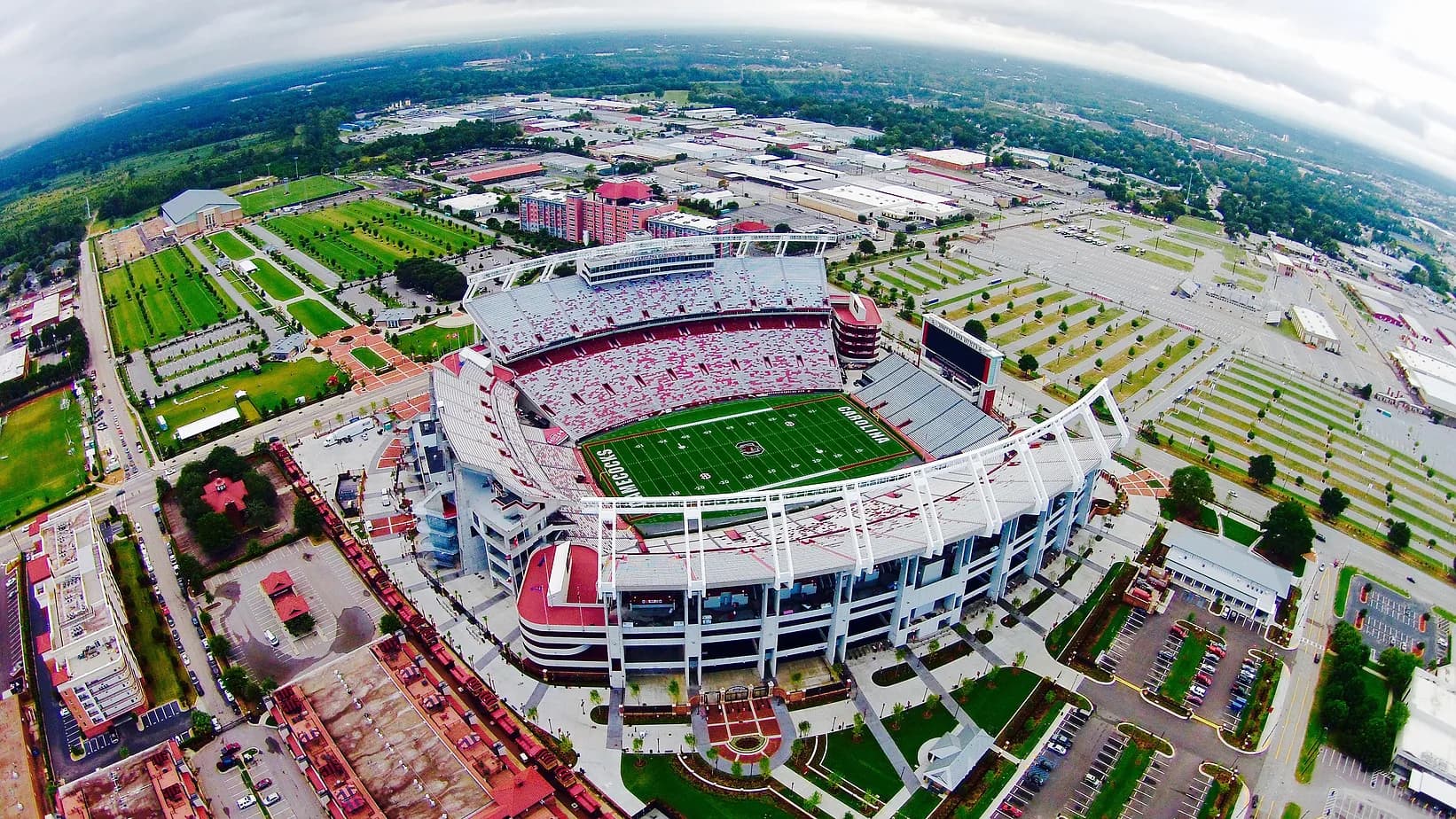
Photo: Eisenthesky Productions · CC BY-SA 4.0 · Cropped for display
Up next · Week 9
Away
On the road at
Saturday, October 31 · Time TBA
The season, taking shape
Final scores show South Carolina first. Oldest to newest.
at AlabamaPregame 24–32
Game details vs. Kentucky
Pregame 32–22
Game details at Florida
Pregame 27–29
Original full-season forecast
This forecast retains the original probabilities for the full schedule. It does not update with completed results or this week’s forecast.
2026 results
Current record, team efficiency, player production, and verified results from completed games.
Current record
4-34 wins · 3 lossesThrough 7 completed gamesLoading player usage…
2026 season preview
South Carolina enters 2026 with three recognizable centerpieces and one overriding question: Can Shane Beamer’s broad reset give them enough support before the schedule hardens? Quarterback LaNorris Sellers, receiver Nyck Harbor and edge Dylan Stewart anchor a roster returning 12 starters, but the Gamecocks also brought in 25 transfers and overhauled much of the offensive staff. In Beamer’s sixth year, the season is less about finding star power than making the pieces around it function together. SEC media’s 11th-place projection captures that tension without determining what the team can become.
Original season forecast
The original SEC forecast, retained alongside current results.
SEC projected standing
#8
5-4 projected · 5.1 expected conference wins · #8 of 16.
Preseason baseline
2025 percentiles retained as preseason context; current results and player production lead this page.
2025 FBS percentile scale · 50 is average
Incoming class
National and conference recruiting ranks, confirmed commitments, and the highest-ranked recruits in this class.
Top committed recruits
South Carolina2026 transfer movement
Incoming and outgoing transfer activity, with rated FBS-to-FBS moves below.
Incoming Transfers
South CarolinaOutgoing Transfers
South CarolinaSeason schedule
Completed games show final results. Upcoming games use this week’s forecast where available; later games retain their published season outlook.
Detailed football intelligence
The full team identity, offense, defense, and supporting evidence.
Team identity
Last season, South Carolina tried to stay balanced between the run and pass; it rarely provided an easy foundation.
Why it matters
The run game was South Carolina's less difficult offensive option, but it did not reliably keep the offense on schedule; the offense must prove it can create movement before opponents have to commit extra help.
 vs. Tennessee
Pregame 25–27
Game detailsPregame comparisons use preserved published forecasts. Results include wins and losses.
At a glance
Current form leads the outlook.
2026 rates aggregate verified completed-game box scores. EPA is expected points added per play.
| Player | C/ATT | YDS | TD | INT |
|---|---|---|---|---|
| Lanorris Sellers | 133/219 | 1548 | 13 | 5 |
| Cutter Woods | 9/14 | 92 | 1 | 0 |
| Lucian Anderson III | 2/2 | 24 | 0 | 0 |
| Player | CAR | YDS | AVG | TD |
|---|---|---|---|---|
| Matthew Fuller | 90 | 513 | 5.7 | 5 |
| Lanorris Sellers | 85 | 507 | 6.0 | 4 |
| Jabree Coleman | 31 | 222 | 7.2 | 4 |
| Player | REC | YDS | AVG | TD |
|---|---|---|---|---|
| Mazeo Bennett | 31 | 324 | 10.5 | 3 |
| Nyck Harbor | 17 | 278 | 16.4 | 2 |
| DJ Black | 14 | 246 | 17.6 | 1 |
| Player | TOT | SOLO | TFL | SACK |
|---|---|---|---|---|
| Justin Okoronkwo | 53 | 31 | 2.5 | 0 |
| Fred Johnson | 48 | 24 | 3 | 0.5 |
| Peyton Williams | 40 | 28 | 1 | 0 |
Saturday, October 24 · Williams-Brice Stadium
Saturday, October 10 · Ben Hill Griffin Stadium
Saturday, October 3 · Williams-Brice Stadium
Beamer did not respond to the 2025 offensive collapse with a minor adjustment. He hired Kendal Briles as coordinator and quarterbacks coach, Randy Clements to coach the offensive line and Stan Drayton to lead the running backs. Deion Barnes joined the defensive edge staff, and Matthew Smiley took over special teams. The scale of the changes makes this a technical and schematic reset, one intended to address protection, the running game and offensive structure together. Beamer’s central challenge is turning extensive change into dependable execution without wasting the continuity provided by his best players.
That starts with Sellers. South Carolina has built its preseason identity around a proven quarterback whose partnership with Harbor gives Briles an obvious foundation. Harbor caught 30 passes for 618 yards and six touchdowns in 2025, averaged 20.6 yards per reception and scored in each of the final five games. He is the clearest explosive-play lever on the offense, capable of stretching coverage and creating space elsewhere. The next step is collective: Sellers needs enough protection and complementary production for the offense to function when defenses devote extra attention to Harbor.
No position room matters more to that plan than the offensive line. South Carolina added eight transfer linemen, six of them redshirt seniors, and reported 8,797 combined career snaps in the group. That experience directly targets a unit that has constrained the offense for multiple seasons, but experience acquired in different systems still must become cohesion. Left tackle carries particular importance after Peak missed spring with an injury and freshman Darius Gray was not scheduled to enroll until summer. Their lost installation time left a consequential protection question for camp rather than settling it in spring.
The running backs present a different version of the same challenge: options are plentiful, but roles still need definition. Returners Jawarn Howell, Isaiah Augustave and Matt Fuller competed in spring alongside transfers Christian Clark, Sam Dixon and Jabree Coleman. A committee could let Briles and Drayton combine complementary traits rather than force an early featured-back designation. Dixon and Coleman wore non-contact jerseys during the March 31 open period, although nothing established that either would miss fall action. At receiver, coach Mike Furrey described a more experienced and connected group, but the season will reveal who can consistently complement Harbor.
Stewart gives the defense its own organizing force. He recorded 33 tackles, 12 tackles for loss, 4.5 sacks, eight quarterback hurries and three forced fumbles in 2025 before receiving first-team preseason All-SEC recognition. Those numbers show why his influence extends beyond sacks: offenses must account for his ability to disrupt the backfield, which can alter protections and create opportunities for teammates. South Carolina supplemented the defensive tackle and edge groups through the portal, and coordinators Torrian Gray and Clayton White now must build a dependable rotation around Stewart’s proven pressure.
The schedule gives the rebuild a short runway, then applies pressure almost continuously. Home games against Kent State and Towson precede the SEC opener against Mississippi State on September 19. South Carolina then visits Alabama, hosts Kentucky and travels to Florida before the October 17 bye. That four-game conference sequence should show whether the new offense and rebuilt line can hold up against league competition. The closing stretch is harsher: Tennessee, Oklahoma, Texas A&M, Arkansas, Georgia and Clemson in six consecutive weeks. Three of those games are on the road, making depth and cohesion as important as top-end talent.
South Carolina’s case for progress rests on Sellers directing a more functional offense, Harbor continuing to stretch defenses and Stewart forcing opponents to account for him on every passing down. Its larger test is whether Beamer’s rebuilt staff can turn older linemen, a crowded backfield and a transfer-heavy supporting cast into connected units. The Gamecocks do not need to discover their defining players; they need to make the structure around those players reliable. With an early SEC proving ground and an unforgiving finish, that work cannot remain unfinished for long.
This preview is based on the linked public reporting and official program records.
Profile high point
Big-play creation held the profile's highest percentile position.Profile low point
Passing held the lowest percentile position among the profile's strength measures.



Big-play creation is what South Carolina can trust most.
Why it matters
The offense has its best route to changing field position without requiring flawless drive efficiency; passing efficiency remains the first counter an opponent should test.
The passing game is South Carolina's biggest concern, and opponents can test it immediately.
Why it matters
Opponents can crowd early downs and make the pass game carry obvious throwing situations; explosive-play creation has to keep that stress from setting the game plan.
South Carolina's best path is to stay balanced between the run and pass, then let the run game finish drives; an average pace puts more weight on winning ordinary downs.
Why it matters
South Carolina's clean script is to stay ahead with early-down runs, draw an extra defender into the box, and then use play action; defenses will try to force obvious passing downs. At an average pace, winning ordinary downs matters more than chasing extra possessions.
Inside the team
Open a section for the football detail and supporting numbers.
The down-to-down question that determines whether the offense can keep both the run and pass available.
Before defenses have to commit extra help, South Carolina must prove the run can create manageable second downs.
What matters
Last season's rushing results did not establish dependable movement or a steady play-action foundation.
The pace, play selection, and methods this offense uses to stay on schedule.
South Carolina played at a balanced pace in 2025.
Why it matters
At that pace, South Carolina cannot count on extra possessions or expect to shorten the game.
South Carolina's prior passing record was bottom-tier.
Why it matters
South Carolina's offense needs protection, field position, or explosive variance when ordinary dropbacks do not create enough value.
South Carolina's prior rushing record was below-average.
Why it matters
When South Carolina's run game cannot stay on schedule, protection and passing-down execution carry more of the offense.
South Carolina both created and limited explosive plays at a strong prior-season level.
Why it matters
That combination can change a game without forcing the offense to trade efficiency for low-percentage shots.
How consistently the offense creates manageable situations and the defense prevents them.
South Carolina's defense was more consistent down to down than its offense.
Why it matters
South Carolina's success rate shows whether it can sustain drives and get stops without relying on sacks, turnovers, or isolated big plays.
Opponent-adjusted EPA identifies the run game as South Carolina's stronger offensive unit.
Why it matters
Forcing longer passing situations is the clearest way to move the offense away from its stronger adjusted unit.
Where the defense can create pressure, control the run, and end drives.
South Carolina's prior defense was above-average overall and strongest in run front.
Why it matters
Opponents can use efficient throws to stay out of obvious passing downs; South Carolina needs its run front to create long-yardage without overloading the box before that plan settles in.
South Carolina's available disruption measures finished above the national average last season; a charted pressure rate is not available.
South Carolina created disruption more consistently than it finished sacks.
Why it matters
South Carolina's disruption can hurry an offense; sacks do more by erasing field position and ending passing downs.
South Carolina's prior run-defense results were top-tier.
Why it matters
A dependable run front can let South Carolina create obvious passing downs without committing extra bodies to the box.