Week 4 · FinalW
vs. Howard
58–7+51 margin
Pregame comparison unavailable
Game detailsSaturday Index
Loading team intelligenceBringing the latest verified football information into focus.
Big Ten · 2026 · Week 8

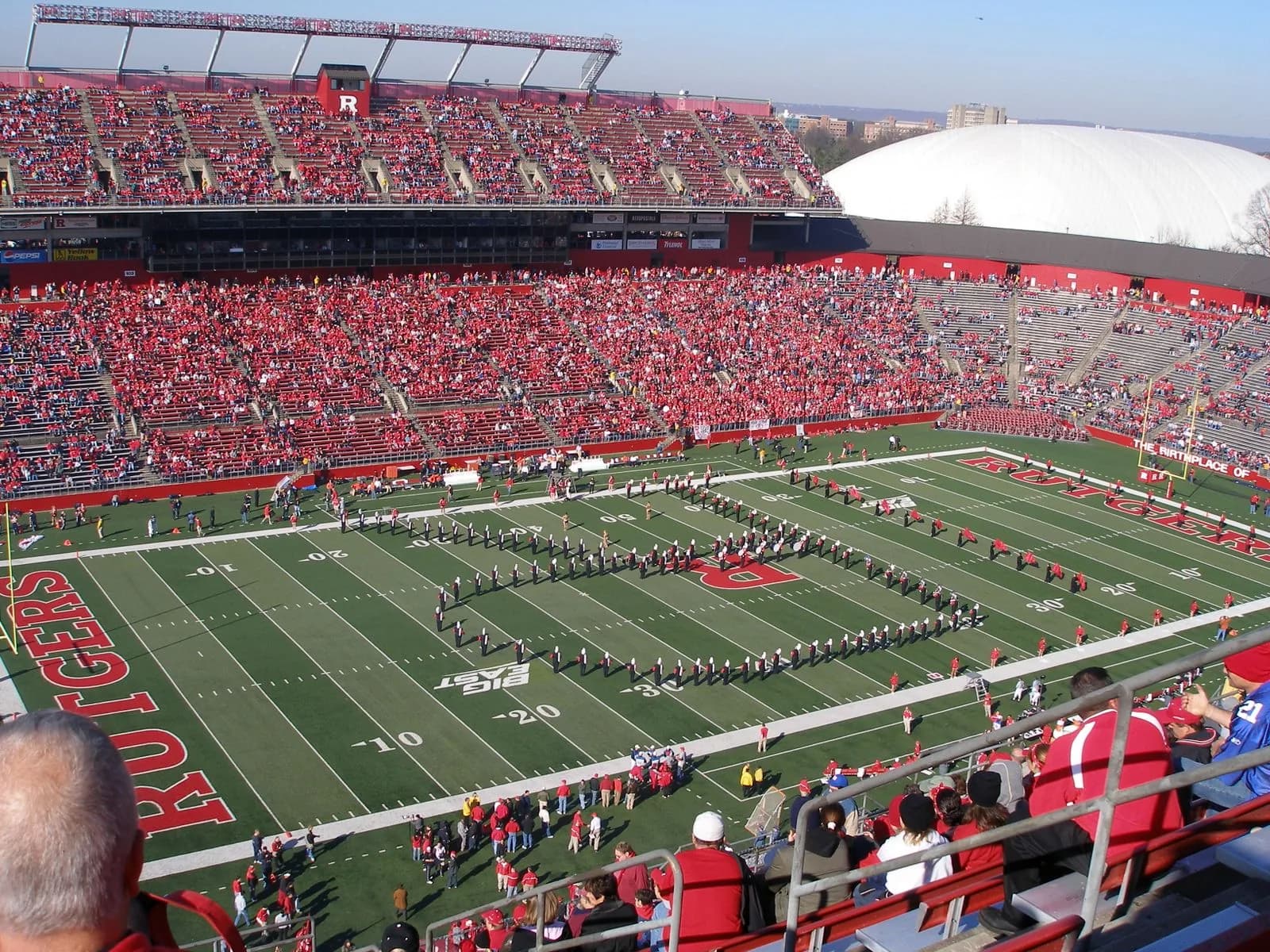
Photo: Gary Miotla · CC BY 3.0 · Cropped for display
Up next · Week 9
Home
Hosting
Saturday, October 31 · Time TBA
The season, taking shape
Final scores show Rutgers first. Oldest to newest.
Pregame comparison unavailable
Game details vs. Indiana
Pregame 18–36
Game details at Maryland
Pregame 26–29
Game detailsOriginal full-season forecast
This forecast retains the original probabilities for the full schedule. It does not update with completed results or this week’s forecast.
2026 results
Current record, team efficiency, player production, and verified results from completed games.
Current record
2-52 wins · 5 lossesThrough 7 completed gamesLoading player usage…
2026 season preview
Rutgers enters 2026 with a clear offensive identity despite an unsettled quarterback job. The Scarlet Knights can build around two of the Big Ten’s most accomplished returning skill players and an offense coming off its best production since the program joined the conference. Greg Schiano’s central task is turning that continuity into stability while a new passer and a different defensive structure take hold.
Schiano enters his 18th season at Rutgers with Kirk Ciarrocca still coordinating the offense, while Travis Johansen takes over the defense and Eddie Allen assumes responsibility for special teams. Schiano has said closer alignment among university and athletic leadership allows him to spend less time raising NIL money and more time coaching and developing players. Whether that change produces an immediate competitive benefit remains uncertain, but it gives Schiano more opportunity to concentrate on the football questions that will define this team.
Original season forecast
The original Big Ten forecast, retained alongside current results.
Big Ten projected standing
#15
3-6 projected · 3.3 expected conference wins · #15 of 18.
Preseason baseline
2025 percentiles retained as preseason context; current results and player production lead this page.
2025 FBS percentile scale · 50 is average
Incoming class
National and conference recruiting ranks, confirmed commitments, and the highest-ranked recruits in this class.
Top committed recruits
Rutgers2026 transfer movement
Incoming and outgoing transfer activity, with rated FBS-to-FBS moves below.
Incoming Transfers
RutgersOutgoing Transfers
RutgersSeason schedule
Completed games show final results. Upcoming games use this week’s forecast where available; later games retain their published season outlook.
Detailed football intelligence
The full team identity, offense, defense, and supporting evidence.
Team identity
Last season, Rutgers tried to stay balanced between the run and pass; the approach consistently kept the offense on schedule.
Why it matters
The passing game was Rutgers's more dependable way to stay ahead of the chains; opponents have to interrupt that rhythm without giving the run an easy box.
 at Northwestern
Pregame 21–34
Pregame comparisons use preserved published forecasts. Results include wins and losses.
At a glance
Current form leads the outlook.
2026 rates aggregate verified completed-game box scores. EPA is expected points added per play.
| Player | C/ATT | YDS | TD | INT |
|---|---|---|---|---|
| Dylan Lonergan | 74/127 | 1066 | 10 | 6 |
| AJ Surace | 40/71 | 539 | 6 | 5 |
| Sean Ashenfelder | 3/10 | 50 | 0 | 1 |
| Player | CAR | YDS | AVG | TD |
|---|---|---|---|---|
| Antwan Raymond | 123 | 648 | 5.3 | 6 |
| Clay Thevenin | 73 | 405 | 5.5 | 4 |
| Dylan Lonergan | 22 | 49 | 2.2 | 0 |
| Player | REC | YDS | AVG | TD |
|---|---|---|---|---|
| KJ Duff | 45 | 774 | 17.2 | 9 |
| Ben Black | 10 | 195 | 19.5 | 2 |
| Jourdin Houston | 17 | 184 | 10.8 | 0 |
| Player | TOT | SOLO | TFL | SACK |
|---|---|---|---|---|
| Chris Joines | 33 | 18 | 0 | 0 |
| Bradlee Jones | 31 | 19 | 2.5 | 0 |
| Jessie Ofurie | 30 | 14 | 2.5 | 0 |
Saturday, October 24 · Ryan Field
Saturday, October 17 · SECU Stadium
Saturday, October 3 · SHI Stadium
The offense supplies the strongest starting point. Rutgers averaged 407.1 yards per game in 2025, its highest mark since joining the Big Ten, and produced a 3,000-yard passer, a 1,000-yard rusher and a 1,000-yard receiver for only the second time in program history. With Ciarrocca remaining in charge, Rutgers does not need to reconstruct its approach. It needs to preserve the balance and explosiveness of 2025 while replacing drafted starting quarterback Athan Kaliakmanis.
Running back Antwan Raymond and receiver KJ Duff can ease that transition. Raymond rushed for 1,241 yards in 2025, ranked third in the Big Ten and scored 15 total touchdowns. Duff caught 60 passes for 1,084 yards and seven touchdowns, while his 90.3 receiving yards per game also ranked third in the conference. PFF charting cited by Rutgers credited Duff with a national-best 22 contested catches. Both players were among the Big Ten media vote’s 12 preseason honorees. Raymond can command defensive attention near the line of scrimmage; Duff can punish that attention downfield and give an inexperienced starter room for error on difficult throws.
Rutgers lists Boston College transfer Dylan Lonergan at quarterback, but the program has not publicly named its 2026 starter. Whoever wins the job will inherit proven playmakers and an experienced interior blocker in right guard Kwabena Asamoah. He started every game in 2025, owns 25 consecutive starts at the position and, according to Rutgers, earned second-team All-America recognition from ESPN. His presence should support Raymond’s workload and help protect the new quarterback, although the composition of the rest of the offensive line remains unsettled.
The defensive transition carries a different kind of uncertainty. Schiano said Johansen’s unit will mix structures according to its personnel rather than remain exclusively in nickel or a 3-4. That flexibility could help Rutgers tailor its front to varied Big Ten offenses, but only if players communicate cleanly and handle changing assignments. Transfers J’Dan Burnett and Malachi Davis give the line an experienced starting point: Together they have played 70 college games and produced 33 tackles for loss and 19.5 sacks. Each earned all-conference recognition in 2025 before joining Rutgers. Their ability to create disruption will be central to making Johansen’s multiplicity functional rather than merely ambitious.
The schedule does not offer a long installation period. Rutgers opens at home against UMass, visits Boston College and then hosts USC in Week 3. Howard follows before reigning national champion Indiana visits ahead of the first open week. UMass and Howard give the Scarlet Knights opportunities to establish their approach, but the trips and matchups around them mean quarterback play, defensive communication and special-teams execution will face meaningful tests early.
After the open week, Rutgers visits Maryland and Northwestern before a demanding finish: Michigan at home, Wisconsin on the road, Nebraska at home, Penn State away and Michigan State at home. That closing sequence leaves limited room for a slow start. The Maryland-Northwestern stretch could become especially consequential because it precedes five games that include two difficult road trips and several prominent Big Ten opponents.
Several roles still have to take shape. Rutgers has not publicly settled the receiving hierarchy behind Duff, its tight-end role, Raymond’s primary backup, Johansen’s linebacker and secondary rotations, or Allen’s kicking, punting and return assignments. A roster listing also does not establish a player’s health or game-day availability. Schiano has called this the deepest and most talented roster of his second Rutgers tenure, but that remains a preseason assessment. Rutgers has credible strengths in Raymond, Duff, Asamoah and its transfer defensive linemen; how quickly the unsettled rooms become dependable will determine whether those strengths survive the schedule’s pressure points.
This preview is based on the linked public reporting and official program records.
Profile high point
Passing held the profile's highest percentile position.Profile low point
Down-to-down defense held the lowest percentile position among the profile's strength measures.



The offense's down-to-down consistency is what Rutgers can trust most.
What matters
Rutgers's offensive efficiency ranked in a strong national range last season.
The defense's control of ordinary downs is Rutgers's biggest concern, and opponents can test it immediately.
What matters
Rutgers's defensive control ranked near the bottom nationally last season.
Rutgers's best path is to stay balanced between the run and pass, then let the passing game finish drives; an average pace puts more weight on winning ordinary downs.
Why it matters
Rutgers's clean script uses efficient early throws to stay ahead of the sticks; defenses will attack protection and route timing before the full passing menu opens. At an average pace, winning ordinary downs matters more than chasing extra possessions.
Inside the team
Open a section for the football detail and supporting numbers.
The down-to-down question that determines whether the offense can keep both the run and pass available.
Opponents have to break Rutgers's passing rhythm before it owns early downs.
Why it matters
If Rutgers keeps finding routine completions, the defense cannot load the box or turn the rush loose.
The pace, play selection, and methods this offense uses to stay on schedule.
Rutgers played at a balanced pace in 2025.
Why it matters
At that pace, Rutgers cannot count on extra possessions or expect to shorten the game.
Rutgers's prior passing record was strong.
Why it matters
A repeatable pass game can let Rutgers punish loaded boxes without relying on low-frequency deep completions.
Rutgers's prior rushing record was above-average.
Why it matters
When Rutgers's run game cannot stay on schedule, protection and passing-down execution carry more of the offense.
Explosive plays were a two-way concern in Rutgers's record last season.
Why it matters
That combination increases dependence on sustained drives while leaving little margin for a missed fit or coverage error.
How consistently the offense creates manageable situations and the defense prevents them.
Rutgers's offense was more consistent down to down than its defense.
Why it matters
Rutgers's success rate shows whether it can sustain drives and get stops without relying on sacks, turnovers, or isolated big plays.
Opponent-adjusted EPA identifies the pass game as Rutgers's stronger offensive unit.
Why it matters
If an opponent removes the first passing answer, the run game's lower adjusted value becomes the key counter to test.
Where the defense can create pressure, control the run, and end drives.
Rutgers's prior defense was bottom-tier overall, with no clear separation among its main units.
Why it matters
An offense can keep both the run and pass available and test each unit until the defense proves it can win ordinary early downs.
Why it matters
Without consistent disruption, Rutgers's defense must win more snaps through coverage, leverage, and early-down prevention.
Rutgers's sack and disruption results were bottom-tier.
Why it matters
Rutgers's disruption can hurry an offense; sacks do more by erasing field position and ending passing downs.
Rutgers's prior run-defense results were bottom-tier.
Why it matters
If Rutgers's front cannot control early downs, opponents can keep every offensive option open and protect their passing game.