Week 4 · FinalL
 vs. Notre Dame
10–49-39 margin
Pregame 13–43
Game detailsSaturday Index
Loading team intelligenceBringing the latest verified football information into focus.
Big Ten · 2026 · Week 8

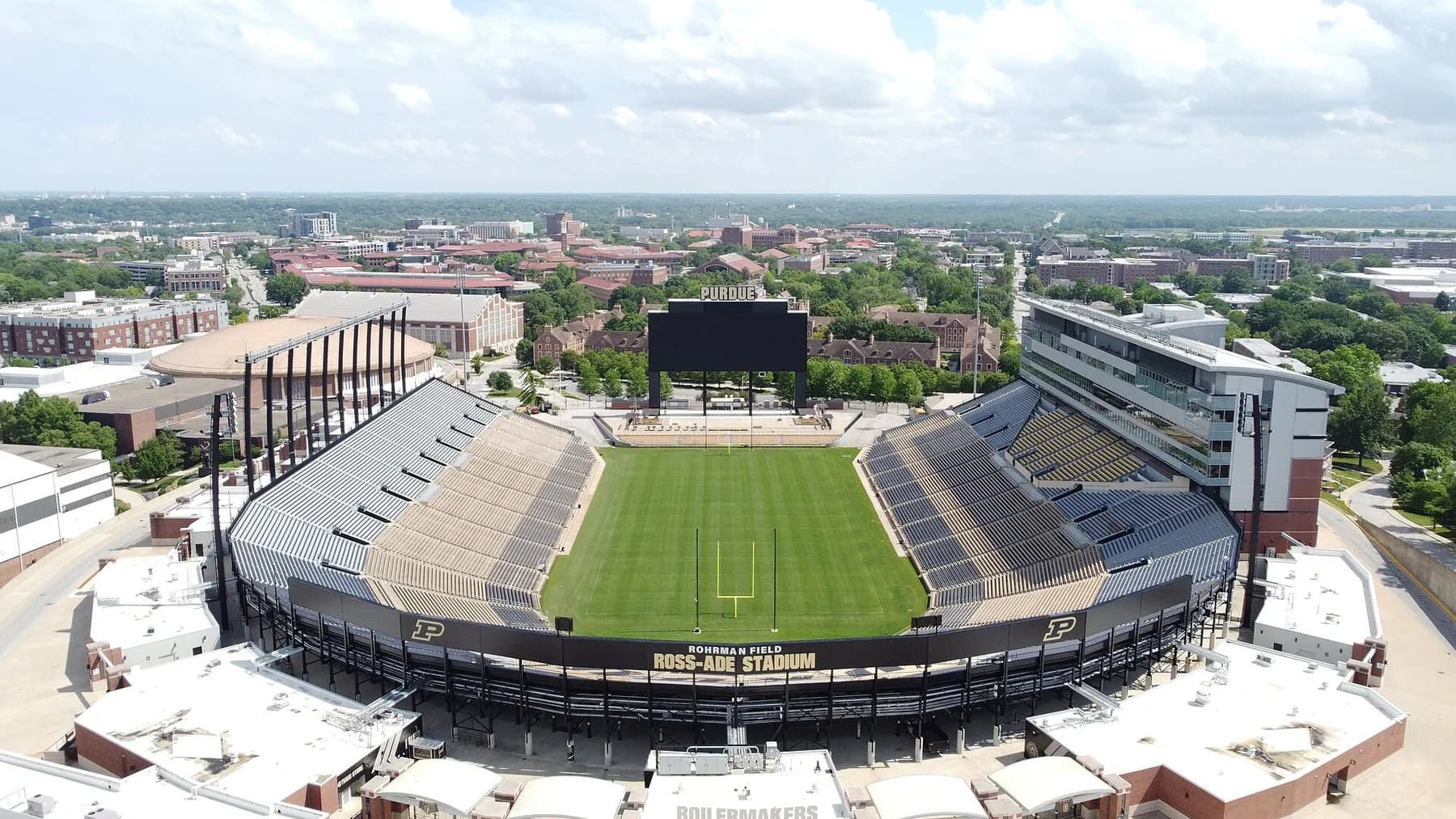
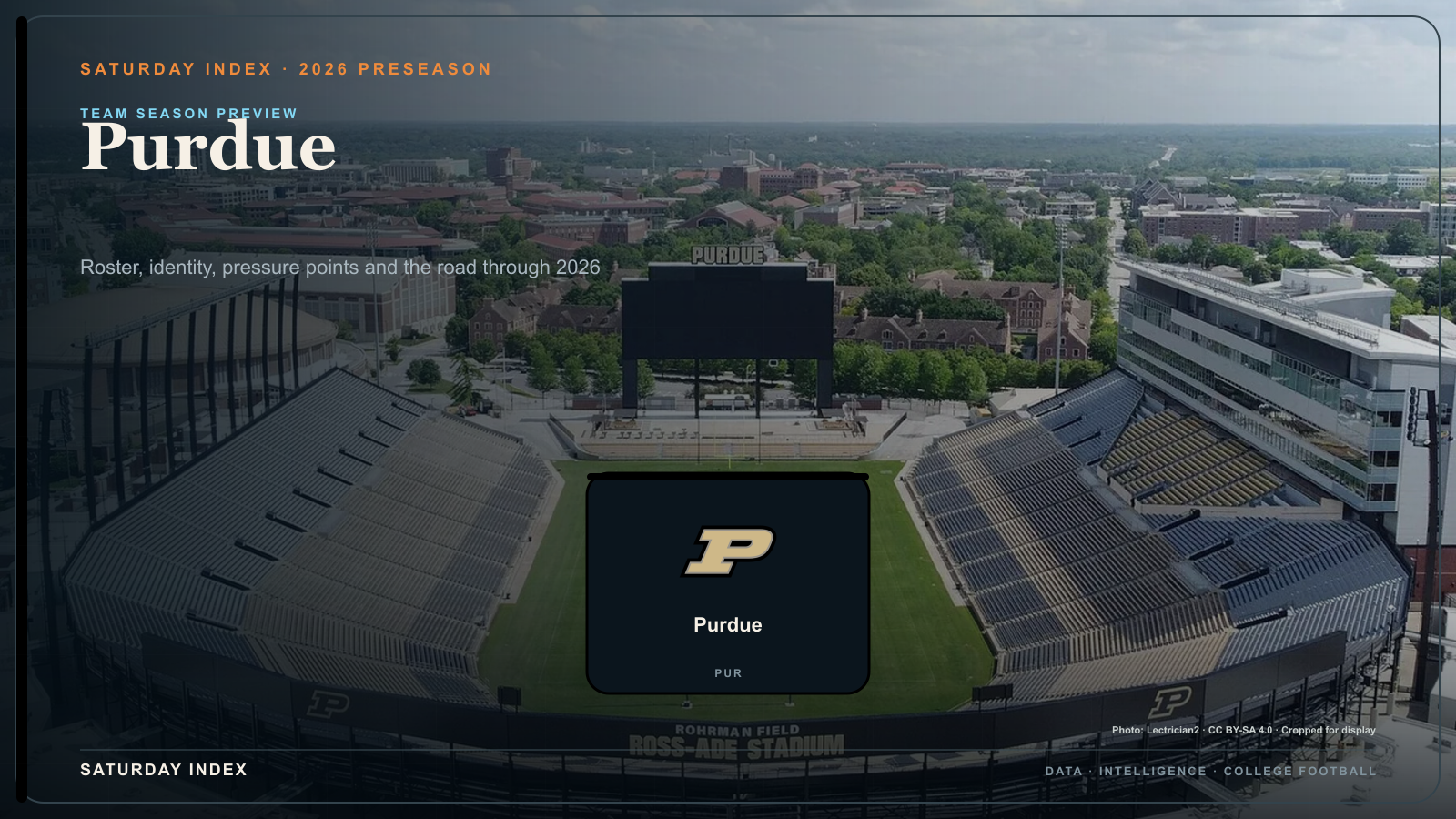
Photo: Lectrician2 · CC BY-SA 4.0 · Cropped for display
Up next · Week 9
Away
On the road at
Saturday, October 31 · Time TBA
The season, taking shape
Final scores show Purdue first. Oldest to newest.
vs. Notre DamePregame 13–43
Game details at Illinois
Pregame 23–35
Game details vs. Minnesota
Pregame comparison unavailable
Game detailsOriginal full-season forecast
This forecast retains the original probabilities for the full schedule. It does not update with completed results or this week’s forecast.
2026 results
Current record, team efficiency, player production, and verified results from completed games.
Current record
3-43 wins · 4 lossesThrough 7 completed gamesLoading player usage…
2026 season preview
Barry Odom’s second Purdue team will be defined by how quickly change becomes cohesion. Purdue opened spring with 66 returners and 54 newcomers, 47 already participating, after adding 32 players through the portal. Odom said the group was bigger, faster and more explosive than at the same point a year earlier. That is the ambition, but the football question is sharper: can Odom, offensive coordinator Josh Henson and defensive coordinator Kevin Kane turn a remade roster into a team before the schedule begins applying real pressure? Their continuity offers a stable framework; the players inside it still have to establish roles, timing and trust.
Original season forecast
The original Big Ten forecast, retained alongside current results.
Big Ten projected standing
#18
2-7 projected · 1.9 expected conference wins · #18 of 18.
Preseason baseline
2025 percentiles retained as preseason context; current results and player production lead this page.
2025 FBS percentile scale · 50 is average
Incoming class
National and conference recruiting ranks, confirmed commitments, and the highest-ranked recruits in this class.
Top committed recruits
Purdue2026 transfer movement
Incoming and outgoing transfer activity, with rated FBS-to-FBS moves below.
Incoming Transfers
PurdueOutgoing Transfers
PurdueSeason schedule
Completed games show final results. Upcoming games use this week’s forecast where available; later games retain their published season outlook.
Detailed football intelligence
The full team identity, offense, defense, and supporting evidence.
Team identity
Last season, Purdue tried to lean on the passing game; too many drives still went off schedule.
Why it matters
The run game was Purdue's more workable option, not an established edge; defenses can fit it honestly until early-down success forces extra support.
 vs. Washington
Pregame comparison unavailable
Game detailsPregame comparisons use preserved published forecasts. Results include wins and losses.
At a glance
Current form leads the outlook.
2026 rates aggregate verified completed-game box scores. EPA is expected points added per play.
| Player | C/ATT | YDS | TD | INT |
|---|---|---|---|---|
| Ryan Browne | 110/156 | 1390 | 8 | 1 |
| Evans Chuba | 11/14 | 96 | 1 | 0 |
| Dylan Drennan | 1/1 | 47 | 0 | 0 |
| Player | CAR | YDS | AVG | TD |
|---|---|---|---|---|
| Fame Ijeboi | 86 | 354 | 4.1 | 6 |
| Antonio Harris | 15 | 68 | 4.5 | 1 |
| Jerrick Gibson | 18 | 58 | 3.2 | 0 |
| Player | REC | YDS | AVG | TD |
|---|---|---|---|---|
| Asaad Waseem | 27 | 453 | 16.8 | 1 |
| Xavier Townsend | 28 | 307 | 11.0 | 2 |
| Chauncey Magwood | 14 | 177 | 12.6 | 1 |
| Player | TOT | SOLO | TFL | SACK |
|---|---|---|---|---|
| John Slaughter | 30 | 20 | 0.5 | 0 |
| Donovan Saunders | 28 | 20 | 2.5 | 0 |
| Jojo Hayden | 28 | 14 | 1.5 | 0 |
Friday, October 16 · Ross-Ade Stadium
Saturday, October 10 · Ross-Ade Stadium
Saturday, October 3 · Memorial Stadium (Champaign, IL)
Ryan Browne gives Purdue the most valuable kind of continuity: a returning starting quarterback. Purdue credited him with starts in all 12 games last season, 2,153 passing yards, nine passing touchdowns, 206 rushing yards and four rushing scores. Familiarity with Henson’s system should let the offense begin beyond the introductory stage. Now Browne must convert experience into more scoring production while building chemistry with a largely new supporting cast. Four of Purdue’s five 2025 quarterbacks returned, and freshman Corin Berry was the only spring addition to the room, but no clear backup had emerged publicly. That makes Browne both the offense’s foundation and its most consequential variable.
Around Browne, the skill-position competitions are about finding dependable combinations rather than anointing one obvious newcomer. Antonio Harris is the only returning running back with game experience after Devin Mockobee’s departure. He produced 305 rushing yards, 137 receiving yards and two touchdowns in 2025, then started the final two games while Mockobee was injured. Transfers Jerrick Gibson, Fame Ijeboi and Travis Terrell Jr. give the backfield several workload options. At receiver, Kyle Holderfield reported that Purdue lost its three leading 2025 wideouts, including Nitro Tuggle, and added more proven transfer options. De’Nylon Morrissette, who missed all of 2025 because of injury after catching 11 passes for 106 yards and two scores in 2024, brings size and experience to a room searching for a new hierarchy.
The offensive line may determine whether those choices become productive. Purdue returned 11 linemen and added five transfers plus four freshmen. Nuku Mafi arrived from Oklahoma State with 12 starts, while Boaz Stanley brought 21 starts across South Carolina and Troy. Their experience should deepen competition, but the larger importance is practical: steadier protection would give Browne time to develop new receiving relationships, and more consistent blocking would help an unsettled backfield reveal which runners deserve the heaviest work. Purdue does not need one lineman to transform the offense; it needs a functional five.
Kevin Kane’s defense is being rebuilt around a connected idea: pass rush and coverage must improve together. Purdue added 18 defensive transfers, and Odom said the new backend could support coverages the Boilermakers could not use in 2025. The 24-player defensive-back room includes 12 returners, eight portal additions and four freshmen; seven players had at least three years of college experience. That blend gives Kane options, though the challenge is making the front and secondary operate on the same clock. Pressure that arrives late exposes unfamiliar coverages. Aggressive coverage without pressure asks a newly assembled group to hold too long.
Charles Correa is the clearest stabilizer in that plan. The linebacker earned honorable-mention All-Big Ten recognition after recording 96 tackles, 7.5 tackles for loss and three sacks; his tackles-for-loss total led Purdue. He gives Kane a proven playmaker in the middle and stability behind a reconstructed front. In the secondary, returning junior Hudauri Hines led the 2025 team with nine passes defended. Correa and Hines provide reference points, but Purdue’s defensive ceiling will depend on how quickly the newcomers around them settle into complementary jobs.
The schedule leaves little room for a slow assembly. Purdue opens at Ross-Ade Stadium against Indiana State and Wake Forest before traveling to UCLA and returning home for Notre Dame. That sequence gives the Boilermakers two home games to establish their rotations, followed by a road game and the Notre Dame test. Conference play also sends Purdue to Illinois before home games against Minnesota and Washington. Later home dates with Maryland and Wisconsin matter because the closing portion of the schedule includes road assignments at Penn State, Iowa and Indiana. If Purdue spends September merely identifying itself, the calendar becomes much less forgiving.
That is the season’s central test: not whether Purdue won the offseason, but whether Odom’s second team can turn experience at quarterback and linebacker into stability for everyone else. Browne, Correa, Morrissette, Harris, Mafi, Stanley and Hines are consequential because each can reduce uncertainty in a different part of the roster. The remaining questions are concentrated in the supporting structure—backup quarterback, receiving order, the best offensive-line combination, the pass-rush rotation and secondary roles. Purdue has enough continuity to avoid starting from zero, but enough change that cohesion, more than novelty, will decide how far the rebuild advances.
This preview is based on the linked public reporting and official program records.
Profile high point
Big-play prevention held the profile's highest percentile position.Profile low point
Down-to-down defense held the lowest percentile position among the profile's strength measures.


Purdue did not have one unit that could carry the whole game plan; the run game came closest.
What matters
Even Purdue's best unit finished near the national middle last season, leaving no proven strength to build around.
The defense's control of ordinary downs is Purdue's biggest concern, and opponents can test it immediately.
What matters
Purdue's defensive control ranked near the bottom nationally last season.
Purdue's best path is to lean on the passing game, then let the run game finish drives; fewer possessions make every empty drive more expensive.
What matters
Purdue's pass-leaning structure played at a deliberate pace. The run game finished middle-of-the-pack, while the pass game finished below-average.
Inside the team
Open a section for the football detail and supporting numbers.
The down-to-down question that determines whether the offense can keep both the run and pass available.
The first question for Purdue is whether the run game can make defenses commit an extra fit.
What matters
Efficient early runs are the most workable route to keeping play action alive, not an established advantage.
The pace, play selection, and methods this offense uses to stay on schedule.
Purdue played at a deliberate pace in 2025.
What matters
Purdue worked with fewer possessions than most teams last season.
Purdue's prior passing record was below-average.
Why it matters
Purdue's offense needs protection, field position, or explosive variance when ordinary dropbacks do not create enough value.
Purdue's prior rushing record was middle-of-the-pack.
Why it matters
When Purdue's run game cannot stay on schedule, protection and passing-down execution carry more of the offense.
Purdue's explosive-play results were mixed rather than a defining edge.
Why it matters
A big play can still flip a possession, but last season's results do not make explosiveness something this team can rely on.
How consistently the offense creates manageable situations and the defense prevents them.
Purdue's offense was more consistent down to down than its defense.
Why it matters
Purdue's success rate shows whether it can sustain drives and get stops without relying on sacks, turnovers, or isolated big plays.
Opponent-adjusted EPA identifies the run game as Purdue's stronger offensive unit.
Why it matters
Forcing longer passing situations is the clearest way to move the offense away from its stronger adjusted unit.
Where the defense can create pressure, control the run, and end drives.
Purdue's prior defense was bottom-tier overall and strongest in disruption.
Why it matters
Opponents can use efficient throws to stay out of obvious passing downs; Purdue needs its disruption to change protection and erase drives with negative plays before that plan settles in.
Purdue's available disruption measures finished below the national average last season; a charted pressure rate is not available.
Why it matters
Without consistent disruption, Purdue's defense must win more snaps through coverage, leverage, and early-down prevention.
Purdue's sack and disruption results were middle-of-the-pack.
Why it matters
Purdue's disruption can hurry an offense; sacks do more by erasing field position and ending passing downs.
Purdue's prior run-defense results were bottom-tier.
Why it matters
If Purdue's front cannot control early downs, opponents can keep every offensive option open and protect their passing game.