Week 5 · FinalW
 at Virginia Tech
35–33+2 margin
Pregame 28–26
Game detailsSaturday Index
Loading team intelligenceBringing the latest verified football information into focus.

ACC · 2026 · Week 8
Photo: Tyrol5 · CC BY-SA 3.0 · Archive venue photograph, 2014 · Cropped for display
Up next · Week 9
Home
Hosting
Saturday, October 31 · Time TBA
The season, taking shape
Final scores show Pittsburgh first. Oldest to newest.
at Virginia TechPregame 28–26
Game details vs. North Carolina
Pregame 31–21
Game details at Boston College
Pregame
Original full-season forecast
This forecast retains the original probabilities for the full schedule. It does not update with completed results or this week’s forecast.
2026 results
Current record, team efficiency, player production, and verified results from completed games.
Current record
5-35 wins · 3 lossesThrough 8 completed gamesLoading player usage…
2026 season preview
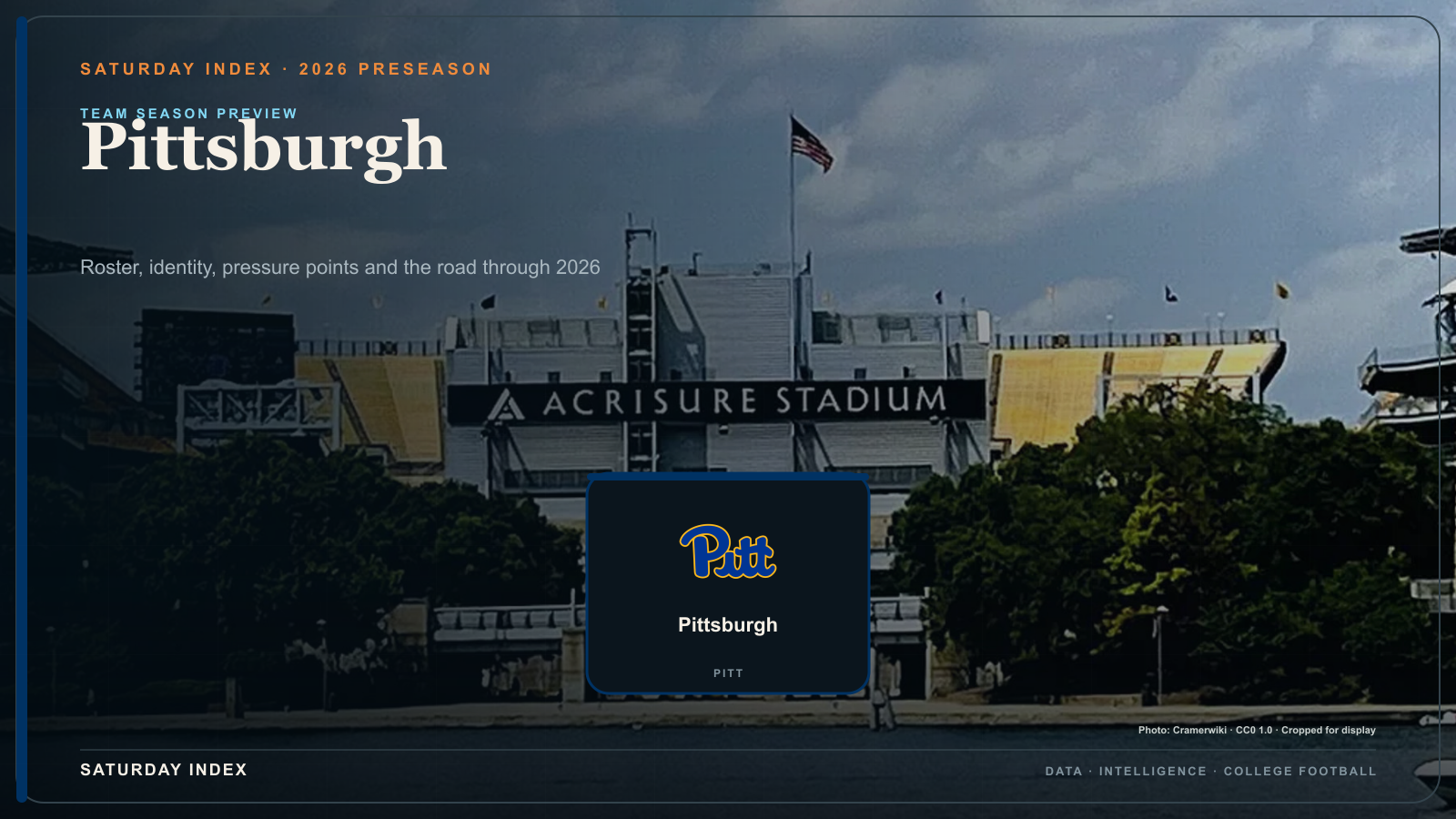
Pittsburgh enters 2026 with the hardest piece to find already in place: a quarterback who has won games and begun taking ownership of the offense. Pitt Athletics reports that Mason Heintschel started eight games as a true freshman, passing for 2,354 yards and 16 touchdowns as the Panthers went 6-3 in his starts. For head coach Pat Narduzzi, the central question is whether that continuity can steady everything around Heintschel that remains unsettled.
Heintschel’s value now extends beyond those numbers. Pitt Athletics reported in July that he was organizing player-led work, correcting teammates’ details and mentoring freshman Corey Dailey. That growing command should help offensive coordinator Kade Bell operate at the tempo he wants, particularly with a young collection of skill players. The contingency plan is less clear: transfer Holden Geriner and freshmen Angelo Renda and Dailey competed behind Heintschel in spring, but the backup order had not been publicly resolved afterward.
Original season forecast
The original ACC forecast, retained alongside current results.
ACC projected standing
#6
5-4 projected · 5.0 expected conference wins · #6 of 17.
Preseason baseline
2025 percentiles retained as preseason context; current results and player production lead this page.
2025 FBS percentile scale · 50 is average
Incoming class
National and conference recruiting ranks, confirmed commitments, and the highest-ranked recruits in this class.
Top committed recruits
Pittsburgh2026 transfer movement
Incoming and outgoing transfer activity, with rated FBS-to-FBS moves below.
Incoming Transfers
PittsburghOutgoing Transfers
PittsburghSeason schedule
Completed games show final results. Upcoming games use this week’s forecast where available; later games retain their published season outlook.
Detailed football intelligence
The full team identity, offense, defense, and supporting evidence.
Team identity
Last season, Pittsburgh tried to lean on the passing game; too many drives still went off schedule.
Why it matters
The passing game was Pittsburgh's more dependable way to stay ahead of the chains; opponents have to interrupt that rhythm without giving the run an easy box.
 at Miami
Pregame 16–36
Game detailsPregame comparisons use preserved published forecasts. Results include wins and losses.
At a glance
Current form leads the outlook.
2026 rates aggregate verified completed-game box scores. EPA is expected points added per play.
| Player | C/ATT | YDS | TD | INT |
|---|---|---|---|---|
| Mason Heintschel | 98/148 | 1304 | 14 | 1 |
| Holden Geriner | 64/102 | 706 | 3 | 2 |
| Corey Dailey | 17/33 | 316 | 3 | 2 |
| Player | CAR | YDS | AVG | TD |
|---|---|---|---|---|
| Damon Ferguson Jr. | 92 | 477 | 5.2 | 4 |
| La'Vell Wright | 63 | 253 | 4.0 | 4 |
| Ja'Kyrian Turner | 30 | 131 | 4.4 | 1 |
| Player | REC | YDS | AVG | TD |
|---|---|---|---|---|
| Cataurus Hicks | 31 | 649 | 20.9 | 5 |
| Carson Kent | 26 | 276 | 10.6 | 1 |
| Bryce Yates | 18 | 255 | 14.2 | 1 |
| Player | TOT | SOLO | TFL | SACK |
|---|---|---|---|---|
| Cruce Brookins | 55 | 33 | 1.5 | 0 |
| Jeremiah Marcelin | 47 | 14 | 5.5 | 2 |
| Alex Sanford | 35 | 16 | 6 | 2 |
Saturday, October 24 · Hard Rock Stadium
Saturday, October 17 · Alumni Stadium (Chestnut Hill, MA)
Saturday, October 10 · Acrisure Stadium
Bell and Heintschel have emphasized efficient decisions and moving the chains, while spring reports showed the passing game could create explosive plays. Bryce Yates, transfer Malik Knight and early enrollee Dylan Wester produced notable gains in the first spring scrimmage. Censere Lee, Cataurus Hicks, Tony Kinsler and Cam Sapp are among the other returning or emerging options. The breadth is encouraging, but regular-season targets still have to separate themselves from a crowded group.
The greater offensive pressure falls on the running game and line. Ja’Kyrian Turner and Western Kentucky transfer La’Vell Wright received positive spring evaluations, with Turner repeatedly breaking long runs, but Narduzzi said the running game still needed improvement. Veteran Jaylin Brown was limited to individual work while rehabilitating, leaving his eventual role uncertain. Up front, Ryan Carretta worked at center alongside experienced pieces Ryan Baer and BJ Williams, while transfers Netinho Olivieri and Keylen Davis arrived with all-conference experience. Finding the best five will shape both Heintschel’s protection and Pitt’s ability to avoid becoming one-dimensional.
On defense, Narduzzi and coordinator Cory Sanders need the front to remain the engine of Pitt’s pressure-oriented approach. Jimmy Scott has moved into a larger leadership role, Isaiah Neal shifted from tackle to end and transfers Jeremiah Warren and Eliyt Nairne joined veterans Sean FitzSimmons and Nick James inside. At linebacker, Braylan Lovelace is the established anchor after the departures of Kyle Louis and Rasheem Biles. DeMarco Ward, Alex Sanford Jr. and Jeremiah Marcelin offered encouraging spring work, but replacing the production that left will require more than promising scrimmage grades.
The secondary presents the same balance of veteran leadership and open jobs. Cruce Brookins is the safety centerpiece, while transfers Raion Strader and Kanye Thompson brought starting experience into a cornerback competition Narduzzi described as six players deep. That gives Pitt options, not a settled starting pair. The eventual choices matter because aggressive pressure asks cornerbacks to withstand difficult coverage assignments when the rush does not arrive immediately.
Pitt is also integrating additions throughout the offense, defensive front, linebacker corps, secondary and specialist positions. The stabilizing force may be a veteran group that Narduzzi, Heintschel, Baer and Lovelace described at ACC Kickoff in terms of loyalty, leadership and assignment discipline. Five players have spent five years in the program and two others four. That experience cannot settle every competition, but it could help new combinations develop without forcing Heintschel to carry the entire transition.
The schedule offers an early opportunity to do that work at home. Pitt opens at Acrisure Stadium against Miami (Ohio), UCF, Syracuse and Bucknell, with Syracuse visiting for a Thursday ACC opener. The Panthers then make their first road trip to Virginia Tech. Four home games provide continuity for new starters, but UCF and an early conference matchup should test whether the offensive line, secondary and other reconstructed areas are progressing quickly enough.
The pressure rises later with road trips to Miami, Louisville and California. Any unresolved protection problem, coverage assignment or specialist role could become more costly during that stretch. Pitt therefore enters 2026 with a clear advantage but no guarantee: Heintschel gives the offense a proven starting point, while Baer, Scott, Lovelace and Brookins provide experienced reference points elsewhere. How effectively Narduzzi’s staff builds around them—not the length of the offseason depth chart—will determine what that continuity is worth.
This preview is based on the linked public reporting and official program records.
Profile high point
Big-play creation held the profile's highest percentile position.Profile low point
Big-play prevention held the lowest percentile position among the profile's strength measures.


Big-play creation is what Pittsburgh can trust most.
Why it matters
The offense has its best route to changing field position without requiring flawless drive efficiency; rushing structure remains the first counter an opponent should test.
The run game is Pittsburgh's biggest concern, and opponents can test it immediately.
What matters
Pittsburgh's rushing structure ranked in the lower national range last season.
For Pittsburgh, the cleanest script is to use the passing game to stay on schedule and finish drives; an average pace puts more weight on winning ordinary downs.
What matters
Pittsburgh's pass-first structure played at a balanced pace. The pass game finished above-average, while the run game finished weak.
Inside the team
Open a section for the football detail and supporting numbers.
The down-to-down question that determines whether the offense can keep both the run and pass available.
Opponents have to break Pittsburgh's passing rhythm before it owns early downs.
Why it matters
If Pittsburgh keeps finding routine completions, the defense cannot load the box or turn the rush loose.
The pace, play selection, and methods this offense uses to stay on schedule.
Pittsburgh played at a balanced pace in 2025.
Why it matters
At that pace, Pittsburgh cannot count on extra possessions or expect to shorten the game.
Pittsburgh's prior passing record was above-average.
Why it matters
Pittsburgh's offense needs protection, field position, or explosive variance when ordinary dropbacks do not create enough value.
Pittsburgh's prior rushing record was weak.
Why it matters
When Pittsburgh's run game cannot stay on schedule, protection and passing-down execution carry more of the offense.
Pittsburgh's explosive-play upside came with real defensive volatility.
Why it matters
That mix can produce fast scoring swings in either direction and makes missed tackles or coverage busts especially expensive.
How consistently the offense creates manageable situations and the defense prevents them.
Pittsburgh's defense was more consistent down to down than its offense.
Why it matters
Pittsburgh's success rate shows whether it can sustain drives and get stops without relying on sacks, turnovers, or isolated big plays.
Opponent-adjusted EPA identifies the pass game as Pittsburgh's stronger offensive unit.
Why it matters
If an opponent removes the first passing answer, the run game's lower adjusted value becomes the key counter to test.
Where the defense can create pressure, control the run, and end drives.
Pittsburgh's prior defense was top-tier overall and strongest in run front.
Why it matters
Opponents can start by using routine throws to stay out of obvious passing downs, though that unit still finished strong. Pittsburgh's run front can still create long-yardage without overloading the box, so the offense has to prove the opening will hold up.
Pittsburgh's available disruption measures ranked among the best in the country last season; a charted pressure rate is not available.
Why it matters
Sustained disruption can create negative plays and give Pittsburgh a better chance to end drives before third down.
Pittsburgh's disruption regularly finished at the quarterback.
What matters
Both sack production and front-seven disruption cleared the FBS midpoint.
Why it matters
A dependable run front can let Pittsburgh create obvious passing downs without committing extra bodies to the box.