Week 4 · FinalL
 vs. Wisconsin
20–24-4 margin
Pregame 29–21
Game detailsSaturday Index
Loading team intelligenceBringing the latest verified football information into focus.
Big Ten · 2026 · Week 8

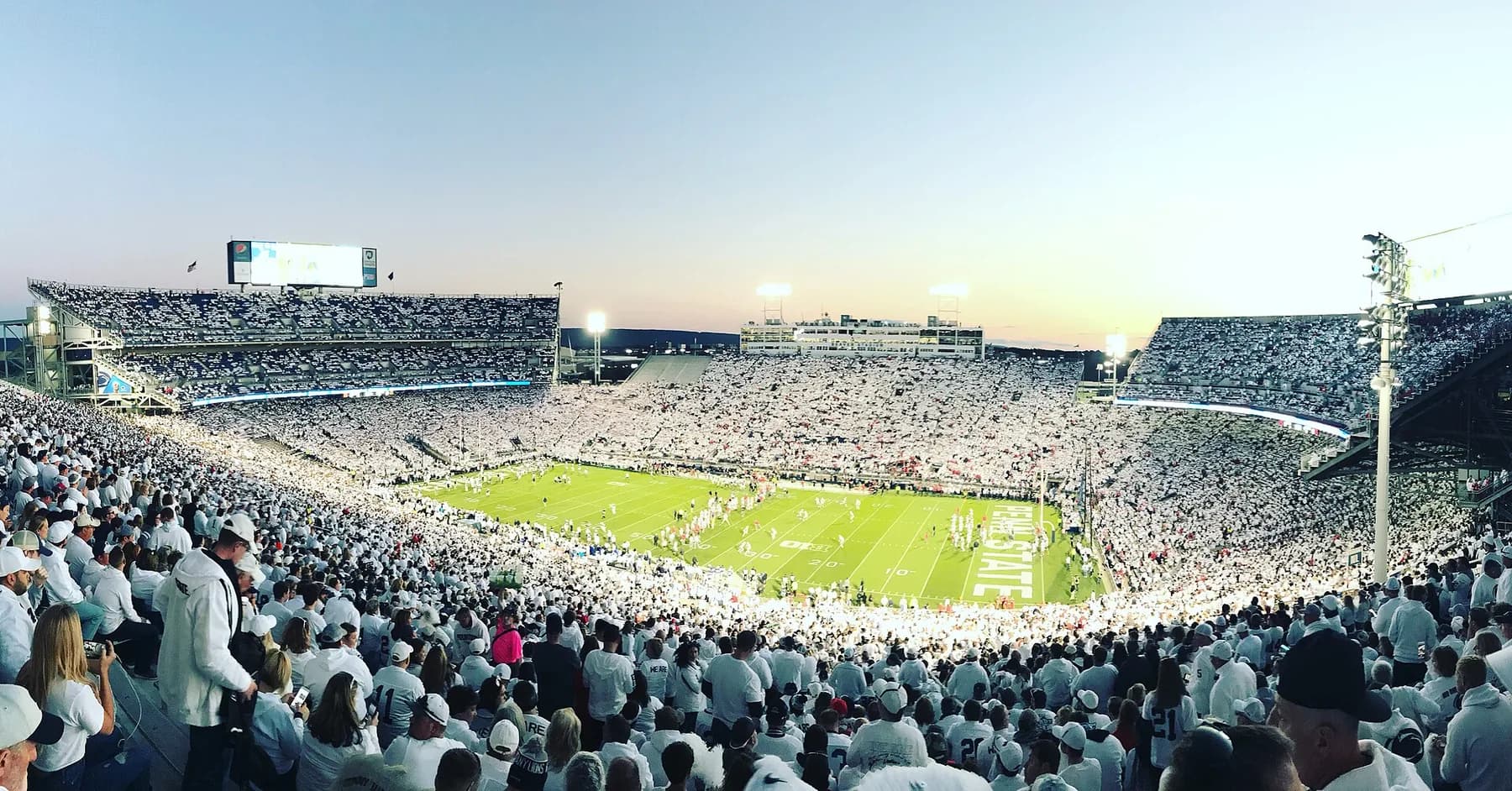
Photo: StateLionPro · CC BY-SA 4.0 · Cropped for display
Up next · Week 9
Home
Hosting
Saturday, October 31 · Time TBA
The season, taking shape
Final scores show Penn State first. Oldest to newest.
vs. WisconsinPregame 29–21
Game details at Northwestern
Pregame 27–23
Game details vs. USC
Pregame 26–28
Original full-season forecast
This forecast retains the original probabilities for the full schedule. It does not update with completed results or this week’s forecast.
2026 results
Current record, team efficiency, player production, and verified results from completed games.
Current record
3-43 wins · 4 lossesThrough 7 completed gamesLoading player usage…
2026 season preview
Penn State’s 2026 season rests on Matt Campbell’s ability to make sweeping change feel familiar. Campbell brought offensive coordinator Taylor Mouser, several position coaches and a large Iowa State transfer contingent to State College, giving his rebuilt roster a shared football language. Penn State officially announced 39 January transfers across every position group, while Joel Haas later counted 40, including 24 from Iowa State. The figures come from different snapshots, but the scale is unmistakable: Campbell is betting that experience in his system can produce cohesion faster than a conventional rebuild.
Original season forecast
The original Big Ten forecast, retained alongside current results.
Big Ten projected standing
#8
5-4 projected · 4.8 expected conference wins · #8 of 18.
Preseason baseline
2025 percentiles retained as preseason context; current results and player production lead this page.
2025 FBS percentile scale · 50 is average
Incoming class
National and conference recruiting ranks, confirmed commitments, and the highest-ranked recruits in this class.
Top committed recruits
Penn State2026 transfer movement
Incoming and outgoing transfer activity, with rated FBS-to-FBS moves below.
Incoming Transfers
Penn StateOutgoing Transfers
Penn StateSeason schedule
Completed games show final results. Upcoming games use this week’s forecast where available; later games retain their published season outlook.
Detailed football intelligence
The full team identity, offense, defense, and supporting evidence.
Team identity
Last season, Penn State tried to lean on the running game; the approach consistently kept the offense on schedule.
Why it matters
Neither offensive unit clearly carried the other, so first-down execution decides whether Penn State can stay on plan.
 at Michigan
Pregame 21–28
Game detailsPregame comparisons use preserved published forecasts. Results include wins and losses.
At a glance
Current form leads the outlook.
2026 rates aggregate verified completed-game box scores. EPA is expected points added per play.
| Player | C/ATT | YDS | TD | INT |
|---|---|---|---|---|
| Rocco Becht | 132/210 | 1664 | 12 | 5 |
| Alex Manske | 9/14 | 102 | 0 | 0 |
| Connor Barry | 2/2 | 8 | 0 | 0 |
| Player | CAR | YDS | AVG | TD |
|---|---|---|---|---|
| Carson Hansen | 72 | 278 | 3.9 | 4 |
| James Peoples | 56 | 191 | 3.4 | 2 |
| Quinton Martin Jr. | 31 | 160 | 5.2 | 1 |
| Player | REC | YDS | AVG | TD |
|---|---|---|---|---|
| Chase Sowell | 34 | 510 | 15.0 | 3 |
| Koby Howard | 12 | 344 | 28.7 | 2 |
| Brett Eskildsen | 22 | 227 | 10.3 | 1 |
| Player | TOT | SOLO | TFL | SACK |
|---|---|---|---|---|
| Tony Rojas | 56 | 29 | 10.5 | 5 |
| Kooper Ebel | 40 | 17 | 2.5 | 1 |
| Jamison Patton | 26 | 14 | 0 | 0 |
Saturday, October 17 · Michigan Stadium
Saturday, October 10 · Beaver Stadium
Friday, October 2 · Ryan Field
Rocco Becht gives that bet its most important advantage. Haas reports that the Iowa State transfer is the clear starting quarterback, and his 26 career wins and familiarity with Campbell and Mouser should let Penn State install the offense around a proven operator rather than conduct an open competition. Becht’s decisions can organize the run game, connect a reshaped group of targets and keep a new line out of avoidable trouble. His physical progression remains important: Campbell said March 24 that Becht was ahead of schedule and throwing, but the staff withheld him from live spring repetitions while pacing his return.
Mouser has the personnel to build a physical, formation-multiple offense around Becht. Haas identifies tight end as a likely strength, with Ben Brahmer, Andrew Rappleyea and Gabe Burkle offering several starting-caliber options for the coordinator’s frequent 12- and 13-personnel packages. At running back, Haas projects Carson Hansen as the physical lead option, James Peoples as an explosive complement and Quinton Martin Jr. as another contender after a 103-yard Pinstripe Bowl. That combination can force defenses to handle heavier formations without making Penn State one-dimensional as it replaces the production of Kaytron Allen and Nicholas Singleton.
The offensive ceiling will be set by the line and the search for a lead receiver. Anthony Donkoh is the lone returning starter in a projected front that also includes former five-star Malachi Goodman, Iowa State veteran Trevor Buhr, Texas State transfer Brock Riker and retained interior lineman Cooper Cousins. The group has the size for Ryan Clanton’s downhill approach, but its early performance will depend on five-man cohesion and Goodman’s adjustment to meaningful college snaps. Outside, Haas credits Brett Eskildsen and Chase Sowell with proven production and identifies Koby Howard as the leading internal breakout candidate. None is yet an established No. 1 target, leaving Penn State to find the receiver who can punish defenses for concentrating on the run and tight ends.
D’Anton Lynn’s defense must create a dependable front from another heavily altered room. Penn State lost 80 percent of its 2025 defensive-line snaps, and Haas describes the replacements as experienced and heavier inside but talented and unproven at end. Added mass can help the defense hold up against the run; credible edge pressure would allow Lynn to disrupt quarterbacks without repeatedly committing extra rushers. Behind that front, Penn State is expected to return to a 4-3-4 base featuring Tony Rojas alongside Iowa State transfers Kooper Ebel and Caleb Bacon. Ebel’s experience makes him the leading MIKE and green-dot candidate, while a fully recovered Rojas would supply the unit’s highest-end athleticism.
Marcus Neal Jr. could be just as consequential at safety. He arrives with the strongest recent production in a group rebuilt around fellow Iowa State transfers Jeremiah Cooper and Jamison Patton, all of whom previously played for position coach Deon Broomfield. Their familiarity should accelerate communication behind the new front, giving Lynn an experienced core at the defense’s back two levels. The room’s margin is narrower if injuries strike, however, and Cooper’s ACL recovery remains relevant. Penn State’s best defensive version needs Neal and Rojas to turn their talent into stabilizing production while the line develops.
The schedule gives Campbell three opening games—Marshall and Buffalo at Beaver Stadium, with a trip to Temple between them—before Wisconsin visits on Sept. 26. Penn State then travels to Northwestern, hosts USC on Oct. 10 and visits Michigan one week later. That USC-Michigan sequence is the clearest early pressure point for the reconstructed lines, Becht’s supporting cast and Lynn’s pass rush. After an open date and a home game against Purdue, November brings a trip to Washington, home dates with Minnesota and Rutgers, and the regular-season finale at Maryland.
Penn State does not need every newcomer to become a star for Campbell’s plan to work. It needs Becht to command the offense, the tight ends and backs to establish its physical identity, and the rebuilt lines to become functional quickly. On defense, Rojas and Neal must provide impact behind a front still searching for proven edge production. Familiarity gives this transition a foundation. Whether that foundation holds under the schedule’s strongest pressure will define Penn State’s first season under Campbell.
This preview is based on the linked public reporting and official program records.
Profile high point
Big-play prevention held the profile's highest percentile position.Profile low point
Big-play creation held the lowest percentile position among the profile's strength measures.




The offense's down-to-down consistency is what Penn State can trust most.
Why it matters
That unit is the most credible foundation for sustaining drives after poor field position or an early negative play; explosive-play creation remains the first counter an opponent should test.
The first place to test Penn State is big-play creation, especially on ordinary early downs; the offense's down-to-down consistency has to keep the game on plan.
Why it matters
Opponents can squeeze underneath space and make the offense finish long drives without chunk gains; offensive efficiency has to keep that stress from setting the game plan.
Penn State's best path is to lean on the running game, then keep both the pass and run available because neither part of the offense has to carry the plan alone; fewer possessions make every empty drive more expensive.
What matters
Penn State's run-first structure played at a deliberate pace. Passing finished strong and rushing finished strong, without a clear split between them.
Inside the team
Open a section for the football detail and supporting numbers.
The down-to-down question that determines whether the offense can keep both the run and pass available.
Opponents have to win first down before Penn State can keep both answers available.
What matters
Neither the pass nor run separated enough to become the only priority, so first-down execution is the real target.
The pace, play selection, and methods this offense uses to stay on schedule.
Penn State played at a deliberate pace in 2025.
What matters
Penn State worked with fewer possessions than most teams last season.
Penn State's prior passing record was strong.
Why it matters
A repeatable pass game can let Penn State punish loaded boxes without relying on low-frequency deep completions.
Why it matters
A sustainable run game keeps Penn State's play action credible and limits obvious passing situations.
Penn State was better at preventing explosive plays than creating them.
Why it matters
The defense can keep a game on schedule, but the offense may need longer drives and more third-down conversions to separate.
How consistently the offense creates manageable situations and the defense prevents them.
Penn State's offense was more consistent down to down than its defense.
Why it matters
Penn State's success rate shows whether it can sustain drives and get stops without relying on sacks, turnovers, or isolated big plays.
Penn State's opponent-adjusted passing and rushing value were closely matched.
Why it matters
When the split is narrow, early-down execution matters more than steering the offense toward one obvious weakness.
Where the defense can create pressure, control the run, and end drives.
Penn State's prior defense was above-average overall and strongest in pass defense.
Why it matters
Opponents can test the fits early enough to keep every offensive option open; Penn State needs its pass defense to tighten throwing windows before that plan settles in.
Penn State's available disruption measures finished above the national average last season; a charted pressure rate is not available.
Why it matters
Sustained disruption can create negative plays and give Penn State a better chance to end drives before third down.
Penn State's disruption regularly finished at the quarterback.
What matters
Both sack production and front-seven disruption cleared the FBS midpoint.
Penn State's prior run-defense results were below-average.
Why it matters
If Penn State's front cannot control early downs, opponents can keep every offensive option open and protect their passing game.