
Week 4 · FinalW
 at USC
41–27+14 margin
Pregame 31–26
Game detailsSaturday Index
Loading team intelligenceBringing the latest verified football information into focus.
Big Ten · 2026 · Week 8

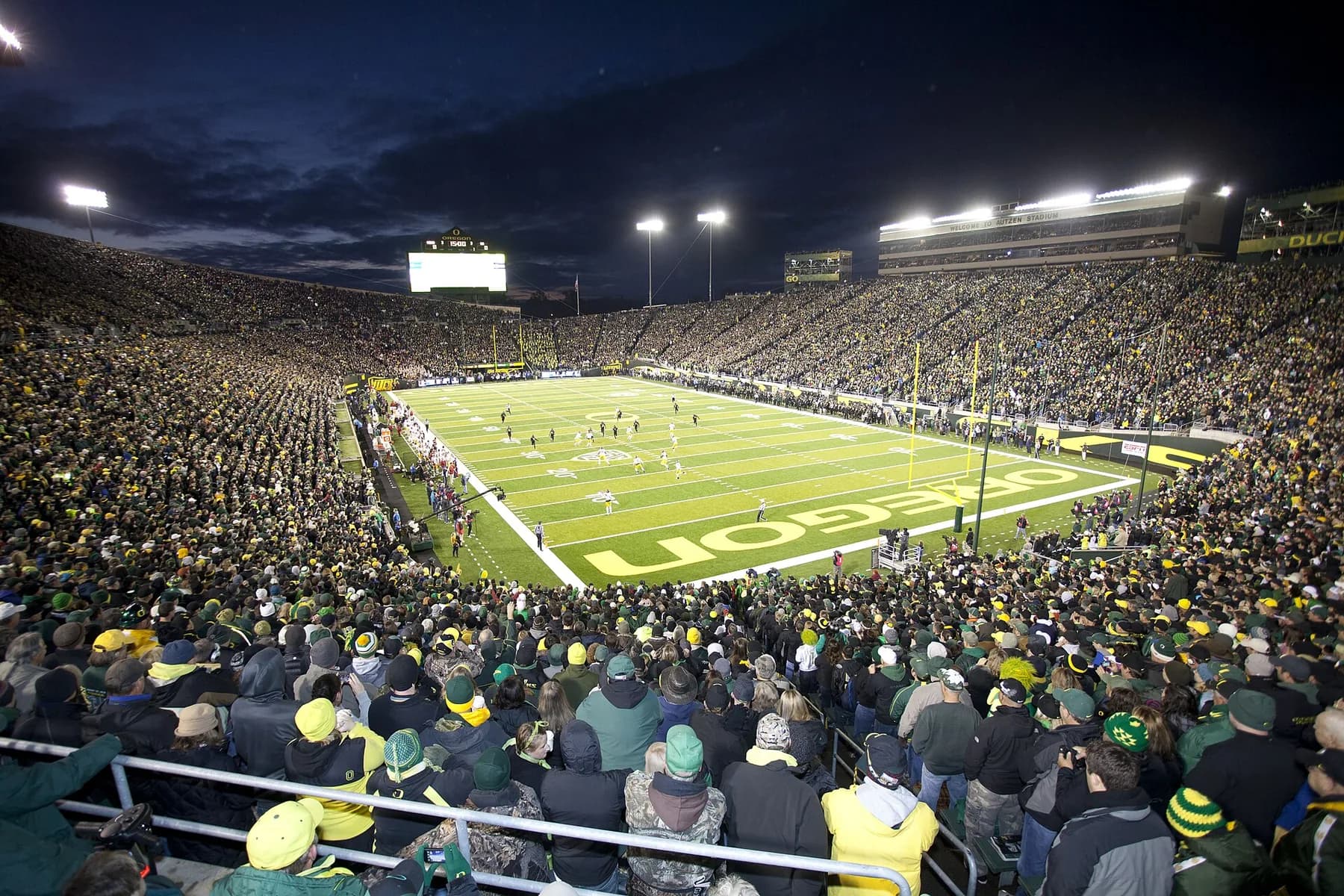
Photo: Ray Terrill · CC BY-SA 2.0 · Cropped for display
Up next · Week 9
Home
Hosting
Saturday, October 31 · Time TBA
The season, taking shape
Final scores show Oregon first. Oldest to newest.
at USCPregame 31–26
Game details vs. UCLA
Pregame 35–22
Game details vs. Nebraska
Pregame 34–18
Game detailsOriginal full-season forecast
This forecast retains the original probabilities for the full schedule. It does not update with completed results or this week’s forecast.
2026 results
Current record, team efficiency, player production, and verified results from completed games.
Current record
4-34 wins · 3 lossesThrough 7 completed gamesLoading player usage…
2026 season preview
Oregon enters 2026 with the kind of continuity that keeps championship expectations intact—and just enough change to make those expectations complicated. Dan Lanning returns quarterback Dante Moore and the starting defensive line from a 13-2 CFP semifinal team, but he also has new play callers, a developing offensive line and several unsettled roles. The Ducks do not need a wholesale reinvention. They need the parts around their proven stars to withstand the moments that decided their biggest games a year ago.
Lanning’s choice of Drew Mehringer on offense and Chris Hampton on defense reflects that balance. Both were promoted from within after Will Stein and Tosh Lupoi departed, preserving relationships and much of the program’s established approach even as game-day authority changes hands. Oregon said its offenses averaged 38.7 points from 2022 through 2025, and Mehringer has emphasized maintaining a dynamic attack. Hampton takes over a defense that Oregon reported ranked fourth nationally in passing yards allowed and opponent completion rate in 2025 while leading the FBS in pass breakups. The identities are recognizable; the test will be how the new coordinators adjust when opponents take away the first answer.
Original season forecast
The original Big Ten forecast, retained alongside current results.
Big Ten projected standing
#2
7-2 projected · 7.2 expected conference wins · #2 of 18.
Preseason baseline
2025 percentiles retained as preseason context; current results and player production lead this page.
2025 FBS percentile scale · 50 is average
Incoming class
National and conference recruiting ranks, confirmed commitments, and the highest-ranked recruits in this class.
Top committed recruits
Oregon2026 transfer movement
Incoming and outgoing transfer activity, with rated FBS-to-FBS moves below.
Incoming Transfers
OregonOutgoing Transfers
OregonSeason schedule
Completed games show final results. Upcoming games use this week’s forecast where available; later games retain their published season outlook.
Detailed football intelligence
The full team identity, offense, defense, and supporting evidence.
Team identity
Last season, Oregon tried to lean on the running game; the approach consistently kept the offense on schedule.
Why it matters
The passing game was Oregon's more dependable way to stay ahead of the chains; opponents have to interrupt that rhythm without giving the run an easy box.
 at Illinois
Pregame 34–19
Game detailsPregame comparisons use preserved published forecasts. Results include wins and losses.
At a glance
Current form leads the outlook.
2026 rates aggregate verified completed-game box scores. EPA is expected points added per play.
| Player | C/ATT | YDS | TD | INT |
|---|---|---|---|---|
| Dante Moore | 69/99 | 926 | 9 | 0 |
| Dylan Raiola | 47/73 | 515 | 6 | 2 |
| Brock Thomas | 23/40 | 202 | 1 | 1 |
| Player | CAR | YDS | AVG | TD |
|---|---|---|---|---|
| Jordon Davison | 74 | 330 | 4.5 | 6 |
| Dierre Hill Jr. | 66 | 295 | 4.5 | 3 |
| Brandon Smith | 20 | 89 | 4.5 | 1 |
| Player | REC | YDS | AVG | TD |
|---|---|---|---|---|
| Evan Stewart | 27 | 352 | 13.0 | 4 |
| Dakorien Moore | 25 | 347 | 13.9 | 4 |
| Jamari Johnson | 17 | 217 | 12.8 | 2 |
| Player | TOT | SOLO | TFL | SACK |
|---|---|---|---|---|
| Koi Perich | 40 | 21 | 0 | 0 |
| Devon Jackson | 36 | 14 | 1 | 0 |
| Teitum Tuioti | 31 | 14 | 5.5 | 3 |
Saturday, October 24 · Memorial Stadium (Champaign, IL)
Saturday, October 17 · Autzen Stadium
Saturday, October 10 · Autzen Stadium
Moore gives Mehringer a proven centerpiece. Tyson Alger reported that Moore passed for 3,565 yards, 30 touchdowns and 10 interceptions in 2025, and he directed three third-down conversions on his opening spring-game series. Nebraska transfer Dylan Raiola brings another substantial résumé after 22 starts and 4,819 career passing yards, according to Alger. Both threw touchdowns in the spring game. Moore remains the returning starter, while Raiola provides competition and unusually experienced insurance. How much Oregon can lean on that depth may depend on Raiola’s recovery and the program’s intended redshirt usage.
The running game begins with sophomores Jordon Davison and Dierre Hill Jr., who combined for 1,323 rushing yards and 15 touchdowns as freshmen, Alger reported. Their value extends beyond production. Oregon’s semifinal loss showed how quickly the offense can become one-dimensional when the backfield thins: Davison missed the game with a collarbone injury, Noah Whittington was held out with an undisclosed injury and the Ducks managed nine first-half rushing yards against Indiana. Davison’s current clearance has not been confirmed, making the development of Tradarian Ball, Brandon Smith and Colorado transfer Simeon Price more than a depth exercise.
The offensive line is the season’s clearest pressure point. After Oregon’s first spring scrimmage, Lanning described highs and lows from the new-look group and said the Ducks had not solidified their above-the-line unit, although young linemen were progressing. That uncertainty matters because protection and rushing problems contributed to both 2025 losses to Indiana. Moore can stabilize the operation, and Davison and Hill can punish favorable boxes, but neither advantage reaches its full value unless Oregon identifies a cohesive front capable of handling high-level pressure.
Defensively, Oregon can build from the opposite starting point. A’Mauri Washington, Matayo Uiagalelei, Bear Alexander and Teitum Tuioti return up front, giving Hampton an experienced first unit. Portal additions D’Antre Robinson and Jerome Simmons help replenish a room that lost several rotational players, but the second wave remains consequential. In a long Big Ten season, the difference between an excellent starting front and an excellent defense often appears when substitutions are required. Oregon’s front-line talent is clear; its durability will depend on how quickly the rotation becomes dependable.
The secondary carries similar promise with a more visible leadership question. Lanning identified Minnesota transfer Koi Perich as a film-driven candidate to replace departed safety Dillon Thieneman. Transfers Peyton Woodyard and Aaron Scott Jr. join returners Brandon Finney Jr. and Na’eem Offord, supplying options for a defense built around disrupting the passing game. Replacing Thieneman, however, means replacing communication as well as production. The hierarchy in the secondary still has to take shape. That unresolved role need not become a weakness, but it will influence how smoothly Oregon’s established system translates to Saturdays.
The schedule will not allow a long settling-in period. Oregon opens against Boise State, then visits Oklahoma State and USC in September. Those trips should reveal whether the new offensive line and play callers are ready to operate under road pressure. The defining stretch arrives in November: at Ohio State, home against Michigan, at Michigan State and home against Washington. Four consecutive games of that weight will test more than Oregon’s best 22 players; they will test the depth behind them and the staff’s ability to adapt from week to week.
Oregon has framed 2026 around pursuing a third consecutive playoff berth and a second Big Ten title in three seasons. That standard fits a roster led by Moore and a veteran defensive front, but recent success also narrows the margin for error. The Ducks’ ceiling will be shaped less by star power than by whether the offensive line settles, the backfield stays functional and Hampton finds trustworthy defensive rotations. If those pieces come together, Lanning will have preserved Oregon’s identity through meaningful change. The season’s hardest games will determine whether continuity is merely comforting or truly decisive.
This preview is based on the linked public reporting and official program records.
Profile high point
Passing held the profile's highest percentile position.Profile low point
Big-play prevention held the lowest percentile position among the profile's strength measures.




The passing game is what Oregon can trust most.
Why it matters
The opening plan has its best answer when opponents crowd the box or force obvious throwing situations; front-seven disruption remains the first counter an opponent should test.
Oregon did not show one unit opponents could treat as an automatic target, even at its lowest point.
What matters
Oregon's lowest-rated unit still ranked in a strong national range last season, so opponents do not have an obvious weakness to attack.
Oregon's best path is to lean on the running game, then let the passing game finish drives; fewer possessions make every empty drive more expensive.
What matters
Oregon's run-leaning structure played at a deliberate pace. The pass game finished top-tier, while the run game finished top-tier.
Inside the team
Open a section for the football detail and supporting numbers.
The down-to-down question that determines whether the offense can keep both the run and pass available.
Opponents have to break Oregon's passing rhythm before it owns early downs.
Why it matters
If Oregon keeps finding routine completions, the defense cannot load the box or turn the rush loose.
The pace, play selection, and methods this offense uses to stay on schedule.
Oregon played at a deliberate pace in 2025.
What matters
Oregon worked with fewer possessions than most teams last season.
Oregon's prior passing record was top-tier.
Why it matters
A repeatable pass game can let Oregon punish loaded boxes without relying on low-frequency deep completions.
Why it matters
A sustainable run game keeps Oregon's play action credible and limits obvious passing situations.
Oregon's explosive-play upside came with real defensive volatility.
Why it matters
That mix can produce fast scoring swings in either direction and makes missed tackles or coverage busts especially expensive.
How consistently the offense creates manageable situations and the defense prevents them.
Oregon won ordinary downs on both sides of the ball.
Why it matters
Oregon's success rate shows whether it can sustain drives and get stops without relying on sacks, turnovers, or isolated big plays.
Oregon's opponent-adjusted passing and rushing value were closely matched.
Why it matters
When the split is narrow, early-down execution matters more than steering the offense toward one obvious weakness.
Where the defense can create pressure, control the run, and end drives.
Oregon's prior defense was top-tier overall and strongest in pass defense.
Why it matters
Opponents can start by leaning on base protection rules until the rush forces an adjustment, though that unit still finished strong. Oregon's pass defense can still tighten throwing windows, so the offense has to prove the opening will hold up.
Oregon's available disruption measures ranked in a strong national range last season; a charted pressure rate is not available.
Why it matters
Sustained disruption can create negative plays and give Oregon a better chance to end drives before third down.
Oregon created disruption more consistently than it finished sacks.
Why it matters
Oregon's disruption can hurry an offense; sacks do more by erasing field position and ending passing downs.
Oregon's prior run-defense results were strong.
Why it matters
A dependable run front can let Oregon create obvious passing downs without committing extra bodies to the box.