Week 4 · FinalW
 at West Virginia
41–24+17 margin
Pregame 22–34
Game detailsSaturday Index
Loading team intelligenceBringing the latest verified football information into focus.
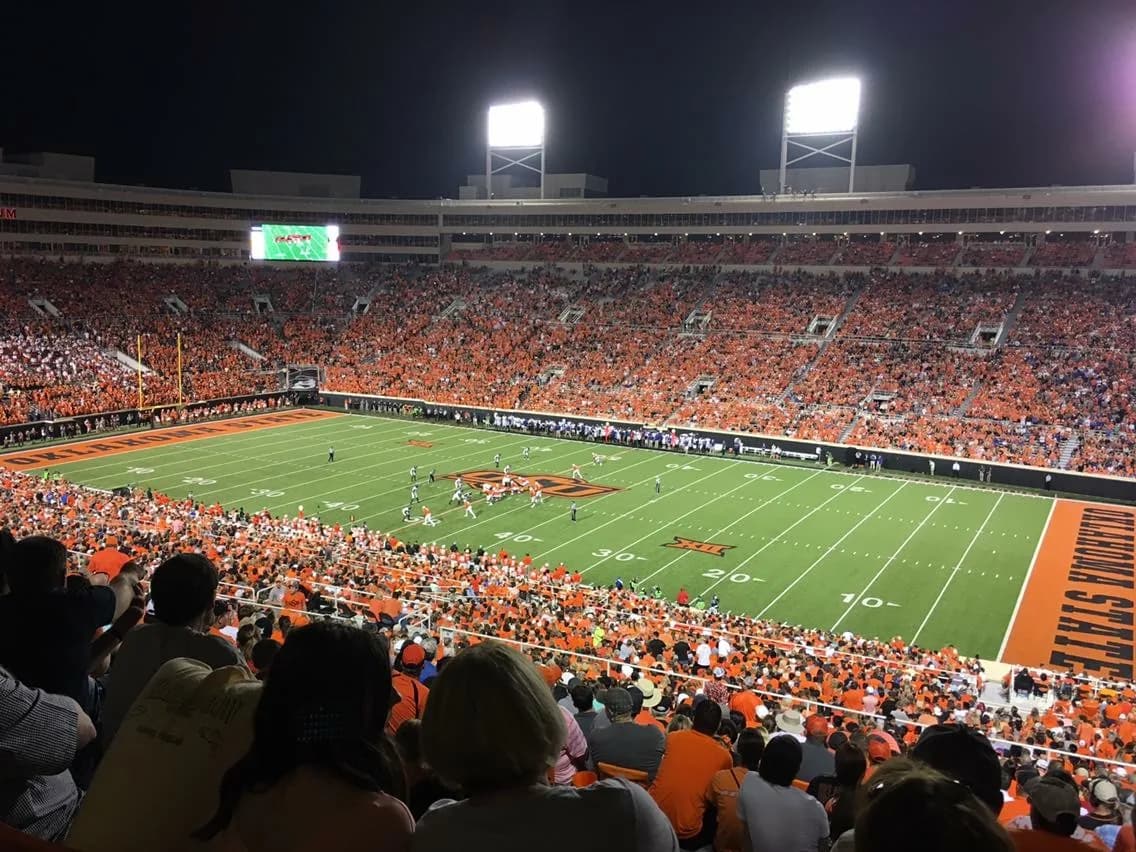
Big 12 · 2026 · Week 8

Photo: XStewart2007 · CC BY-SA 4.0 · Cropped for display
Up next · Week 9
Away
On the road at
Saturday, October 31 · Time TBA
The season, taking shape
Final scores show Oklahoma State first. Oldest to newest.
at West VirginiaPregame 22–34
Game details vs. UCF
Pregame 25–27
Game details at Houston
Pregame 21–37
Original full-season forecast
This forecast retains the original probabilities for the full schedule. It does not update with completed results or this week’s forecast.
2026 results
Current record, team efficiency, player production, and verified results from completed games.
Current record
5-25 wins · 2 lossesThrough 7 completed gamesLoading player usage…
2026 season preview
A proven quarterback-running back-receiver core gives the Cowboys a foundation, but line play and defensive cohesion will determine how quickly an overhauled roster can function in the Big 12.
Oklahoma State’s 2026 season begins with a sweeping experiment: Can familiarity at the most important offensive positions stabilize one of the Big 12’s most comprehensively remade rosters? First-year coach Eric Morris is replacing rather than gradually repairing. The February roster announcement included more than 80 newcomers, including 21 players who had played for him at North Texas. That combination gives the Cowboys a plausible shortcut through a rebuild, but only if players arriving from different programs become a functional team quickly.
Original season forecast
The original Big 12 forecast, retained alongside current results.
Big 12 projected standing
#16
1-8 projected · 1.6 expected conference wins · #16 of 16.
Preseason baseline
2025 percentiles retained as preseason context; current results and player production lead this page.
2025 FBS percentile scale · 50 is average
Incoming class
National and conference recruiting ranks, confirmed commitments, and the highest-ranked recruits in this class.
Top committed recruits
Oklahoma State2026 transfer movement
Incoming and outgoing transfer activity, with rated FBS-to-FBS moves below.
Incoming Transfers
Oklahoma StateOutgoing Transfers
Oklahoma StateSeason schedule
Completed games show final results. Upcoming games use this week’s forecast where available; later games retain their published season outlook.
Detailed football intelligence
The full team identity, offense, defense, and supporting evidence.
Team identity
Last season, Oklahoma State tried to lean on the passing game; it rarely provided an easy foundation.
Why it matters
Neither offensive unit clearly carried the other, so first-down execution decides whether Oklahoma State can stay on plan.
 vs. Colorado
Pregame 29–27
Game detailsPregame comparisons use preserved published forecasts. Results include wins and losses.
At a glance
Current form leads the outlook.
2026 rates aggregate verified completed-game box scores. EPA is expected points added per play.
| Player | C/ATT | YDS | TD | INT |
|---|---|---|---|---|
| Drew Mestemaker | 136/203 | 1940 | 16 | 6 |
| Broderick Vehrs | 6/6 | 37 | 1 | 0 |
| Player | CAR | YDS | AVG | TD |
|---|---|---|---|---|
| Caleb Hawkins | 123 | 592 | 4.8 | 2 |
| Ayo Adeyi | 30 | 200 | 6.7 | 1 |
| Drew Mestemaker | 21 | 142 | 6.8 | 2 |
| Player | REC | YDS | AVG | TD |
|---|---|---|---|---|
| Wyatt Young | 32 | 561 | 17.5 | 5 |
| Justin Bowick | 29 | 469 | 16.2 | 6 |
| Miles Coleman | 19 | 283 | 14.9 | 1 |
| Player | TOT | SOLO | TFL | SACK |
|---|---|---|---|---|
| Ethan Wesloski | 62 | 25 | 2.5 | 1.5 |
| Tate Romney | 51 | 25 | 6 | 1.5 |
| Quinton Hammonds | 43 | 19 | 0.5 | 0 |
Saturday, October 24 · Boone Pickens Stadium
Saturday, October 17 · TDECU Stadium
Saturday, October 10 · Boone Pickens Stadium
Morris is the organizing idea behind the overhaul. His teams produced top-five national passing offenses nine times in his previous 13 seasons as a head coach or coordinator, giving Oklahoma State a clear offensive identity to pursue. Offensive coordinator Sean Brophy and defensive coordinator Skyler Cassity entered spring alongside him, with many newcomers already conversant in the staff’s terminology. Morris also deliberately mixed North Texas transfers, Oklahoma State holdovers and other newcomers from the first team meeting. Quarterback Drew Mestemaker said the group made substantial cohesion gains during spring, an encouraging start for a roster with little time to grow together.
Mestemaker gives the rebuild its most important piece. He followed Morris from North Texas after throwing for 4,379 yards and 34 touchdowns in 2025, and CBS Sports characterized him as the centerpiece of the transfer class. His production matters, but his command of Morris’s system may be just as valuable. Oklahoma State does not need to teach its likely offensive centerpiece a new language while simultaneously assembling the rest of the lineup. The remaining question is how effectively that production translates against Big 12 defenses.
The Cowboys also preserved the core around their quarterback. Caleb Hawkins rushed for 1,434 yards and 25 touchdowns as a North Texas freshman, giving the offense a runner capable of punishing defenses that lean too heavily toward stopping the pass. Wyatt Young, who ranked seventh nationally in receiving yards in 2025, brings an established connection with Mestemaker. Their timing offers Morris a dependable starting point in the passing game. Roles behind Young remain less defined, while tight ends Oscar Hammond, Carson Kolb, Morgan McPhaul and Donovan Green give the staff several experienced options without an established primary assignment.
No position may shape the offense more than the line. Oklahoma State lists veteran transfers Johnny Dickson III, Tyler Mercer, Braydon Nelson, Desmond Magiya, Ashton Lepo, Kai Holec and Jacob Sexton, creating a sizable pool of experienced candidates. Experience accumulated at several programs, however, does not automatically produce five linemen operating as one. Protection calls, combination blocks and consistency against Power Four fronts will determine whether Mestemaker has time to use the passing system and whether Hawkins finds the space to keep the offense balanced. The room has options; its cohesion will carry more weight than its number of recognizable names.
Cassity’s defense faces a different rebuilding challenge. He has called defensive tackle essential to his scheme and acknowledged a learning curve in that room. His 2025 North Texas defense improved by roughly 10 points and 90 total yards allowed per game from the previous season, but Oklahoma State first must establish the interior foundation that lets an aggressive structure work. Linebacker Ethan Wesloski, a North Texas transfer and redshirt senior, can serve as a communication bridge even though no starting assignment has been finalized. The secondary has similar organizational responsibility: defensive backs coach Jordan Malone said the back end is expected to run the defense through communication while playing fast, physical and selectively aggressive.
The schedule will test the rebuild before it has much time to settle. Oklahoma State opens at Tulsa on September 5, then hosts Oregon on September 12 and Murray State on September 19 before visiting West Virginia on September 26. That first month should provide an early measure of how quickly the familiar offensive core can support the rebuilt lines and defense. Later, the Cowboys face a demanding sequence at Iowa State, at Kansas State and home against Texas Tech, followed by a trip to Arizona State and a home finale against Kansas. Sustaining execution through those consecutive pressure points will require more than early offensive chemistry.
Oklahoma State’s case for rapid improvement rests on something tangible: Morris brought a productive quarterback, a high-output running back and an established leading receiver into a system they already know. The larger uncertainty lies around them. The offensive line must develop shared timing, the defensive tackles must make Cassity’s structure viable, and the secondary must communicate well enough to play aggressively without losing discipline. Complementary receiving roles and specialist jobs also remain unsettled. If the familiar core gives those rooms time to cohere, Oklahoma State can accelerate its rebuild; how far that acceleration carries the Cowboys remains an open question.
This preview is based on the linked public reporting and official program records.
Profile high point
Pressure held the profile's highest percentile position.Profile low point
The run game held the lowest percentile position among the profile's strength measures.



Oklahoma State did not have one unit that could carry the whole game plan; front-seven disruption came closest.
What matters
Even Oklahoma State's best unit finished near the national middle last season, leaving no proven strength to build around.
The offense's down-to-down consistency is Oklahoma State's biggest concern, and opponents can test it immediately.
Why it matters
Opponents can demand long drives and make the offense recover from every empty possession; front-seven disruption has to keep that stress from setting the game plan.
For Oklahoma State, the cleanest script is to lean on the passing game, then keep winning first down because neither the pass nor run can rescue the other; fewer possessions make every empty drive more expensive.
What matters
Oklahoma State's pass-leaning structure played at a deliberate pace. Passing finished bottom-tier and rushing finished bottom-tier, without a clear split between them.
Inside the team
Open a section for the football detail and supporting numbers.
The down-to-down question that determines whether the offense can keep both the run and pass available.
Oklahoma State must establish a first-down answer before opponents have to defend both the run and pass.
Why it matters
Without one part of the offense forcing an adjustment, opponents can keep the offense in long-yardage and play from a position of strength.
The pace, play selection, and methods this offense uses to stay on schedule.
Oklahoma State played at a deliberate pace in 2025.
What matters
Oklahoma State worked with fewer possessions than most teams last season.
Oklahoma State's prior passing record was bottom-tier.
Why it matters
Oklahoma State's offense needs protection, field position, or explosive variance when ordinary dropbacks do not create enough value.
Why it matters
When Oklahoma State's run game cannot stay on schedule, protection and passing-down execution carry more of the offense.
Explosive plays were a two-way concern in Oklahoma State's record last season.
Why it matters
That combination increases dependence on sustained drives while leaving little margin for a missed fit or coverage error.
How consistently the offense creates manageable situations and the defense prevents them.
Oklahoma State's defense was more consistent down to down than its offense.
Why it matters
Oklahoma State's success rate shows whether it can sustain drives and get stops without relying on sacks, turnovers, or isolated big plays.
Oklahoma State's opponent-adjusted passing and rushing value were closely matched.
Why it matters
When the split is narrow, early-down execution matters more than steering the offense toward one obvious weakness.
Where the defense can create pressure, control the run, and end drives.
Oklahoma State's prior defense was weak overall and strongest in disruption.
Why it matters
Opponents can use efficient throws to stay out of obvious passing downs; Oklahoma State needs its disruption to change protection and erase drives with negative plays before that plan settles in.
Oklahoma State's available disruption measures finished near the national middle last season; a charted pressure rate is not available.
Oklahoma State created disruption more consistently than it finished sacks.
Why it matters
Oklahoma State's disruption can hurry an offense; sacks do more by erasing field position and ending passing downs.
Oklahoma State's prior run-defense results were below-average.
Why it matters
If Oklahoma State's front cannot control early downs, opponents can keep every offensive option open and protect their passing game.