
Week 4 · FinalL
 at Georgia
13–41-28 margin
Pregame 19–29
Game detailsSaturday Index
Loading team intelligenceBringing the latest verified football information into focus.
SEC · 2026 · Week 8

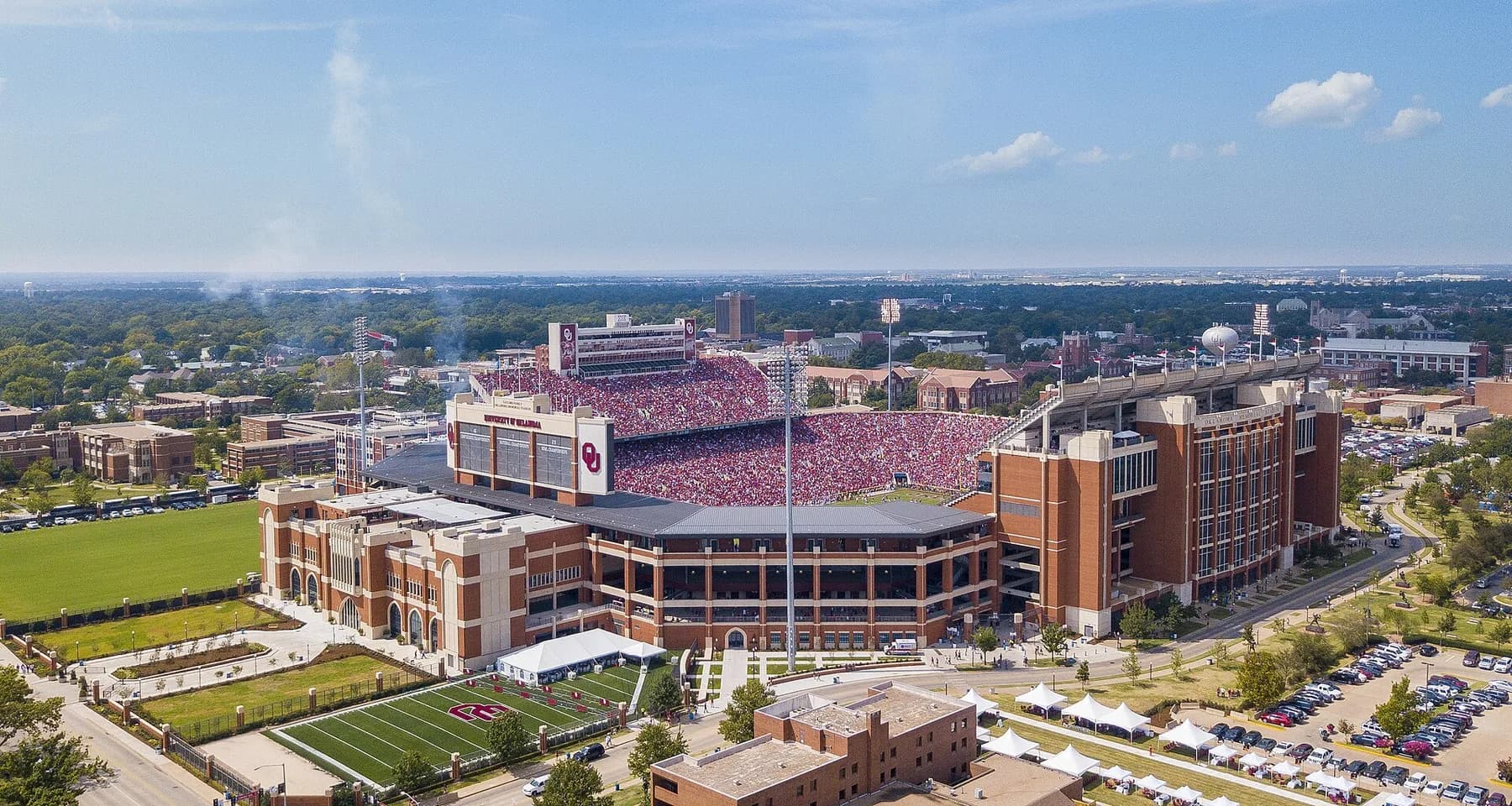
Photo: Toniklemm · CC BY-SA 4.0 · Cropped for display
Up next · Week 9
Home
Hosting
Saturday, October 31 · Time TBA
The season, taking shape
Final scores show Oklahoma first. Oldest to newest.
at GeorgiaPregame 19–29
Game details vs. Texas
Pregame 20–25
Game details vs. Kentucky
Pregame 31–18
Game detailsOriginal full-season forecast
This forecast retains the original probabilities for the full schedule. It does not update with completed results or this week’s forecast.
2026 results
Current record, team efficiency, player production, and verified results from completed games.
Current record
4-34 wins · 3 lossesThrough 7 completed gamesLoading player usage…
2026 season preview
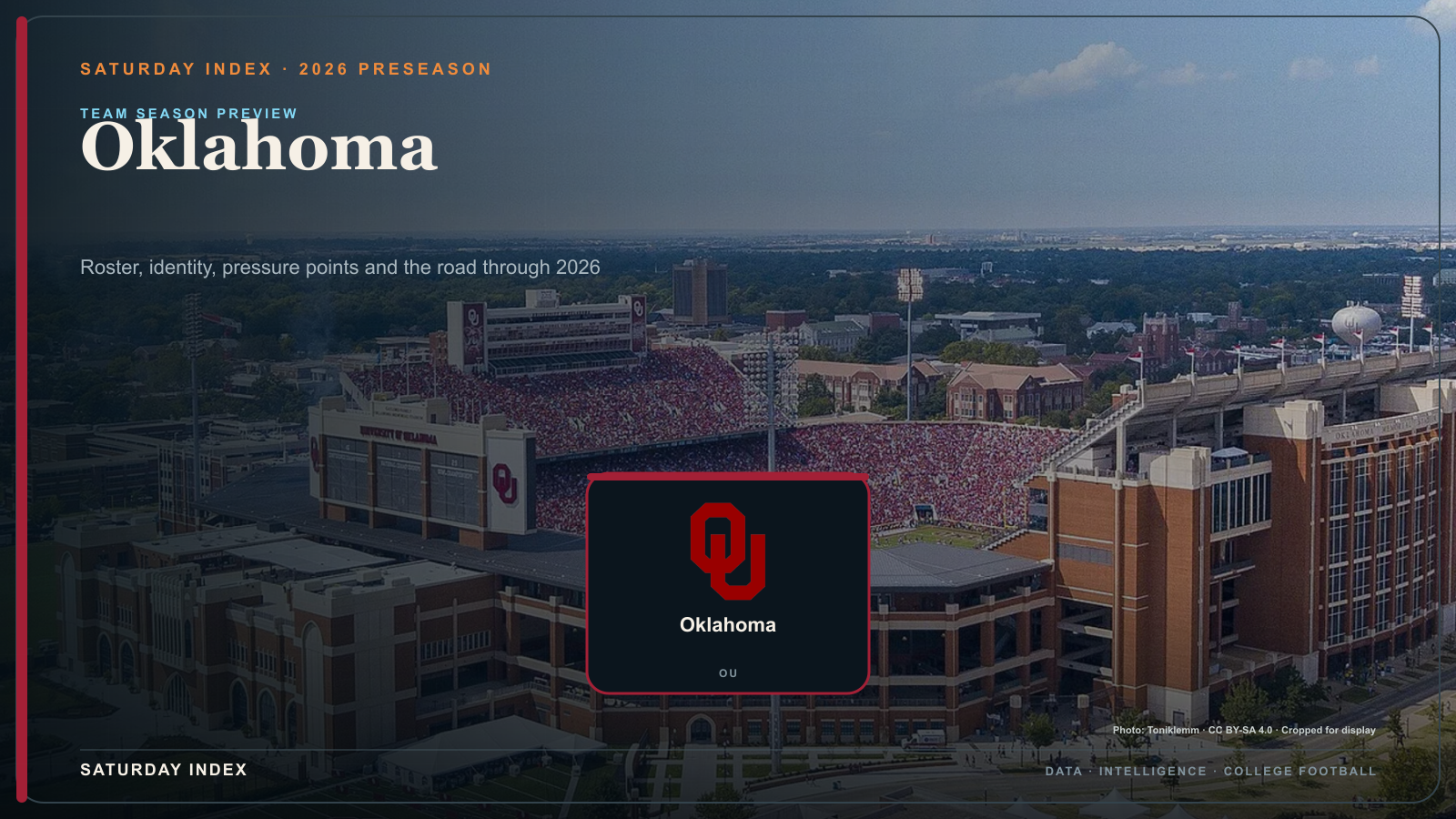
Brent Venables enters 2026 with a team built around continuity in the most consequential places and churn nearly everywhere else. Oklahoma opened spring with 40 newcomers among 106 players, even as John Mateer, the defensive front and the specialist operation returned. That contrast defines the Sooners: Venables does not need to manufacture an identity, but he and coordinators Ben Arbuckle and Todd Bates must turn a crowded mix of veterans, transfers and freshmen into dependable depth before a schedule that tests it early.
Mateer is the center of the offensive case. He returns as the established starter and leader for his second season in Arbuckle’s system, shifting the question from acclimation to execution. At SEC Media Days, Mateer described a more demanding leadership style grounded in relationships, praise and correction of mental mistakes. The vulnerability is behind him. Brady Trantham placed Whitt Newbauer ahead of true freshman Bowe Bentley after Newbauer’s encouraging spring, but that was a projection rather than a settled reserve order. Mateer’s command can elevate a veteran offense; his availability remains unusually important.
Original season forecast
The original SEC forecast, retained alongside current results.
SEC projected standing
#6
6-3 projected · 5.6 expected conference wins · #6 of 16.
Preseason baseline
2025 percentiles retained as preseason context; current results and player production lead this page.
2025 FBS percentile scale · 50 is average
Incoming class
National and conference recruiting ranks, confirmed commitments, and the highest-ranked recruits in this class.
Top committed recruits
Oklahoma2026 transfer movement
Incoming and outgoing transfer activity, with rated FBS-to-FBS moves below.
Incoming Transfers
OklahomaOutgoing Transfers
OklahomaSeason schedule
Completed games show final results. Upcoming games use this week’s forecast where available; later games retain their published season outlook.
Detailed football intelligence
The full team identity, offense, defense, and supporting evidence.
Team identity
Last season, Oklahoma tried to lean on the passing game; it rarely provided an easy foundation.
Why it matters
The passing game was Oklahoma's less difficult offensive option, but it did not provide a dependable way to stay ahead of the chains; the offense must prove that rhythm before opponents have to widen their structure.
 at Mississippi State
Pregame 28–23
Game detailsPregame comparisons use preserved published forecasts. Results include wins and losses.
At a glance
Current form leads the outlook.
2026 rates aggregate verified completed-game box scores. EPA is expected points added per play.
| Player | C/ATT | YDS | TD | INT |
|---|---|---|---|---|
| John Mateer | 136/204 | 1591 | 11 | 7 |
| Whitt Newbauer | 1/1 | 6 | 0 | 0 |
| Player | CAR | YDS | AVG | TD |
|---|---|---|---|---|
| Lloyd Avant | 72 | 320 | 4.4 | 2 |
| John Mateer | 75 | 116 | 1.5 | 0 |
| Tory Blaylock | 29 | 116 | 4.0 | 0 |
| Player | REC | YDS | AVG | TD |
|---|---|---|---|---|
| Isaiah Sategna | 41 | 578 | 14.1 | 3 |
| Rocky Beers | 30 | 395 | 13.2 | 4 |
| Manny Choice | 9 | 125 | 13.9 | 1 |
| Player | TOT | SOLO | TFL | SACK |
|---|---|---|---|---|
| Owen Heinecke | 55 | 25 | 7.5 | 3 |
| Peyton Bowen | 36 | 20 | 2.5 | 1 |
| Reggie Powers III | 32 | 15 | 5 | 2 |
Saturday, October 24 · Davis Wade Stadium
Saturday, October 17 · Memorial Stadium (Norman, OK)
Saturday, October 10 · Cotton Bowl
The offensive line is the best chance to keep that burden reasonable. Trantham’s projected first unit included Michael Fasusi, Eddy Pierre-Louis, Jake Maikkula, Ryan Fodje and E’Marion Harris. More important than the names is whether the group can create a steadier run game and keep Mateer from solving every difficult down himself. Fodje’s guard-tackle flexibility may help Oklahoma find its best five, while freshman Noah Best’s center development bears on depth. Xavier Robinson and Tory Blaylock entered summer as the leading backs, but the room still has to identify a dependable lead option. Both were expected back after missing spring; their actual workloads remained to be seen.
The passing game offers Mateer more defined help. Returning All-SEC target Isaiah Sategna III is joined by Trell Harris and Parker Livingstone, transfers with recent production: Harris had 847 yards and five touchdowns at Virginia in 2025, while Livingstone posted 516 yards and six scores at Texas. If their roles translate, Arbuckle can move beyond an offense that asks Sategna to defeat concentrated coverage. Tight ends Hayden Hansen, Rocky Beers and Jack Van Dorselear offer another route to balance. Hansen’s blocking and Beers’ four-catch, 65-yard spring-game performance suggest the room could support the run and give Mateer middle-of-field answers.
Venables’s strongest foundation remains the defensive front. Edge Taylor Wein and tackles David Stone and Jayden Jackson lead a group with Danny Okoye and Adepoju Adebawore competing opposite Wein. Its value is not just pass rush; enough usable bodies would allow Bates to rotate while protecting the run defense. The caution is health: Stone and Jackson missed spring, and Adebawore was coming back from foot surgery. Venables expected Stone and Jackson to participate fully in summer work, but fall workloads and durability still matter. Behind them, Kip Lewis and Owen Heinecke bring experience, while Michigan transfer Cole Sullivan’s ability to play linebacker or cheetah gives the defense flexibility without constant substitution.
The secondary carries more transition. Eli Bowen and Courtland Guillory were projected as the leading corners, with Peyton Bowen at safety and Michael Boganowski in line for his first starting season. Transfers Dakoda Fields and Prince Ijioma deepen the corner group, but replacing Robert Spears-Jennings puts immediate pressure on Boganowski’s readiness and on the reserves behind the top corners. Athleticism is apparent in the projected lineup; communication and late-game reliability will have to be demonstrated.
Special teams provide the cleanest continuity. Lou Groza Award winner Tate Sandell returns after making 24 consecutive field goals, alongside punter Grayson Miller, long snapper Ben Anderson and holder Jacob Ulrich. That familiarity matters because Oklahoma’s schedule creates ample possibility for close, possession-level decisions. Sandell is more than a supporting detail: dependable placekicking can preserve points when the offense stalls and reduce the need for Venables to chase marginal fourth downs.
The pressure begins quickly. Oklahoma opens at home against UTEP, visits Michigan in Week 2 for an 11 a.m. CT kickoff on Fox, then starts SEC play at Georgia on Sept. 26. Texas follows an open date at the Cotton Bowl. The later stretch brings Ole Miss and Texas A&M to Norman before a road finale at Missouri, with trips to Mississippi State and Florida also waiting. That sequence leaves little room for slow integration: the offensive line, reserve quarterback and reworked secondary could be tested before their roles feel settled.
Oklahoma’s ceiling therefore rests less on discovering a star than on making its supporting structure trustworthy. Mateer gives Arbuckle command, the front gives Venables and Bates a defensive anchor, and Sandell supplies unusual security in scoring range. The decisive variables are whether the line and backs can create balance, whether newcomers broaden the receiving corps and defensive rotation, and whether Boganowski and the reserve quarterback tier can handle consequential snaps. The Sooners have recognizable strengths. The season will show whether those strengths are deep enough to survive the schedule’s pressure points.
This preview is based on the linked public reporting and official program records.
Profile high point
Pressure held the profile's highest percentile position.Profile low point
The run game held the lowest percentile position among the profile's strength measures.

Front-seven disruption is what Oklahoma can trust most.
Why it matters
The defense has its best route to changing protection rules before coverage must hold; rushing structure remains the first counter an opponent should test.
The run game is Oklahoma's biggest concern, and opponents can test it immediately.
What matters
Oklahoma's rushing structure ranked near the bottom nationally last season.
Oklahoma is at its best when it can use the passing game to stay on schedule and finish drives; extra possessions give that plan time to build.
What matters
Oklahoma's pass-leaning structure played at a fast pace. The pass game finished below-average, while the run game finished bottom-tier.
Inside the team
Open a section for the football detail and supporting numbers.
The down-to-down question that determines whether the offense can keep both the run and pass available.
Before defenses have to adjust, Oklahoma must prove routine throws can keep first down on schedule.
What matters
Last season's passing results did not establish a dependable way to stay out of long-yardage.
The pace, play selection, and methods this offense uses to stay on schedule.
Oklahoma played at a fast pace in 2025.
Why it matters
More possessions give Oklahoma's strengths additional chances to build, but they also leave more time to recover from mistakes.
Oklahoma's prior passing record was below-average.
Why it matters
Oklahoma's offense needs protection, field position, or explosive variance when ordinary dropbacks do not create enough value.
Oklahoma's prior rushing record was bottom-tier.
Why it matters
When Oklahoma's run game cannot stay on schedule, protection and passing-down execution carry more of the offense.
Oklahoma's explosive-play results were mixed rather than a defining edge.
Why it matters
A big play can still flip a possession, but last season's results do not make explosiveness something this team can rely on.
How consistently the offense creates manageable situations and the defense prevents them.
Oklahoma's defense was more consistent down to down than its offense.
Why it matters
Oklahoma's success rate shows whether it can sustain drives and get stops without relying on sacks, turnovers, or isolated big plays.
Oklahoma's opponent-adjusted passing and rushing value were closely matched.
Why it matters
When the split is narrow, early-down execution matters more than steering the offense toward one obvious weakness.
Where the defense can create pressure, control the run, and end drives.
Oklahoma's prior defense was top-tier overall, with no clear separation among its main units.
Why it matters
That balance makes it harder for an offense to choose one automatic target; the defense still has to win early downs before any unit can dictate the offensive options.
Oklahoma's available disruption measures ranked among the best in the country last season; a charted pressure rate is not available.
Why it matters
Sustained disruption can create negative plays and give Oklahoma a better chance to end drives before third down.
Oklahoma's disruption regularly finished at the quarterback.
What matters
Both sack production and front-seven disruption cleared the FBS midpoint.
Oklahoma's prior run-defense results were top-tier.
Why it matters
A dependable run front can let Oklahoma create obvious passing downs without committing extra bodies to the box.