
Week 4 · FinalW
 vs. Illinois
42–19+23 margin
Pregame 40–14
Game detailsSaturday Index
Loading team intelligenceBringing the latest verified football information into focus.
Big Ten · 2026 · Week 8

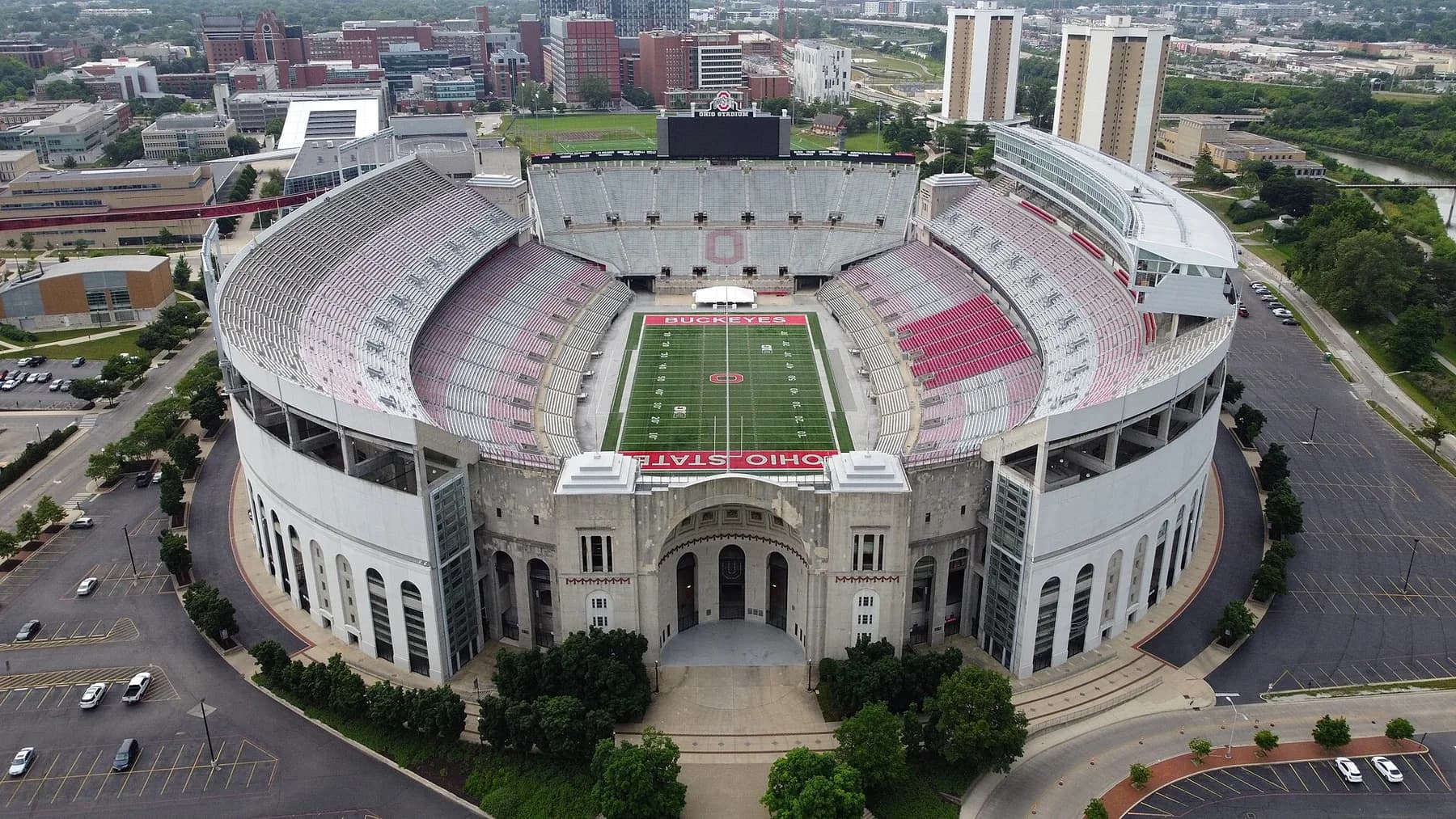
Photo: Lectrician2 · CC BY-SA 4.0 · Cropped for display
Up next · Week 9
Away
On the road at
Saturday, October 31 · Time TBA
The season, taking shape
Final scores show Ohio State first. Oldest to newest.
vs. IllinoisPregame 40–14
Game details at Iowa
Pregame 30–20
Game details vs. Maryland
Pregame 44–12
Game detailsOriginal full-season forecast
This forecast retains the original probabilities for the full schedule. It does not update with completed results or this week’s forecast.
2026 results
Current record, team efficiency, player production, and verified results from completed games.
Current record
6-16 wins · 1 lossThrough 7 completed gamesLoading player usage…
2026 season preview
Ohio State enters 2026 with established production at the two positions most capable of stabilizing an offense: quarterback and No. 1 receiver. Julian Sayin and Jeremiah Smith return from prolific seasons, giving Ryan Day a foundation sturdy enough to absorb change elsewhere. The question is not whether the Buckeyes possess top-end talent. It is whether a new offensive direction, a recovering backfield and a rebuilt defensive middle can develop quickly enough to support it when the schedule becomes demanding.
Arthur Smith is the central figure in that offensive transition. After 17 NFL seasons that included coordinator jobs with Tennessee and Pittsburgh and a head-coaching stint in Atlanta, he joins co-offensive coordinator and tight ends coach Keenan Bailey. Smith’s history and spring emphasis point toward a more forceful running component, though the final distribution of the offense will emerge only in games. The practical aim is clear: pair Ohio State’s passing talent with a ground game that keeps opponents from attacking Sayin on predictable downs.
Original season forecast
The original Big Ten forecast, retained alongside current results.
Big Ten projected standing
#1
7-2 projected · 7.2 expected conference wins · conference favorite.
Preseason baseline
2025 percentiles retained as preseason context; current results and player production lead this page.
2025 FBS percentile scale · 50 is average
Incoming class
National and conference recruiting ranks, confirmed commitments, and the highest-ranked recruits in this class.
Top committed recruits
Ohio State2026 transfer movement
Incoming and outgoing transfer activity, with rated FBS-to-FBS moves below.
Incoming Transfers
Ohio StateOutgoing Transfers
Ohio StateSeason schedule
Completed games show final results. Upcoming games use this week’s forecast where available; later games retain their published season outlook.
Detailed football intelligence
The full team identity, offense, defense, and supporting evidence.
Team identity
Last season, Ohio State tried to stay balanced between the run and pass; the approach consistently kept the offense on schedule.
Why it matters
The passing game was Ohio State's more dependable way to stay ahead of the chains; opponents have to interrupt that rhythm without giving the run an easy box.
 at Indiana
Pregame 26–24
Game detailsPregame comparisons use preserved published forecasts. Results include wins and losses.
At a glance
Current form leads the outlook.
2026 rates aggregate verified completed-game box scores. EPA is expected points added per play.
| Player | C/ATT | YDS | TD | INT |
|---|---|---|---|---|
| Julian Sayin | 131/192 | 2007 | 19 | 4 |
| Luke Fahey | 9/13 | 203 | 2 | 2 |
| Tavien St. Clair | 5/7 | 52 | 1 | 1 |
| Player | CAR | YDS | AVG | TD |
|---|---|---|---|---|
| Bo Jackson | 107 | 516 | 4.8 | 4 |
| Ja'Kobi Jackson | 59 | 354 | 6.0 | 6 |
| Isaiah West | 28 | 125 | 4.5 | 1 |
| Player | REC | YDS | AVG | TD |
|---|---|---|---|---|
| Jeremiah Smith | 52 | 984 | 18.9 | 12 |
| Devin Mccuin | 19 | 268 | 14.1 | 1 |
| Chris Henry Jr. | 6 | 202 | 33.7 | 2 |
| Player | TOT | SOLO | TFL | SACK |
|---|---|---|---|---|
| Earl Little II | 38 | 15 | 0 | 0 |
| Payton Pierce | 37 | 13 | 0.5 | 0.5 |
| Jaylen McClain | 32 | 15 | 1 | 1 |
Saturday, October 17 · Memorial Stadium (Bloomington, IN)
Saturday, October 10 · Ohio Stadium
Saturday, October 3 · Kinnick Stadium
Sayin makes that evolution easier to attempt. He completed 77.0 percent of his passes for 3,610 yards, 32 touchdowns and eight interceptions in 2025, finishing fourth in Heisman voting. Day used the spring to press for greater pre-snap responsibility and timely contributions as a runner. Those additions could make Sayin harder to defend without asking him to abandon the efficiency that already defines his game. Tavien St. Clair entered spring as the leading backup candidate, so his readiness remains the offense’s most important contingency rather than evidence of a competition for the starting job.
Smith commands the passing game after catching 87 passes for 1,243 yards and 12 touchdowns, and Brandon Inniss provides another established target. The consequential competition is behind them. Transfers Devin McCuin and Kyle Parker worked outside, while freshman Chris Henry Jr. displayed size and vertical ability on a long spring-game touchdown from St. Clair. Experienced transfers Hunter Welcing and Mason Williams joined Bennett Christian at tight end. Ohio State needs that group to produce reliable complementary options, because opponents will gladly tilt coverage toward Smith until someone else consistently makes the choice expensive.
The running game can give Smith’s offense its desired balance if its leading players regain lost preparation time. Bo Jackson returns from a 1,000-yard freshman season, but he and Isaiah West missed spring work while recovering from shoulder surgeries. Florida transfer Ja’Kobi Jackson and freshmen Legend Bey and Favour Akih deepen the room without predetermining its rotation. Four offensive-line starters also return, led by center Carson Hinzman and his 35 career starts. That continuity will be measured in the toughest moments: Ohio State surrendered five sacks in each of its season-ending losses to Indiana and Miami.
Matt Patricia and Tim Walton retain leadership of a defense that led the nation in scoring defense in 2025, but the unit’s identity must be rebuilt through the middle. Kenyatta Jackson Jr. supplies 14 career starts up front, and transfers John Walker, James Smith, Qua Russaw and Beau Atkinson add starting experience. At linebacker, TJ Alford, Payton Pierce and Wisconsin transfer Christian Alliegro are positioned to help replace first-team All-Americans Arvell Reese and Sonny Styles. The front must reproduce Kayden McDonald’s every-down interior influence, while the linebackers must restore the communication and range that held the structure together.
The secondary gives Patricia and Walton a broader base of experience after Caleb Downs and Davison Igbinosun left for the NFL. Jermaine Mathews Jr. and Jaylen McClain return with substantial starting backgrounds, transfers Terry Moore and Earl Little Jr. expand the options, and Dominick Kelly and Devin Sanchez stood out in spring observations. McClain’s selection with Sayin and Smith for Big Ten media days also identifies him as part of the program’s visible leadership spine before official captains are named. That steadiness matters on a roster that counted 51 new players in the spring.
The schedule turns Ohio State’s developmental work into an immediate competitive issue. Ball State visits for the opener before the Buckeyes travel to Texas in Week 2. Big Ten road games at Iowa, Indiana, USC and Nebraska repeatedly test the team away from Columbus, while Oregon visits Ohio Stadium on Nov. 7 and Michigan arrives for the Nov. 28 finale. Sayin and Smith can carry significant weight, but they cannot solve every pressure point alone. Day’s season will hinge on whether protection, backfield readiness and the reconstructed defensive core become strengths before elite opponents force those questions into the open.
This preview is based on the linked public reporting and official program records.
Profile high point
Big-play prevention held the profile's highest percentile position.Profile low point
Big-play creation held the lowest percentile position among the profile's strength measures.




The passing game is what Ohio State can trust most.
Why it matters
The opening plan has its best answer when opponents crowd the box or force obvious throwing situations; explosive-play creation remains the first counter an opponent should test.
Big-play creation is Ohio State's biggest concern, and opponents can test it immediately.
Why it matters
Opponents can squeeze underneath space and make the offense finish long drives without chunk gains; passing efficiency has to keep that stress from setting the game plan.
Ohio State is at its best when it can stay balanced between the run and pass, then let the passing game finish drives; fewer possessions make every empty drive more expensive.
Why it matters
Ohio State's clean script uses efficient early throws to stay ahead of the sticks; defenses will attack protection and route timing before the full passing menu opens. In a slower game, one empty drive or failed early-down series carries extra weight.
Inside the team
Open a section for the football detail and supporting numbers.
The down-to-down question that determines whether the offense can keep both the run and pass available.
Opponents have to break Ohio State's passing rhythm before it owns early downs.
Why it matters
If Ohio State keeps finding routine completions, the defense cannot load the box or turn the rush loose.
The pace, play selection, and methods this offense uses to stay on schedule.
Ohio State played at a deliberate pace in 2025.
What matters
Ohio State worked with fewer possessions than most teams last season.
Ohio State's prior passing record was top-tier.
Why it matters
A repeatable pass game can let Ohio State punish loaded boxes without relying on low-frequency deep completions.
Ohio State's prior rushing record was middle-of-the-pack.
Why it matters
When Ohio State's run game cannot stay on schedule, protection and passing-down execution carry more of the offense.
Ohio State was better at preventing explosive plays than creating them.
Why it matters
The defense can keep a game on schedule, but the offense may need longer drives and more third-down conversions to separate.
How consistently the offense creates manageable situations and the defense prevents them.
Ohio State won ordinary downs on both sides of the ball.
Why it matters
Ohio State's success rate shows whether it can sustain drives and get stops without relying on sacks, turnovers, or isolated big plays.
Opponent-adjusted EPA identifies the pass game as Ohio State's stronger offensive unit.
Why it matters
If an opponent removes the first passing answer, the run game's lower adjusted value becomes the key counter to test.
Where the defense can create pressure, control the run, and end drives.
Ohio State's prior defense was top-tier overall and strongest in run front.
Why it matters
Opponents can start by leaning on base protection rules until the rush forces an adjustment, though that unit still finished strong. Ohio State's run front can still create long-yardage without overloading the box, so the offense has to prove the opening will hold up.
Ohio State's available disruption measures ranked in a strong national range last season; a charted pressure rate is not available.
Why it matters
Sustained disruption can create negative plays and give Ohio State a better chance to end drives before third down.
Ohio State's disruption regularly finished at the quarterback.
What matters
Both sack production and front-seven disruption cleared the FBS midpoint.
Why it matters
A dependable run front can let Ohio State create obvious passing downs without committing extra bodies to the box.