Week 4 · FinalW
 at Purdue
49–10+39 margin
Pregame 43–13
Game detailsSaturday Index
Loading team intelligenceBringing the latest verified football information into focus.
FBS Independents · 2026 · Week 8
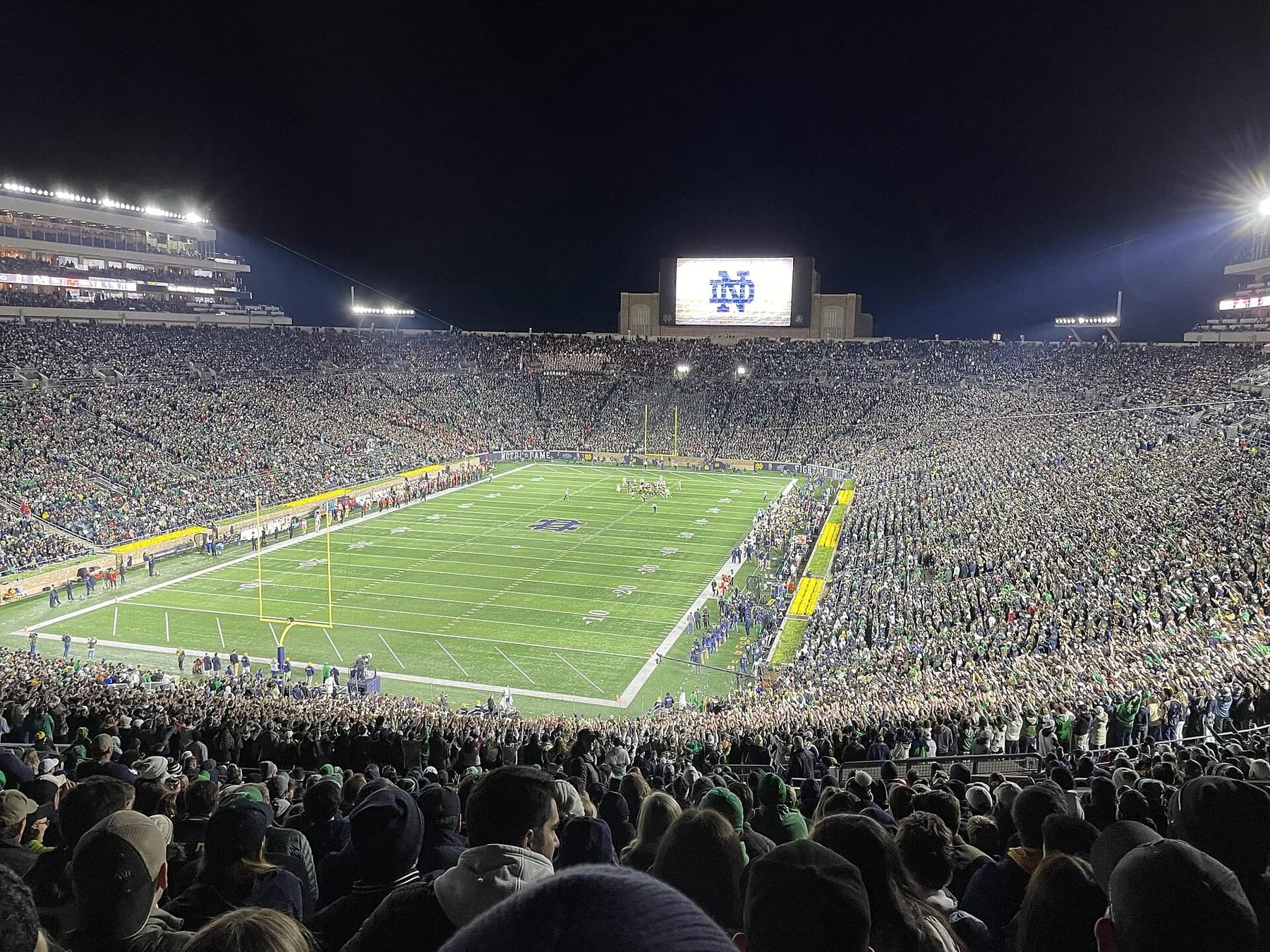
Photo: Eccekevin · CC BY-SA 4.0 · Cropped for display
Up next · Week 9
Neutral site
Neutral site vs.
Saturday, October 31 · 12:00 PM EDT
The season, taking shape
Final scores show Notre Dame first. Oldest to newest.
at PurduePregame 43–13
Game details at North Carolina
Pregame 36–13
Game details vs. Stanford
Pregame 47–8
Original full-season forecast
This forecast retains the original probabilities for the full schedule. It does not update with completed results or this week’s forecast.
2026 results
Current record, team efficiency, player production, and verified results from completed games.
Current record
6-16 wins · 1 lossThrough 7 completed gamesLoading player usage…
2026 season preview
CJ Carr started every game last season. Now the Irish must replace two first-round running backs while folding a talented transfer class into the offense and defense.
Notre Dame is not starting over at quarterback. CJ Carr started all 12 games in 2025, completed 66.7 percent of his passes and threw for 2,741 yards and 24 touchdowns. That is a valuable foundation for Marcus Freeman and offensive coordinator Mike Denbrock. The complication is everything changing around him: the Irish lost two first-round running backs, must settle their offensive line and are asking a high-upside transfer class to become useful quickly.
Carr’s full season of work changes the nature of the preseason. Notre Dame can spend August refining an offense around an established starter instead of dividing first-team snaps in another quarterback competition. His next step is less about proving he belongs and more about controlling games when the supporting cast is still taking shape. Protection calls, third-down decisions and red-zone efficiency will matter as much as the raw passing totals.
Preseason baseline
2025 percentiles retained as preseason context; current results and player production lead this page.
2025 FBS percentile scale · 50 is average
Incoming class
National and conference recruiting ranks, confirmed commitments, and the highest-ranked recruits in this class.
Top committed recruits
Notre Dame2026 transfer movement
Incoming and outgoing transfer activity, with rated FBS-to-FBS moves below.
Incoming Transfers
Notre DameOutgoing Transfers
Notre DameSeason schedule
Completed games show final results. Upcoming games use this week’s forecast where available; later games retain their published season outlook.
Detailed football intelligence
The full team identity, offense, defense, and supporting evidence.
Team identity
Last season, Notre Dame tried to lean on the running game; the approach consistently kept the offense on schedule.
Why it matters
The passing game was Notre Dame's more dependable way to stay ahead of the chains; opponents have to interrupt that rhythm without giving the run an easy box.
 at BYU
Pregame 31–19
Game detailsPregame comparisons use preserved published forecasts. Results include wins and losses.
At a glance
Current form leads the outlook.
2026 rates aggregate verified completed-game box scores. EPA is expected points added per play.
| Player | C/ATT | YDS | TD | INT |
|---|---|---|---|---|
| C.J. Carr | 129/193 | 1639 | 16 | 1 |
| Noah Grubbs | 14/22 | 164 | 1 | 0 |
| Teddy Jarrard | 2/2 | 29 | 0 | 0 |
| Player | CAR | YDS | AVG | TD |
|---|---|---|---|---|
| Jonaz Walton | 57 | 426 | 7.5 | 3 |
| Nolan James Jr. | 81 | 412 | 5.1 | 6 |
| Aneyas Williams | 70 | 302 | 4.3 | 4 |
| Player | REC | YDS | AVG | TD |
|---|---|---|---|---|
| Jordan Faison | 34 | 451 | 13.3 | 4 |
| Micah Gilbert | 22 | 409 | 18.6 | 2 |
| Jaden Greathouse | 19 | 263 | 13.8 | 2 |
| Player | TOT | SOLO | TFL | SACK |
|---|---|---|---|---|
| Drayk Bowen | 38 | 22 | 1 | 0 |
| Jaylen Sneed | 28 | 18 | 0 | 0 |
| Luke Talich | 27 | 22 | 4.5 | 1 |
Saturday, October 17 · LaVell Edwards Stadium
Saturday, October 10 · Notre Dame Stadium
Saturday, October 3 · Kenan Stadium
The backfield has the largest hole to fill. Jeremiyah Love and Jadarian Price were the first two running backs selected in the 2026 NFL Draft, with Price going No. 32 overall to Seattle. Price ran for 674 yards and 11 touchdowns in 2025 while also contributing as a receiver and returner. Losing both backs removes much more than one featured runner; Notre Dame must replace explosiveness, pass protection, receiving value and two trusted options for finishing drives. Aneyas Williams was held out of spring contact after an elbow injury, so his fall workload remains an important question.
Notre Dame attacked the passing-game transition with two former five-star receivers from Ohio State. Mylan Graham and Quincy Porter arrive with modest college production but obvious recruiting pedigree. Graham caught six passes for 93 yards last season, while Porter had four catches for 59 yards in five games. Neither should be treated as a finished answer, but their size and upside give Carr two new options who could change the ceiling of the receiver room if they earn Denbrock’s trust.
The offensive line may decide how quickly those pieces fit. Charles Jagusah entered fall camp without a clear return timetable, increasing the urgency around Notre Dame’s tackle-and-guard combinations. Tight end is open as well, with Ty Washington, Cooper Flanagan, James Flanigan and Jack Larsen competing to replace Eli Raridon. Carr’s experience can steady that transition, but the offense will be at its best if the line and tight ends allow Denbrock to use the full playbook instead of constantly protecting new starters.
The defense gives Freeman more room for patience. Boubacar Traore led Notre Dame with 10 tackles for loss and 6.5 sacks last season, while Kyngstonn Viliamu-Asa added 7.5 tackles for loss and three sacks. Drayk Bowen, Jaiden Ausberry and Viliamu-Asa also return as the core of an experienced linebacker group. That unit can keep the Irish out of early shootouts while the offense builds rhythm.
The transfer class strengthens two areas that already had useful pieces. Francis Brewu made 13 starts at Pitt last season and recorded 10 tackles for loss, while Tionne Gray brings Power Four experience from Oregon to the defensive-line rotation. In the secondary, DJ McKinney arrives after starting 22 games across two seasons at Colorado. He joins a back end that returns Leonard Moore, who had five interceptions and seven pass breakups in 10 games, and Adon Shuler, who added two interceptions and five breakups. The Irish do not need every newcomer to become a star; they need enough of them to create deeper, more flexible rotations.
The schedule will not offer a long runway. Notre Dame opens against Wisconsin at Lambeau Field, then hosts Rice and Michigan State before road games at Purdue and North Carolina. The first five weeks should reveal whether the offense can replace Love and Price without losing its balance, and whether the transfer additions can turn depth into dependable snaps. Notre Dame enters 2026 with fewer questions than the previous draft suggested. Carr is an experienced returning starter, the defense has proven playmakers and the incoming class raises the roster’s ceiling. The season hinges on how quickly that new cast becomes a coherent team around its quarterback.
This preview is based on the linked public reporting and official program records.
Profile high point
Big-play creation held the profile's highest percentile position.Profile low point
Big-play prevention held the lowest percentile position among the profile's strength measures.




Big-play creation is what Notre Dame can trust most.
Why it matters
The offense has its best route to changing field position without requiring flawless drive efficiency; front-seven disruption remains the first counter an opponent should test.
Notre Dame did not show one unit opponents could treat as an automatic target; front-seven disruption is only the first place to look.
What matters
Notre Dame's lowest-rated unit still finished above the national average last season, so opponents do not have an obvious weakness to attack.
For Notre Dame, the cleanest script is to lean on the running game, then let the passing game finish drives; fewer possessions make every empty drive more expensive.
What matters
Notre Dame's run-leaning structure played at a deliberate pace. The pass game finished top-tier, while the run game finished strong.
Inside the team
Open a section for the football detail and supporting numbers.
The down-to-down question that determines whether the offense can keep both the run and pass available.
Opponents have to break Notre Dame's passing rhythm before it owns early downs.
Why it matters
If Notre Dame keeps finding routine completions, the defense cannot load the box or turn the rush loose.
The pace, play selection, and methods this offense uses to stay on schedule.
Notre Dame played at a deliberate pace in 2025.
What matters
Notre Dame worked with fewer possessions than most teams last season.
Notre Dame's prior passing record was top-tier.
Why it matters
A repeatable pass game can let Notre Dame punish loaded boxes without relying on low-frequency deep completions.
Notre Dame's prior rushing record was strong.
Why it matters
A sustainable run game keeps Notre Dame's play action credible and limits obvious passing situations.
Notre Dame's explosive-play upside came with real defensive volatility.
Why it matters
That mix can produce fast scoring swings in either direction and makes missed tackles or coverage busts especially expensive.
How consistently the offense creates manageable situations and the defense prevents them.
Notre Dame won ordinary downs on both sides of the ball.
Why it matters
Notre Dame's success rate shows whether it can sustain drives and get stops without relying on sacks, turnovers, or isolated big plays.
Notre Dame's opponent-adjusted passing and rushing value were closely matched.
Why it matters
When the split is narrow, early-down execution matters more than steering the offense toward one obvious weakness.
Where the defense can create pressure, control the run, and end drives.
Notre Dame's prior defense was top-tier overall and strongest in pass defense.
Why it matters
Opponents can start by leaning on base protection rules until the rush forces an adjustment, though that unit still finished above-average. Notre Dame's pass defense can still tighten throwing windows, so the offense has to prove the opening will hold up.
Notre Dame's available disruption measures finished above the national average last season; a charted pressure rate is not available.
Why it matters
Sustained disruption can create negative plays and give Notre Dame a better chance to end drives before third down.
Notre Dame's disruption regularly finished at the quarterback.
What matters
Both sack production and front-seven disruption cleared the FBS midpoint.
Notre Dame's prior run-defense results were strong.
Why it matters
A dependable run front can let Notre Dame create obvious passing downs without committing extra bodies to the box.