Week 5 · FinalW
 vs. Penn State
34–13+21 margin
Pregame 23–27
Game detailsSaturday Index
Loading team intelligenceBringing the latest verified football information into focus.
Big Ten · 2026 · Week 8
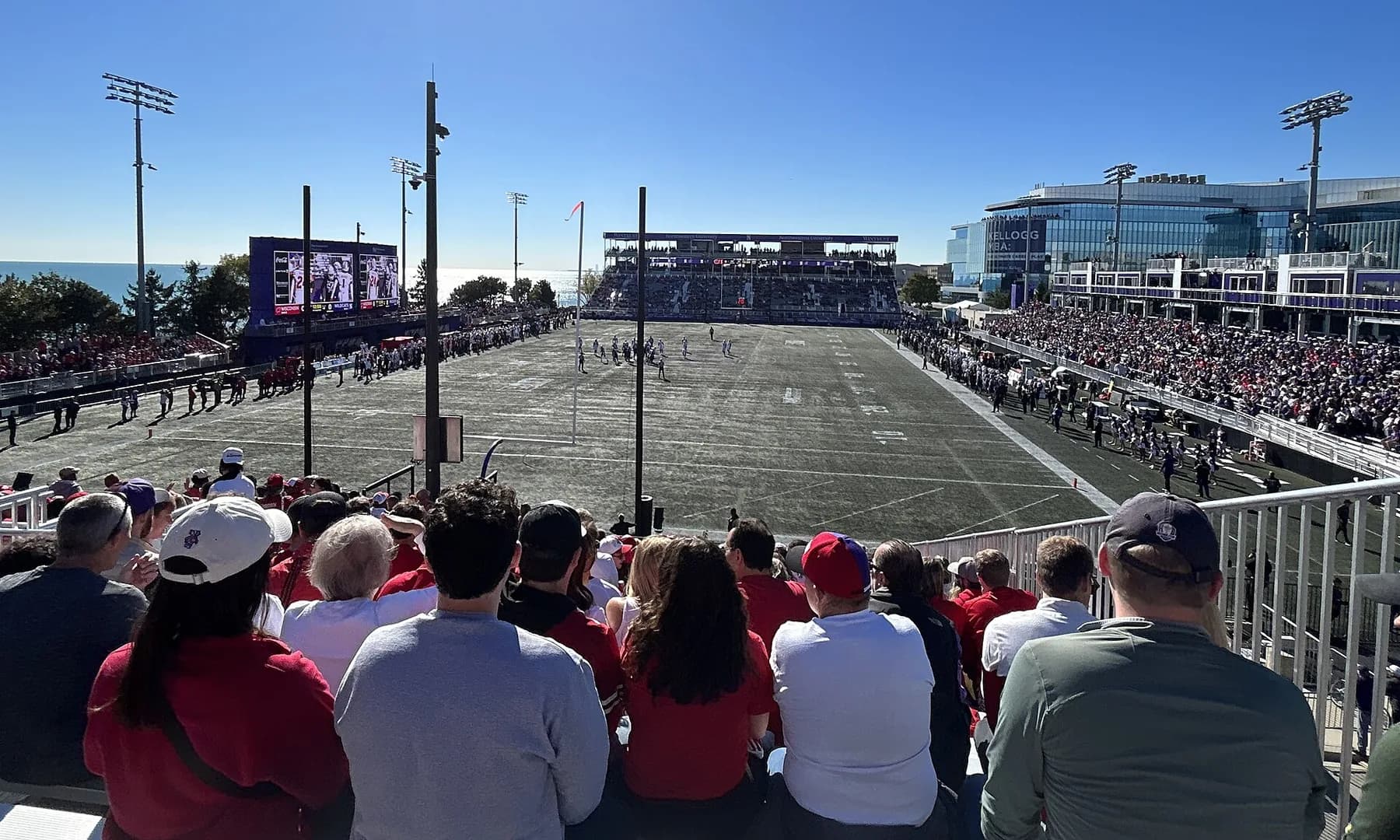
Photo: SecretName101 · CC BY 4.0 · Cropped for display
Up next · Week 9
Away
On the road at
Saturday, October 31 · Time TBA
The season, taking shape
Final scores show Northwestern first. Oldest to newest.
vs. Penn StatePregame 23–27
Game details vs. Ball State
Pregame 43–10
Game details at Michigan State
Pregame
Original full-season forecast
This forecast retains the original probabilities for the full schedule. It does not update with completed results or this week’s forecast.
2026 results
Current record, team efficiency, player production, and verified results from completed games.
Current record
6-16 wins · 1 lossThrough 7 completed gamesLoading player usage…
2026 season preview
An experienced quarterback competition and unusual receiver continuity give Northwestern options, but progress will depend on rebuilt lines and a defense replacing edge production.
Northwestern’s 2026 season turns on whether David Braun can make a major offensive reset work without sacrificing the defensive continuity that has become the program’s sturdier foundation. Chip Kelly arrives as offensive coordinator, while Tim McGarigle remains in charge of the defense and Paul Creighton continues to oversee special teams. Braun has described Kelly’s offense as variable in tempo and built around efficiency and decision-making, with the run game central to that design. The aim is to give the quarterback clearer answers, stress defenses at multiple speeds and turn a change in leadership into a coherent identity.
Original season forecast
The original Big Ten forecast, retained alongside current results.
Big Ten projected standing
#17
3-6 projected · 2.8 expected conference wins · #17 of 18.
Preseason baseline
2025 percentiles retained as preseason context; current results and player production lead this page.
2025 FBS percentile scale · 50 is average
Incoming class
National and conference recruiting ranks, confirmed commitments, and the highest-ranked recruits in this class.
Top committed recruits
Northwestern2026 transfer movement
Incoming and outgoing transfer activity, with rated FBS-to-FBS moves below.
Incoming Transfers
NorthwesternOutgoing Transfers
NorthwesternSeason schedule
Completed games show final results. Upcoming games use this week’s forecast where available; later games retain their published season outlook.
Detailed football intelligence
The full team identity, offense, defense, and supporting evidence.
Team identity
Last season, Northwestern tried to stay balanced between the run and pass; the results were uneven when the offense tried to live that way.
Why it matters
The run game was Northwestern's steadier way to stay ahead of the chains; opponents have to win early fits without handing away play action.
 vs. Rutgers
Pregame 34–21
Game detailsPregame comparisons use preserved published forecasts. Results include wins and losses.
At a glance
Current form leads the outlook.
2026 rates aggregate verified completed-game box scores. EPA is expected points added per play.
| Player | C/ATT | YDS | TD | INT |
|---|---|---|---|---|
| Aidan Chiles | 117/164 | 1617 | 12 | 1 |
| Player | CAR | YDS | AVG | TD |
|---|---|---|---|---|
| Caleb Komolafe | 88 | 551 | 6.3 | 5 |
| Joseph Himon II | 38 | 371 | 9.8 | 3 |
| Gavin Sawchuk | 46 | 223 | 4.8 | 0 |
| Player | REC | YDS | AVG | TD |
|---|---|---|---|---|
| Griffin Wilde | 39 | 615 | 15.8 | 4 |
| Alex Honig | 14 | 221 | 15.8 | 3 |
| Drew Wagner | 23 | 218 | 9.5 | 2 |
| Player | TOT | SOLO | TFL | SACK |
|---|---|---|---|---|
| Braydon Brus | 62 | 31 | 10.5 | 4 |
| Kobie McKinzie | 49 | 22 | 4 | 2 |
| Robert Fitzgerald | 45 | 20 | 0 | 0 |
Saturday, October 24 · Ryan Field
Saturday, October 17 · Spartan Stadium
Saturday, October 10 · Ryan Field
Aidan Chiles enters the most consequential competition on the roster. July coverage expected him to lead a quarterback room that also includes fellow experienced transfer Nicco Marchiol, returner Ryan Boe and several developmental options. Chiles’ arm talent and mobility could expand Kelly’s playbook, but steadier processing and ball security will determine whether those traits translate into dependable production. Marchiol gives Northwestern credible competition and insurance rather than a ceremonial alternative. No starter had been formally identified entering camp, and true freshman Johnny O’Brien appears more relevant to the room’s long-term depth than its immediate race.
The supporting cast should make that transition more manageable. Caleb Komolafe and Joseph Himon II return at running back, with Gavin Sawchuck and Mar’Kel Porter adding experienced alternatives after Cam Porter’s graduation and two other departures. Kelly can build a rotation around several plausible options instead of asking one back to carry the entire run game. At receiver, Griffin Wilde leads a group returning essentially its full depth chart. Wilde caught 71 passes for 880 yards and eight touchdowns in 2025, while Hayden Eligon II and Drew Wagner also return. That familiarity gives either quarterback an established primary target and fewer new relationships to build at once.
Tight end offers formation flexibility but less certainty. Spring projections placed UConn transfer Alex Honig and Division II transfer Jake Dehnicke among the leading candidates, and Kelly’s history suggests the position can become a meaningful matchup tool. The larger offensive concern is up front. New line coach Tim Drevno previously worked with Kelly at UCLA and brings 33 years of college and NFL experience, including a development résumé featuring six eventual first-round selections. His familiarity with the scheme matters, but he must assemble a rebuilt unit around transfers and a new center quickly enough for Kelly’s run game and tempo changes to function.
McGarigle gives the defense a more familiar starting point. Northwestern is expected to retain the 4-2-5 and multiple 4-3 structure used previously, generally pairing four down linemen with two linebackers and a nickel defensive back. That continuity reduces the installation burden, but the front still needs new sources of disruption. Michael Kilbane returns after recording 43 tackles, 7.5 tackles for loss and 3.5 sacks in 2025, with Brendan Flakes another returning leader. Anto Saka’s transfer and Aidan Hubbard’s move toward the NFL leave Kilbane’s development central to Northwestern’s effort to replace its most significant edge production.
There is veteran help behind that front. Spring projections paired Braydon Brus with Oklahoma transfer Kobie McKinzie at linebacker, with Nigel Glover and Jack Sadowsky V among the options behind them. Those roles were not settled entering camp, but experience in the middle could steady a changing line. Braden Turner supplies the secondary’s clearest anchor after starting 12 games and producing 56 tackles, two forced fumbles, two recoveries and an interception in 2025. His work at nickel connects coverage with run support; the development of the corners and safeties around him will shape how aggressively McGarigle can use that versatility.
Braun’s broader challenge is integration. January coverage counted 14 transfer additions, including Northwestern’s first two four-star transfers, and placed the class 11th in the Big Ten in 247Sports’ transfer metric at that time. The portal has become a primary route to immediate talent, particularly at quarterback and along both lines. That raises the roster’s possibilities while putting more pressure on the staff to create cohesion. Kelly and Drevno must make new pieces operate as a unit on offense, while McGarigle must preserve the defense’s structure as personnel changes around it.
The schedule will test that work early and repeatedly. Northwestern opens at Martin Stadium against South Dakota State and Colorado, then travels to Indiana before Ryan Field reopens against Penn State on October 2. That sequence creates an immediate measure of the new offense before an emotionally significant homecoming. Later, the Wildcats visit Oregon, travel to Ohio State two weeks afterward and then go to Minnesota before Illinois closes the regular season at Ryan Field. Northwestern’s path is not difficult to define: efficient quarterback play, a credible run game, Wilde-led receiving continuity and a defense stabilized by familiar coaching. Whether that formula holds will depend most heavily on the two rebuilt lines—and on how quickly Braun’s collection of new parts becomes a connected team.
This preview is based on the linked public reporting and official program records.
Profile high point
Big-play prevention held the profile's highest percentile position.Profile low point
Big-play creation held the lowest percentile position among the profile's strength measures.




The run game is Northwestern's best starting point, though big-play creation keeps it from carrying the plan alone.
What matters
Northwestern's rushing structure finished above the national average last season.
Big-play creation is Northwestern's biggest concern, and opponents can test it immediately.
Why it matters
Opponents can squeeze underneath space and make the offense finish long drives without chunk gains; rushing structure has to keep that stress from setting the game plan.
Northwestern is at its best when it can stay balanced between the run and pass, then let the run game finish drives; fewer possessions make every empty drive more expensive.
Why it matters
Northwestern's clean script is to stay ahead with early-down runs, draw an extra defender into the box, and then use play action; defenses will try to force obvious passing downs. In a slower game, one empty drive or failed early-down series carries extra weight.
Inside the team
Open a section for the football detail and supporting numbers.
The down-to-down question that determines whether the offense can keep both the run and pass available.
Opponents have to keep Northwestern's run game from turning first down into second-and-manageable.
Why it matters
If Northwestern stays on schedule on the ground, the offense keeps more answers available.
The pace, play selection, and methods this offense uses to stay on schedule.
Northwestern played at a deliberate pace in 2025.
What matters
Northwestern worked with fewer possessions than most teams last season.
Northwestern's prior passing record was below-average.
Why it matters
Northwestern's offense needs protection, field position, or explosive variance when ordinary dropbacks do not create enough value.
Northwestern's prior rushing record was above-average.
Why it matters
When Northwestern's run game cannot stay on schedule, protection and passing-down execution carry more of the offense.
Northwestern was better at preventing explosive plays than creating them.
Why it matters
The defense can keep a game on schedule, but the offense may need longer drives and more third-down conversions to separate.
How consistently the offense creates manageable situations and the defense prevents them.
Northwestern's offense was more consistent down to down than its defense.
Why it matters
Northwestern's success rate shows whether it can sustain drives and get stops without relying on sacks, turnovers, or isolated big plays.
Opponent-adjusted EPA identifies the run game as Northwestern's stronger offensive unit.
Why it matters
Forcing longer passing situations is the clearest way to move the offense away from its stronger adjusted unit.
Where the defense can create pressure, control the run, and end drives.
Northwestern's prior defense was weak overall and strongest in pass defense.
Why it matters
Opponents can test the fits early enough to keep every offensive option open; Northwestern needs its pass defense to tighten throwing windows before that plan settles in.
Northwestern's available disruption measures ranked in the lower national range last season; a charted pressure rate is not available.
Why it matters
Without consistent disruption, Northwestern's defense must win more snaps through coverage, leverage, and early-down prevention.
Northwestern's sack and disruption results were weak.
Why it matters
Northwestern's disruption can hurry an offense; sacks do more by erasing field position and ending passing downs.
Northwestern's prior run-defense results were bottom-tier.
Why it matters
If Northwestern's front cannot control early downs, opponents can keep every offensive option open and protect their passing game.