Week 5 · FinalL
 vs. Notre Dame
26–37-11 margin
Pregame 13–36
Game detailsSaturday Index
Loading team intelligenceBringing the latest verified football information into focus.
ACC · 2026 · Week 8
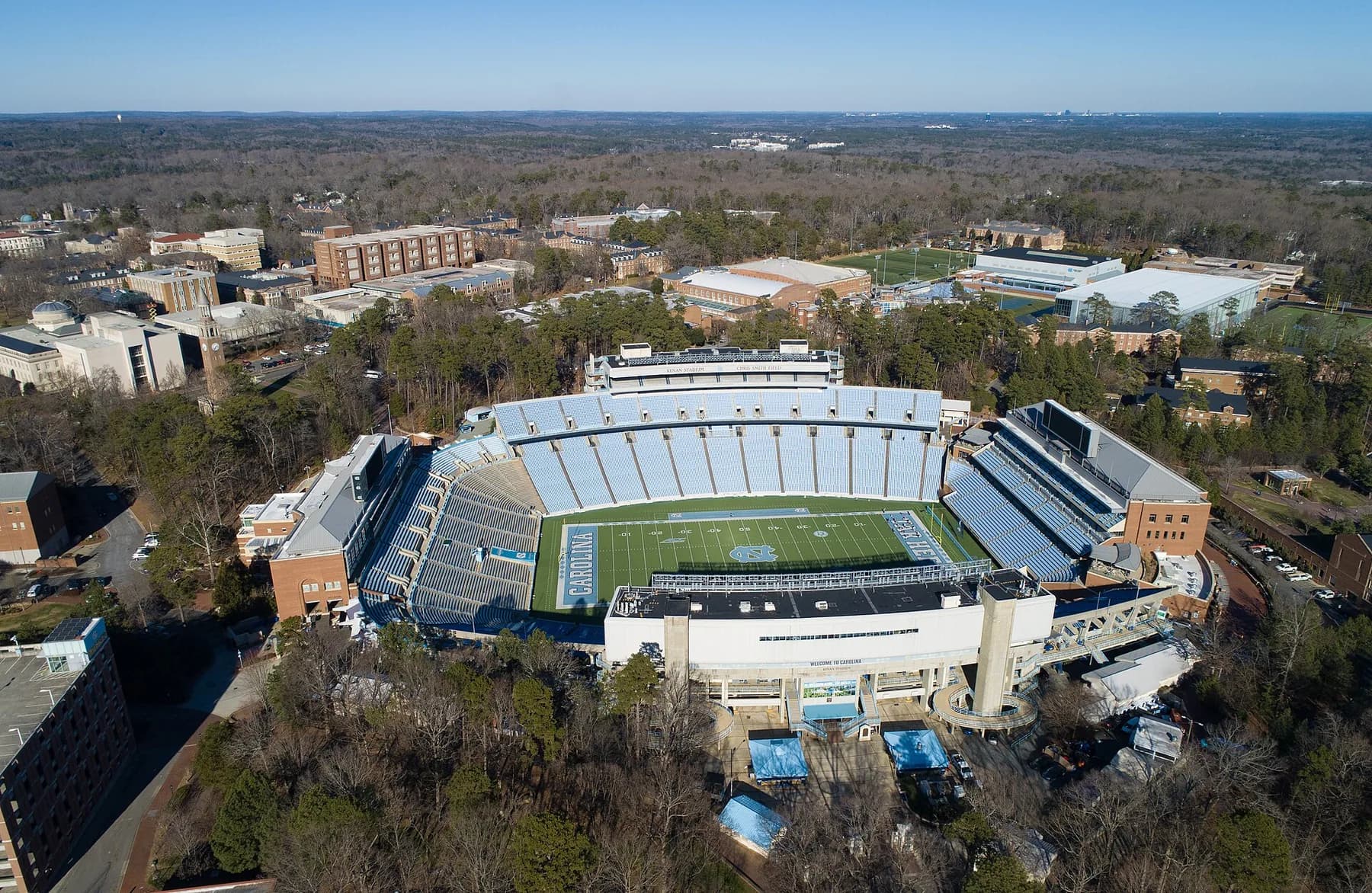
Photo: CramBetter.com · CC BY 4.0 · Cropped for display
Up next · Week 9
Home
Hosting
Saturday, October 31 · Time TBA
The season, taking shape
Final scores show North Carolina first. Oldest to newest.
vs. Notre DamePregame 13–36
Game details at Pittsburgh
Pregame 21–31
Game details at Duke
Pregame 22–28
Original full-season forecast
This forecast retains the original probabilities for the full schedule. It does not update with completed results or this week’s forecast.
2026 results
Current record, team efficiency, player production, and verified results from completed games.
Current record
4-34 wins · 3 lossesThrough 7 completed gamesLoading player usage…
2026 season preview
Bill Belichick’s second team is further along in its preparation, but UNC’s progress will depend on a healthy quarterback, a cohesive offensive line and defensive answers around proven playmakers.
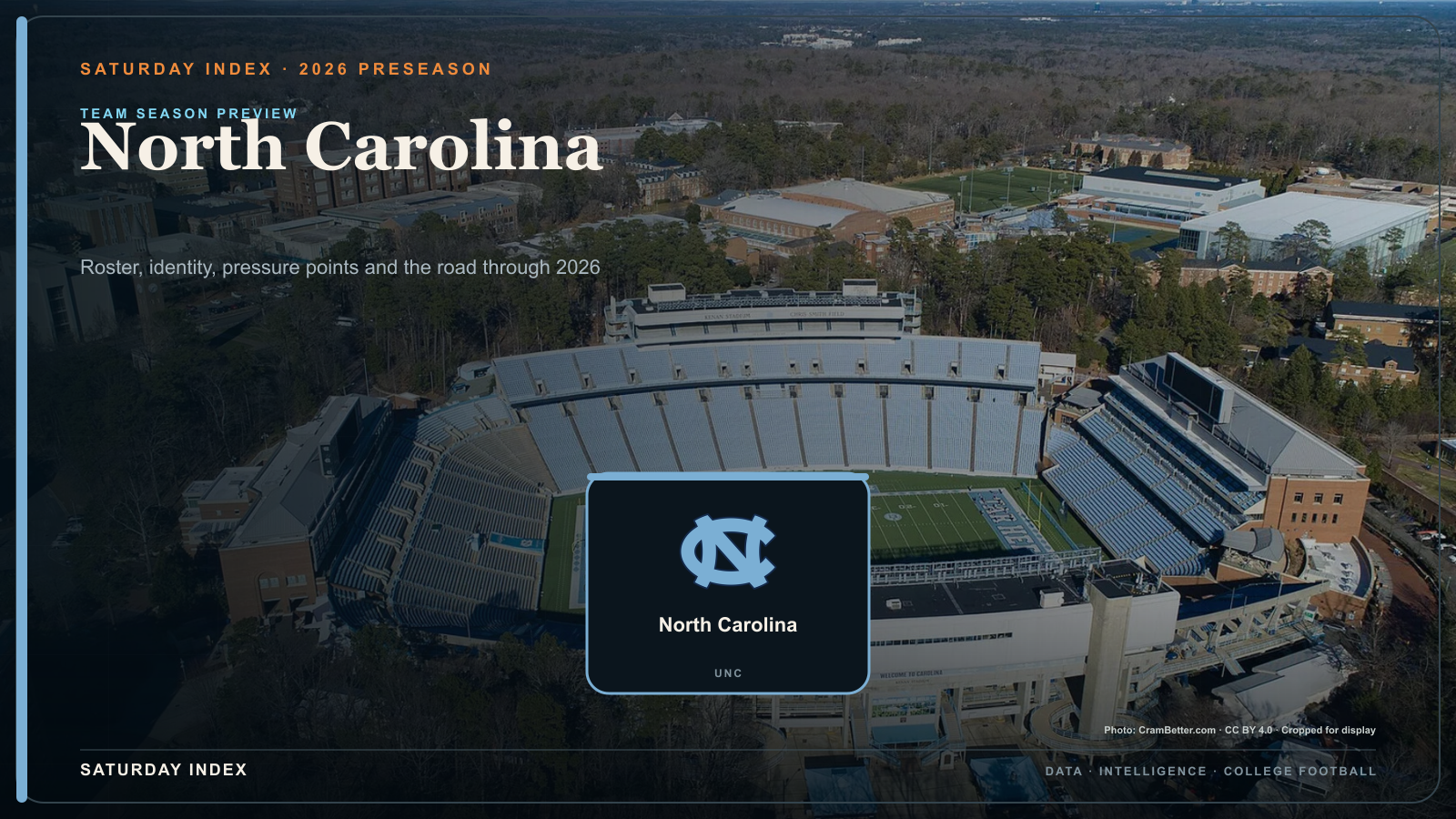
North Carolina enters 2026 with something Bill Belichick’s first team never enjoyed: time. After a 4-8 debut assembled on a compressed calendar, Belichick begins year two with most of his roster in place earlier, Stephen Belichick continuing to run the defense and Bobby Petrino taking over the offense. That continuity does not erase extensive personnel turnover, but it changes the central question. UNC is no longer racing simply to put a team together; it must show what a fuller offseason can produce.
Original season forecast
The original ACC forecast, retained alongside current results.
ACC projected standing
#14
2-6 projected · 2.4 expected conference wins · #14 of 17.
Preseason baseline
2025 percentiles retained as preseason context; current results and player production lead this page.
2025 FBS percentile scale · 50 is average
Incoming class
National and conference recruiting ranks, confirmed commitments, and the highest-ranked recruits in this class.
Top committed recruits
North Carolina2026 transfer movement
Incoming and outgoing transfer activity, with rated FBS-to-FBS moves below.
Incoming Transfers
North CarolinaOutgoing Transfers
North CarolinaSeason schedule
Completed games show final results. Upcoming games use this week’s forecast where available; later games retain their published season outlook.
Detailed football intelligence
The full team identity, offense, defense, and supporting evidence.
Team identity
Last season, North Carolina tried to stay balanced between the run and pass; it rarely provided an easy foundation.
Why it matters
The passing game was North Carolina's less difficult offensive option, but it did not provide a dependable way to stay ahead of the chains; the offense must prove that rhythm before opponents have to widen their structure.
 vs. Syracuse
Pregame 31–22
Game detailsPregame comparisons use preserved published forecasts. Results include wins and losses.
At a glance
Current form leads the outlook.
2026 rates aggregate verified completed-game box scores. EPA is expected points added per play.
| Player | C/ATT | YDS | TD | INT |
|---|---|---|---|---|
| Billy Edwards | 121/201 | 1530 | 11 | 5 |
| Miles O'Neill | 3/6 | 22 | 0 | 0 |
| Player | CAR | YDS | AVG | TD |
|---|---|---|---|---|
| Benjamin Hall | 57 | 283 | 5.0 | 0 |
| Demon June | 59 | 245 | 4.2 | 7 |
| Jaylen McGill | 42 | 234 | 5.6 | 2 |
| Player | REC | YDS | AVG | TD |
|---|---|---|---|---|
| Jordan Shipp | 41 | 543 | 13.2 | 2 |
| Jelani Thurman | 33 | 391 | 11.8 | 4 |
| Trech Kekahuna | 14 | 162 | 11.6 | 0 |
| Player | TOT | SOLO | TFL | SACK |
|---|---|---|---|---|
| Derek Mcdonald | 71 | 26 | 2 | 0 |
| Peyton Seelmann | 64 | 27 | 2 | 1.5 |
| Leroy Jackson | 44 | 14 | 1 | 1 |
Saturday, October 24 · Kenan Stadium
Saturday, October 17 · Wallace Wade Stadium
Saturday, October 10 · Acrisure Stadium
Petrino’s arrival gives that evaluation a clear offensive focus. Arkansas averaged 454.8 yards and 32.9 points per game under him in 2025 and scored on 91.7% of its red-zone trips. Those results will not transfer automatically to Chapel Hill, especially with UNC rebuilding several position groups, but they illustrate the standard Petrino brings. Belichick said late in the spring that roughly 90% of the team was already on campus, giving the new coordinator substantially more time to install his system and identify the combinations capable of running it.
Billy Edwards Jr. is the pivotal figure in that effort. UNC credits the graduate transfer with 11 starts, 2,881 passing yards and 15 touchdowns in 2024 before an injury cost him most of the following season. He is the roster’s most experienced quarterback and the clearest candidate to give Petrino an established operator, but his recent injury history makes durability central to the season. Miles O’Neill, Au’Tori Newkirk and Andres Miyares Jr. are also listed at quarterback, while Taron Dickens and freshman Travis Burgess participated in the spring competition. How the backup order develops will matter behind a player coming off a largely lost year.
Petrino has options around the quarterback, even if the distribution of touches is still taking shape. Sophomore Demon June returns as the leading established runner, with Benjamin Hall also featured in UNC’s coverage after the first practice. Jordan Shipp supplies continuity at receiver, and transfers Trech Kekahuna, Nathan Leacock and Dayton Sneed broaden the group. Mason Humphrey adds a vertical element after producing 650 yards, four touchdowns and 18.6 yards per catch for Lehigh in 2025. The task is turning those varied pieces into dependable answers rather than a rotating collection of possibilities.
Tight end offers similar upside without established UNC production. Arkansas transfer Shamar Easter, Ohio State transfer Jelani Thurman and freshmen Carson Sneed and Dream Rashad make the room physically intriguing, but their roles remain open. More consequential is the offensive line, where graduate transfer Christo Kelly and senior Andrew Threatt bring experience to a group that also includes several freshmen and redshirt freshmen. A stable five would give Edwards the protection and Petrino the flexibility to use the backfield and receiving talent; prolonged shuffling would limit both.
The defense has a more obvious starting point. Melkart Abou Jaoude returns after earning second-team All-ACC recognition and leading the conference with 10.5 sacks. Richmond transfer Donovan Hoilette Jr. recorded 13 tackles for loss in 2025, giving Stephen Belichick another proven source of disruption. Their ability to pressure offenses can help a rebuilt front and reduce the burden on developing combinations behind them, making the edge tandem UNC’s most established defensive strength.
At linebacker, Oklahoma State transfer Jonathan Agumadu and Richmond transfer Peyton Seelmann join returners and a freshman group that includes DQ Forkpa. That room must establish its communication and run-fit reliability. The secondary has a proven reference point in Kaleb Cost, who made 45 tackles, broke up five passes and intercepted one in 11 appearances. Florida transfer Greg Smith and UCLA transfer Khristian Dunbar-Hawkins add options, but chemistry across the corner, nickel and safety combinations will be as important as individual talent.
The larger tension is whether preparation time can overcome roster churn. UNC recorded 20 incoming and 31 outgoing transfers, leaving plenty of new relationships to form on both sides of the ball. Earlier arrivals should make installation and evaluation more orderly than they were before the 2025 season. They do not settle the offensive line, Edwards’ durability, the linebacker rotation or the secondary combinations. Those are connected issues: protection determines how fully Petrino can use his quarterback, while communication behind the defensive front determines whether the pass rush can become a complete defense.
The schedule will test that progress quickly. UNC opens against TCU in Dublin on Aug. 29, receives an early bye and hosts ETSU before beginning ACC play at Clemson on Sept. 19. A second bye leads into Notre Dame’s visit to Kenan Stadium, followed by consecutive trips to Pittsburgh and Duke. The preparation windows are valuable, but TCU, Clemson and Notre Dame create demanding early measuring points. For Belichick’s second team, the season turns less on the volume of new names than on whether Edwards, the offensive line and the defense around Abou Jaoude can convert a steadier build into functional football.
This preview is based on the linked public reporting and official program records.
Profile high point
Big-play prevention held the profile's highest percentile position.Profile low point
Big-play creation held the lowest percentile position among the profile's strength measures.



North Carolina did not have one unit that could carry the whole game plan, even at its best available point.
What matters
Even North Carolina's best unit finished below the national average last season, leaving no proven strength to build around.
Big-play creation is North Carolina's biggest concern, and opponents can test it immediately.
Why it matters
Opponents can squeeze underneath space and make the offense finish long drives without chunk gains; defensive control has to keep that stress from setting the game plan.
North Carolina's best path is to stay balanced between the run and pass, then let the passing game finish drives; fewer possessions make every empty drive more expensive.
Why it matters
North Carolina's clean script uses efficient early throws to stay ahead of the sticks; defenses will attack protection and route timing before the full passing menu opens. In a slower game, one empty drive or failed early-down series carries extra weight.
Inside the team
Open a section for the football detail and supporting numbers.
The down-to-down question that determines whether the offense can keep both the run and pass available.
Before defenses have to adjust, North Carolina must prove routine throws can keep first down on schedule.
What matters
Last season's passing results did not establish a dependable way to stay out of long-yardage.
The pace, play selection, and methods this offense uses to stay on schedule.
North Carolina played at a deliberate pace in 2025.
What matters
North Carolina worked with fewer possessions than most teams last season.
North Carolina's prior passing record was weak.
Why it matters
North Carolina's offense needs protection, field position, or explosive variance when ordinary dropbacks do not create enough value.
North Carolina's prior rushing record was bottom-tier.
Why it matters
When North Carolina's run game cannot stay on schedule, protection and passing-down execution carry more of the offense.
North Carolina's explosive-play results were mixed rather than a defining edge.
Why it matters
A big play can still flip a possession, but last season's results do not make explosiveness something this team can rely on.
How consistently the offense creates manageable situations and the defense prevents them.
North Carolina's defense was more consistent down to down than its offense.
Why it matters
North Carolina's success rate shows whether it can sustain drives and get stops without relying on sacks, turnovers, or isolated big plays.
Opponent-adjusted EPA identifies the pass game as North Carolina's stronger offensive unit.
Why it matters
If an opponent removes the first passing answer, the run game's lower adjusted value becomes the key counter to test.
Where the defense can create pressure, control the run, and end drives.
North Carolina's prior defense was below-average overall and strongest in pass defense.
Why it matters
Opponents can trust normal protection and make coverage hold through the route; North Carolina needs its pass defense to tighten throwing windows before that plan settles in.
North Carolina's available disruption measures finished below the national average last season; a charted pressure rate is not available.
North Carolina's sack production outpaced its broader disruption record.
Why it matters
North Carolina's disruption can hurry an offense; sacks do more by erasing field position and ending passing downs.
North Carolina's prior run-defense results were middle-of-the-pack.
Why it matters
If North Carolina's front cannot control early downs, opponents can keep every offensive option open and protect their passing game.