Week 4 · FinalW
 at Michigan State
31–13+18 margin
Pregame 27–22
Game detailsSaturday Index
Loading team intelligenceBringing the latest verified football information into focus.
Big Ten · 2026 · Week 8

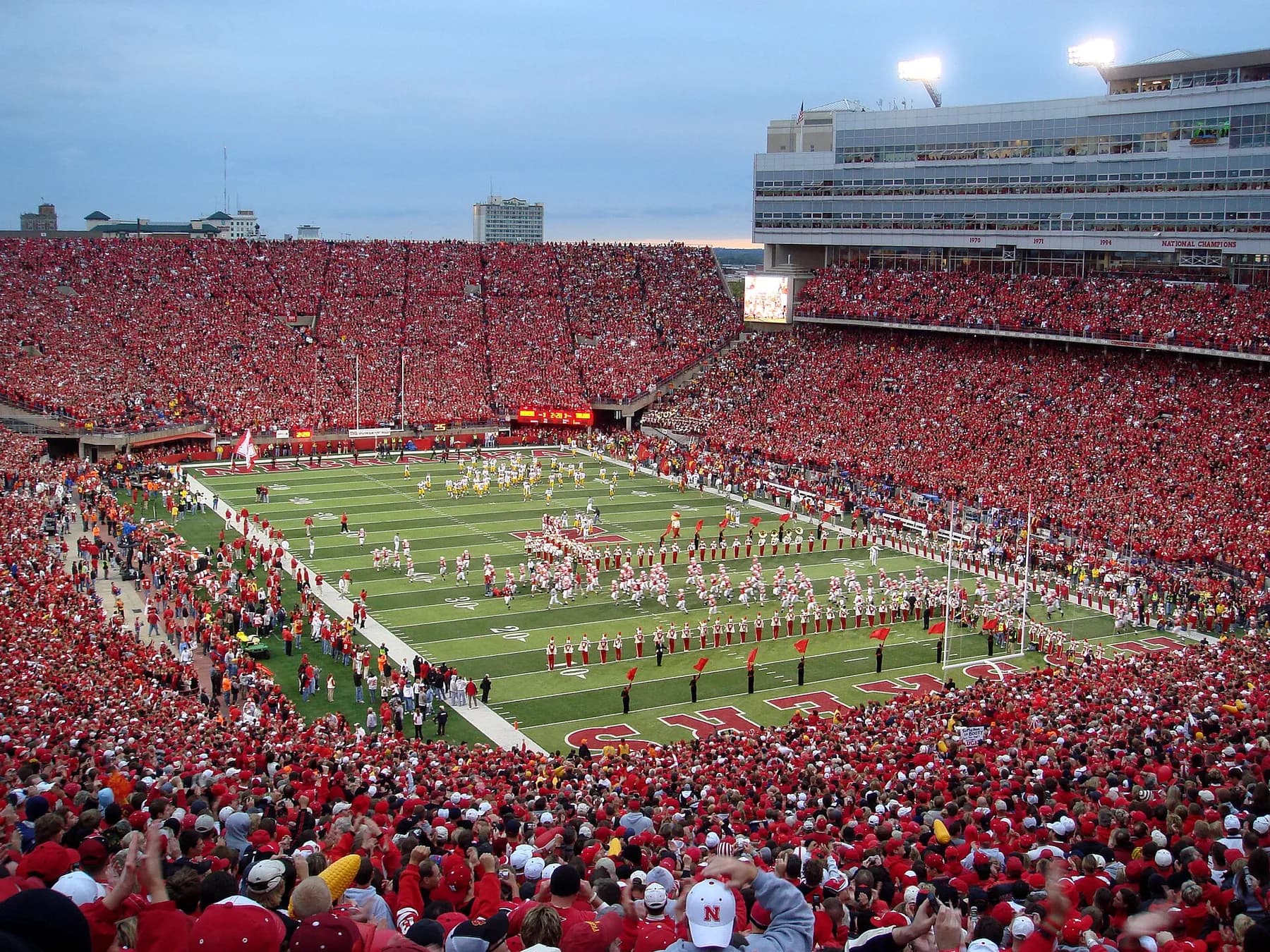
Photo: Bobak Ha'Eri · CC BY 3.0 · Cropped for display
Up next · Week 9
Home
Hosting
Saturday, October 31 · Time TBA
The season, taking shape
Final scores show Nebraska first. Oldest to newest.
at Michigan StatePregame 27–22
Game details vs. Maryland
Pregame 35–20
Game details vs. Indiana
Pregame 22–29
Original full-season forecast
This forecast retains the original probabilities for the full schedule. It does not update with completed results or this week’s forecast.
2026 results
Current record, team efficiency, player production, and verified results from completed games.
Current record
5-25 wins · 2 lossesThrough 7 completed gamesLoading player usage…
2026 season preview
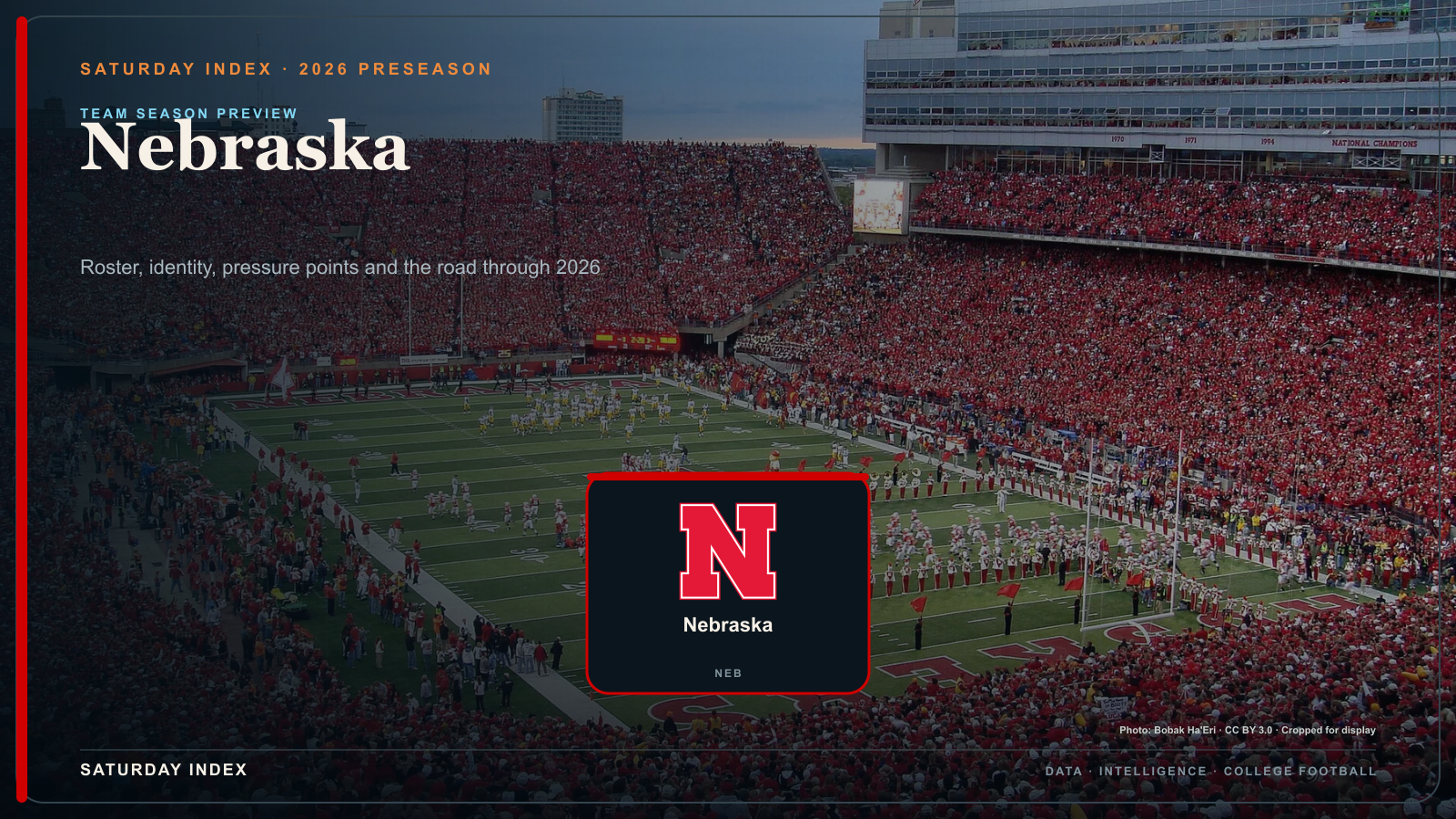
Nebraska’s 2026 season is a test of how Matt Rhule manages continuity and change at the same time. Rhule enters his fourth year in Lincoln with Dana Holgorsen beginning his second full season as offensive coordinator, giving the Huskers stability in play-calling as they replace major backfield production. Defense brings the opposite dynamic. First-year coordinator Rob Aurich is expected to install an attacking 4-2-5, making the speed of that transition central to whether Nebraska can take a meaningful step forward.
The most visible change comes at quarterback. UNLV transfer Anthony Colandrea, the 2025 Mountain West Offensive Player of the Year, is the leading option after Dylan Raiola’s departure, though Nebraska has not formally established its opening-day starter. Colandrea brings mobility and off-schedule creativity that could give Holgorsen a different way to generate explosive plays. Daniel Kaelin’s return to Nebraska supplies credible competition and depth. Whoever starts will inherit an offense that can use quarterback movement but must avoid turning improvisation into unnecessary pressure or contact.
Original season forecast
The original Big Ten forecast, retained alongside current results.
Big Ten projected standing
#13
4-5 projected · 3.6 expected conference wins · #13 of 18.
Preseason baseline
2025 percentiles retained as preseason context; current results and player production lead this page.
2025 FBS percentile scale · 50 is average
Incoming class
National and conference recruiting ranks, confirmed commitments, and the highest-ranked recruits in this class.
Top committed recruits
Nebraska2026 transfer movement
Incoming and outgoing transfer activity, with rated FBS-to-FBS moves below.
Incoming Transfers
NebraskaOutgoing Transfers
NebraskaSeason schedule
Completed games show final results. Upcoming games use this week’s forecast where available; later games retain their published season outlook.
Detailed football intelligence
The full team identity, offense, defense, and supporting evidence.
Team identity
Last season, Nebraska tried to stay balanced between the run and pass; the approach gave the offense a dependable starting point.
Why it matters
The run game was Nebraska's steadier way to stay ahead of the chains; opponents have to win early fits without handing away play action.
 at Oregon
Pregame 18–34
Game detailsPregame comparisons use preserved published forecasts. Results include wins and losses.
At a glance
Current form leads the outlook.
2026 rates aggregate verified completed-game box scores. EPA is expected points added per play.
| Player | C/ATT | YDS | TD | INT |
|---|---|---|---|---|
| Anthony Colandrea | 137/219 | 1568 | 14 | 4 |
| TJ Lateef | 8/11 | 82 | 1 | 0 |
| Player | CAR | YDS | AVG | TD |
|---|---|---|---|---|
| Jamal Rule | 60 | 391 | 6.5 | 5 |
| Anthony Colandrea | 68 | 334 | 4.9 | 4 |
| Mekhi Nelson | 71 | 309 | 4.4 | 4 |
| Player | REC | YDS | AVG | TD |
|---|---|---|---|---|
| Kwazi Gilmer | 38 | 492 | 12.9 | 7 |
| Jacory Barney Jr. | 29 | 393 | 13.6 | 2 |
| Luke Lindenmeyer | 22 | 178 | 8.1 | 1 |
| Player | TOT | SOLO | TFL | SACK |
|---|---|---|---|---|
| Owen Chambliss | 46 | 15 | 3.5 | 0.5 |
| Dwayne McDougle | 43 | 26 | 0 | 0 |
| Donovan Jones | 30 | 19 | 5 | 2 |
Saturday, October 17 · Autzen Stadium
Saturday, October 10 · Memorial Stadium (Lincoln, NE)
Saturday, October 3 · Memorial Stadium (Lincoln, NE)
Nebraska has experienced targets to ease that transition. Nyziah Hunter and Jacory Barney Jr. combined for 88 catches, 1,101 yards and 10 touchdowns in 2025, and UCLA transfer Kwazi Gilmer adds another seasoned receiver. Tight end Luke Lindenmeyer started every game last season and earned honorable-mention All-Big Ten recognition, while Carter Nelson offers additional formation flexibility. That group should give the quarterback answers across the field. The less settled question is who replaces All-American running back Emmett Johnson. Mekhi Nelson, Isaiah Mozee, freshman Jamal Rule and July addition Tikey Hayes form the principal competition, but none arrives as a proven replacement for Johnson’s production.
The offensive line will determine how comfortably those pieces fit together. Center Justin Evans and tackle Elijah Pritchett return, while Paul Mubenga, Brendan Black and Tree Babalade bring previous starting experience. Nebraska has a veteran foundation, but a retooled unit still must establish its best five and develop cohesion around a new quarterback and backfield. Opening at home against Ohio, Bowling Green and North Dakota gives the Huskers three games to work through those combinations before Big Ten play begins at Michigan State.
Aurich’s defensive assignment is easier to define than to execute. Nebraska finished third nationally against the pass in 2025 but 100th against the run. The new 4-2-5 is expected to attack, yet aggression will matter only if the front and linebackers play with dependable leverage and fit the run correctly. Aurich must improve that weakness without sacrificing the coverage strength Nebraska already possesses. Installation, communication and discipline will therefore matter as much as the scheme’s promise.
Riley Van Poppel, Williams Nwaneri and Cameron Lenhardt return along the front, with Jahsear Whittington and Anthony Jones Jr. joining a pass rush that averaged fewer than two sacks per game last season. More disruption could prevent opponents from sustaining drives and repeatedly testing Nebraska’s run defense. At linebacker, Vincent Shavers Jr. returns alongside transfers Owen Chambliss and Dexter Foster; Chambliss’s previous experience with Aurich could help teammates absorb the system. Corner Andrew Marshall anchors the secondary after starting all 13 games in 2025 and earning honorable-mention All-Big Ten recognition. His steadiness gives the defense a proven boundary presence while roles elsewhere take shape.
The schedule offers an early runway before the degree of difficulty rises. After the three home nonconference games, Nebraska travels to Michigan State and later faces Indiana and Washington in Lincoln, Oregon on the road and Ohio State at home. The final two games sharpen the pressure further: Ohio State visits Memorial Stadium before Nebraska closes at Iowa. Those stretches will test whether the offensive line and backfield have settled and whether Aurich’s defense can hold up against stronger running games without losing its effectiveness against the pass.
Nebraska’s outlook rests less on one star than on Rhule’s ability to connect several transitions. Colandrea’s mobility can change the offense, but the running backs and line must provide stability around him. Aurich’s structure can create more pressure, but only if improved run fits support an already accomplished secondary. Summer rosters do not settle depth charts or game availability, so several roles may still move. The larger stakes are already clear: Nebraska has enough experienced pieces to build around, and its season will turn on how quickly those pieces become coherent units.
This preview is based on the linked public reporting and official program records.
Profile high point
The run game held the profile's highest percentile position.Profile low point
Big-play creation held the lowest percentile position among the profile's strength measures.


Nebraska can lean on the run game when a drive slips off schedule, but big-play creation still needs support.
What matters
Nebraska's rushing structure ranked in a strong national range last season.
Big-play creation is Nebraska's biggest concern, and opponents can test it immediately.
Why it matters
Opponents can squeeze underneath space and make the offense finish long drives without chunk gains; rushing structure has to keep that stress from setting the game plan.
Nebraska is at its best when it can stay balanced between the run and pass, then let the run game finish drives; fewer possessions make every empty drive more expensive.
Why it matters
Nebraska's clean script is to stay ahead with early-down runs, draw an extra defender into the box, and then use play action; defenses will try to force obvious passing downs. In a slower game, one empty drive or failed early-down series carries extra weight.
Inside the team
Open a section for the football detail and supporting numbers.
The down-to-down question that determines whether the offense can keep both the run and pass available.
Opponents have to keep Nebraska's run game from turning first down into second-and-manageable.
Why it matters
If Nebraska stays on schedule on the ground, the offense keeps more answers available.
The pace, play selection, and methods this offense uses to stay on schedule.
Nebraska played at a deliberate pace in 2025.
What matters
Nebraska worked with fewer possessions than most teams last season.
Nebraska's prior passing record was above-average.
Why it matters
Nebraska's offense needs protection, field position, or explosive variance when ordinary dropbacks do not create enough value.
Nebraska's prior rushing record was strong.
Why it matters
A sustainable run game keeps Nebraska's play action credible and limits obvious passing situations.
Nebraska's explosive-play results were mixed rather than a defining edge.
Why it matters
A big play can still flip a possession, but last season's results do not make explosiveness something this team can rely on.
How consistently the offense creates manageable situations and the defense prevents them.
Nebraska's offense was more consistent down to down than its defense.
Why it matters
Nebraska's success rate shows whether it can sustain drives and get stops without relying on sacks, turnovers, or isolated big plays.
Nebraska's opponent-adjusted passing and rushing value were closely matched.
Why it matters
When the split is narrow, early-down execution matters more than steering the offense toward one obvious weakness.
Where the defense can create pressure, control the run, and end drives.
Nebraska's prior defense was weak overall and strongest in pass defense.
Why it matters
Opponents can test the fits early enough to keep every offensive option open; Nebraska needs its pass defense to tighten throwing windows before that plan settles in.
Nebraska's available disruption measures finished below the national average last season; a charted pressure rate is not available.
Why it matters
Without consistent disruption, Nebraska's defense must win more snaps through coverage, leverage, and early-down prevention.
Nebraska's sack and disruption results were weak.
Why it matters
Nebraska's disruption can hurry an offense; sacks do more by erasing field position and ending passing downs.
Nebraska's prior run-defense results were bottom-tier.
Why it matters
If Nebraska's front cannot control early downs, opponents can keep every offensive option open and protect their passing game.