
Week 4 · FinalL
 at Mississippi State
24–31-7 margin
Pregame 30–25
Game detailsSaturday Index
Loading team intelligenceBringing the latest verified football information into focus.
SEC · 2026 · Week 8

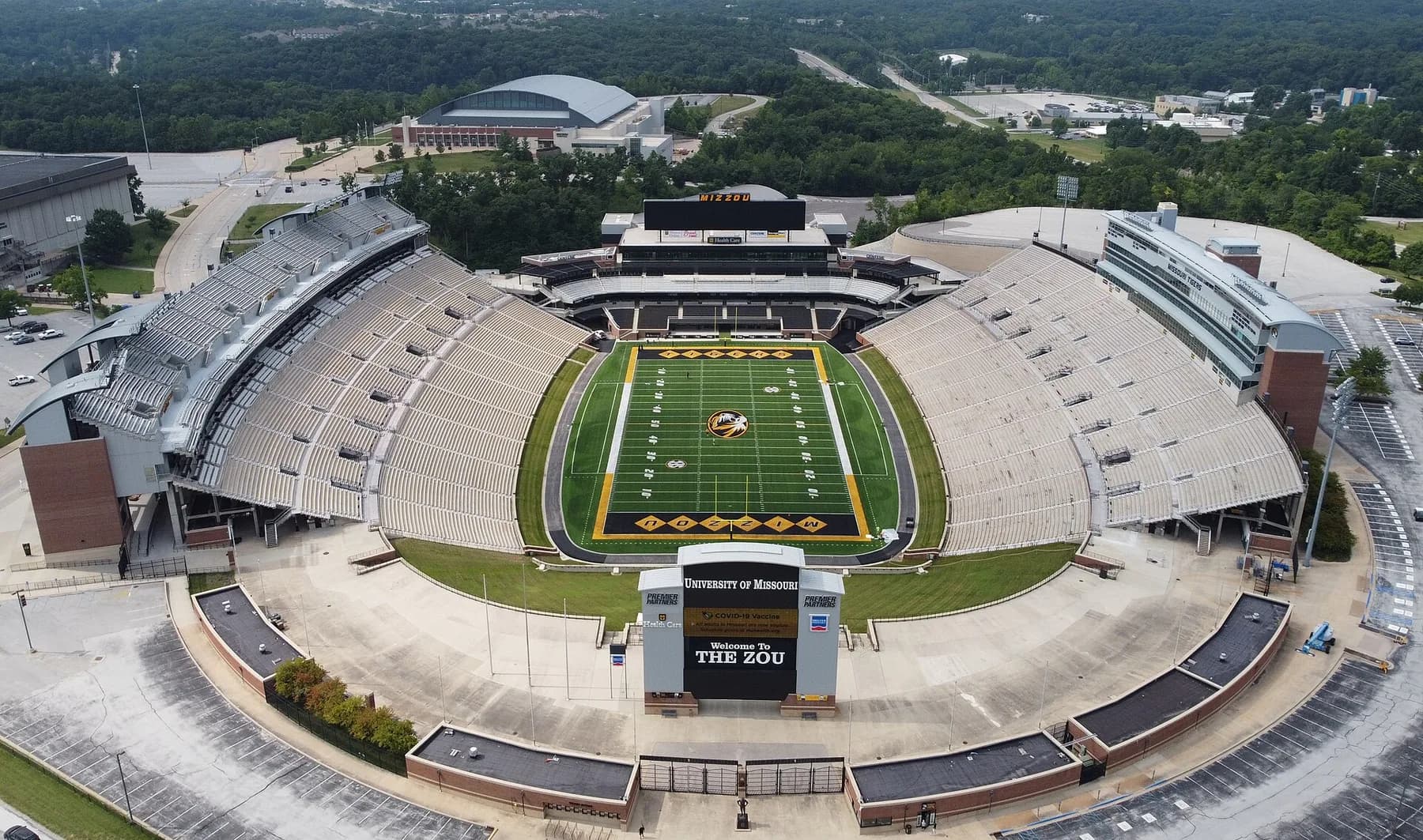
Photo: Lectrician2 · CC BY-SA 4.0 · Cropped for display
Up next · Week 9
Away
On the road at
Saturday, October 31 · Time TBA
The season, taking shape
Final scores show Missouri first. Oldest to newest.
at Mississippi StatePregame 30–25
Game details vs. Florida
Pregame 27–26
Game details vs. Texas A&M
Pregame 26–25
Original full-season forecast
This forecast retains the original probabilities for the full schedule. It does not update with completed results or this week’s forecast.
2026 results
Current record, team efficiency, player production, and verified results from completed games.
Current record
5-25 wins · 2 lossesThrough 7 completed gamesLoading player usage…
2026 season preview
Missouri enters 2026 with a proven offensive foundation and a demanding question for Eli Drinkwitz: Can the Tigers expand what they do well before the schedule begins exposing what they have not settled? First-year offensive coordinator Chip Lindsey is installing his system around Ole Miss transfer Austin Simmons, while star running back Ahmad Hardy continues working toward game readiness. On defense, continuity in the coaching structure meets extensive personnel change. Missouri’s season will turn on how quickly those moving parts become a functional team.
Drinkwitz has made the offensive objective clear. Missouri wants to preserve its productive running game while generating more downfield explosives, a change that depends on protection, receivers, quarterback execution and play-calling rather than one schematic adjustment. Lindsey’s most recent offense at Michigan averaged 213.2 rushing yards and 185.8 passing yards per game in 2025, fitting the idea of evolution rather than reinvention. The Tigers do not need Simmons to replace their rushing identity. They need him to punish defenses for crowding it.
Original season forecast
The original SEC forecast, retained alongside current results.
SEC projected standing
#11
5-4 projected · 4.6 expected conference wins · #11 of 16.
Preseason baseline
2025 percentiles retained as preseason context; current results and player production lead this page.
2025 FBS percentile scale · 50 is average
Incoming class
National and conference recruiting ranks, confirmed commitments, and the highest-ranked recruits in this class.
Top committed recruits
Missouri2026 transfer movement
Incoming and outgoing transfer activity, with rated FBS-to-FBS moves below.
Incoming Transfers
MissouriOutgoing Transfers
MissouriSeason schedule
Completed games show final results. Upcoming games use this week’s forecast where available; later games retain their published season outlook.
Detailed football intelligence
The full team identity, offense, defense, and supporting evidence.
Team identity
Last season, Missouri tried to lean on the running game; the approach gave the offense a dependable starting point.
Why it matters
The run game was Missouri's steadier way to stay ahead of the chains; opponents have to win early fits without handing away play action.
 at Ole Miss
Pregame 25–31
Game detailsPregame comparisons use preserved published forecasts. Results include wins and losses.
At a glance
Current form leads the outlook.
2026 rates aggregate verified completed-game box scores. EPA is expected points added per play.
| Player | C/ATT | YDS | TD | INT |
|---|---|---|---|---|
| Austin Simmons | 131/208 | 1756 | 14 | 2 |
| Matt Zollers | 8/13 | 87 | 0 | 0 |
| Nick Evers | 1/2 | 18 | 0 | 0 |
| Player | CAR | YDS | AVG | TD |
|---|---|---|---|---|
| Jamal Roberts | 165 | 810 | 4.9 | 7 |
| Xai'Shaun Edwards | 39 | 146 | 3.7 | 1 |
| Preston Hatfield | 4 | 34 | 8.5 | 1 |
| Player | REC | YDS | AVG | TD |
|---|---|---|---|---|
| Cayden Lee | 45 | 652 | 14.5 | 5 |
| Donovan Olugbode | 36 | 543 | 15.1 | 6 |
| Naeshaun Montgomery | 10 | 136 | 13.6 | 0 |
| Player | TOT | SOLO | TFL | SACK |
|---|---|---|---|---|
| Nicholas Rodriguez | 72 | 34 | 4 | 1.5 |
| Santana Banner | 55 | 26 | 2 | 0 |
| Robert Woodyard Jr. | 39 | 12 | 2 | 0 |
Saturday, October 17 · Vaught-Hemingway Stadium
Saturday, October 10 · Memorial Stadium
Saturday, October 3 · Memorial Stadium
Drinkwitz has described Simmons as Missouri’s first-year starter and said the quarterback’s confidence and rapport with receivers grew during spring. That gives Simmons a clear runway to direct Lindsey’s installation. His central challenge will come when obvious running situations disappear and SEC defenses make him win from the pocket. Matt Zollers, Nick Evers, Gavin Sidwar and Brett Brown provide alternatives behind him, though Missouri has not established a public backup order. The larger issue is whether Simmons can turn spring progress into timely vertical production without sacrificing offensive stability.
Hardy remains the player most capable of easing that transition. He set a school record with 1,649 rushing yards in 2025, scored 16 touchdowns and recorded seven 100-yard games, earning first-team preseason All-SEC recognition. His combination of production and explosiveness can keep Simmons out of predictable passing situations and force defenses to commit resources near the line. His availability, however, cannot yet be taken for granted. Hardy was medically cleared after suffering a gunshot wound and undergoing surgery in May, but Drinkwitz said the form and timing of his return remained uncertain. Jamal Roberts and the rest of the running-back room may need to absorb early work while Hardy completes football rehabilitation.
The line connecting Hardy’s effectiveness to Simmons’ development runs through senior left tackle Cayden Green. A first-team preseason All-SEC selection, Green gives Missouri an established blind-side anchor. The other four jobs must be assembled from a group that includes veteran transfers Zach Owens, Josh Atkins, Dominick Giudice and Luke Work, along with returnees Logan Reichert and Jack Lange. That competition is not merely about identifying the five most talented linemen. Missouri needs a combination that can create consistent rushing lanes, communicate against pressure and give longer-developing pass concepts time to work.
Defense brings the opposite balance: steadier leadership and a reshaped roster. Corey Batoon remains the coordinator, with Derek Nicholson serving as co-coordinator and linebackers coach, but transfer additions could feature throughout the unit. Miami edge Malik Bryant and linebacker Bobby Washington reinforce the front seven, while safeties Kensley Louidor-Faustin and Elijah Dotson and cornerbacks Jahlil Florence and Nasir Pogue add experienced options in the secondary. Their names create possibilities, not automatic answers. Tackling, coverage communication and a dependable rotation will determine whether the group’s experience translates into cohesion.
Special teams offers one established component in long snapper Brett Le Blanc, a third-team preseason All-SEC selection. Blake Craig is the returning kicker listed on the roster, while Mark Shenouda, John Butcher and Brunno Reus comprise the punting competition. Those roles may attract less attention than the quarterback and defensive changes, but unsettled punting and kicking operations can magnify pressure in close conference games. Missouri’s clearest recognized strengths remain concentrated in Hardy, Green and Le Blanc; much of the rest of the roster must establish its hierarchy through camp.
The schedule gives Lindsey and Simmons an initial installation window, though the trip to Kansas in the second week adds rivalry pressure between home games against Arkansas-Pine Bluff and Troy. SEC play begins at Mississippi State, followed by home dates with Florida and Texas A&M, a trip to Ole Miss and a road game at Arkansas. The sharpest pressure arrives in November: Texas visits Columbia, Missouri travels to Georgia, then returns home for Kentucky and Oklahoma. By then, Simmons’ command, Hardy’s condition, the line’s chemistry and the defense’s communication should no longer be developing ideas. They will define what Missouri has become.
This preview is based on the linked public reporting and official program records.
Profile high point
Down-to-down defense held the profile's highest percentile position.Profile low point
Big-play creation held the lowest percentile position among the profile's strength measures.




The defense's control of ordinary downs is what Missouri can trust most.
Why it matters
That unit is the most credible foundation for making opponents string together clean drives; explosive-play creation remains the first counter an opponent should test.
Big-play creation is the concern opponents should keep testing while the defense's control of ordinary downs tries to steady Missouri.
What matters
Missouri's explosive-play creation finished below the national average last season.
Missouri is at its best when it can use the running game to control early downs and finish drives; extra possessions give that plan time to build.
What matters
Missouri's run-first structure played at a fast pace. The run game finished top-tier, while the pass game finished below-average.
Inside the team
Open a section for the football detail and supporting numbers.
The down-to-down question that determines whether the offense can keep both the run and pass available.
Opponents have to keep Missouri's run game from turning first down into second-and-manageable.
Why it matters
If Missouri stays on schedule on the ground, the offense keeps more answers available.
The pace, play selection, and methods this offense uses to stay on schedule.
Missouri played at a fast pace in 2025.
Why it matters
More possessions give Missouri's strengths additional chances to build, but they also leave more time to recover from mistakes.
Missouri's prior passing record was below-average.
Why it matters
Missouri's offense needs protection, field position, or explosive variance when ordinary dropbacks do not create enough value.
Missouri's prior rushing record was top-tier.
Why it matters
A sustainable run game keeps Missouri's play action credible and limits obvious passing situations.
Missouri's explosive-play results were mixed rather than a defining edge.
Why it matters
A big play can still flip a possession, but last season's results do not make explosiveness something this team can rely on.
How consistently the offense creates manageable situations and the defense prevents them.
Missouri won ordinary downs on both sides of the ball.
Why it matters
Missouri's success rate shows whether it can sustain drives and get stops without relying on sacks, turnovers, or isolated big plays.
Opponent-adjusted EPA identifies the run game as Missouri's stronger offensive unit.
Why it matters
Forcing longer passing situations is the clearest way to move the offense away from its stronger adjusted unit.
Where the defense can create pressure, control the run, and end drives.
Missouri's prior defense was top-tier overall, with no clear separation among its main units.
Why it matters
That balance makes it harder for an offense to choose one automatic target; the defense still has to win early downs before any unit can dictate the offensive options.
Missouri's available disruption measures ranked among the best in the country last season; a charted pressure rate is not available.
Why it matters
Sustained disruption can create negative plays and give Missouri a better chance to end drives before third down.
Missouri's disruption regularly finished at the quarterback.
What matters
Both sack production and front-seven disruption cleared the FBS midpoint.
Missouri's prior run-defense results were top-tier.
Why it matters
A dependable run front can let Missouri create obvious passing downs without committing extra bodies to the box.