
Week 4 · FinalW
 vs. Missouri
31–24+7 margin
Pregame 25–30
Game detailsSaturday Index
Loading team intelligenceBringing the latest verified football information into focus.
SEC · 2026 · Week 8

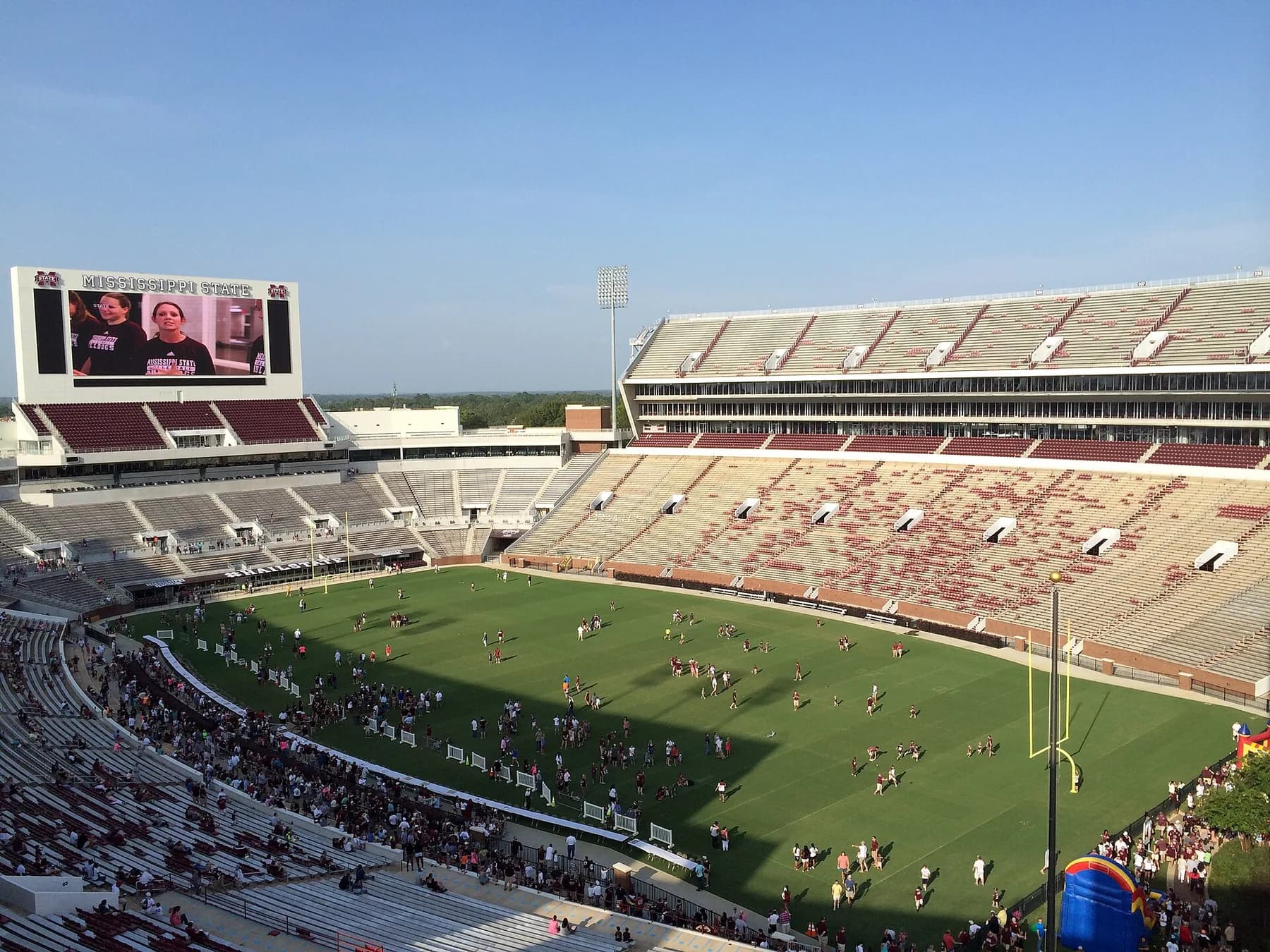
Photo: Nateb2003 · CC BY-SA 3.0 · Cropped for display
Up next · Week 9
Away
On the road at
Saturday, October 31 · Time TBA
The season, taking shape
Final scores show Mississippi State first. Oldest to newest.
vs. MissouriPregame 25–30
Game details vs. Alabama
Pregame 24–34
Game details at LSU
Pregame 21–35
Original full-season forecast
This forecast retains the original probabilities for the full schedule. It does not update with completed results or this week’s forecast.
2026 results
Current record, team efficiency, player production, and verified results from completed games.
Current record
4-34 wins · 3 lossesThrough 7 completed gamesLoading player usage…
2026 season preview
Mississippi State’s 2026 season will turn less on dramatic reinvention than on whether Jeff Lebby can accelerate the development already underway. Sophomore quarterback Kamario Taylor gives the Bulldogs a dual-threat centerpiece, while a transfer-heavy rebuild has targeted the offensive line and defense. The formula is clear: support Taylor, turn Zach Arnett’s defense into an attacking unit and make the new pieces functional before an unforgiving stretch of the schedule arrives.
Lebby remains the head coach and one of the program’s offensive coordinators, keeping the offense grounded in his preference for tempo, spacing and explosive opportunities. The March addition of Philip Montgomery as associate head coach for offense and receivers coach gives him another veteran designer. Montgomery has coordinated offenses at Virginia Tech, Auburn, Baylor and Houston and was Tulsa’s head coach. His experience developing quarterbacks and receivers should be particularly useful for an offense placing so much responsibility on a young passer.
Original season forecast
The original SEC forecast, retained alongside current results.
SEC projected standing
#15
1-8 projected · 1.6 expected conference wins · #15 of 16.
Preseason baseline
2025 percentiles retained as preseason context; current results and player production lead this page.
2025 FBS percentile scale · 50 is average
Incoming class
National and conference recruiting ranks, confirmed commitments, and the highest-ranked recruits in this class.
Top committed recruits
Mississippi State2026 transfer movement
Incoming and outgoing transfer activity, with rated FBS-to-FBS moves below.
Incoming Transfers
Mississippi StateOutgoing Transfers
Mississippi StateSeason schedule
Completed games show final results. Upcoming games use this week’s forecast where available; later games retain their published season outlook.
Detailed football intelligence
The full team identity, offense, defense, and supporting evidence.
Team identity
Last season, Mississippi State tried to lean on the running game; too many drives still went off schedule.
Why it matters
The run game was Mississippi State's less difficult offensive option, but it did not reliably keep the offense on schedule; the offense must prove it can create movement before opponents have to commit extra help.
 vs. Oklahoma
Pregame 23–28
Game detailsPregame comparisons use preserved published forecasts. Results include wins and losses.
At a glance
Current form leads the outlook.
2026 rates aggregate verified completed-game box scores. EPA is expected points added per play.
| Player | C/ATT | YDS | TD | INT |
|---|---|---|---|---|
| Kamario Taylor | 104/159 | 1460 | 17 | 4 |
| Parker Puckett | 41/64 | 368 | 1 | 2 |
| Sam West | 1/1 | 18 | 1 | 0 |
| Player | CAR | YDS | AVG | TD |
|---|---|---|---|---|
| Fluff Bothwell | 91 | 514 | 5.6 | 3 |
| Kolin Wilson | 54 | 218 | 4.0 | 0 |
| J.J. Hill | 15 | 147 | 9.8 | 2 |
| Player | REC | YDS | AVG | TD |
|---|---|---|---|---|
| Anthony Evans III | 53 | 647 | 12.2 | 5 |
| Sanfrisco Magee | 22 | 360 | 16.4 | 6 |
| Marquis Johnson | 18 | 259 | 14.4 | 1 |
| Player | TOT | SOLO | TFL | SACK |
|---|---|---|---|---|
| Tyler Lockhart | 48 | 23 | 2.5 | 2 |
| Amaree Williams | 38 | 16 | 3.5 | 1.5 |
| Amarien Jefferson | 38 | 20 | 0 | 0 |
Saturday, October 24 · Davis Wade Stadium
Saturday, October 17 · Tiger Stadium (LA)
Saturday, October 3 · Davis Wade Stadium
Taylor is expected to start after closing 2025 in that role. He has made two career starts, earned two SEC Freshman of the Week awards and drew praise from Lebby for his preparation and retention. His running ability can alter defensive numbers and create opportunities beyond the original play design, but Mississippi State still needs to keep obvious passing situations from defining his season. Veteran transfers AJ Swann and Jaden Rashada provide experienced alternatives, though their order behind Taylor will be settled in camp.
Fluff Bothwell can ease that burden if his return to health carries into the season. The 230-pound back said he was fully healthy after an injury affected the latter half of 2025, and Lebby described his spring and summer as strong. A productive Bothwell would give the Bulldogs a credible downhill complement to Taylor and help preserve the play-action element of the offense. That balance matters most on high-leverage downs, when asking Taylor to create everything himself would expose both his inexperience and the line around him.
Anthony Evans III is the established receiving anchor after recording 831 yards in 2025. He has set Mississippi State’s single-season receiving record as a personal goal, but his immediate importance is simpler: he gives Taylor a proven target after Brenen Thompson’s departure. Ayden Williams and Sanfrisco Magee return, while transfers Marquis Johnson and Zion Ragins add speed suited to Lebby’s vertical passing game. At tight end, Oregon State transfer Riley Williams brings veteran experience to a young group whose receiving and blocking roles remain open.
The offensive line may decide how much of that skill-position promise becomes usable. Lebby said six linemen entered camp capable of playing winning football, while also emphasizing the need for more depth. Eight portal additions, including DJ Chester, LJ Prudhomme, Miles McVay and Brandon Sneh, give the staff options. The pressing task is turning those options into a coherent five-man unit and developing dependable reserves. Taylor’s growth and Bothwell’s effectiveness both depend on consistent protection and clean run fits.
Arnett’s defensive mandate is to make Mississippi State the aggressor, affect quarterbacks and create negative plays. He previously coordinated three consecutive Bulldogs defenses that ranked among the SEC’s top five from 2020 through 2022. Returning interior linemen Diesel Moye, DJ Reed and Trevion Williams provide size, while Dealyn Evans, Jayson Jenkins and edge transfer Amaree Williams add new possibilities up front. Linebackers Fatt Forrest, Derion Gullette and Tyler Lockhart return under co-coordinator Matt Brock, giving the middle of the defense some continuity as Arnett installs his approach.
The secondary has two reliable reference points in corner Kelley Jones and safety Isaac Smith. Jones allowed the fewest receptions among SEC corners in 2025, while Smith is a three-year letterman and an established leadership voice. Transfers will compete for the jobs around them, making communication and role definition central to camp. Those answers must come quickly. After opening at home against ULM, State visits Minnesota and South Carolina before hosting Missouri and Alabama. Later dates at LSU and Texas surround a home game against Oklahoma, and the regular season ends at Ole Miss. A clean September would create valuable room for error; reaching it will require Taylor’s supporting cast and Arnett’s rebuilt defense to mature on the field, not merely look improved on paper.
This preview is based on the linked public reporting and official program records.
Profile high point
Big-play creation held the profile's highest percentile position.Profile low point
Pressure held the lowest percentile position among the profile's strength measures.



Mississippi State can lean on big-play creation when a drive slips off schedule, but front-seven disruption still needs support.
What matters
Mississippi State's explosive-play creation ranked in a strong national range last season.
Front-seven disruption is Mississippi State's biggest concern, and opponents can test it immediately.
Why it matters
Opponents can trust normal protection and make the defense win without steady negative plays; explosive-play creation has to keep that stress from setting the game plan.
Mississippi State is at its best when it can use the running game to control early downs and finish drives; extra possessions give that plan time to build.
What matters
Mississippi State's run-leaning structure played at a fast pace. The run game finished below-average, while the pass game finished weak.
Inside the team
Open a section for the football detail and supporting numbers.
The down-to-down question that determines whether the offense can keep both the run and pass available.
Before defenses have to commit extra help, Mississippi State must prove the run can create manageable second downs.
What matters
Last season's rushing results did not establish dependable movement or a steady play-action foundation.
The pace, play selection, and methods this offense uses to stay on schedule.
Mississippi State played at a fast pace in 2025.
Why it matters
More possessions give Mississippi State's strengths additional chances to build, but they also leave more time to recover from mistakes.
Mississippi State's prior passing record was weak.
Why it matters
Mississippi State's offense needs protection, field position, or explosive variance when ordinary dropbacks do not create enough value.
Mississippi State's prior rushing record was below-average.
Why it matters
When Mississippi State's run game cannot stay on schedule, protection and passing-down execution carry more of the offense.
Mississippi State's explosive-play results were mixed rather than a defining edge.
Why it matters
A big play can still flip a possession, but last season's results do not make explosiveness something this team can rely on.
How consistently the offense creates manageable situations and the defense prevents them.
Mississippi State's down-to-down results were weak overall.
Why it matters
Mississippi State's success rate shows whether it can sustain drives and get stops without relying on sacks, turnovers, or isolated big plays.
Mississippi State's opponent-adjusted passing and rushing value were closely matched.
Why it matters
When the split is narrow, early-down execution matters more than steering the offense toward one obvious weakness.
Where the defense can create pressure, control the run, and end drives.
Mississippi State's prior defense was weak overall and strongest in pass defense.
What matters
Pass defense finished middle-of-the-pack, while run front finished bottom-tier; the latter is the first place an offense should test.
Mississippi State's available disruption measures ranked near the bottom nationally last season; a charted pressure rate is not available.
Why it matters
Without consistent disruption, Mississippi State's defense must win more snaps through coverage, leverage, and early-down prevention.
Mississippi State's sack and disruption results were bottom-tier.
Why it matters
Mississippi State's disruption can hurry an offense; sacks do more by erasing field position and ending passing downs.
Mississippi State's prior run-defense results were bottom-tier.
Why it matters
If Mississippi State's front cannot control early downs, opponents can keep every offensive option open and protect their passing game.