
Week 4 · FinalW
 at Washington
27–24+3 margin
Pregame 21–29
Game detailsSaturday Index
Loading team intelligenceBringing the latest verified football information into focus.
Big Ten · 2026 · Week 8

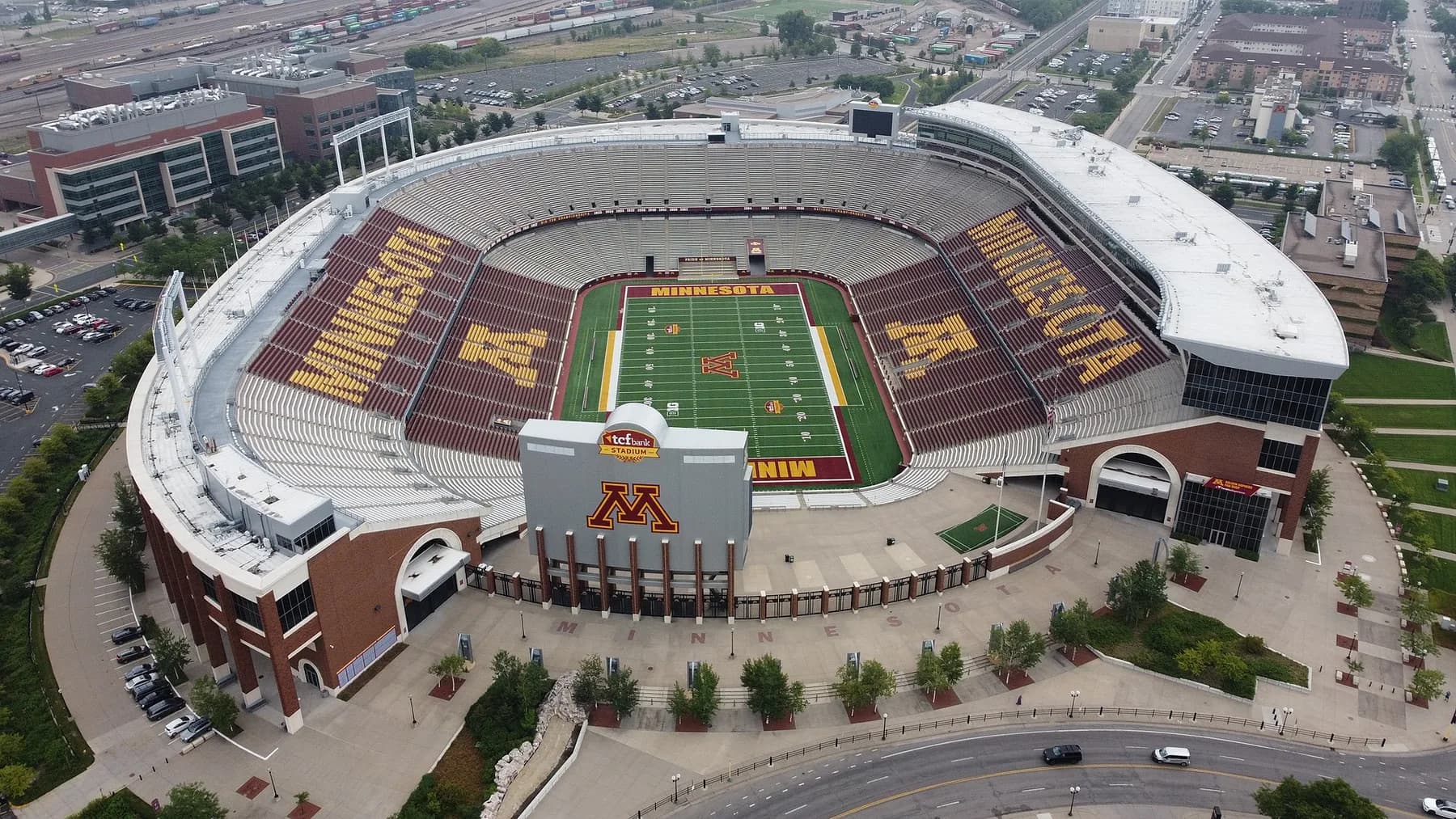
Photo: Lectrician2 · CC BY-SA 4.0 · Cropped for display
Up next · Week 9
Away
On the road at
Saturday, October 31 · Time TBA
The season, taking shape
Final scores show Minnesota first. Oldest to newest.
at WashingtonPregame 21–29
Game details vs. Michigan
Pregame 21–28
Game details at Purdue
Pregame comparison unavailable
Game detailsOriginal full-season forecast
This forecast retains the original probabilities for the full schedule. It does not update with completed results or this week’s forecast.
2026 results
Current record, team efficiency, player production, and verified results from completed games.
Current record
5-25 wins · 2 lossesThrough 7 completed gamesLoading player usage…
2026 season preview
Drake Lindsey, Darius Taylor and a productive edge group provide stability, but rebuilt rooms across the roster will determine Minnesota’s ceiling.
Minnesota’s 2026 season is a test of how far concentrated experience can carry a changing roster. P.J. Fleck enters his 10th season with a new contract and continuity among his coordinators: Greg Harbaugh Jr. and Matt Simon lead the offense, while Danny Collins runs the defense. That stability should ease the transition for a program that listed 19 incoming and 20 outgoing transfers. The Gophers are not starting over, but neither are they simply running back last year’s team. Their season will turn on whether established leaders can accelerate the development of remade position groups.
Original season forecast
The original Big Ten forecast, retained alongside current results.
Big Ten projected standing
#9
4-5 projected · 4.2 expected conference wins · #9 of 18.
Preseason baseline
2025 percentiles retained as preseason context; current results and player production lead this page.
2025 FBS percentile scale · 50 is average
Incoming class
National and conference recruiting ranks, confirmed commitments, and the highest-ranked recruits in this class.
Top committed recruits
Minnesota2026 transfer movement
Incoming and outgoing transfer activity, with rated FBS-to-FBS moves below.
Incoming Transfers
MinnesotaOutgoing Transfers
MinnesotaSeason schedule
Completed games show final results. Upcoming games use this week’s forecast where available; later games retain their published season outlook.
Detailed football intelligence
The full team identity, offense, defense, and supporting evidence.
Team identity
Last season, Minnesota tried to lean on the passing game; it rarely provided an easy foundation.
Why it matters
The passing game was Minnesota's less difficult offensive option, but it did not provide a dependable way to stay ahead of the chains; the offense must prove that rhythm before opponents have to widen their structure.
 vs. Iowa
Pregame 19–28
Game detailsPregame comparisons use preserved published forecasts. Results include wins and losses.
At a glance
Current form leads the outlook.
2026 rates aggregate verified completed-game box scores. EPA is expected points added per play.
| Player | C/ATT | YDS | TD | INT |
|---|---|---|---|---|
| Drake Lindsey | 105/157 | 1087 | 8 | 4 |
| Max Shikenjanski | 3/3 | 50 | 0 | 0 |
| Brady Palmer | 4/6 | 34 | 0 | 0 |
| Player | CAR | YDS | AVG | TD |
|---|---|---|---|---|
| TJ Thomas Jr. | 46 | 307 | 6.7 | 1 |
| Darius Taylor | 57 | 139 | 2.4 | 4 |
| Xavier Ford | 14 | 75 | 5.4 | 1 |
| Player | REC | YDS | AVG | TD |
|---|---|---|---|---|
| Noah Jennings | 26 | 345 | 13.3 | 1 |
| Javon Tracy | 27 | 300 | 11.1 | 1 |
| Jalen Smith | 12 | 121 | 10.1 | 2 |
| Player | TOT | SOLO | TFL | SACK |
|---|---|---|---|---|
| Maverick Baranowski | 34 | 18 | 3 | 1 |
| Kerry Brown | 25 | 18 | 1 | 0 |
| Zack Harden | 24 | 12 | 2 | 0 |
Saturday, October 24 · Huntington Bank Stadium
Saturday, October 10 · Ross-Ade Stadium
Saturday, October 3 · Huntington Bank Stadium
Drake Lindsey is the most important source of continuity. He started all 13 games in 2025, completing 63.2% of his passes for 2,382 yards, 18 touchdowns and six interceptions while adding four rushing scores. Those numbers describe a quarterback who has already managed a full season and protected the ball, giving Minnesota room to pursue offensive growth rather than conduct a search for basic competence. One issue remains unresolved: Lindsey apologized following a May 1 arrest involving underage alcohol possession and a fraudulent identification document, and Fleck said discipline was being handled internally. Whether that affects the opening game has not been announced.
The offense also has a proven centerpiece in Darius Taylor, Minnesota’s leading rusher in each of his first three seasons. The larger concern is how the Gophers support him. A.J. Turner was reported to be recovering from the serious leg injury that ended his 2025 season in Week 3, leaving the complementary role unsettled. Up front, Greg Johnson brings unusual flexibility after starting every 2025 game across three line positions, but Minnesota still must establish a cohesive five. Tight end carries a similar question: Pierce Walsh and Roman Voss are among the options, without a clear receiving or blocking order. Those rooms will shape protection, formations and Taylor’s workload as much as any play-calling adjustment.
Receiver is the offense’s most visible renovation. Perry Thompson, Noah Jennings and Zion Steptoe arrived through the portal after multiple departures from the 2025 group. The spring game showed possibilities rather than firm roles: Jennings broke a 74-yard reception, Steptoe scored and Jalen Smith led the receivers with five catches. Lindsey should have different body types and big-play options around him, but the crucial work is more ordinary—timing, route precision and identifying who earns targets on important downs. His experience can steady that process; it cannot substitute for chemistry.
Minnesota’s clearest defensive advantage is a pass rush that does not need much introduction. Anthony Smith recorded 12.5 sacks in 2025, Karter Menz added 6.5 and Jaxon Howard had four. Together they produced 23 of the team’s 39 sacks. That group gives Collins a chance to generate disruption without constantly committing extra rushers, an important benefit while other units settle. Maverick Baranowski anchors the second level, where Matt Kingsbury and Emmanuel Karmo have meaningful experience and Eastern Michigan transfer Andrew Marshall adds depth. The uncertainty is concentrated inside: a rebuilt defensive-tackle rotation must hold its ground well enough for those edge and linebacker strengths to matter.
The secondary faces its own reconstruction after Koi Perich’s departure. Minnesota added Aydan West, Elisha West, Parker Knutson and Mekhai Smith, with Aydan West expected to challenge opposite John Nestor and the nickel role still open earlier in the offseason. The task is bigger than selecting starters. New and expanded roles must fit together well enough to prevent coverage busts and give the pass rush time to arrive. With several candidates entering the competition, Minnesota has options; how quickly those options become a coherent unit is one of the defense’s defining preseason questions.
The schedule gives the Gophers an opening window to sort through those decisions, followed by an immediate rise in difficulty. Eastern Illinois, Mississippi State and Akron visit Huntington Bank Stadium before Minnesota travels to Washington and returns home to face Michigan. That sequence places a premium on using September’s first three games to establish rotations and communication. Later road trips to Indiana, Penn State and Wisconsin create another demanding stretch, while Iowa, UCLA and Northwestern come to Minneapolis. Minnesota will have little room for reconstructed units to remain unfinished deep into conference play.
That makes Fleck’s 10th season less about discovering the identity of his team than extending a familiar one through extensive personnel change. Lindsey, Taylor, Smith and Baranowski give Minnesota credible answers at four consequential positions. Johnson’s versatility, the new receivers, Taylor’s eventual complement, the defensive tackles and the rebuilt secondary must connect those answers into a complete team. The Gophers have enough continuity to avoid a full reset. Their 2026 trajectory will depend on whether that continuity can turn a collection of new roles into dependable football before the schedule applies its greatest pressure.
This preview is based on the linked public reporting and official program records.
Profile high point
Pressure held the profile's highest percentile position.Profile low point
The run game held the lowest percentile position among the profile's strength measures.




Front-seven disruption is what Minnesota can trust most.
Why it matters
The defense has its best route to changing protection rules before coverage must hold; rushing structure remains the first counter an opponent should test.
The run game is Minnesota's biggest concern, and opponents can test it immediately.
What matters
Minnesota's rushing structure ranked near the bottom nationally last season.
For Minnesota, the cleanest script is to use the passing game to stay on schedule and finish drives; fewer possessions make every empty drive more expensive.
What matters
Minnesota's pass-first structure played at a deliberate pace. The pass game finished below-average, while the run game finished bottom-tier.
Inside the team
Open a section for the football detail and supporting numbers.
The down-to-down question that determines whether the offense can keep both the run and pass available.
Before defenses have to adjust, Minnesota must prove routine throws can keep first down on schedule.
What matters
Last season's passing results did not establish a dependable way to stay out of long-yardage.
The pace, play selection, and methods this offense uses to stay on schedule.
Minnesota played at a deliberate pace in 2025.
What matters
Minnesota worked with fewer possessions than most teams last season.
Minnesota's prior passing record was below-average.
Why it matters
Minnesota's offense needs protection, field position, or explosive variance when ordinary dropbacks do not create enough value.
Minnesota's prior rushing record was bottom-tier.
Why it matters
When Minnesota's run game cannot stay on schedule, protection and passing-down execution carry more of the offense.
Minnesota's explosive-play results were mixed rather than a defining edge.
Why it matters
A big play can still flip a possession, but last season's results do not make explosiveness something this team can rely on.
How consistently the offense creates manageable situations and the defense prevents them.
Minnesota's down-to-down results were weak overall.
Why it matters
Minnesota's success rate shows whether it can sustain drives and get stops without relying on sacks, turnovers, or isolated big plays.
Opponent-adjusted EPA identifies the pass game as Minnesota's stronger offensive unit.
Why it matters
If an opponent removes the first passing answer, the run game's lower adjusted value becomes the key counter to test.
Where the defense can create pressure, control the run, and end drives.
Minnesota's prior defense was below-average overall and strongest in disruption.
Why it matters
Opponents can use efficient throws to stay out of obvious passing downs; Minnesota needs its disruption to change protection and erase drives with negative plays before that plan settles in.
Minnesota's available disruption measures ranked among the best in the country last season; a charted pressure rate is not available.
Why it matters
Sustained disruption can create negative plays and give Minnesota a better chance to end drives before third down.
Minnesota's disruption regularly finished at the quarterback.
What matters
Both sack production and front-seven disruption cleared the FBS midpoint.
Minnesota's prior run-defense results were below-average.
Why it matters
If Minnesota's front cannot control early downs, opponents can keep every offensive option open and protect their passing game.