Week 5 · FinalL
 at Wisconsin
3–31-28 margin
Pregame 19–28
Game detailsSaturday Index
Loading team intelligenceBringing the latest verified football information into focus.
Big Ten · 2026 · Week 8

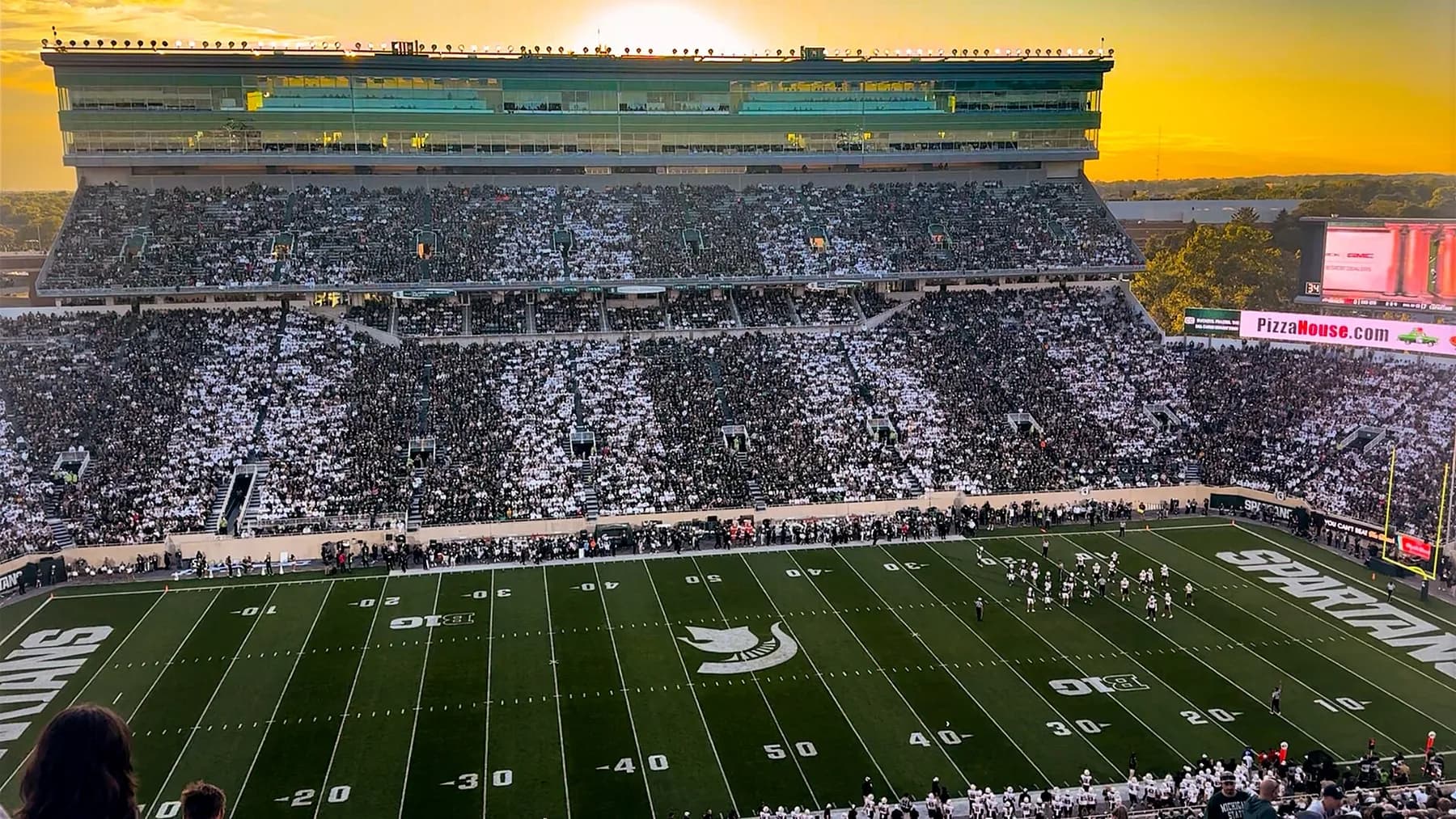
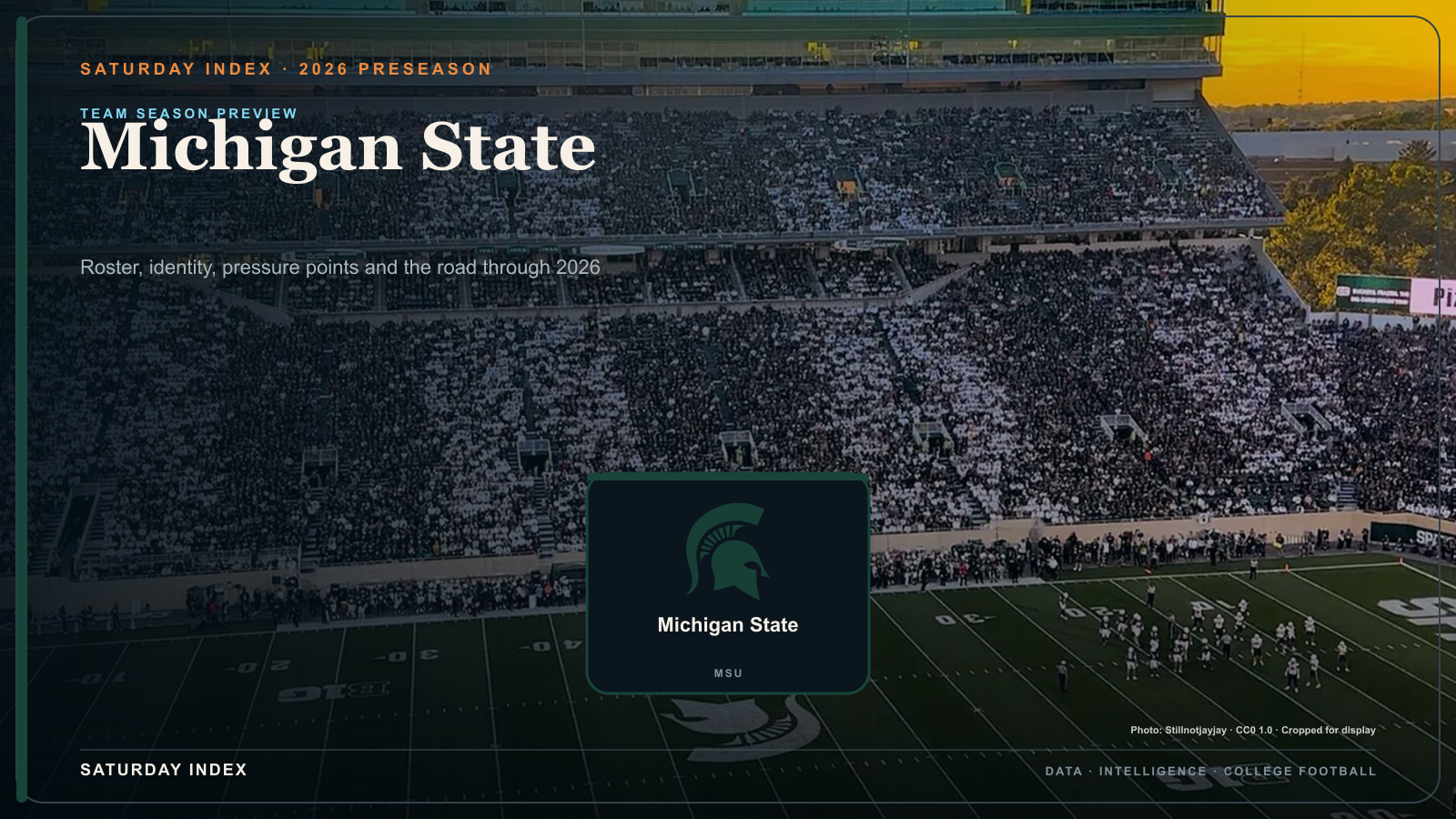
Photo: Stillnotjayjay · CC0 1.0 · Cropped for display
Up next · Week 10
Away
On the road at
Saturday, November 7 · Time TBA
The season, taking shape
Final scores show Michigan State first. Oldest to newest.
at WisconsinPregame 19–28
Game details vs. Illinois
Pregame 27–25
Game details vs. Northwestern
Pregame 23–28
Original full-season forecast
This forecast retains the original probabilities for the full schedule. It does not update with completed results or this week’s forecast.
2026 results
Current record, team efficiency, player production, and verified results from completed games.
Current record
2-62 wins · 6 lossesThrough 8 completed gamesLoading player usage…
2026 season preview
Pat Fitzgerald begins at Michigan State with an established quarterback and defensive continuity, but line play and the integration of a transfer-heavy roster will shape the Spartans' season.
Michigan State enters 2026 with one foundational offensive decision already made. Pat Fitzgerald reaffirmed redshirt sophomore Alessio Milivojevic as his quarterback and called him the team's unequivocal leader, while Joe Rossi remains defensive coordinator for a third season. Those are useful anchors. The larger task is turning competition and newly imported experience into dependable units, especially along both lines.
Offense: A known quarterback, an unfinished supporting cast
Original season forecast
The original Big Ten forecast, retained alongside current results.
Big Ten projected standing
#16
3-6 projected · 2.9 expected conference wins · #16 of 18.
Preseason baseline
2025 percentiles retained as preseason context; current results and player production lead this page.
2025 FBS percentile scale · 50 is average
Incoming class
National and conference recruiting ranks, confirmed commitments, and the highest-ranked recruits in this class.
Top committed recruits
Michigan State2026 transfer movement
Incoming and outgoing transfer activity, with rated FBS-to-FBS moves below.
Incoming Transfers
Michigan StateOutgoing Transfers
Michigan StateSeason schedule
Completed games show final results. Upcoming games use this week’s forecast where available; later games retain their published season outlook.
Detailed football intelligence
The full team identity, offense, defense, and supporting evidence.
Team identity
Last season, Michigan State tried to lean on the passing game; too many drives still went off schedule.
Why it matters
The passing game was Michigan State's more workable option, not an established edge; defenses can begin balanced until routine throws force an adjustment.
 at UCLA
Pregame 18–31
Game detailsPregame comparisons use preserved published forecasts. Results include wins and losses.
At a glance
Current form leads the outlook.
2026 rates aggregate verified completed-game box scores. EPA is expected points added per play.
| Player | C/ATT | YDS | TD | INT |
|---|---|---|---|---|
| Alessio Milivojevic | 121/185 | 1263 | 7 | 3 |
| Cam Fancher | 8/11 | 59 | 0 | 1 |
| Carson Gulker | 1/1 | 19 | 0 | 0 |
| Player | CAR | YDS | AVG | TD |
|---|---|---|---|---|
| Jaziun Patterson | 77 | 326 | 4.2 | 5 |
| Camryn Edwards | 64 | 304 | 4.8 | 3 |
| Marvis Parrish | 33 | 96 | 2.9 | 0 |
| Player | REC | YDS | AVG | TD |
|---|---|---|---|---|
| Jayden Savoury | 27 | 261 | 9.7 | 0 |
| Rodney Bullard Jr. | 21 | 253 | 12.0 | 1 |
| Chrishon Mccray | 26 | 247 | 9.5 | 1 |
| Player | TOT | SOLO | TFL | SACK |
|---|---|---|---|---|
| Devin Vaught | 46 | 31 | 1 | 0 |
| Dion Crawford | 41 | 13 | 1.5 | 0 |
| Nikai Martinez | 30 | 15 | 1 | 0 |
Saturday, October 24 · Rose Bowl
Saturday, October 17 · Spartan Stadium
Saturday, October 10 · Spartan Stadium
There is no advertised quarterback competition. Fitzgerald named Milivojevic the starter in April and reaffirmed the decision at Big Ten Media Day, allowing the offense to focus on his command of Nick Sheridan's new system. Fitzgerald has described that system as multiple and matchup-driven, with weapons moving into different roles. Its first test is how quickly Milivojevic and a reworked supporting cast can execute it.
The offensive line is the offense's most consequential unresolved competition. Fitzgerald said 10 or 11 linemen remained in contention and expected the first 10 to 14 days of camp to begin clarifying the unit. The April showcase also used controlled, non-live tackling after spring bumps and bruises, including along the line. Fitzgerald said the team left that practice healthy, but that spring snapshot does not establish full August availability.
Fitzgerald identified Cam Edwards, Jaziun Patterson, Kenneth Williams, Marvis Parrish and Zion Gist in a deep running-back competition, with protection, receiving and special-teams work helping determine the rotation. At receiver, Chrishon McCray leads the returners after 24 catches for 330 yards and three touchdowns in 2025. Transfers Fredrick Moore and KK Smith and four freshmen join a room that lost Nick Marsh and Omari Kelly, leaving the target order unsettled. Ferris State transfer Carson Gulker adds another option at H-back after totaling 1,089 all-purpose yards and 12 touchdowns for the 2025 Division II champion, though his production must translate to Big Ten competition.
Defense: Continuity must absorb turnover
Rossi's return provides scheme continuity, and co-coordinator and linebackers coach Max Bullough adds direct oversight of a central position group. Rossi said moving away from responsibility for one position room will allow him to work across the defense and handle broader quality control. That structure will be tested as Michigan State incorporates 14 defensive transfers who arrived with 176 combined prior starts.
Middle linebacker Jordan Hall is the defense's most established centerpiece after a career-high 88 tackles in 2025. Hall cited continuity with Rossi as important, and Fitzgerald presented him as a defensive leader. The secondary also adds experience: Michael Richard and Devin Vaught bring 45 combined starts and nine interceptions, while Fitzgerald and Rossi identified returning safety Nikai Martinez as a glue player. The sharper concern is inside, where only three spring defensive linemen returned after six letterwinners departed. Senior Ben Roberts, who missed five games with an injury in 2025, leads a group that also added Eli Coenen and Carlos Hazelwood, but its depth and durability have not been established.
Special teams: A priority, not an afterthought
Fitzgerald hired former Iowa special-teams coordinator LeVar Woods as assistant head coach and special-teams coordinator, calling him his right-hand man. He has also emphasized using skill-position depth in the kicking game and winning at the margins. Specific kicker, punter and return roles still need to emerge, but the staffing and Fitzgerald's public emphasis make special teams part of the program's core plan.
Schedule: Two home games before Notre Dame
The current official schedule opens with Toledo at Spartan Stadium on Friday, Sept. 4, followed by another home game against Eastern Michigan and a trip to Notre Dame. That sequence gives the new staff two home dates before its first road game. Oregon visits Spartan Stadium on Friday, Nov. 20.
Michigan State's foundation is easy to identify: Milivojevic at quarterback, Hall at middle linebacker, Rossi's continuity on defense and Fitzgerald's emphasis on competition and special teams. The tests are equally clear. The offensive line must cohere, the skill positions need a hierarchy, the defensive interior must withstand turnover and a large transfer group must become one unit. Fitzgerald has leaders around whom to build; whether the surrounding competition becomes cohesion will define the Spartans' 2026 season.
This preview is based on the linked public reporting and official program records.
Profile high point
Big-play prevention held the profile's highest percentile position.Profile low point
Down-to-down defense held the lowest percentile position among the profile's strength measures.



Michigan State did not have one unit that could carry the whole game plan; the passing game came closest.
What matters
Even Michigan State's best unit finished near the national middle last season, leaving no proven strength to build around.
The defense's control of ordinary downs is Michigan State's biggest concern, and opponents can test it immediately.
Why it matters
Opponents can stay patient, keep every offensive option open, and make the defense win ordinary downs; passing efficiency has to keep that stress from setting the game plan.
Michigan State is at its best when it can use the passing game to stay on schedule and finish drives; an average pace puts more weight on winning ordinary downs.
What matters
Michigan State's pass-leaning structure played at a balanced pace. The pass game finished middle-of-the-pack, while the run game finished weak.
Inside the team
Open a section for the football detail and supporting numbers.
The down-to-down question that determines whether the offense can keep both the run and pass available.
The first question for Michigan State is whether its passing rhythm can force defenses to adjust.
What matters
Routine completions are the most workable route to manageable third downs, not an established advantage.
The pace, play selection, and methods this offense uses to stay on schedule.
Michigan State played at a balanced pace in 2025.
Why it matters
At that pace, Michigan State cannot count on extra possessions or expect to shorten the game.
Michigan State's prior passing record was middle-of-the-pack.
Why it matters
Michigan State's offense needs protection, field position, or explosive variance when ordinary dropbacks do not create enough value.
Michigan State's prior rushing record was weak.
Why it matters
When Michigan State's run game cannot stay on schedule, protection and passing-down execution carry more of the offense.
Michigan State was better at preventing explosive plays than creating them.
Why it matters
The defense can keep a game on schedule, but the offense may need longer drives and more third-down conversions to separate.
How consistently the offense creates manageable situations and the defense prevents them.
Michigan State's offense was more consistent down to down than its defense.
Why it matters
Michigan State's success rate shows whether it can sustain drives and get stops without relying on sacks, turnovers, or isolated big plays.
Opponent-adjusted EPA identifies the pass game as Michigan State's stronger offensive unit.
Why it matters
If an opponent removes the first passing answer, the run game's lower adjusted value becomes the key counter to test.
Where the defense can create pressure, control the run, and end drives.
Michigan State's prior defense was bottom-tier overall, with no clear separation among its main units.
Why it matters
An offense can keep both the run and pass available and test each unit until the defense proves it can win ordinary early downs.
Michigan State's available disruption measures ranked in the lower national range last season; a charted pressure rate is not available.
Michigan State's sack and disruption results were weak.
Why it matters
Michigan State's disruption can hurry an offense; sacks do more by erasing field position and ending passing downs.
Michigan State's prior run-defense results were weak.
Why it matters
If Michigan State's front cannot control early downs, opponents can keep every offensive option open and protect their passing game.