
Week 4 · FinalL
 vs. Iowa
19–20-1 margin
Pregame 25–23
Game detailsSaturday Index
Loading team intelligenceBringing the latest verified football information into focus.
Big Ten · 2026 · Week 8

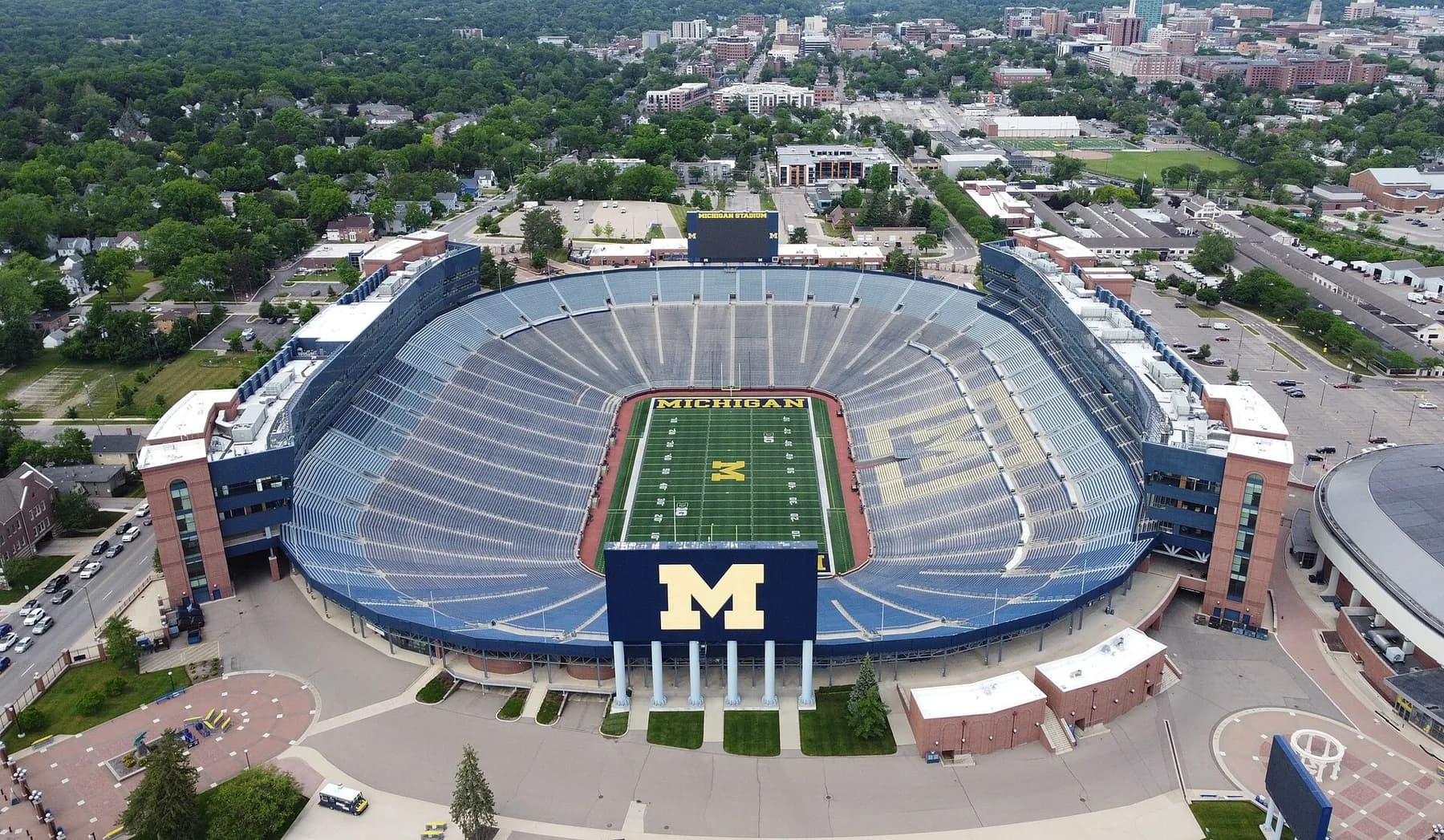
Photo: Lectrician2 · CC BY-SA 4.0 · Cropped for display
Up next · Week 9
Away
On the road at
Saturday, October 31 · Time TBA
The season, taking shape
Final scores show Michigan first. Oldest to newest.
vs. IowaPregame 25–23
Game details at Minnesota
Pregame 28–21
Game details vs. Penn State
Pregame 28–21
Game detailsOriginal full-season forecast
This forecast retains the original probabilities for the full schedule. It does not update with completed results or this week’s forecast.
2026 results
Current record, team efficiency, player production, and verified results from completed games.
Current record
4-34 wins · 3 lossesThrough 7 completed gamesLoading player usage…
2026 season preview
Kyle Whittingham inherits a proven running-game base and a deep defensive front, but Michigan’s ceiling depends on its young quarterback, rebuilt passing game and unsettled depth.
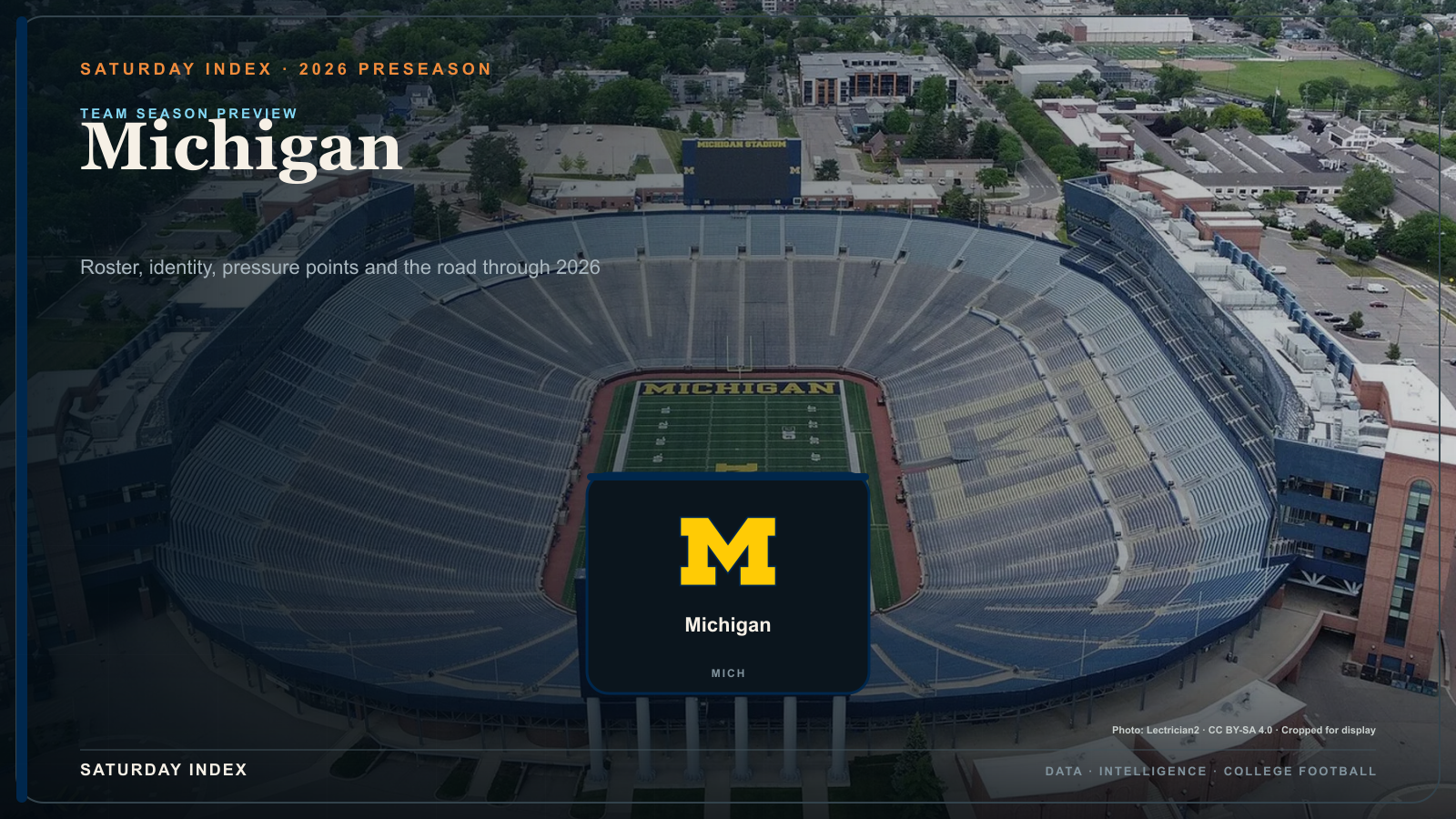
Michigan enters 2026 with recognizable strengths but a new center of gravity. Kyle Whittingham takes over as head coach, with Jason Beck coordinating the offense and Jay Hill directing the defense. The Wolverines can lean on a productive running game and what Whittingham called a deep defensive front, yet this season will turn on less-settled areas: Bryce Underwood’s development, the reconstruction of the passing game and the ability of thin position groups to withstand a demanding Big Ten schedule.
Original season forecast
The original Big Ten forecast, retained alongside current results.
Big Ten projected standing
#6
6-3 projected · 5.5 expected conference wins · #6 of 18.
Preseason baseline
2025 percentiles retained as preseason context; current results and player production lead this page.
2025 FBS percentile scale · 50 is average
Incoming class
National and conference recruiting ranks, confirmed commitments, and the highest-ranked recruits in this class.
Top committed recruits
Michigan2026 transfer movement
Incoming and outgoing transfer activity, with rated FBS-to-FBS moves below.
Incoming Transfers
MichiganOutgoing Transfers
MichiganSeason schedule
Completed games show final results. Upcoming games use this week’s forecast where available; later games retain their published season outlook.
Detailed football intelligence
The full team identity, offense, defense, and supporting evidence.
Team identity
Last season, Michigan tried to lean on the running game; the approach gave the offense a dependable starting point.
Why it matters
The run game was Michigan's steadier way to stay ahead of the chains; opponents have to win early fits without handing away play action.
 vs. Indiana
Pregame 21–27
Game detailsPregame comparisons use preserved published forecasts. Results include wins and losses.
At a glance
Current form leads the outlook.
2026 rates aggregate verified completed-game box scores. EPA is expected points added per play.
| Player | C/ATT | YDS | TD | INT |
|---|---|---|---|---|
| Bryce Underwood | 72/124 | 924 | 5 | 6 |
| Tommy Carr | 27/41 | 237 | 1 | 1 |
| Player | CAR | YDS | AVG | TD |
|---|---|---|---|---|
| Jordan Marshall | 81 | 319 | 3.9 | 4 |
| Savion Hiter | 67 | 238 | 3.6 | 2 |
| Bryce Underwood | 61 | 222 | 3.6 | 2 |
| Player | REC | YDS | AVG | TD |
|---|---|---|---|---|
| JJ Buchanan | 33 | 539 | 16.3 | 4 |
| Andrew Marsh | 32 | 309 | 9.7 | 1 |
| Hogan Hansen | 11 | 100 | 9.1 | 0 |
| Player | TOT | SOLO | TFL | SACK |
|---|---|---|---|---|
| Troy Bowles | 55 | 26 | 5 | 0.5 |
| Chris Bracy | 44 | 26 | 2 | 1 |
| Nathaniel Staehling | 40 | 19 | 2.5 | 0 |
Saturday, October 24 · Michigan Stadium
Saturday, October 17 · Michigan Stadium
Saturday, October 3 · Huntington Bank Stadium
Whittingham’s first Michigan team appears built to support its quarterback with physical football. According to CBS, the Wolverines averaged 210.2 rushing yards per game in 2025, second in the Big Ten, and leading rusher Jordan Marshall returns. Whittingham identified Marshall, freshman Savion Hiter and Bryson Kuzdzal as the leading spring running backs, with Hiter earning praise for his blitz pickup—an encouraging sign for a freshman seeking snaps beyond designed carries. The room did lose an experienced option when Micah Ka’apana suffered what Whittingham described as a season-ending lower-leg injury, leaving the fourth spot unsettled.
There is no corresponding uncertainty about the starting quarterback. Underwood entered spring as the clear No. 1, and Whittingham pointed to both his athletic profile and his election as a spring captain. The question is how quickly he can master Beck’s system. Whittingham reported improvement in Underwood’s footwork and decision-making but still called him a work in progress. Those skills matter after Michigan managed only 11 passing touchdowns in 2025. Tommy Carr left spring as the provisional backup, although that order could change during preseason practice.
Underwood’s progress will depend partly on a receiving corps learning under new position coach Micah Simon. Returning leader Andrew Marsh is central to that transition, but route precision and quarterback chemistry—not simply new personnel—will determine whether Michigan becomes more dangerous through the air. Zack Marshall, the most productive 2025 holdover with 16 catches for 199 yards, missed spring work but said in May that he expected to play in 2026. Up front, Jake Guarnera worked as the starting center and emerged as the line’s spring leader. That stability could be valuable as Underwood assumes more protection responsibility, while the tackle picture may depend on Andrew Babalola’s return from a 2025 ACL injury.
Michigan’s defensive line offers the clearest counterweight to those offensive questions. Whittingham estimated that roughly five tackles and five ends could contribute, giving Hill the possibility of rotating fresh players rather than leaning heavily on a small core. That depth could also protect an inexperienced linebacker group. Chase Taylor, Troy Bowles and Nathaniel Au were the spring risers Whittingham identified, while late-July reporting said Nathaniel Staehling was expected back for fall camp after missing spring following surgery. Until his readiness and the eventual rotation are established, linebacker remains the defense’s most obvious developmental concern.
The secondary presents the opposite shape: more confidence in the starters than in the players behind them. Whittingham said he felt good about the first unit but wanted greater depth, a concern sharpened by Rod Moore’s recovery from multiple recent injuries. If Moore and the veteran group remain available, Hill should have more freedom to pair aggressive coverage with pressure from the defensive front. If injuries force reserves into larger roles, that approach could become harder to sustain. Michigan’s broad transfer turnover adds another variable across the roster, making cohesion and clearly defined roles especially important in Whittingham’s first season.
The schedule will not allow those questions to linger indefinitely. Michigan opens at home against Western Michigan before Oklahoma visits in Week 2, providing an early test of Underwood and the new systems. UTEP and Iowa complete the opening home stretch before a trip to Minnesota. The later schedule raises the pressure considerably: Penn State visits Michigan Stadium, and the closing weeks include a trip to Oregon, a home game against UCLA and the regular-season finale at Ohio State. Michigan State and Indiana also visit Ann Arbor, while Michigan travels to Rutgers.
That sequence makes the season’s central challenge clear without requiring a prediction. Michigan has a credible formula: run through Marshall and a promising backfield, give Underwood room to grow, and let a deep defensive line ease pressure on less-established linebackers and secondary reserves. But the formula depends on health at tackle, receiver and safety, along with faster development in the passing game. Oklahoma will offer the first meaningful reading; Penn State, Oregon and Ohio State will test whether Whittingham’s reconstructed roster has become a complete team.
This preview is based on the linked public reporting and official program records.
Profile high point
Big-play prevention held the profile's highest percentile position.Profile low point
Big-play creation held the lowest percentile position among the profile's strength measures.



The run game is what Michigan can trust most.
Why it matters
The offense has its best route to favorable third downs and a credible play-action menu; explosive-play creation remains the first counter an opponent should test.
Big-play creation is Michigan's biggest concern, and opponents can test it immediately.
Why it matters
Opponents can squeeze underneath space and make the offense finish long drives without chunk gains; rushing structure has to keep that stress from setting the game plan.
Michigan's best path is to use the running game to control early downs and finish drives; an average pace puts more weight on winning ordinary downs.
What matters
Michigan's run-leaning structure played at a balanced pace. The run game finished top-tier, while the pass game finished weak.
Inside the team
Open a section for the football detail and supporting numbers.
The down-to-down question that determines whether the offense can keep both the run and pass available.
Opponents have to keep Michigan's run game from turning first down into second-and-manageable.
Why it matters
If Michigan stays on schedule on the ground, the offense keeps more answers available.
The pace, play selection, and methods this offense uses to stay on schedule.
Michigan played at a balanced pace in 2025.
Why it matters
At that pace, Michigan cannot count on extra possessions or expect to shorten the game.
Michigan's prior passing record was weak.
Why it matters
Michigan's offense needs protection, field position, or explosive variance when ordinary dropbacks do not create enough value.
Michigan's prior rushing record was top-tier.
Why it matters
A sustainable run game keeps Michigan's play action credible and limits obvious passing situations.
Michigan was better at preventing explosive plays than creating them.
Why it matters
The defense can keep a game on schedule, but the offense may need longer drives and more third-down conversions to separate.
How consistently the offense creates manageable situations and the defense prevents them.
Michigan's offense was more consistent down to down than its defense.
Why it matters
Michigan's success rate shows whether it can sustain drives and get stops without relying on sacks, turnovers, or isolated big plays.
Opponent-adjusted EPA identifies the run game as Michigan's stronger offensive unit.
Why it matters
Forcing longer passing situations is the clearest way to move the offense away from its stronger adjusted unit.
Where the defense can create pressure, control the run, and end drives.
Michigan's prior defense was above-average overall and strongest in run front.
Why it matters
Opponents can use efficient throws to stay out of obvious passing downs; Michigan needs its run front to create long-yardage without overloading the box before that plan settles in.
Michigan's available disruption measures finished above the national average last season; a charted pressure rate is not available.
Why it matters
Sustained disruption can create negative plays and give Michigan a better chance to end drives before third down.
Michigan's sack and disruption results were above-average.
Why it matters
Michigan's disruption can hurry an offense; sacks do more by erasing field position and ending passing downs.
Michigan's prior run-defense results were strong.
Why it matters
A dependable run front can let Michigan create obvious passing downs without committing extra bodies to the box.