
Week 4 · FinalW
 vs. Central Michigan
52–3+49 margin
Pregame 47–6
Game detailsSaturday Index
Loading team intelligenceBringing the latest verified football information into focus.
ACC · 2026 · Week 8
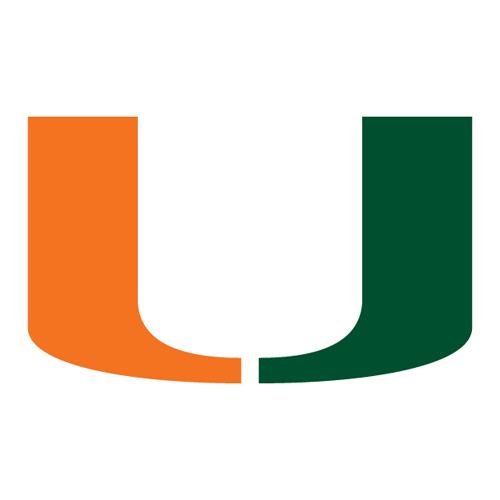
Photo: elisfkc2 · CC BY-SA 2.0 · Cropped for display
Up next · Week 9
Away
On the road at
Saturday, October 31 · Time TBA
The season, taking shape
Final scores show Miami first. Oldest to newest.
vs. Central MichiganPregame 47–6
Game details at Clemson
Pregame 31–19
Game details vs. Florida State
Pregame 38–17
Original full-season forecast
This forecast retains the original probabilities for the full schedule. It does not update with completed results or this week’s forecast.
2026 results
Current record, team efficiency, player production, and verified results from completed games.
Current record
7-07 wins · 0 lossesThrough 7 completed gamesLoading player usage…
2026 season preview
Miami enters 2026 with a more demanding challenge than simply replacing stars. After reaching the CFP championship game, the Hurricanes must show that Mario Cristobal’s roster-building approach can sustain national contention through heavy NFL attrition on both lines. Miami still has proven playmakers at quarterback, running back and receiver, and it added transfers at several premium positions. The season’s central question is whether Cristobal can turn that collection into a cohesive team before the schedule begins applying pressure.
Continuity should help. Shannon Dawson returns to direct the offense, and Corey Hetherman remains in charge of the defense. Miami did replace its running backs and tight ends coaches after Matt Merritt and Cody Woodiel left for other jobs, creating new teaching relationships in two offensive rooms. Cristobal’s ACC Kickoff delegation offered a useful outline of the team’s leadership: quarterback Darian Mensah, running back Mark Fletcher Jr. and veteran linebacker Mohamed Toure joined him as representatives across the offense and defense.
Original season forecast
The original ACC forecast, retained alongside current results.
ACC projected standing
#1
8-1 projected · 8.0 expected conference wins · conference favorite.
Preseason baseline
2025 percentiles retained as preseason context; current results and player production lead this page.
2025 FBS percentile scale · 50 is average
Incoming class
National and conference recruiting ranks, confirmed commitments, and the highest-ranked recruits in this class.
Top committed recruits
Miami2026 transfer movement
Incoming and outgoing transfer activity, with rated FBS-to-FBS moves below.
Incoming Transfers
MiamiOutgoing Transfers
MiamiSeason schedule
Completed games show final results. Upcoming games use this week’s forecast where available; later games retain their published season outlook.
Detailed football intelligence
The full team identity, offense, defense, and supporting evidence.
Team identity
Last season, Miami tried to stay balanced between the run and pass; the approach consistently kept the offense on schedule.
Why it matters
The passing game was Miami's more dependable way to stay ahead of the chains; opponents have to interrupt that rhythm without giving the run an easy box.
 vs. Pittsburgh
Pregame 36–16
Game detailsPregame comparisons use preserved published forecasts. Results include wins and losses.
At a glance
Current form leads the outlook.
2026 rates aggregate verified completed-game box scores. EPA is expected points added per play.
| Player | C/ATT | YDS | TD | INT |
|---|---|---|---|---|
| Darian Mensah | 166/204 | 2162 | 22 | 1 |
| Luke Nickel | 14/19 | 188 | 3 | 1 |
| Dereon Coleman | 5/6 | 30 | 0 | 0 |
| Player | CAR | YDS | AVG | TD |
|---|---|---|---|---|
| Javian Mallory | 59 | 444 | 7.5 | 7 |
| Mark Fletcher Jr. | 81 | 414 | 5.1 | 7 |
| Chris Wheatley-Humphrey | 15 | 116 | 7.7 | 1 |
| Player | REC | YDS | AVG | TD |
|---|---|---|---|---|
| Malachi Toney | 65 | 947 | 14.6 | 11 |
| Cooper Barkate | 24 | 301 | 12.5 | 4 |
| Daylyn Upshaw | 19 | 251 | 13.2 | 2 |
| Player | TOT | SOLO | TFL | SACK |
|---|---|---|---|---|
| Mohamed Toure | 35 | 24 | 0 | 0 |
| JJ Dunnigan | 28 | 16 | 2 | 1 |
| Chase Smith | 26 | 13 | 1 | 0 |
Saturday, October 24 · Hard Rock Stadium
Saturday, October 17 · Hard Rock Stadium
Saturday, October 3 · Memorial Stadium (Clemson, SC)
Mensah makes quarterback less of a search than an integration project. The Duke transfer arrived after passing for 3,973 yards and 34 touchdowns in 2025. After his first spring practice, Cristobal praised his command, accuracy and pocket presence. Dawson therefore has a proven veteran distributor for a third consecutive season, but Mensah must synchronize with a reshaped supporting cast. Sophomore Malachi Toney gives him an established centerpiece after earning first-team Walter Camp preseason All-America recognition from the ACC. Joshua Moore, Daylyn Upshaw and transfers are among the candidates to build the rotation around Toney; Moore returned to make catches after being limited early in spring, though his August workload was not confirmed.
Fletcher can steady the offense while those connections develop. He led Miami with 1,192 rushing yards in 2025 and described his spring role as helping freshmen and transfers learn the program standard. His production and leadership matter because the line in front of him is being reconstructed. Four starters departed, leaving offensive line coach Alex Mirabal to build around returners Matt McCoy, Samson Okunlola and Ryan Rodriguez. Barry Jackson reported that McCoy’s spring work at tackle was partly prompted by Okunlola’s injury and that McCoy’s eventual position remained unsettled.
The competition up front carries consequences for nearly every offensive strength. Protection will determine how comfortably Mensah can operate Dawson’s passing game, while movement in the running game will shape how heavily Miami can lean on Fletcher. Freshman tackle Jackson Cantwell received expanded spring-game work, according to Cristobal, but Mirabal emphasized the technical adjustment required against college speed and power. Cantwell could work into the two-deep, but Miami had not declared him a starter. The final alignment will depend on health and the development of younger linemen, making this the offense’s most consequential position room.
Hetherman faces his own reconstruction along the defensive front. First-round edge rushers Rueben Bain Jr. and Akheem Mesidor are gone after defining Miami’s 2025 pass rush. Georgia transfer Damon Wilson II has been identified by Barry Jackson as a pivotal replacement, while tackles Jarquez Carter and Keona Davis joined the spring work. Wilson does not need to reproduce two departed stars by himself, but Miami must find a credible way to create pressure without them. That will influence how aggressively Hetherman can call games and how much strain falls on the secondary.
There is useful experience behind the front. Toure provides veteran leadership at linebacker, and Miami lists returning defenders Xavier Lucas, Zechariah Poyser, Bryce Fitzgerald, Damari Brown, Justin Scott and Ahmad Moten Sr. across the three levels. The secondary’s defining issue is deployment. Jackson described Boston College transfer Omar Thornton and Fitzgerald as movable pieces between safety and nickel. Their versatility gives Hetherman options as Miami replaces Keionte Scott, although settling those roles will be important for communication and coverage continuity.
The schedule will test those rebuilt units immediately. Miami opens with a cross-country trip to Stanford and plays three of its first five games on the road, including visits to Wake Forest and Clemson. That stretch offers little insulation for a developing offensive line or a reworked pass rush. An open week before Florida State visits Hard Rock Stadium gives Miami additional preparation time for the rivalry game, while the November trip to Notre Dame supplies another major road test. The Hurricanes have enough established skill talent and defensive experience to avoid treating 2026 as a conventional rebuild. Whether they can sustain their breakthrough will come down to Cristobal’s signature concern: how quickly Miami becomes dependable at the line of scrimmage.
This preview is based on the linked public reporting and official program records.
Profile high point
Passing held the profile's highest percentile position.Profile low point
Big-play creation held the lowest percentile position among the profile's strength measures.



The passing game is what Miami can trust most.
Why it matters
The opening plan has its best answer when opponents crowd the box or force obvious throwing situations; explosive-play creation remains the first counter an opponent should test.
Big-play creation is Miami's biggest concern, and opponents can test it immediately.
Why it matters
Opponents can squeeze underneath space and make the offense finish long drives without chunk gains; passing efficiency has to keep that stress from setting the game plan.
For Miami, the cleanest script is to stay balanced between the run and pass, then let the passing game finish drives; fewer possessions make every empty drive more expensive.
What matters
Miami's balanced structure played at a deliberate pace. The pass game finished top-tier, while the run game finished above-average.
Inside the team
Open a section for the football detail and supporting numbers.
The down-to-down question that determines whether the offense can keep both the run and pass available.
Opponents have to break Miami's passing rhythm before it owns early downs.
Why it matters
If Miami keeps finding routine completions, the defense cannot load the box or turn the rush loose.
The pace, play selection, and methods this offense uses to stay on schedule.
Miami played at a deliberate pace in 2025.
What matters
Miami worked with fewer possessions than most teams last season.
Miami's prior passing record was top-tier.
Why it matters
A repeatable pass game can let Miami punish loaded boxes without relying on low-frequency deep completions.
Miami's prior rushing record was above-average.
Why it matters
When Miami's run game cannot stay on schedule, protection and passing-down execution carry more of the offense.
Miami's explosive-play results were mixed rather than a defining edge.
Why it matters
A big play can still flip a possession, but last season's results do not make explosiveness something this team can rely on.
How consistently the offense creates manageable situations and the defense prevents them.
Miami won ordinary downs on both sides of the ball.
Why it matters
Miami's success rate shows whether it can sustain drives and get stops without relying on sacks, turnovers, or isolated big plays.
Opponent-adjusted EPA identifies the pass game as Miami's stronger offensive unit.
Why it matters
If an opponent removes the first passing answer, the run game's lower adjusted value becomes the key counter to test.
Where the defense can create pressure, control the run, and end drives.
Miami's prior defense was top-tier overall, with no clear separation among its main units.
Why it matters
That balance makes it harder for an offense to choose one automatic target; the defense still has to win early downs before any unit can dictate the offensive options.
Miami's available disruption measures ranked among the best in the country last season; a charted pressure rate is not available.
Why it matters
Sustained disruption can create negative plays and give Miami a better chance to end drives before third down.
Miami's disruption regularly finished at the quarterback.
What matters
Both sack production and front-seven disruption cleared the FBS midpoint.
Miami's prior run-defense results were top-tier.
Why it matters
A dependable run front can let Miami create obvious passing downs without committing extra bodies to the box.