
Week 4 · FinalL
 vs. UCLA
3–54-51 margin
Pregame 29–28
Game detailsSaturday Index
Loading team intelligenceBringing the latest verified football information into focus.
Big Ten · 2026 · Week 8

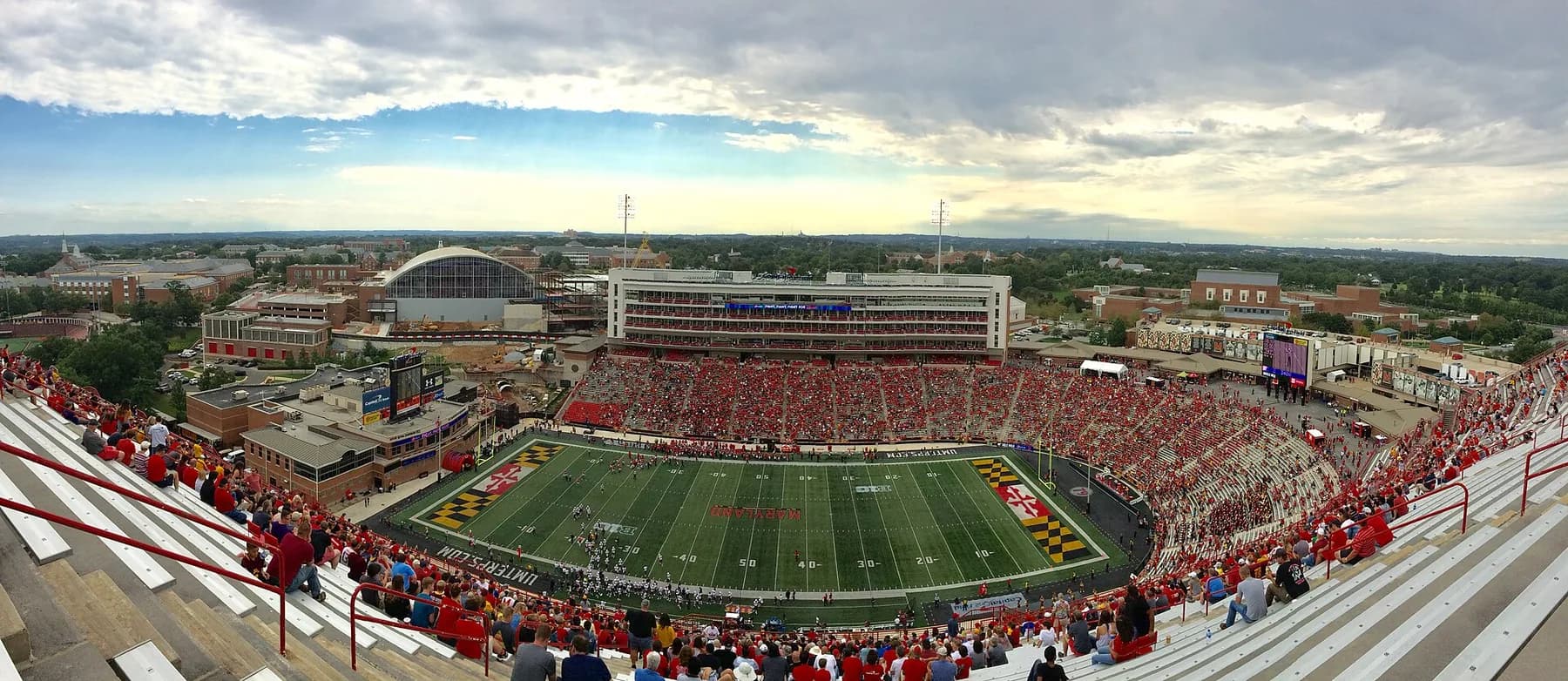
Photo: Bluesnote · CC BY-SA 4.0 · Cropped for display
Up next · Week 9
Home
Hosting
Saturday, October 31 · Time TBA
The season, taking shape
Final scores show Maryland first. Oldest to newest.
vs. UCLAPregame 29–28
Game details at Nebraska
Pregame 20–35
Game details at Ohio State
Pregame 12–44
Game detailsOriginal full-season forecast
This forecast retains the original probabilities for the full schedule. It does not update with completed results or this week’s forecast.
2026 results
Current record, team efficiency, player production, and verified results from completed games.
Current record
2-52 wins · 5 lossesThrough 7 completed gamesLoading player usage…
2026 season preview
Maryland enters 2026 with enough continuity that Mike Locksley can reasonably expect more than another year of foundation-building. The school reports that 71% of the Terrapins’ 2025 production returns, the second-highest share nationally, while 11 scholarship transfers and 11 early enrollees took part in spring practice. Locksley has an established quarterback, a veteran defensive leader and retained building blocks across the roster. The season turns on whether that experience produces a more balanced offense and a front seven that dictates play rather than absorbs it.
Malik Washington is the centerpiece of that conversion. As a freshman in 2025, he completed 273 of 473 passes for a Maryland freshman record of 2,963 yards and 17 touchdowns, rushed for more than 300 yards and threw for 459 yards against Michigan State in the finale. New offensive coordinator and quarterbacks coach Clint Trickett inherits a proven high-volume starter with dual-threat ability. Washington’s next step is not simply throwing more; it is making the offense more efficient, avoiding needless stress and punishing defenses when the structure around him creates favorable downs.
Original season forecast
The original Big Ten forecast, retained alongside current results.
Big Ten projected standing
#14
3-6 projected · 3.3 expected conference wins · #14 of 18.
Preseason baseline
2025 percentiles retained as preseason context; current results and player production lead this page.
2025 FBS percentile scale · 50 is average
Incoming class
National and conference recruiting ranks, confirmed commitments, and the highest-ranked recruits in this class.
Top committed recruits
Maryland2026 transfer movement
Incoming and outgoing transfer activity, with rated FBS-to-FBS moves below.
Incoming Transfers
MarylandOutgoing Transfers
MarylandSeason schedule
Completed games show final results. Upcoming games use this week’s forecast where available; later games retain their published season outlook.
Detailed football intelligence
The full team identity, offense, defense, and supporting evidence.
Team identity
Last season, Maryland tried to lean on the passing game; too many drives still went off schedule.
Why it matters
The passing game was Maryland's less difficult offensive option, but it did not provide a dependable way to stay ahead of the chains; the offense must prove that rhythm before opponents have to widen their structure.
 vs. Rutgers
Pregame 29–26
Game detailsPregame comparisons use preserved published forecasts. Results include wins and losses.
At a glance
Current form leads the outlook.
2026 rates aggregate verified completed-game box scores. EPA is expected points added per play.
| Player | C/ATT | YDS | TD | INT |
|---|---|---|---|---|
| Malik Washington | 155/260 | 1615 | 9 | 6 |
| Cardell Williams | 6/7 | 63 | 1 | 0 |
| Jack Capaldi | 2/2 | 35 | 0 | 0 |
| Player | CAR | YDS | AVG | TD |
|---|---|---|---|---|
| DeJuan Williams | 38 | 281 | 7.4 | 3 |
| Iverson Howard | 60 | 226 | 3.8 | 4 |
| Harry Dalton III | 30 | 113 | 3.8 | 3 |
| Player | REC | YDS | AVG | TD |
|---|---|---|---|---|
| Chris Durr Jr. | 52 | 580 | 11.2 | 4 |
| Kaleb Webb | 21 | 273 | 13.0 | 0 |
| Na'eem Abdul-Rahim Gladding | 20 | 242 | 12.1 | 2 |
| Player | TOT | SOLO | TFL | SACK |
|---|---|---|---|---|
| Daniel Wingate | 45 | 21 | 2.5 | 0 |
| Carlton Smith | 44 | 24 | 3 | 1 |
| Sidney Stewart | 26 | 16 | 3.5 | 2 |
Saturday, October 17 · SECU Stadium
Saturday, October 10 · Ohio Stadium
Saturday, October 3 · Memorial Stadium (Lincoln, NE)
The receiving corps will test that growth. Shaleak Knotts, Jalil Farooq and Octavian Smith Jr. exhausted their eligibility, taking Washington’s three leading veteran targets out of the lineup. Old Dominion transfer Na’eem Abdul-Rahim Gladding arrives after making 51 catches for 667 yards and six touchdowns in 2025, while Wyoming transfer Chris Durr Jr. produced 45 receptions for 469 yards and four scores. Their college production is real, but its translation to Big Ten coverage and physicality remains unproven. At tight end, former Terp Preston Howard returned from Auburn, though spring usage indicated the every-down role was still unsettled.
The more consequential offensive repair is the running game. Maryland averaged 104.3 rushing yards per game in 2025, next-to-last in the Big Ten. Michael Ostrowski identified DeJuan Williams as the likely lead back after he averaged 3.9 yards per carry and caught 45 passes, but the depth behind him remains young. Center Michael Hershey anchors a line that allowed only nine sacks, tied for third-fewest nationally, and three starters were retained. Pass protection, however, is not the same as displacing defensive fronts. With right tackle unsettled in spring reporting and right-side turnover to address, this line must create productive early-down carries that keep Washington out of obvious passing situations.
The defense faces its own conversion test under Ted Monachino, who coordinates the unit and coaches outside linebackers. Aazaar Abdul-Rahim remains co-defensive coordinator and cornerbacks coach, while Randy Starks takes over the defensive line. Linebacker Daniel Wingate gives that staff a proven organizer after leading Maryland with 102 tackles, including 62 solo stops and 6.5 tackles for loss, and earning honorable-mention All-Big Ten recognition. His production is valuable, but the better outcome would be a front that prevents so many plays from reaching him with room to run.
That places immediate pressure on the defensive line and edge room. Sidney Stewart and Zahir Mathis worked ahead of five-star freshman Zion Elee during the spring showcase, allowing Maryland to treat Elee as a high-upside rotational player rather than an emergency starter. The school, citing 247Sports ratings, identified the Baltimore prospect as the highest-rated signee in program history. Locksley has said the outside linebackers must supply substantial production, making sustained growth from Mathis and Stewart essential while Elee adjusts. Inside, transfer additions offer options, but recent injury or limited-production questions attached to several newcomers leave Starks with a rotation to establish.
The secondary appears more continuity-based. Jamare Glasker, Dontay Joyner, Boston College transfer Amari Jackson and Messiah Delhomme formed the spring first group, with freshman Hakim Satterwhite working behind them. That experience can matter only if the front makes coverage manageable. If Maryland controls the run and creates longer passing downs, Monachino can ask the edge players to rush and the secondary to challenge routes. If not, even a settled back end will spend too many snaps defending an offense with its entire playbook available.
The schedule offers an early sequence in which those relationships can take shape, but the runway extends beyond the first three games. Maryland opens at home against Hampton, visits UConn and hosts Virginia Tech, then welcomes UCLA after those opening three games. Consecutive trips to Nebraska and Ohio State create the first severe pressure point. Home games against Rutgers, Illinois and Wisconsin are arranged around a trip to Purdue, while the closing sequence sends Maryland to USC before Penn State visits SECU Stadium. Seven home dates provide opportunities, but the demanding road pairings magnify the cost of failing to develop balance early.
Maryland’s formula is therefore specific rather than sentimental: the running game must buy Washington better downs, Washington must turn those downs into efficient offense, and the front seven must stop the run well enough to unleash its edge talent. Accomplish those three things, and the Terrapins’ continuity becomes a competitive advantage that can survive the schedule’s pressure points. Miss on the run-game repair or front-seven execution, and Washington and Wingate will again be asked to rescue too many snaps individually. Locksley’s 2026 team will be defined by whether its experience changes the geometry of games, not merely the familiarity of the lineup.
This preview is based on the linked public reporting and official program records.
Profile high point
Big-play prevention held the profile's highest percentile position.Profile low point
Pressure held the lowest percentile position among the profile's strength measures.



Big-play creation is what Maryland can trust most.
Why it matters
The offense has its best route to changing field position without requiring flawless drive efficiency; front-seven disruption remains the first counter an opponent should test.
Front-seven disruption is Maryland's biggest concern, and opponents can test it immediately.
Why it matters
Opponents can trust normal protection and make the defense win without steady negative plays; explosive-play creation has to keep that stress from setting the game plan.
Maryland is at its best when it can use the passing game to stay on schedule and finish drives; fewer possessions make every empty drive more expensive.
What matters
Maryland's pass-heavy structure played at a deliberate pace. The pass game finished below-average, while the run game finished weak.
Inside the team
Open a section for the football detail and supporting numbers.
The down-to-down question that determines whether the offense can keep both the run and pass available.
Before defenses have to adjust, Maryland must prove routine throws can keep first down on schedule.
What matters
Last season's passing results did not establish a dependable way to stay out of long-yardage.
The pace, play selection, and methods this offense uses to stay on schedule.
Maryland played at a deliberate pace in 2025.
What matters
Maryland worked with fewer possessions than most teams last season.
Maryland's prior passing record was below-average.
Why it matters
Maryland's offense needs protection, field position, or explosive variance when ordinary dropbacks do not create enough value.
Maryland's prior rushing record was weak.
Why it matters
When Maryland's run game cannot stay on schedule, protection and passing-down execution carry more of the offense.
Maryland both created and limited explosive plays at a strong prior-season level.
Why it matters
That combination can change a game without forcing the offense to trade efficiency for low-percentage shots.
How consistently the offense creates manageable situations and the defense prevents them.
Maryland's down-to-down results were weak overall.
Why it matters
Maryland's success rate shows whether it can sustain drives and get stops without relying on sacks, turnovers, or isolated big plays.
Opponent-adjusted EPA identifies the pass game as Maryland's stronger offensive unit.
Why it matters
If an opponent removes the first passing answer, the run game's lower adjusted value becomes the key counter to test.
Where the defense can create pressure, control the run, and end drives.
Maryland's prior defense was below-average overall and strongest in pass defense.
Why it matters
Opponents can trust normal protection and make coverage hold through the route; Maryland needs its pass defense to tighten throwing windows before that plan settles in.
Maryland's available disruption measures ranked near the bottom nationally last season; a charted pressure rate is not available.
Why it matters
Without consistent disruption, Maryland's defense must win more snaps through coverage, leverage, and early-down prevention.
Maryland's sack production outpaced its broader disruption record.
Why it matters
Maryland's disruption can hurry an offense; sacks do more by erasing field position and ending passing downs.
Maryland's prior run-defense results were weak.
Why it matters
If Maryland's front cannot control early downs, opponents can keep every offensive option open and protect their passing game.