
Week 5 · FinalW
vs. McNeese
63–14+49 margin
Pregame comparison unavailable
Game detailsSaturday Index
Loading team intelligenceBringing the latest verified football information into focus.
SEC · 2026 · Week 8

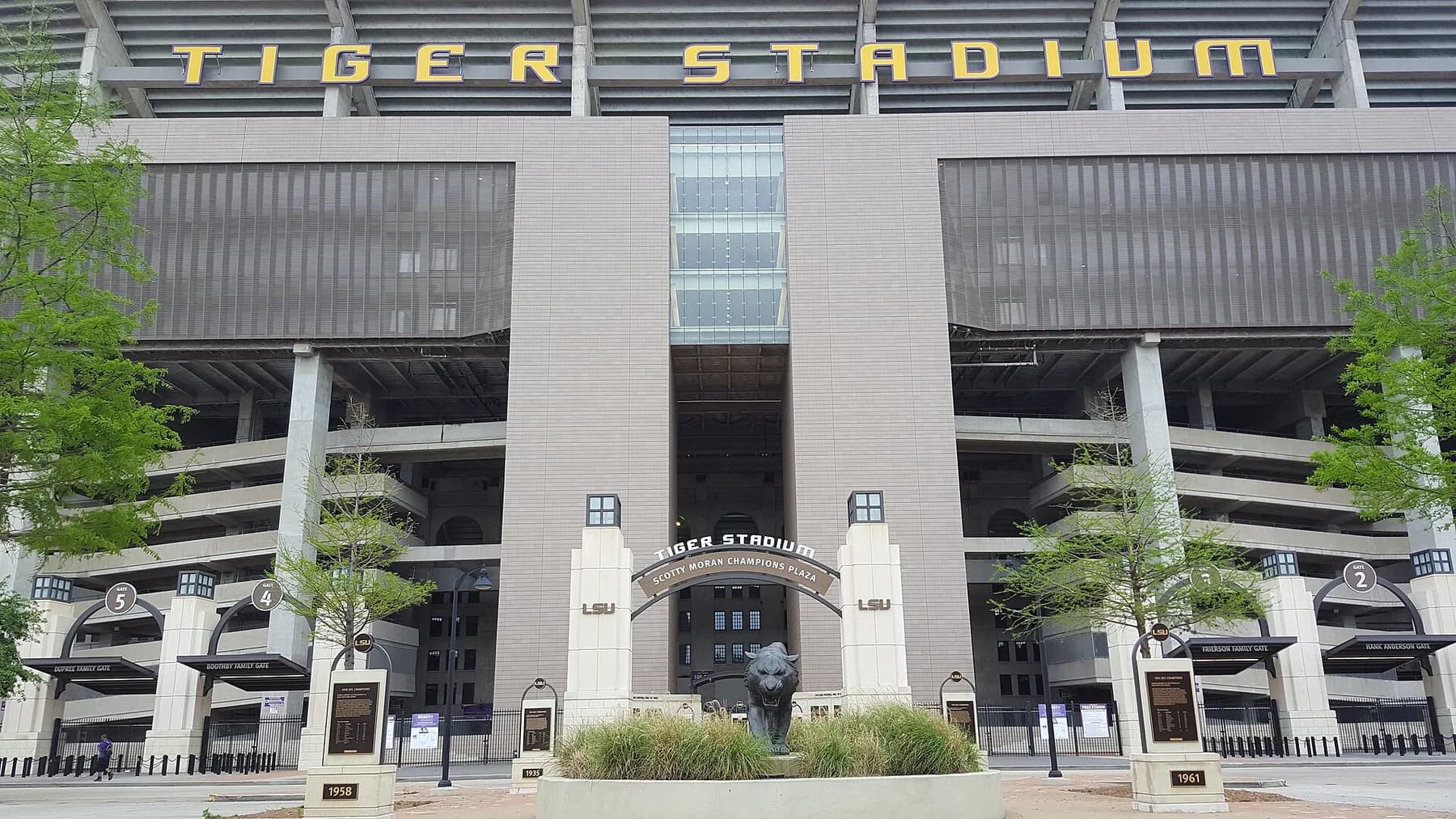
Photo: Spatms · CC BY-SA 4.0 · Cropped for display
Up next · Week 10
Home
Hosting
Saturday, November 7 · Time TBA
The season, taking shape
Final scores show LSU first. Oldest to newest.
Pregame comparison unavailable
Game details at Kentucky
Pregame 32–20
Game details vs. Mississippi State
Pregame 35–21
Game detailsOriginal full-season forecast
This forecast retains the original probabilities for the full schedule. It does not update with completed results or this week’s forecast.
2026 results
Current record, team efficiency, player production, and verified results from completed games.
Current record
6-26 wins · 2 lossesThrough 8 completed gamesLoading player usage…
2026 season preview
Sam Leavitt and a rebuilt offense give LSU intriguing options, but line play and a remade defensive interior will shape Lane Kiffin’s first season in Baton Rouge.
LSU enters 2026 with Lane Kiffin taking over a roster reshaped around Arizona State transfer Sam Leavitt, a deeper backfield and an imported group of pass catchers. The promise is obvious, but the calendar offers almost no runway: Kiffin opens his tenure at home against Clemson before an early trip to Ole Miss and a home date with Texas A&M. LSU’s season will turn on how quickly Kiffin gives the offense an identity and how well Blake Baker steadies a defense rebuilding its interior.
Original season forecast
The original SEC forecast, retained alongside current results.
SEC projected standing
#10
5-4 projected · 4.8 expected conference wins · #10 of 16.
Preseason baseline
2025 percentiles retained as preseason context; current results and player production lead this page.
2025 FBS percentile scale · 50 is average
Incoming class
National and conference recruiting ranks, confirmed commitments, and the highest-ranked recruits in this class.
Top committed recruits
LSU2026 transfer movement
Incoming and outgoing transfer activity, with rated FBS-to-FBS moves below.
Incoming Transfers
LSUOutgoing Transfers
LSUSeason schedule
Completed games show final results. Upcoming games use this week’s forecast where available; later games retain their published season outlook.
Detailed football intelligence
The full team identity, offense, defense, and supporting evidence.
Team identity
Last season, LSU tried to lean on the passing game; it rarely provided an easy foundation.
Why it matters
The passing game was LSU's less difficult offensive option, but it did not provide a dependable way to stay ahead of the chains; the offense must prove that rhythm before opponents have to widen their structure.
 at Auburn
Pregame 30–22
Pregame comparisons use preserved published forecasts. Results include wins and losses.
At a glance
Current form leads the outlook.
2026 rates aggregate verified completed-game box scores. EPA is expected points added per play.
| Player | C/ATT | YDS | TD | INT |
|---|---|---|---|---|
| Sam Leavitt | 180/256 | 2171 | 17 | 8 |
| Landen Clark | 14/32 | 235 | 1 | 0 |
| Husan Longstreet | 7/10 | 95 | 0 | 0 |
| Player | CAR | YDS | AVG | TD |
|---|---|---|---|---|
| Dilin Jones | 149 | 659 | 4.4 | 6 |
| Sam Leavitt | 72 | 324 | 4.5 | 8 |
| Harlem Berry | 33 | 202 | 6.1 | 1 |
| Player | REC | YDS | AVG | TD |
|---|---|---|---|---|
| Jackson Harris | 36 | 634 | 17.6 | 7 |
| Winston Watkins | 37 | 487 | 13.2 | 2 |
| Eugene Wilson | 27 | 284 | 10.5 | 1 |
| Player | TOT | SOLO | TFL | SACK |
|---|---|---|---|---|
| TJ Dottery | 60 | 29 | 3 | 1 |
| Davhon Keys | 42 | 22 | 3.5 | 1.5 |
| P.J. Woodland | 33 | 18 | 0 | 0 |
Saturday, October 24 · Jordan-Hare Stadium
Saturday, October 17 · Tiger Stadium (LA)
Saturday, October 10 · Kroger Field
Kiffin will direct the offensive transition with Charlie Weis Jr., while LSU’s current roster also lists tight ends coach Joe Cox as co-offensive coordinator. Palmer reported that Kiffin and Weis have leaned more heavily on the run than LSU has in recent seasons, including an Ole Miss offense that led the SEC in rushing attempts in 2023. A credible ground game would do more than change the play distribution. It could support Kiffin’s tempo and play-action structure while reducing the burden on Leavitt.
Leavitt is the presumptive centerpiece of that plan. LSU’s roster lists him as a redshirt junior, with redshirt freshman Husan Longstreet and redshirt sophomore Landen Clark also in the quarterback room. Leavitt is returning from foot surgery, but Lane Kiffin said in mid-June that the quarterback was practicing at close to full strength. That progress matters behind a changing offensive line. Longstreet is the most prominent developmental alternative if availability or performance forces LSU to adjust.
The backfield gives Kiffin options. Palmer identified returners Caden Durham and Harlem Berry alongside transfers Dilin Jones, Rod Gainey, Raycine Guillory and Stacy Gage, with Jones receiving first-team work during spring. Durham and Jones have prior foot-injury context, so the group’s depth has practical value beyond creating specialized roles. At receiver, Jackson Harris arrives after producing 963 yards and 12 touchdowns at Hawai’i, while Tre’ Brown averaged 20.1 yards per catch at Old Dominion. Jayce Brown and Eugene Wilson III add more experience, and tight ends Trey’Dez Green and Malachi Thomas offer size inside. The task now is establishing a target hierarchy around Leavitt.
The offensive line may determine whether those options become a coherent attack. Palmer reported that center Braelin Moore was expected to anchor a remade interior, with Bo Bordelon and Maryland transfer Aliou Bah taking most first-unit guard work in spring. Ole Miss transfer Devin Harper can play tackle or guard, giving the staff useful flexibility. LSU still must assemble its opening five, and the interior carries particular responsibility: create a more dependable rushing lane structure while keeping Leavitt protected against a schedule that tests the unit immediately.
Baker’s greatest concern is defensive tackle, where LSU must replace Bernard Gooden, Jacobian Guillory, Ahmad Breaux and Walter Mathis. Veteran edge Princewill Umanmielen and junior tackle Dominick McKinley provide starting points, while Malik Blocton, Stephiylan Green, Jaylen Brown and Jordan Ross join the front. Behind them, linebacker is the defense’s most continuity-rich room. Whit Weeks, Davhon Keys and Tylen Singleton return, and transfer TJ Dottery adds experience. That group should carry much of the communication and run-fit burden while Baker builds a workable rotation in front of it.
The secondary offers Baker several flexible pieces but fewer settled answers. Palmer projected Ty Benefield and Tamarcus Cooley as the primary safeties, with Dashawn Spears moving to the STAR role and Faheem Delane and Joel Thomas among the next options. Benefield’s size and Spears’ versatility can help Baker vary personnel, though the cornerback order still needs definition. Special teams is undergoing an even broader reset after LSU added punter Hayden Craig, long snapper Mack Mulhern and kicker Scott Starzyk. Timing and coverage cohesion will have to be built rather than inherited.
LSU’s schedule magnifies every transition point. Clemson comes to Tiger Stadium for the opener, followed by Louisiana Tech and the earliest LSU-Ole Miss meeting in that series. Kiffin’s return to Oxford adds emotional weight to a game already carrying SEC consequences, and Texas A&M visits Baton Rouge the following week. Later home games against Alabama and Texas give LSU major opportunities, but they also reinforce the same message as the opening month: the Tigers cannot expect an extended adjustment period.
That is the defining tension of Kiffin’s first LSU team. The offense has a quarterback around whom a system can be built, enough backfield depth to emphasize the run and proven transfer production on the perimeter. Baker has veteran leadership at linebacker and useful pieces in the secondary. But the most consequential work remains concentrated along both lines, where protection, rushing efficiency and defensive interior play will decide whether LSU’s collection of talent functions quickly enough for the schedule it faces.
This preview is based on the linked public reporting and official program records.
Profile high point
Down-to-down defense held the profile's highest percentile position.Profile low point
The run game held the lowest percentile position among the profile's strength measures.



The defense's control of ordinary downs is what LSU can trust most.
Why it matters
That unit is the most credible foundation for making opponents string together clean drives; rushing structure remains the first counter an opponent should test.
The run game is LSU's biggest concern, and opponents can test it immediately.
What matters
LSU's rushing structure ranked near the bottom nationally last season.
LSU is at its best when it can use the passing game to stay on schedule and finish drives; an average pace puts more weight on winning ordinary downs.
What matters
LSU's pass-first structure played at a balanced pace. The pass game finished weak, while the run game finished bottom-tier.
Inside the team
Open a section for the football detail and supporting numbers.
The down-to-down question that determines whether the offense can keep both the run and pass available.
Before defenses have to adjust, LSU must prove routine throws can keep first down on schedule.
What matters
Last season's passing results did not establish a dependable way to stay out of long-yardage.
The pace, play selection, and methods this offense uses to stay on schedule.
LSU played at a balanced pace in 2025.
Why it matters
At that pace, LSU cannot count on extra possessions or expect to shorten the game.
LSU's prior passing record was weak.
Why it matters
LSU's offense needs protection, field position, or explosive variance when ordinary dropbacks do not create enough value.
LSU's prior rushing record was bottom-tier.
Why it matters
When LSU's run game cannot stay on schedule, protection and passing-down execution carry more of the offense.
LSU's explosive-play results were mixed rather than a defining edge.
Why it matters
A big play can still flip a possession, but last season's results do not make explosiveness something this team can rely on.
How consistently the offense creates manageable situations and the defense prevents them.
LSU's defense was more consistent down to down than its offense.
Why it matters
LSU's success rate shows whether it can sustain drives and get stops without relying on sacks, turnovers, or isolated big plays.
Opponent-adjusted EPA identifies the pass game as LSU's stronger offensive unit.
Why it matters
If an opponent removes the first passing answer, the run game's lower adjusted value becomes the key counter to test.
Where the defense can create pressure, control the run, and end drives.
LSU's prior defense was strong overall and strongest in run front.
What matters
Run front finished top-tier, while disruption finished middle-of-the-pack; the latter is the first place to test, not an automatic answer.
LSU's available disruption measures finished near the national middle last season; a charted pressure rate is not available.
Why it matters
Without consistent disruption, LSU's defense must win more snaps through coverage, leverage, and early-down prevention.
LSU's sack and disruption results were middle-of-the-pack.
Why it matters
LSU's disruption can hurry an offense; sacks do more by erasing field position and ending passing downs.
LSU's prior run-defense results were top-tier.
Why it matters
A dependable run front can let LSU create obvious passing downs without committing extra bodies to the box.