Week 4 · FinalL
 vs. Wake Forest
27–30-3 margin
Pregame 33–23
Game detailsSaturday Index
Loading team intelligenceBringing the latest verified football information into focus.
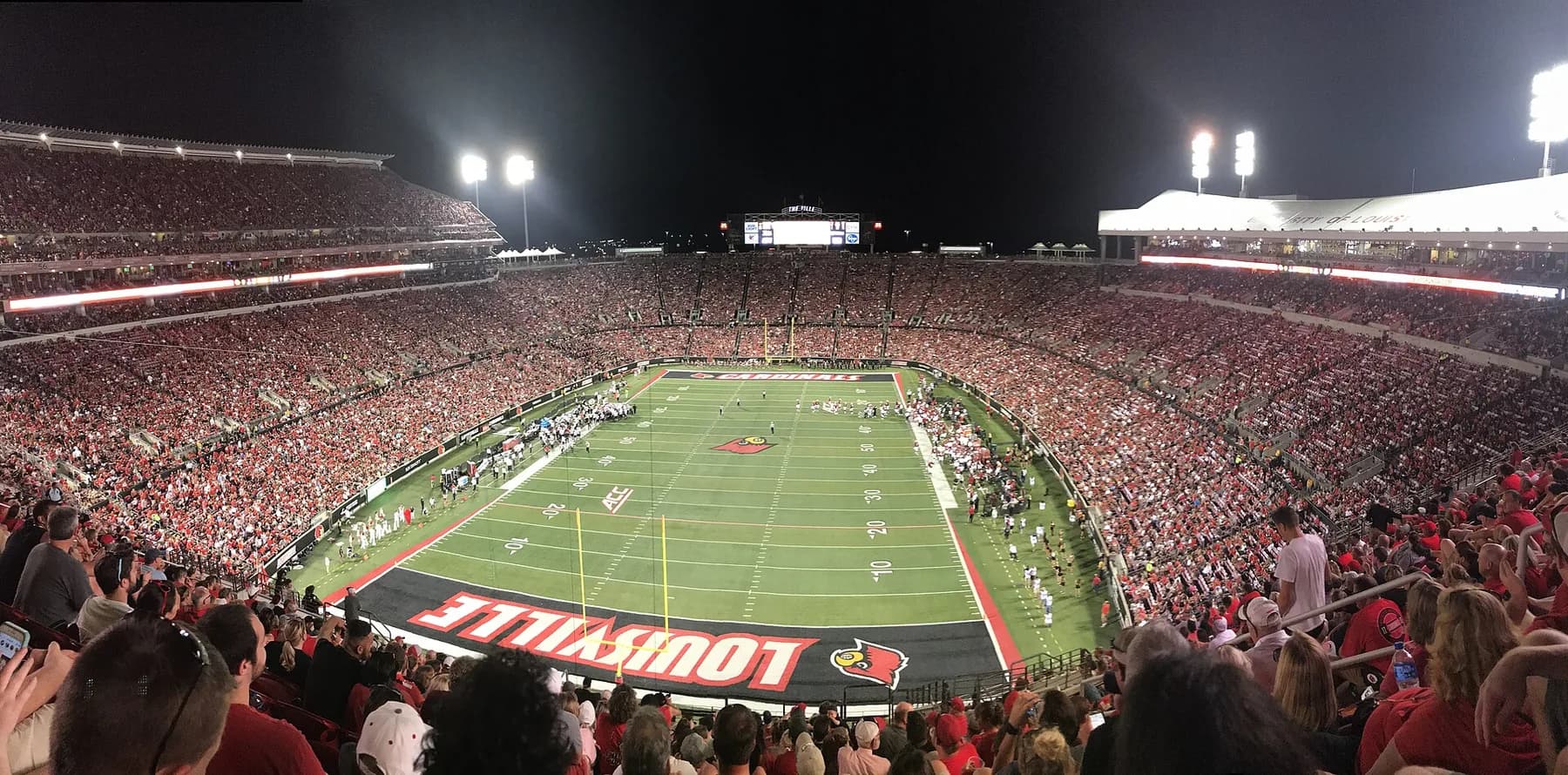
ACC · 2026 · Week 8

Photo: Nolanwebb · CC BY-SA 4.0 · Cropped for display
Up next · Week 9
Home
Hosting
Saturday, October 31 · Time TBA
The season, taking shape
Final scores show Louisville first. Oldest to newest.
vs. Wake ForestPregame 33–23
Game details at NC State
Pregame 30–27
Game details vs. Florida State
Pregame 30–27
Original full-season forecast
This forecast retains the original probabilities for the full schedule. It does not update with completed results or this week’s forecast.
2026 results
Current record, team efficiency, player production, and verified results from completed games.
Current record
4-34 wins · 3 lossesThrough 7 completed gamesLoading player usage…
2026 season preview
Jeff Brohm's Cardinals left spring with backfield depth and disruptive defensive pieces, but quarterback readiness, player availability and offensive-line cohesion remained defining questions.
Louisville enters 2026 with Jeff Brohm as head coach and a roster still learning how its many new parts fit together. Brohm said the Cardinals opened spring with 48 newcomers, a level of turnover that made communication and role clarity central concerns. This preview captures Louisville as it left spring: it does not resolve the opening-day quarterback, the clearance of rehabbing players or the healthy first-team offensive-line alignment.
Quarterback was the defining offensive question. Ohio State transfer Lincoln Kienholz worked as the spring-game starter and completed 10 of 16 passes for 91 yards against the first-team defense. Brian Brohm described him as a strong-armed athlete who could add designed runs, reads and option elements, while also emphasizing his limited live experience compared with Louisville's recent transfer starters.
Original season forecast
The original ACC forecast, retained alongside current results.
ACC projected standing
#5
5-4 projected · 5.1 expected conference wins · #5 of 17.
Preseason baseline
2025 percentiles retained as preseason context; current results and player production lead this page.
2025 FBS percentile scale · 50 is average
Incoming class
National and conference recruiting ranks, confirmed commitments, and the highest-ranked recruits in this class.
Top committed recruits
Louisville2026 transfer movement
Incoming and outgoing transfer activity, with rated FBS-to-FBS moves below.
Incoming Transfers
LouisvilleOutgoing Transfers
LouisvilleSeason schedule
Completed games show final results. Upcoming games use this week’s forecast where available; later games retain their published season outlook.
Detailed football intelligence
The full team identity, offense, defense, and supporting evidence.
Team identity
Last season, Louisville tried to lean on the passing game; the results were uneven when the offense tried to live that way.
Why it matters
The run game was Louisville's steadier way to stay ahead of the chains; opponents have to win early fits without handing away play action.
 at Syracuse
Pregame 33–23
Game detailsPregame comparisons use preserved published forecasts. Results include wins and losses.
At a glance
Current form leads the outlook.
2026 rates aggregate verified completed-game box scores. EPA is expected points added per play.
| Player | C/ATT | YDS | TD | INT |
|---|---|---|---|---|
| Lincoln Kienholz | 121/180 | 1844 | 10 | 3 |
| Briggs Cherry | 2/2 | 24 | 0 | 0 |
| Davin Wydner | 3/4 | 19 | 1 | 0 |
| Player | CAR | YDS | AVG | TD |
|---|---|---|---|---|
| Isaac Brown | 83 | 568 | 6.8 | 4 |
| Keyjuan Brown | 51 | 417 | 8.2 | 5 |
| Lincoln Kienholz | 71 | 251 | 3.5 | 10 |
| Player | REC | YDS | AVG | TD |
|---|---|---|---|---|
| Lawayne McCoy | 25 | 513 | 20.5 | 4 |
| Tre Richardson | 30 | 493 | 16.4 | 2 |
| Treyshun Hurry | 28 | 337 | 12.0 | 0 |
| Player | TOT | SOLO | TFL | SACK |
|---|---|---|---|---|
| T.J. Capers | 53 | 26 | 1.5 | 0 |
| Kaleb Beasley | 49 | 24 | 2 | 0 |
| Stanquan Clark | 48 | 14 | 3.5 | 0.5 |
Saturday, October 17 · JMA Wireless Dome
Friday, October 9 · L&N Federal Credit Union Stadium
Saturday, October 3 · Carter-Finley Stadium
West Georgia transfer Davin Wydner followed Kienholz in the spring game and produced a strong showing. Courier Journal beat writer Alexis Cubit characterized the competition as less settled than Louisville's previous transfer-quarterback transitions under Brohm. The spring order favored Kienholz, but it did not establish an uncontested starter. Whoever wins the job must turn physical ability into dependable decisions against live pressure.
The best support for a developing quarterback may be the backfield. Matthew McGavic assessed running back as Louisville's strongest room, led by Isaac Brown with Keyjuan Brown as a capable alternate and Marquise Davis, Braxton Jennings and Lekhy Thompkins adding depth. A productive rotation could reduce the quarterback's burden, keep the offense out of obvious passing situations and give Brohm more freedom to use Kienholz's mobility if he earns the job.
The post-spring receiving projection placed Lawayne McCoy, TreyShun Hurry and Vanderbilt transfer Tre Richardson in the first group, with T.J. McWilliams, Jakob Dixon and Jackson Voth behind them. At tight end, Brody Foley and Jaleel Skinner projected as the top two. Richardson and Foley missed spring while rehabbing, so those projections depended on later availability. With transfers and players moving into larger roles, the passing game's development also depended on how quickly its primary targets built timing with the quarterback.
The offensive line carried similar uncertainty. The post-spring projection ran Anwar O'Neal, Eryx Daugherty, Lance Robinson, Johnnie Brown III and Cason Henry from left to right, but absences forced Robinson to left tackle and Evan Wibberley to center in the spring scrimmage. O'Neal and Henry were limited or unavailable around that game. The cross-training showed useful flexibility, but spring did not establish the healthy combination that would protect the quarterback and create space for Louisville's deepest offensive room. Dale Williams also replaced Richard Owens as offensive-line coach, while senior offensive assistant Paul Petrino took charge of the tight ends.
Louisville's defense had a more established focal point in Clev Lubin. He returned after a reported 2025 line of 61 tackles, 13.5 tackles for loss, 8.5 sacks, three forced fumbles and five pass breakups. A.J. Green, North Carolina transfer Tyler Thompson and Kentucky transfer Jerod Smith II added edge options, with Smith able to work inside or outside. That group offered the personnel for a rotating pass rush capable of disrupting protections rather than asking the back end to cover indefinitely.
Behind the front, the post-spring projection paired Stanquan Clark and T.J. Capers at linebacker, backed by Caleb Matelau and Trent Carter. The projected secondary featured Tayon Holloway and D.J. Waller at corner, Kaleb Beasley at free safety, Iowa transfer Koen Entringer at strong safety and Antonio Watts at STAR. Entringer was active near the box during spring, suggesting an aggressive role behind the rush, although Watts missed spring while rehabbing and the listed assignments still required later confirmation.
The schedule gives Louisville little room to solve its largest questions slowly. The Cardinals are scheduled to open against Ole Miss at Nissan Stadium on Sept. 6, then return home to face Villanova five days later. SMU and Wake Forest also visit in September. Trips to NC State and Syracuse fall on either side of a home game against Florida State, creating an early stretch that can test quarterback composure, line communication and the defense's ability to generate pressure.
Stanford visits on Oct. 31 before Louisville travels to Georgia Tech and North Carolina on consecutive weekends. Pittsburgh comes to Louisville on Nov. 21, followed by the rivalry finale at Kentucky. Three of the final four games are away from home. As Louisville stood after spring, its clearest strengths were backfield depth and edge disruption; its season would turn on whether Brohm's staff could settle the quarterback position, assemble a dependable offensive front and convert extensive roster turnover into a coherent team.
This preview is based on the linked public reporting and official program records.
Profile high point
Down-to-down defense held the profile's highest percentile position.Profile low point
Passing held the lowest percentile position among the profile's strength measures.



The defense's control of ordinary downs is what Louisville can trust most.
Why it matters
That unit is the most credible foundation for making opponents string together clean drives; passing efficiency remains the first counter an opponent should test.
The first place to test Louisville is the passing game, especially on ordinary early downs; the defense's control of ordinary downs has to keep the game on plan.
What matters
Louisville's passing efficiency ranked in the lower national range last season.
Louisville's best path is to lean on the passing game, then let the run game finish drives; an average pace puts more weight on winning ordinary downs.
What matters
Louisville's pass-leaning structure played at a balanced pace. The run game finished strong, while the pass game finished weak.
Inside the team
Open a section for the football detail and supporting numbers.
The down-to-down question that determines whether the offense can keep both the run and pass available.
Opponents have to keep Louisville's run game from turning first down into second-and-manageable.
Why it matters
If Louisville stays on schedule on the ground, the offense keeps more answers available.
The pace, play selection, and methods this offense uses to stay on schedule.
Louisville played at a balanced pace in 2025.
Why it matters
At that pace, Louisville cannot count on extra possessions or expect to shorten the game.
Louisville's prior passing record was weak.
Why it matters
Louisville's offense needs protection, field position, or explosive variance when ordinary dropbacks do not create enough value.
Louisville's prior rushing record was strong.
Why it matters
A sustainable run game keeps Louisville's play action credible and limits obvious passing situations.
Louisville was better at preventing explosive plays than creating them.
Why it matters
The defense can keep a game on schedule, but the offense may need longer drives and more third-down conversions to separate.
How consistently the offense creates manageable situations and the defense prevents them.
Louisville won ordinary downs on both sides of the ball.
Why it matters
Louisville's success rate shows whether it can sustain drives and get stops without relying on sacks, turnovers, or isolated big plays.
Opponent-adjusted EPA identifies the run game as Louisville's stronger offensive unit.
Why it matters
Forcing longer passing situations is the clearest way to move the offense away from its stronger adjusted unit.
Where the defense can create pressure, control the run, and end drives.
Louisville's prior defense was top-tier overall and strongest in pass defense.
Why it matters
Opponents can start by leaning on base protection rules until the rush forces an adjustment, though that unit still finished strong. Louisville's pass defense can still tighten throwing windows, so the offense has to prove the opening will hold up.
Louisville's available disruption measures ranked in a strong national range last season; a charted pressure rate is not available.
Why it matters
Sustained disruption can create negative plays and give Louisville a better chance to end drives before third down.
Louisville's disruption regularly finished at the quarterback.
What matters
Both sack production and front-seven disruption cleared the FBS midpoint.
Louisville's prior run-defense results were strong.
Why it matters
A dependable run front can let Louisville create obvious passing downs without committing extra bodies to the box.