
Week 5 · FinalW
 at South Carolina
35–34+1 margin
Pregame 22–32
Game detailsSaturday Index
Loading team intelligenceBringing the latest verified football information into focus.
SEC · 2026 · Week 8

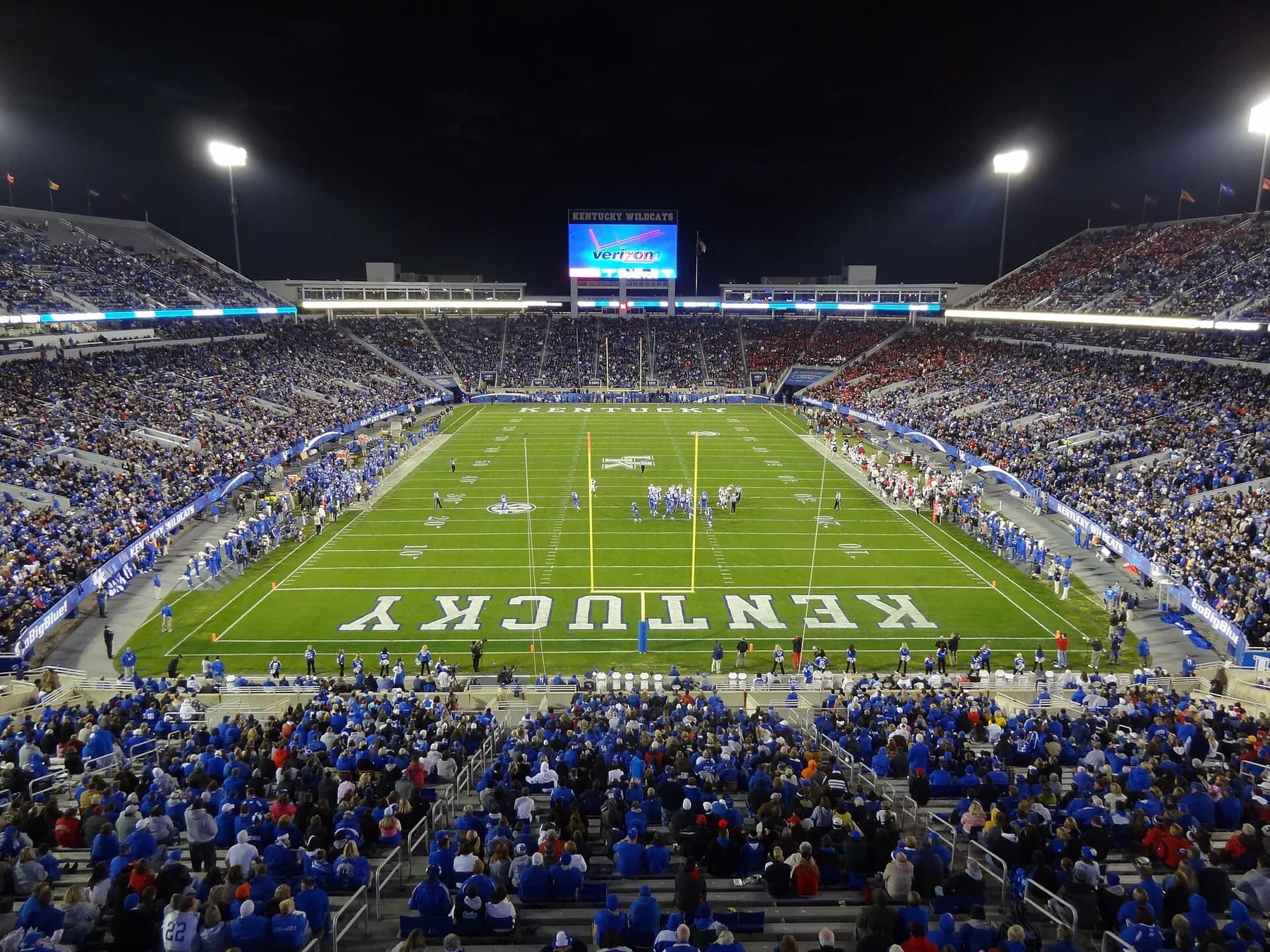
Photo: Navin75 · CC BY-SA 2.0 · Cropped for display
Up next · Week 10
Away
On the road at
Saturday, November 7 · Time TBA
The season, taking shape
Final scores show Kentucky first. Oldest to newest.
at South CarolinaPregame 22–32
Game details vs. LSU
Pregame 20–32
Game details at Oklahoma
Pregame 18–31
Game detailsOriginal full-season forecast
This forecast retains the original probabilities for the full schedule. It does not update with completed results or this week’s forecast.
2026 results
Current record, team efficiency, player production, and verified results from completed games.
Current record
7-17 wins · 1 lossThrough 8 completed gamesLoading player usage…
2026 season preview
THE THESIS Kentucky’s first season under Will Stein is a race to turn sweeping change into functional football. Stein takes over with offensive coordinator Joe Sloan, defensive coordinator Jay Bateman and 45 newcomers, a combination that makes teaching speed and cohesion as important as talent. The schedule supplies the deadline: Alabama visits in Week 2, and Kentucky travels to Texas A&M one week later.
A NEW IDENTITY Stein has emphasized connection, toughness, accountability and fewer self-inflicted mistakes. He said by SEC Media Days that players had learned the new systems and practice structure, but knowing the framework is only the beginning. With new methods arriving across all three phases, Kentucky must communicate cleanly enough to avoid turning ordinary transition problems into penalties, missed assignments and lost possessions.
Original season forecast
The original SEC forecast, retained alongside current results.
SEC projected standing
#16
1-8 projected · 1.2 expected conference wins · #16 of 16.
Preseason baseline
2025 percentiles retained as preseason context; current results and player production lead this page.
2025 FBS percentile scale · 50 is average
Incoming class
National and conference recruiting ranks, confirmed commitments, and the highest-ranked recruits in this class.
Top committed recruits
Kentucky2026 transfer movement
Incoming and outgoing transfer activity, with rated FBS-to-FBS moves below.
Incoming Transfers
KentuckyOutgoing Transfers
KentuckySeason schedule
Completed games show final results. Upcoming games use this week’s forecast where available; later games retain their published season outlook.
Detailed football intelligence
The full team identity, offense, defense, and supporting evidence.
Team identity
Last season, Kentucky tried to lean on the running game; it rarely provided an easy foundation.
Why it matters
The run game was Kentucky's more workable option, not an established edge; defenses can fit it honestly until early-down success forces extra support.
 vs. Vanderbilt
Pregame 29–24
Game detailsPregame comparisons use preserved published forecasts. Results include wins and losses.
At a glance
Current form leads the outlook.
2026 rates aggregate verified completed-game box scores. EPA is expected points added per play.
| Player | C/ATT | YDS | TD | INT |
|---|---|---|---|---|
| Kenny Minchey | 160/232 | 1755 | 14 | 1 |
| Player | CAR | YDS | AVG | TD |
|---|---|---|---|---|
| CJ Baxter Jr. | 88 | 487 | 5.5 | 8 |
| Jason Patterson | 71 | 443 | 6.2 | 3 |
| Jovantae Barnes | 43 | 224 | 5.2 | 1 |
| Player | REC | YDS | AVG | TD |
|---|---|---|---|---|
| Kenny Darby | 38 | 507 | 13.3 | 3 |
| Willie Rodriguez | 39 | 324 | 8.3 | 2 |
| DJ Miller | 18 | 221 | 12.3 | 1 |
| Player | TOT | SOLO | TFL | SACK |
|---|---|---|---|---|
| Grant Godfrey | 72 | 30 | 4 | 2 |
| Jordan Castell | 65 | 26 | 3 | 0 |
| Ty Bryant | 59 | 29 | 1 | 0.5 |
Saturday, October 24 · Kroger Field
Saturday, October 17 · Memorial Stadium (Norman, OK)
Saturday, October 10 · Kroger Field
THE QUARTERBACK QUESTION Kenny Minchey is the clearest candidate to steady that process, though the spring reporting did not establish him as the starter. Sloan praised the Notre Dame transfer’s accuracy, processing, pre-snap checks and ability to adjust protections and runs—traits that could help a new offense operate before every position around him is settled. Minchey ran for a touchdown and directed a drive that ended in a 43-yard field goal during the spring game. Brennen Ward also flashed by connecting with Mikkel Skinner for 48 yards, leaving Kentucky with competition but no confirmed fall order.
THE OFFENSIVE HEARTBEAT The running backs give Sloan a plausible foundation. Transfers CJ Baxter and Jovantae Barnes join Jason Patterson, who entered spring with 336 yards on 77 career Kentucky carries. The staff wants the position to drive short yardage and red-zone football, which would reduce the burden on whichever quarterback wins the job. Baxter and Barnes were limited during spring, however, so their readiness and the eventual distribution of work remain fall questions.
THE FIVE WHO MAKE IT WORK That plan depends on an offensive line still seeking its best combination. Position coach Cutter Leftwich mixed groups during spring and stressed common terminology, communication and consistency. The experimentation may help Kentucky identify versatile options, but the final five must settle quickly. A coordinated line would give the running backs room to establish the offense and allow the quarterback to use the pre-snap control Sloan praised; persistent communication problems would disrupt both.
TARGETS WITH DIFFERENT JOBS Wide receiver is being rebuilt around complementary body types rather than established production. Coach Joe Price III said Kentucky sought perimeter speed for vertical throws as well as physical blockers, with transfers Nic Anderson and Shane Carr among the options. Tight end offers more continuity: Willie Rodriguez returns after 23 catches for 310 yards and a touchdown in 2025, while Henry Boyer and Skinner can contribute as receivers and blockers. That trio can give the quarterback protection help, formation flexibility and intermediate answers while the receiver rotation develops.
DEFENSE FROM THE FRONT BACK Bateman’s early optimism began up front. He said the defensive front impressed him and credited experienced transfer additions with providing leadership as he combined concepts from previous stops. If that group can absorb the scheme quickly, it can protect the rest of the defense by controlling early downs and limiting how long the secondary must cover. Edge Sam Greene is an important part of that equation; he was unable to practice early in spring, although Bateman praised his engagement and expected impact when available.
THE COVERAGE TEST Cornerback is the defense’s sharper concern. Position coach Allen Brown described the room during spring as inexperienced and still learning the game, a difficult combination against an SEC schedule that will repeatedly stress communication and depth. Kentucky also held several unnamed injured players out of the spring game. Stein said he expected them back for fall, but their identities and diagnoses were not disclosed, so specific conclusions about affected position groups would be premature.
THE EARLY DEADLINE Kentucky opens September 5 against Youngstown State at Kroger Field, then immediately moves into the defining pressure point of the schedule: Alabama at home on September 12 and Texas A&M in College Station on September 19. South Alabama visits the following week. That September sequence leaves little time for a new quarterback, a developing offensive line and an inexperienced cornerback room to learn through mistakes before the level of opposition rises.
THE LONG HAUL The pressure extends well beyond September. Kentucky travels to South Carolina on October 3, hosts LSU on October 10 and visits Oklahoma on October 17 before Vanderbilt comes to Lexington on October 24. There is no open week before that Vanderbilt game. After the break, the Wildcats visit Tennessee, host Florida, travel to Missouri and finish at home against Louisville, making depth and week-to-week health important throughout the season rather than only during the opening sprint.
BOTTOM LINE Kentucky’s football thesis is straightforward: let operational command at quarterback, a deep group of running-back options and an encouraging defensive front stabilize a team undergoing extensive change. Minchey’s spring work, the backfield’s potential and Bateman’s early impressions offer reasons for interest, but none solves the central challenge by itself. Stein’s first team must establish its offensive-line combination, receiver roles, coverage reliability and overall cohesion before an unforgiving schedule begins testing all of them at once.
This preview is based on the linked public reporting and official program records.
Profile high point
Big-play prevention held the profile's highest percentile position.Profile low point
Big-play creation held the lowest percentile position among the profile's strength measures.


Kentucky did not have one unit that could carry the whole game plan; the run game came closest.
What matters
Even Kentucky's best unit finished near the national middle last season, leaving no proven strength to build around.
Big-play creation is Kentucky's biggest concern, and opponents can test it immediately.
Why it matters
Opponents can squeeze underneath space and make the offense finish long drives without chunk gains; rushing structure has to keep that stress from setting the game plan.
Kentucky is at its best when it can use the running game to control early downs and finish drives; an average pace puts more weight on winning ordinary downs.
What matters
Kentucky's run-leaning structure played at a balanced pace. The run game finished middle-of-the-pack, while the pass game finished weak.
Inside the team
Open a section for the football detail and supporting numbers.
The down-to-down question that determines whether the offense can keep both the run and pass available.
The first question for Kentucky is whether the run game can make defenses commit an extra fit.
What matters
Efficient early runs are the most workable route to keeping play action alive, not an established advantage.
The pace, play selection, and methods this offense uses to stay on schedule.
Kentucky played at a balanced pace in 2025.
Why it matters
At that pace, Kentucky cannot count on extra possessions or expect to shorten the game.
Kentucky's prior passing record was weak.
Why it matters
Kentucky's offense needs protection, field position, or explosive variance when ordinary dropbacks do not create enough value.
Kentucky's prior rushing record was middle-of-the-pack.
Why it matters
When Kentucky's run game cannot stay on schedule, protection and passing-down execution carry more of the offense.
Kentucky's explosive-play results were mixed rather than a defining edge.
Why it matters
A big play can still flip a possession, but last season's results do not make explosiveness something this team can rely on.
How consistently the offense creates manageable situations and the defense prevents them.
Kentucky's down-to-down results were weak overall.
Why it matters
Kentucky's success rate shows whether it can sustain drives and get stops without relying on sacks, turnovers, or isolated big plays.
Kentucky's opponent-adjusted passing and rushing value were closely matched.
Why it matters
When the split is narrow, early-down execution matters more than steering the offense toward one obvious weakness.
Where the defense can create pressure, control the run, and end drives.
Kentucky's prior defense was weak overall and strongest in run front.
Why it matters
Opponents can use efficient throws to stay out of obvious passing downs; Kentucky needs its run front to create long-yardage without overloading the box before that plan settles in.
Kentucky's available disruption measures finished below the national average last season; a charted pressure rate is not available.
Why it matters
Without consistent disruption, Kentucky's defense must win more snaps through coverage, leverage, and early-down prevention.
Kentucky's sack and disruption results were middle-of-the-pack.
Why it matters
Kentucky's disruption can hurry an offense; sacks do more by erasing field position and ending passing downs.
Kentucky's prior run-defense results were middle-of-the-pack.
Why it matters
If Kentucky's front cannot control early downs, opponents can keep every offensive option open and protect their passing game.