Week 4 · FinalL
 at Cincinnati
26–31-5 margin
Pregame 31–25
Game detailsSaturday Index
Loading team intelligenceBringing the latest verified football information into focus.
Big 12 · 2026 · Week 8

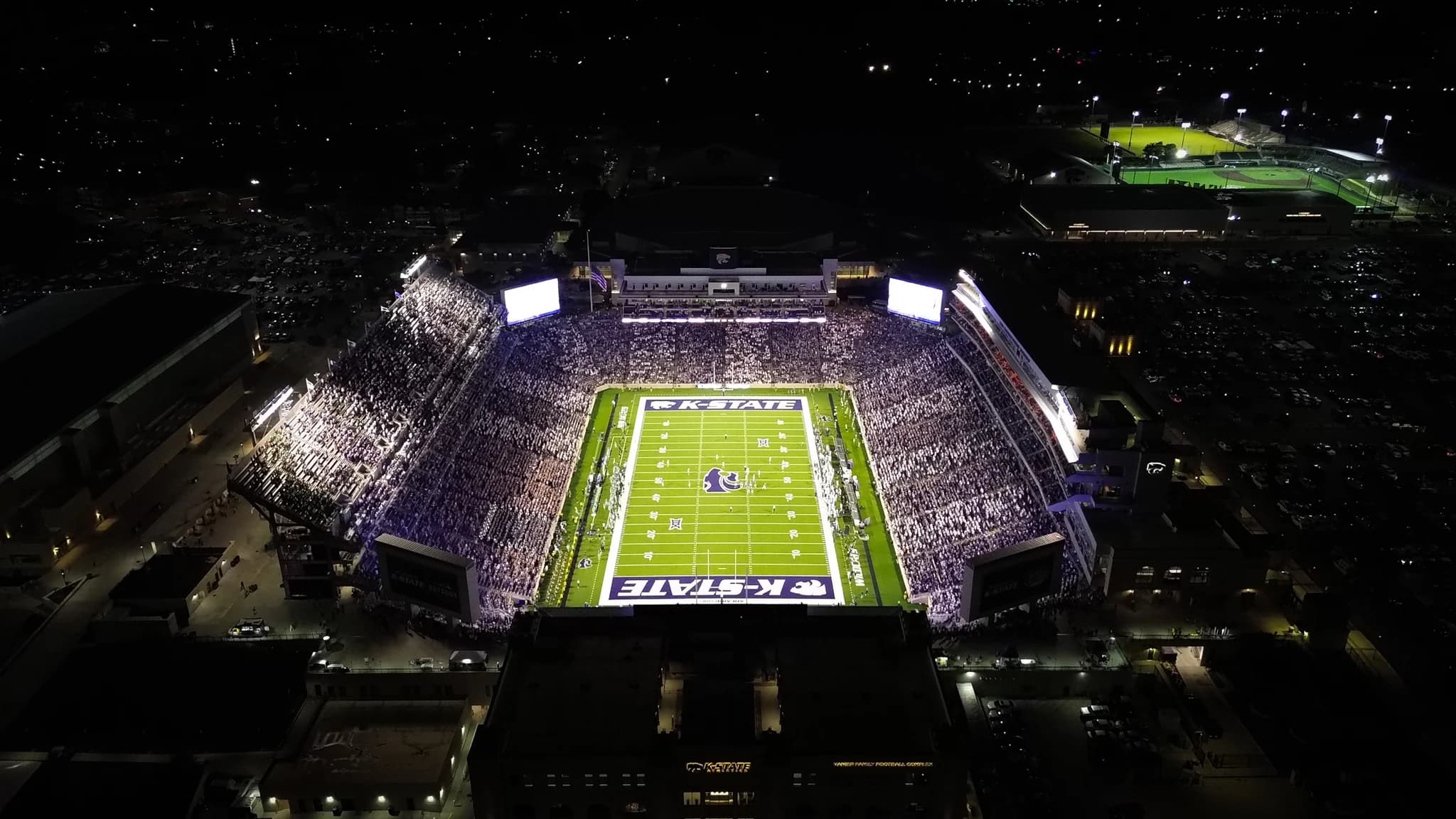
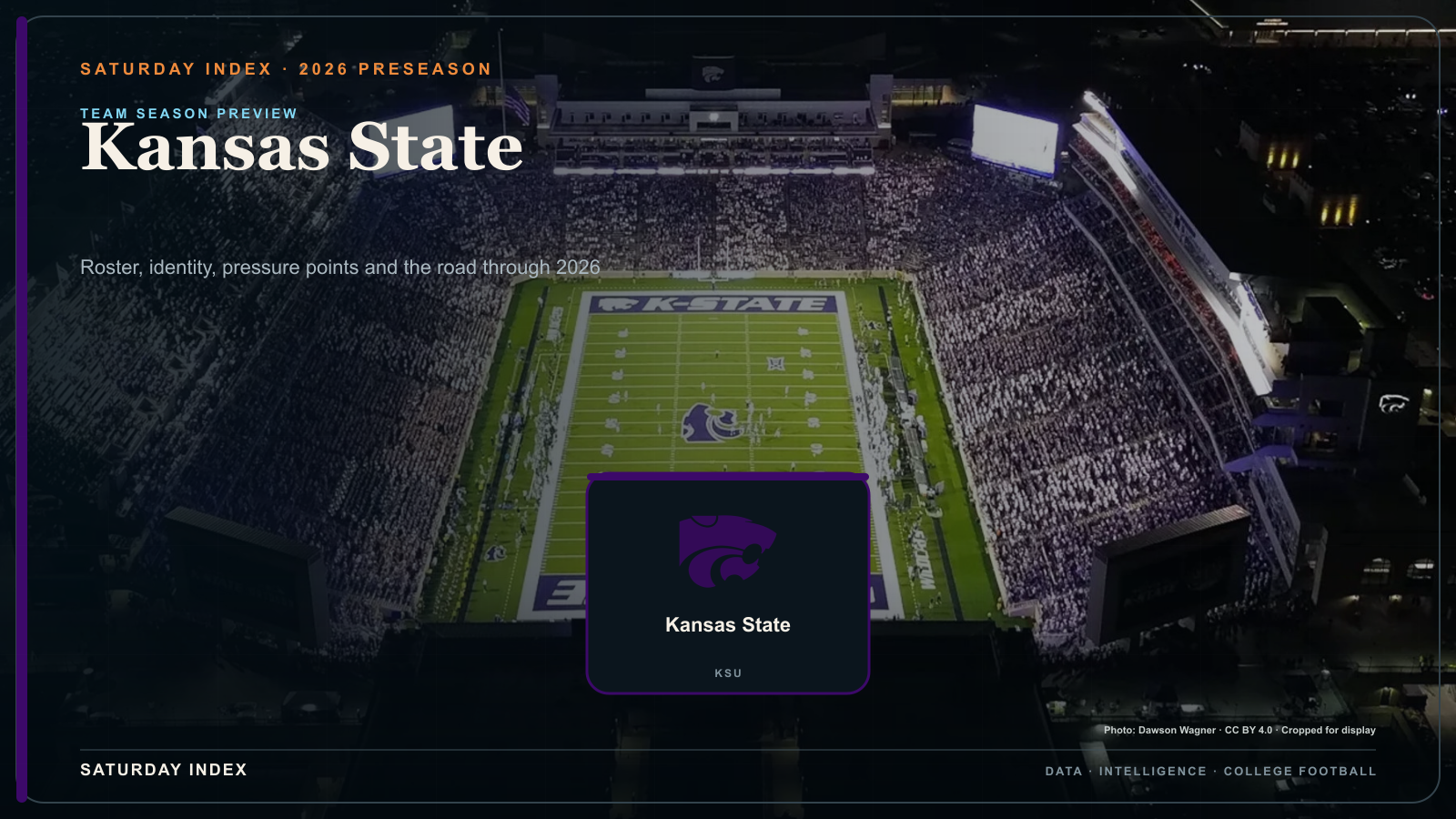
Photo: Dawson Wagner · CC BY 4.0 · Archive venue photograph, 2025 · Cropped for display
Up next · Week 9
Away
On the road at
Saturday, October 31 · Time TBA
The season, taking shape
Final scores show Kansas State first. Oldest to newest.
at CincinnatiPregame 31–25
Game details vs. Houston
Pregame 29–25
Game details vs. Kansas
Pregame 30–26
Original full-season forecast
This forecast retains the original probabilities for the full schedule. It does not update with completed results or this week’s forecast.
2026 results
Current record, team efficiency, player production, and verified results from completed games.
Current record
4-34 wins · 3 lossesThrough 7 completed gamesLoading player usage…
2026 season preview
Kansas State’s 2026 identity starts with an advantage few first-year head coaches inherit: Collin Klein already knows the quarterback around whom he can build. Senior Avery Johnson enters the season tied for the school record with 48 touchdown passes and carrying 1,378 career rushing yards. Klein will call the offense, concentrating its design and game-day direction with the coach most familiar with Johnson’s dual-threat ability. For a program integrating 53 newcomers after returning only 34 letterwinners, that relationship gives Kansas State a stabilizing center rather than a blank slate.
Original season forecast
The original Big 12 forecast, retained alongside current results.
Big 12 projected standing
#4
6-3 projected · 5.9 expected conference wins · #4 of 16.
Preseason baseline
2025 percentiles retained as preseason context; current results and player production lead this page.
2025 FBS percentile scale · 50 is average
Incoming class
National and conference recruiting ranks, confirmed commitments, and the highest-ranked recruits in this class.
Top committed recruits
Kansas State2026 transfer movement
Incoming and outgoing transfer activity, with rated FBS-to-FBS moves below.
Incoming Transfers
Kansas StateOutgoing Transfers
Kansas StateSeason schedule
Completed games show final results. Upcoming games use this week’s forecast where available; later games retain their published season outlook.
Detailed football intelligence
The full team identity, offense, defense, and supporting evidence.
Team identity
Last season, Kansas State tried to lean on the running game; the results were uneven when the offense tried to live that way.
Why it matters
Neither offensive unit clearly carried the other, so first-down execution decides whether Kansas State can stay on plan.
 at Arizona State
Pregame 30–25
Game detailsPregame comparisons use preserved published forecasts. Results include wins and losses.
At a glance
Current form leads the outlook.
2026 rates aggregate verified completed-game box scores. EPA is expected points added per play.
| Player | C/ATT | YDS | TD | INT |
|---|---|---|---|---|
| Avery Johnson | 117/186 | 1290 | 10 | 3 |
| Blake Barnett | 4/5 | 41 | 0 | 0 |
| Jacob Knuth | 1/1 | 7 | 0 | 0 |
| Player | CAR | YDS | AVG | TD |
|---|---|---|---|---|
| Avery Johnson | 51 | 462 | 9.1 | 3 |
| Rodney Fields Jr. | 71 | 386 | 5.4 | 5 |
| Joe Jackson | 68 | 354 | 5.2 | 2 |
| Player | REC | YDS | AVG | TD |
|---|---|---|---|---|
| Jaron Tibbs | 25 | 268 | 10.7 | 3 |
| Derrick Salley Jr. | 13 | 248 | 19.1 | 1 |
| Joshua Manning | 19 | 196 | 10.3 | 2 |
| Player | TOT | SOLO | TFL | SACK |
|---|---|---|---|---|
| Logan Bartley | 34 | 25 | 1 | 0 |
| Mekhi Mason | 28 | 21 | 1.5 | 1 |
| Gabe Powers | 25 | 18 | 3.5 | 0 |
Saturday, October 24 · Mountain America Stadium
Saturday, October 17 · Bill Snyder Family Stadium
Saturday, October 10 · Bill Snyder Family Stadium
Klein said his prior history with Johnson accelerated their re-alignment, and that head start should shape an offense designed to make defenses account for the quarterback on every snap. Johnson’s legs can alter numbers in the running game, while his experience gives Klein room to vary formations and tempo without abandoning a physical foundation. The official roster lists Jacob Knuth and Dillon Duff behind him but does not establish a fall order between them. That makes Johnson both the offense’s greatest asset and its clearest point of dependence.
The backfield gives Klein a practical way to spread the workload. According to Kellis Robinett, Joe Jackson leads a room reinforced by transfers Rodney Fields and Jay Harris. Fields rushed for 614 yards in 2025, and Harris arrived after scoring in Oregon’s playoff semifinal. A three-back rotation would let Kansas State preserve its physical style without forcing Johnson or Jackson to supply every important carry. Linkon Cure adds another dimension: Klein plans to use him predominantly as a true tight end while retaining his alignment flexibility and maintaining substantial two-tight-end usage.
Kansas State’s passing game will be shaped by whether its protection and receiving corps turn useful options into dependable answers. Transfer corner Kaleb Patterson identified Jaron Tibbs, Derrick Salley Jr. and Josh Manning as receivers who repeatedly challenged the secondary during spring, giving Johnson an experienced group with size. Spring praise alone does not establish a primary target. Up front, John Pastore and Tanner Morley had their work managed, while George Fitzpatrick progressed through medical benchmarks. No settled five-man line emerged, making protection chemistry the offense’s most consequential unresolved issue rather than merely another position battle.
Jordan Peterson’s defense is intended to win with pressure, flexibility and decisive situational execution. Peterson installed a multiple, adjustment-heavy system emphasizing speed, physicality and disruption after his 2025 Texas A&M defense led the nation on third down and ranked second in sacks and tackles for loss. Those results describe the standard and style he is bringing, not a guarantee that a heavily remade Kansas State unit will reproduce them immediately. The central task is to turn multiplicity into fast reactions instead of hesitation as players absorb new responsibilities.
The secondary offers the strongest platform for that approach. Returning starters Zashon Rich and Donovan McIntosh are joined by Illinois transfer Kaleb Patterson, who arrived with 15 career starts. Rich produced 11 pass breakups in 2025, and the competition for roles remained open during spring. That combination of experience and competition should give Peterson coverage options behind an aggressive front. Klein also identified Rich and McIntosh as vocal leaders alongside Rex Van Wyhe and Jordan Allen, an important internal core for a defense learning new language and assignments.
The schedule gives Kansas State an immediate chance to establish its habits at home against Nicholls, Washington State and Tulane before traveling to Cincinnati. The next major pressure point begins with Houston and Kansas visiting Bill Snyder Family Stadium, followed by consecutive road games at Arizona State and Colorado. November continues the alternating strain: Oklahoma State at home, TCU away, Arizona at home and Iowa State away. For a roster joining new teammates to new systems, the defining schedule challenge is sustaining communication and execution as venues and weekly demands change.
Kansas State does not need to search for its preseason thesis. Johnson’s familiarity with Klein should make the offense the team’s early anchor, supported by a deeper backfield and Cure’s formation versatility. Peterson’s experienced corners give the defense a place to begin building its disruptive style. The season’s direction will hinge on whether the offensive line becomes cohesive, a receiver commands Johnson’s trust and a remodeled defense plays Peterson’s system at full speed. Klein has a quarterback and a blueprint; turning widespread change into connected football is the job that will define Year 1.
This preview is based on the linked public reporting and official program records.
Profile high point
Big-play creation held the profile's highest percentile position.Profile low point
Big-play prevention held the lowest percentile position among the profile's strength measures.




Big-play creation is what Kansas State can trust most.
Why it matters
The offense has its best route to changing field position without requiring flawless drive efficiency; rushing structure remains the first counter an opponent should test.
The run game is the concern opponents should keep testing while big-play creation tries to steady Kansas State.
What matters
Kansas State's rushing structure finished below the national average last season.
Kansas State's best path is to lean on the running game, then keep winning first down because neither the pass nor run clearly carries the other; extra possessions give that plan time to build.
What matters
Kansas State's run-leaning structure played at a fast pace. Passing finished middle-of-the-pack and rushing finished below-average, without a clear split between them.
Inside the team
Open a section for the football detail and supporting numbers.
The down-to-down question that determines whether the offense can keep both the run and pass available.
Kansas State needs first-down execution before either the run or pass can demand extra attention.
Why it matters
Until that happens, opponents can play the situation rather than sell out to stop one identity.
The pace, play selection, and methods this offense uses to stay on schedule.
Kansas State played at a fast pace in 2025.
Why it matters
More possessions give Kansas State's strengths additional chances to build, but they also leave more time to recover from mistakes.
Kansas State's prior passing record was middle-of-the-pack.
Why it matters
Kansas State's offense needs protection, field position, or explosive variance when ordinary dropbacks do not create enough value.
Kansas State's prior rushing record was below-average.
Why it matters
When Kansas State's run game cannot stay on schedule, protection and passing-down execution carry more of the offense.
Kansas State's explosive-play upside came with real defensive volatility.
Why it matters
That mix can produce fast scoring swings in either direction and makes missed tackles or coverage busts especially expensive.
How consistently the offense creates manageable situations and the defense prevents them.
Kansas State's defense was more consistent down to down than its offense.
Why it matters
Kansas State's success rate shows whether it can sustain drives and get stops without relying on sacks, turnovers, or isolated big plays.
Opponent-adjusted EPA identifies the run game as Kansas State's stronger offensive unit.
Why it matters
Forcing longer passing situations is the clearest way to move the offense away from its stronger adjusted unit.
Where the defense can create pressure, control the run, and end drives.
Kansas State's prior defense was above-average overall and strongest in pass defense.
What matters
Pass defense finished strong, while run front still finished above-average; the latter is only the first question, not a weakness an offense can assume.
Kansas State's available disruption measures finished above the national average last season; a charted pressure rate is not available.
Why it matters
Sustained disruption can create negative plays and give Kansas State a better chance to end drives before third down.
Kansas State's disruption regularly finished at the quarterback.
What matters
Both sack production and front-seven disruption cleared the FBS midpoint.
Why it matters
If Kansas State's front cannot control early downs, opponents can keep every offensive option open and protect their passing game.