
Week 5 · FinalW
 vs. Middle Tennessee
55–0+55 margin
Pregame 35–17
Game detailsSaturday Index
Loading team intelligenceBringing the latest verified football information into focus.
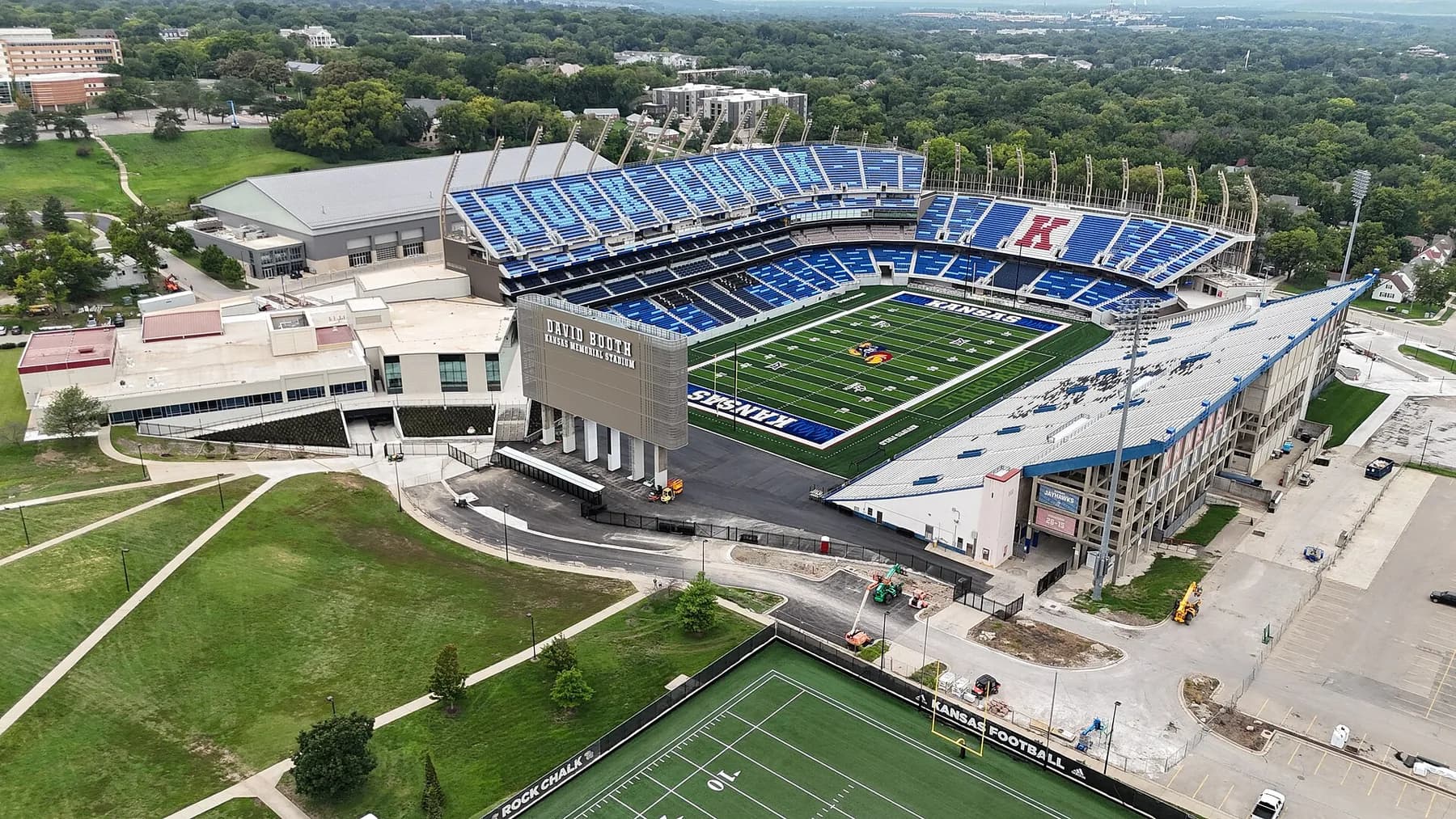
Big 12 · 2026 · Week 8
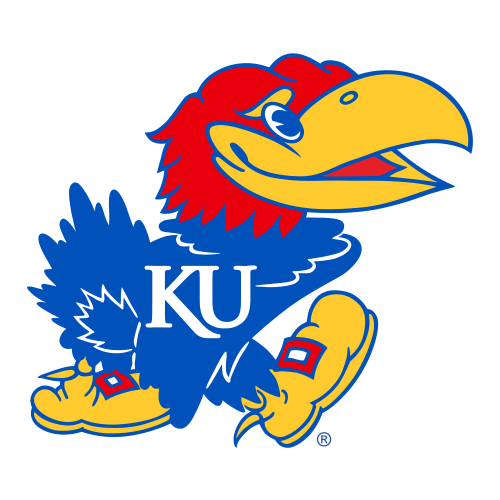
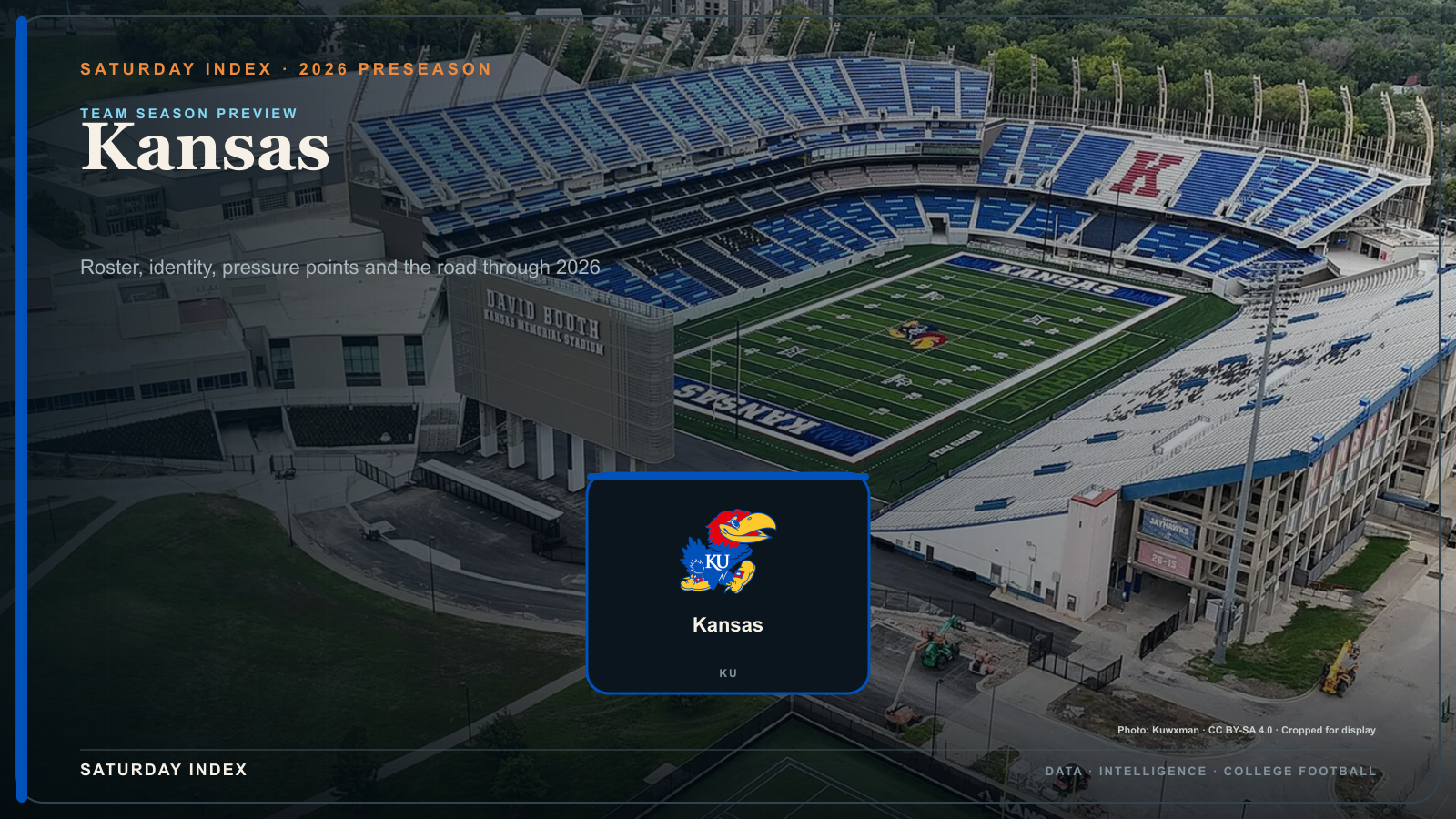
Photo: Kuwxman · CC BY-SA 4.0 · Cropped for display
Up next · Week 9
Away
On the road at
Saturday, October 31 · Time TBA
The season, taking shape
Final scores show Kansas first. Oldest to newest.
vs. Middle TennesseePregame 35–17
Game details at Utah
Pregame comparison unavailable
Game details at Kansas State
Pregame 26–30
Game detailsOriginal full-season forecast
This forecast retains the original probabilities for the full schedule. It does not update with completed results or this week’s forecast.
2026 results
Current record, team efficiency, player production, and verified results from completed games.
Current record
3-43 wins · 4 lossesThrough 7 completed gamesLoading player usage…
2026 season preview
Kansas has a familiar offensive architect and experienced defensive leaders, but its response to an unsettled quarterback race will shape Lance Leipold’s sixth season.
Kansas reaches Lance Leipold’s sixth season with a familiar problem and a newly familiar solution. The Jayhawks went 5-7 in 2025 and missed a bowl for a second straight year, putting bowl eligibility back at the center of the program’s expectations. Leipold has responded by bringing Andy Kotelnicki back as associate head coach, with Matt Lubick listed as co-offensive coordinator, while D.K. McDonald continues to lead the defense. The defining question is not whether Kansas has a plan. It is how quickly that plan can become functional around a new quarterback and a rebuilt supporting cast.
Original season forecast
The original Big 12 forecast, retained alongside current results.
Big 12 projected standing
#8
4-5 projected · 4.1 expected conference wins · #8 of 16.
Preseason baseline
2025 percentiles retained as preseason context; current results and player production lead this page.
2025 FBS percentile scale · 50 is average
Incoming class
National and conference recruiting ranks, confirmed commitments, and the highest-ranked recruits in this class.
Top committed recruits
Kansas2026 transfer movement
Incoming and outgoing transfer activity, with rated FBS-to-FBS moves below.
Incoming Transfers
KansasOutgoing Transfers
KansasSeason schedule
Completed games show final results. Upcoming games use this week’s forecast where available; later games retain their published season outlook.
Detailed football intelligence
The full team identity, offense, defense, and supporting evidence.
Team identity
Last season, Kansas tried to lean on the running game; the approach consistently kept the offense on schedule.
Why it matters
The run game was Kansas's steadier way to stay ahead of the chains; opponents have to win early fits without handing away play action.
 vs. Baylor
Pregame 29–25
Game detailsPregame comparisons use preserved published forecasts. Results include wins and losses.
At a glance
Current form leads the outlook.
2026 rates aggregate verified completed-game box scores. EPA is expected points added per play.
| Player | C/ATT | YDS | TD | INT |
|---|---|---|---|---|
| Isaiah Marshall | 88/167 | 1294 | 9 | 5 |
| Cole Ballard | 5/7 | 96 | 0 | 0 |
| Chase Jenkins | 3/3 | 65 | 0 | 0 |
| Player | CAR | YDS | AVG | TD |
|---|---|---|---|---|
| Dylan Edwards | 75 | 376 | 5.0 | 4 |
| Isaiah Marshall | 74 | 372 | 5.0 | 1 |
| Yasin Willis | 27 | 125 | 4.6 | 2 |
| Player | REC | YDS | AVG | TD |
|---|---|---|---|---|
| Nik McMillan | 23 | 400 | 17.4 | 4 |
| Nahzae Cox | 7 | 208 | 29.7 | 2 |
| Cam Pickett | 17 | 193 | 11.4 | 0 |
| Player | TOT | SOLO | TFL | SACK |
|---|---|---|---|---|
| Trey Lathan | 41 | 23 | 3.5 | 1 |
| Corey Gordon | 31 | 19 | 1.5 | 0 |
| David Santiago | 27 | 19 | 6.5 | 2 |
Saturday, October 24 · Memorial Stadium
Saturday, October 17 · Bill Snyder Family Stadium
Saturday, October 10 · Rice-Eccles Stadium
Kotelnicki’s return supplies more than nostalgia. Kansas noted that his 2023 offense ranked in the national top 10 in yards per play, rushing, yards per rush and explosive-play rate. That history points toward an attack built to create hesitation with motion and multiplicity, then punish it through the running game and play-action. Replicating those results is no certainty, particularly with the quarterback job unsettled, but the intended identity is clear: Kansas wants to make the offense difficult to diagnose before asking its passer to win conventional dropback football.
The competition between Ballard and Marshall therefore carries consequences beyond who takes the first snap. A July 18 Kansas City Star report, citing a program source, said Ballard held a slight edge, though Kansas had not publicly named a starter. Ballard’s experience could offer stability, while Marshall’s upside keeps the race open. Either choice will be operating under immediate pressure to manage Kotelnicki’s shifts and reads, protect the football and turn manufactured advantages into explosive gains. How decisively one quarterback takes command may determine how much of the offense Kansas can use early.
The running backs should give that quarterback meaningful help. Kansas State transfer Dylan Edwards arrived with 1,072 career rushing yards and eight rushing touchdowns, while Syracuse transfer Yasin Willis and early enrollee Kory Amachree add different options to the room. Their presence gives Kotelnicki multiple ways to stress a defense and reduce the number of obvious passing situations. At receiver, Cam Pickett is the vital returner, with Keaton Kubecka, Nahzae Cox and Nik McMillan among the veteran candidates around him. Pickett can provide continuity, but the offense still needs a dependable target order to emerge behind him.
That skill-position flexibility will matter only if the offensive line becomes cohesive. Calvin Clements returns at left tackle, and July reporting described Amir Herring as one of Kansas’ highest-graded offensive players. Tavake Tuikolovatu, Connor Stroh and Cal transfer Nick Morrow bring reported size and physicality, giving the unit credible pieces around which to build. The challenge is collective rather than cosmetic. A line incorporating multiple newcomers must communicate well enough to keep the quarterback comfortable and sustain the run game that makes Kotelnicki’s misdirection dangerous.
Kansas can approach that offensive transition with more continuity on defense. Blake Herold returns at defensive tackle, and defensive end Leroy Harris III joined him in the Jayhawks’ Big 12 media-days delegation. They are central to stabilizing a front carrying substantial transfer turnover. Trey Lathan, also chosen to represent Kansas at media days, gives McDonald an experienced linebacker who can serve as a communication anchor. If that trio controls early downs and helps the incoming pieces settle, the defense can force opponents into situations where McDonald has more freedom to vary pressure and coverage.
The cornerback room offers a similar mix of known players and new competition. Jalen Todd and Austin Alexander return, while experienced transfers Syeed Gibbs, Jahlil Hurley and Roman Pearson expand McDonald’s matchup options. The exact deployment remains to be settled, but the collection of experience gives Kansas a chance to withstand different receiver types without relying on one solution. No Jayhawk made the media-voted Preseason All-Big 12 team, so this defense enters without broad preseason acclaim. Its case will have to be made through the cohesion of its veteran spine and transfer additions.
The schedule will not wait long for those pieces to connect. After opening against LIU, Kansas hosts Missouri on Sept. 12 and faces Arizona State at Wembley Stadium on Sept. 19 before a bye. That rivalry game and international conference matchup will test the quarterback, offensive-line communication and defensive integration almost immediately, with the bye offering an early chance to adjust. October later brings consecutive trips to Utah and Kansas State, followed by Baylor at home and TCU on the road. Kansas’ path back to a bowl rests on a straightforward but demanding thesis: Kotelnicki must accelerate the quarterback’s development, the running game must carry real weight, and McDonald’s experienced leaders must turn a changing roster into a dependable defense.
This preview is based on the linked public reporting and official program records.
Profile high point
The run game held the profile's highest percentile position.Profile low point
Big-play prevention held the lowest percentile position among the profile's strength measures.



The run game is what Kansas can trust most.
Why it matters
The offense has its best route to favorable third downs and a credible play-action menu; explosive-play creation remains the first counter an opponent should test.
Big-play creation is Kansas's biggest concern, and opponents can test it immediately.
Why it matters
Opponents can squeeze underneath space and make the offense finish long drives without chunk gains; rushing structure has to keep that stress from setting the game plan.
For Kansas, the cleanest script is to use the running game to control early downs and finish drives; fewer possessions make every empty drive more expensive.
What matters
Kansas's run-leaning structure played at a deliberate pace. The run game finished top-tier, while the pass game finished strong.
Inside the team
Open a section for the football detail and supporting numbers.
The down-to-down question that determines whether the offense can keep both the run and pass available.
Opponents have to keep Kansas's run game from turning first down into second-and-manageable.
Why it matters
If Kansas stays on schedule on the ground, the offense keeps more answers available.
The pace, play selection, and methods this offense uses to stay on schedule.
Kansas played at a deliberate pace in 2025.
What matters
Kansas worked with fewer possessions than most teams last season.
Kansas's prior passing record was strong.
Why it matters
A repeatable pass game can let Kansas punish loaded boxes without relying on low-frequency deep completions.
Kansas's prior rushing record was top-tier.
Why it matters
A sustainable run game keeps Kansas's play action credible and limits obvious passing situations.
Explosive plays were a two-way concern in Kansas's record last season.
Why it matters
That combination increases dependence on sustained drives while leaving little margin for a missed fit or coverage error.
How consistently the offense creates manageable situations and the defense prevents them.
Kansas's offense was more consistent down to down than its defense.
Why it matters
Kansas's success rate shows whether it can sustain drives and get stops without relying on sacks, turnovers, or isolated big plays.
Opponent-adjusted EPA identifies the run game as Kansas's stronger offensive unit.
Why it matters
Forcing longer passing situations is the clearest way to move the offense away from its stronger adjusted unit.
Where the defense can create pressure, control the run, and end drives.
Kansas's prior defense was middle-of-the-pack overall and strongest in disruption.
Why it matters
Opponents can use efficient throws to stay out of obvious passing downs; Kansas needs its disruption to change protection and erase drives with negative plays before that plan settles in.
Kansas's available disruption measures ranked among the best in the country last season; a charted pressure rate is not available.
Why it matters
Sustained disruption can create negative plays and give Kansas a better chance to end drives before third down.
Kansas created disruption more consistently than it finished sacks.
Why it matters
Kansas's disruption can hurry an offense; sacks do more by erasing field position and ending passing downs.
Kansas's prior run-defense results were middle-of-the-pack.
Why it matters
If Kansas's front cannot control early downs, opponents can keep every offensive option open and protect their passing game.