Week 4 · FinalL
 vs. Utah
17–31-14 margin
Pregame 20–31
Game detailsSaturday Index
Loading team intelligenceBringing the latest verified football information into focus.
Big 12 · 2026 · Week 8

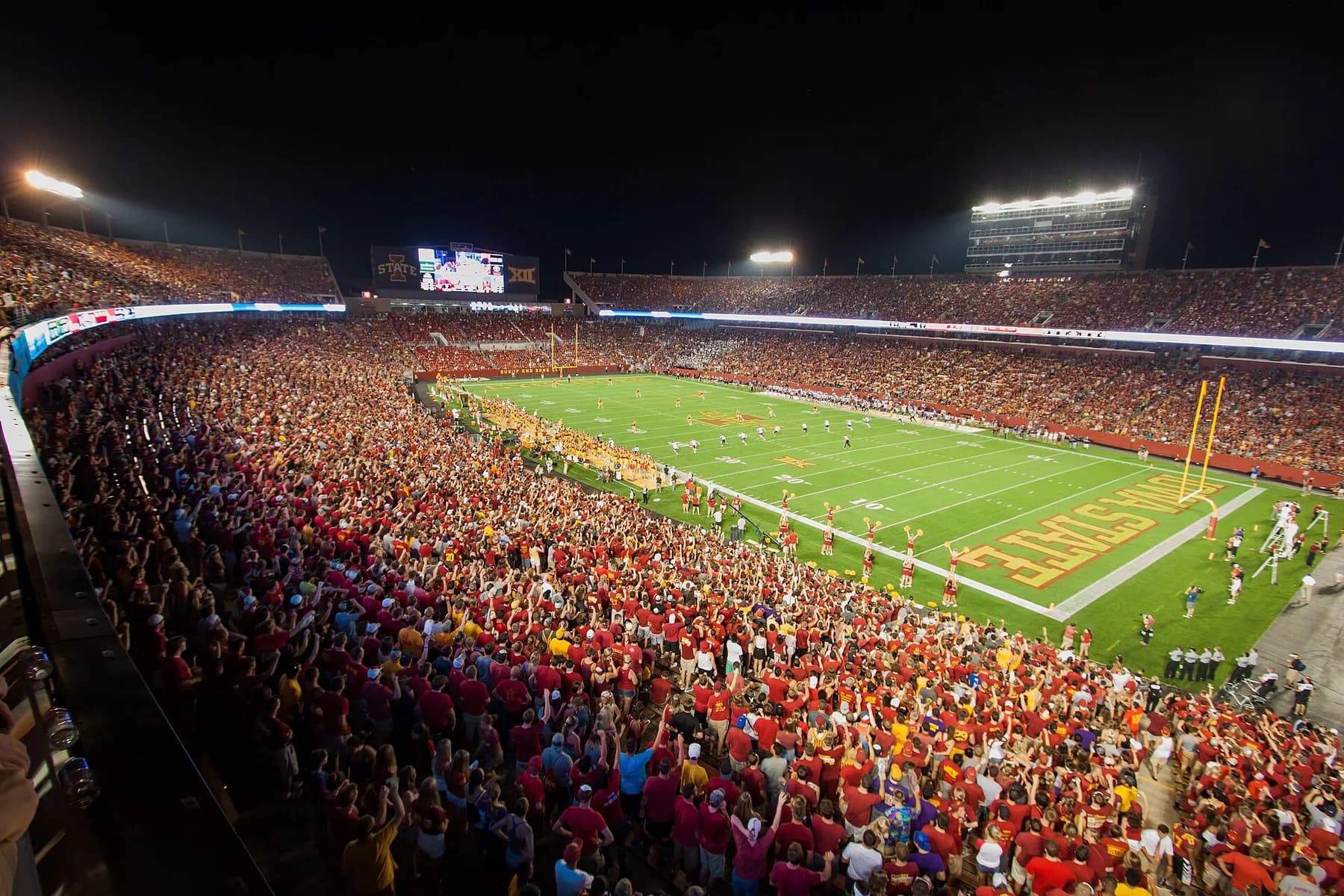
Photo: Unknown contributor · CC BY-SA 3.0 · Cropped for display
Up next · Week 9
Home
Hosting
Saturday, October 31 · Time TBA
The season, taking shape
Final scores show Iowa State first. Oldest to newest.
vs. UtahPregame 20–31
Game details vs. West Virginia
Pregame 32–23
Game details at BYU
Pregame 19–31
Game detailsOriginal full-season forecast
This forecast retains the original probabilities for the full schedule. It does not update with completed results or this week’s forecast.
2026 results
Current record, team efficiency, player production, and verified results from completed games.
Current record
3-43 wins · 4 lossesThrough 7 completed gamesLoading player usage…
2026 season preview
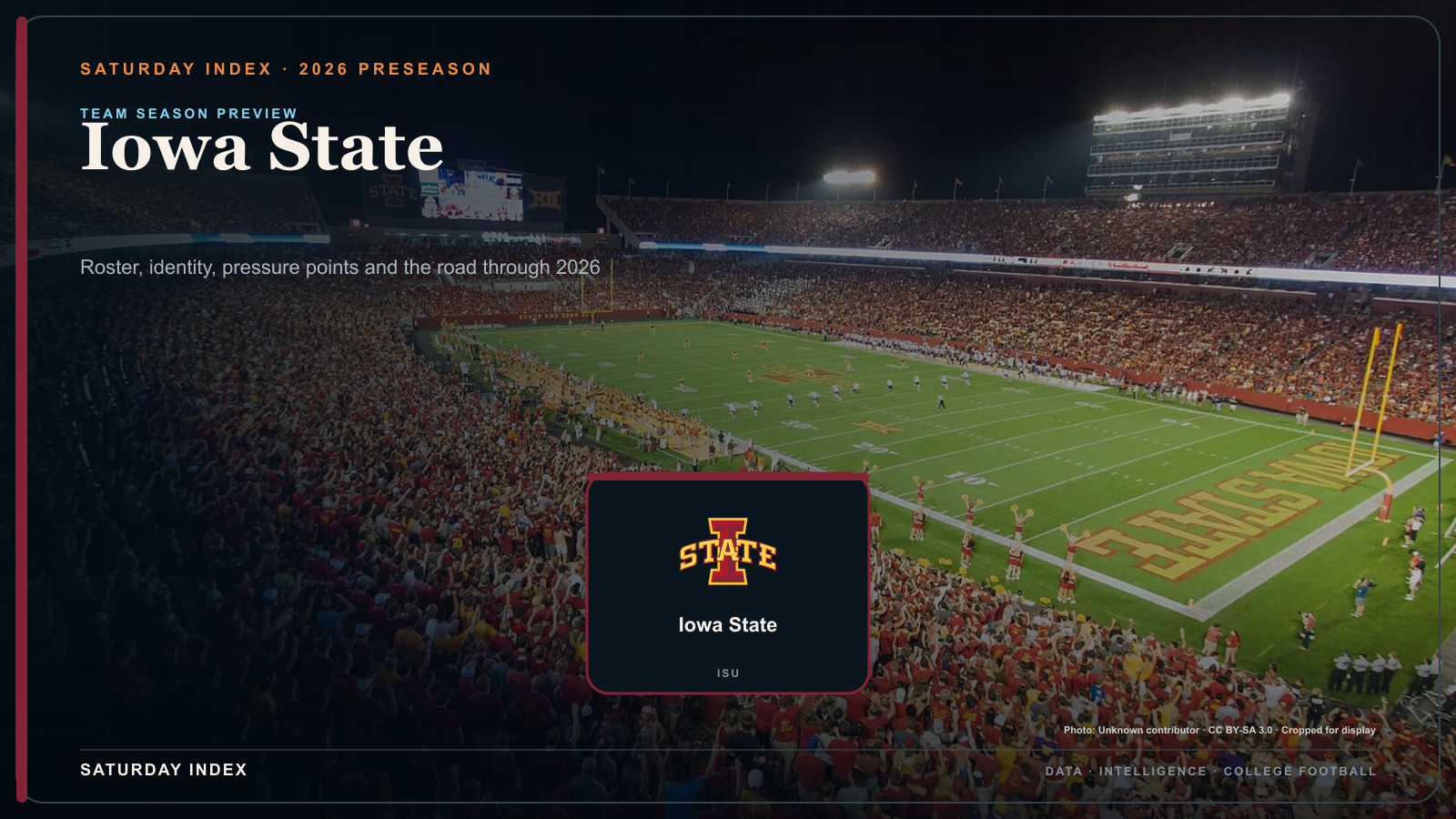
Iowa State’s 2026 season begins with a race Jimmy Rogers cannot avoid. The first-year head coach and coordinators Tyler Roehl and Jesse Bobbit must turn a dramatically altered roster into a connected Big 12 team before the schedule demands one. The Gazette reported nearly 50 departures after Rogers was hired, followed by an influx of experienced players from the FCS and lower levels. Those additions bring production from elsewhere, but the defining issue is how quickly their experience translates to a faster level and a new set of responsibilities.
Jaylen Raynor sits at the center of that transition. Quarterbacks coach Keith Heckendorf previously worked with him, giving Iowa State a valuable existing relationship inside a new offense. Raynor also made several notable throws in the spring showcase and developed early connections with Cody Jackson, Dominic Overby and Trevor Fortenberry. Nothing from spring settles the Week 1 pecking order, but Raynor’s comfort in Roehl’s system will matter: reliable downfield throws and yards after the catch could prevent defenses from crowding a rebuilt line and backfield.
Original season forecast
The original Big 12 forecast, retained alongside current results.
Big 12 projected standing
#11
4-5 projected · 3.7 expected conference wins · #11 of 16.
Preseason baseline
2025 percentiles retained as preseason context; current results and player production lead this page.
2025 FBS percentile scale · 50 is average
Incoming class
National and conference recruiting ranks, confirmed commitments, and the highest-ranked recruits in this class.
Top committed recruits
Iowa State2026 transfer movement
Incoming and outgoing transfer activity, with rated FBS-to-FBS moves below.
Incoming Transfers
Iowa StateOutgoing Transfers
Iowa StateSeason schedule
Completed games show final results. Upcoming games use this week’s forecast where available; later games retain their published season outlook.
Detailed football intelligence
The full team identity, offense, defense, and supporting evidence.
Team identity
Last season, Iowa State tried to lean on the running game; the approach gave the offense a dependable starting point.
Why it matters
Neither offensive unit clearly carried the other, so first-down execution decides whether Iowa State can stay on plan.
 at Arizona
Pregame 20–32
Game detailsPregame comparisons use preserved published forecasts. Results include wins and losses.
At a glance
Current form leads the outlook.
2026 rates aggregate verified completed-game box scores. EPA is expected points added per play.
| Player | C/ATT | YDS | TD | INT |
|---|---|---|---|---|
| Jaylen Raynor | 85/148 | 1001 | 6 | 4 |
| Aiden Flora | 2/2 | 48 | 2 | 0 |
| Connor Moberly | 2/2 | 20 | 0 | 0 |
| Player | CAR | YDS | AVG | TD |
|---|---|---|---|---|
| Aiden Flora | 90 | 680 | 7.6 | 6 |
| Jaylen Raynor | 51 | 166 | 3.3 | 3 |
| Arnold Barnes | 25 | 90 | 3.6 | 2 |
| Player | REC | YDS | AVG | TD |
|---|---|---|---|---|
| Dominic Overby | 10 | 212 | 21.2 | 0 |
| Omari Hayes | 17 | 208 | 12.2 | 1 |
| Cody Jackson | 10 | 191 | 19.1 | 1 |
| Player | TOT | SOLO | TFL | SACK |
|---|---|---|---|---|
| Sullivan Schlimgen | 56 | 30 | 3 | 1 |
| Carson Willich | 36 | 20 | 7 | 1 |
| Brody Miller | 22 | 10 | 0.5 | 0 |
Saturday, October 24 · Arizona Stadium
Friday, October 9 · LaVell Edwards Stadium
Saturday, October 3 · Jack Trice Stadium
The running backs give Roehl different ways to create favorable matchups. Rogers highlighted holdover Aiden Flora and Bowling Green transfer Cameron Pettaway for their explosiveness and receiving flexibility, including the ability to align outside against linebackers or safeties. That versatility became more important after Oregon State transfer Salahadin Allah tore an Achilles and was ruled out for the season. Tulane transfer Arnold Barnes later joined the room, but the distribution of carries among Flora, Pettaway, Barnes and the younger backs remains a fall question rather than a settled hierarchy.
Tight end can help bridge the offense’s strengths and its largest concern. Roehl praised former defensive lineman Vince Benetti’s move to the position, while Keaton Roskop is the key returning scholarship presence identified during spring work. Their size and formation flexibility could add protection, disguise intentions and support play-action. The greater burden falls on an offensive line Rob Gray described as entirely rebuilt and still developing after spring. Until that group establishes cohesion, every attractive skill-position possibility comes with a practical limit.
Bobbit faces a similar construction project on defense, where the spring showcase confirmed a shift to a four-man front. Tackles Bryson Lamb and Zaimir Hawk repeatedly reset the line of scrimmage during spring work, according to Bobbit, offering the unit a possible interior foundation. Edge Isaac “Bobby” Terrell was held out of the showcase with what was described as a minor tweak, yet he joined Raynor, Flora, David Coffey and Kyle Konrardy among Iowa State’s representatives at Big 12 media day. That group forms the most visible leadership spine of Rogers’ first team.
Linebacker Tristan Exline embodies both the opportunity and the risk in Iowa State’s transfer-heavy rebuild. The Division II transfer flashed in the showcase after Bobbit saw his mental processing begin to match the speed and explosiveness on his previous tape. If that improvement survives the jump in competition, Exline could provide range and pressure ability behind the new front. In the secondary, Coffey supplies scarce program continuity after remaining through the coaching change and could become an important communication anchor as Bobbit integrates new faces.
Konrardy gives the Cyclones something few rebuilding teams can take for granted: demonstrated long-range kicking. He decided each of the previous two Cy-Hawk games with a 54-yard field goal. That history does not guarantee another rivalry moment, but it can shape fourth-down decisions and provide leverage in low-possession games. His value should become apparent quickly because Iowa State visits Iowa at night in Week 2, an immediate examination of composure for a roster and staff still learning one another.
The opener against Southeast Missouri State and the home game against Bowling Green surround that trip to Iowa, creating a short runway before conference play. Utah and West Virginia then visit Jack Trice Stadium before the Cyclones travel to BYU and reach a bye. Those early home dates carry extra weight because the second half includes trips to Arizona, Baylor and UCF, while Oklahoma State, Cincinnati and Kansas State come to Ames. The schedule offers opportunities, but it does not offer much room for a slow installation.
Rogers used a reported last-place USA Today Big 12 projection as motivation at media day, an understandable message for a team remade so extensively. Iowa State’s response will depend less on preseason placement than on whether its most important pieces fit together: Raynor connecting with new targets, versatile backs easing the load, the offensive line protecting the design, and Lamb, Hawk, Exline and Coffey organizing Bobbit’s defense. The Cyclones have useful building blocks. Rogers’ first test is making them function as one team before September turns unforgiving.
This preview is based on the linked public reporting and official program records.
Profile high point
Down-to-down defense held the profile's highest percentile position.Profile low point
Big-play creation held the lowest percentile position among the profile's strength measures.




Iowa State can lean on the defense's control of ordinary downs when a drive slips off schedule, but big-play creation still needs support.
Why it matters
That unit is the most credible foundation for making opponents string together clean drives; explosive-play creation remains the first counter an opponent should test.
The first place to test Iowa State is big-play creation, especially on ordinary early downs; the defense's control of ordinary downs has to keep the game on plan.
What matters
Iowa State's explosive-play creation ranked in the lower national range last season.
Iowa State is at its best when it can lean on the running game, then keep both the pass and run available because neither part of the offense has to carry the plan alone; extra possessions give that plan time to build.
What matters
Iowa State's run-leaning structure played at a fast pace. Passing finished strong and rushing finished above-average, without a clear split between them.
Inside the team
Open a section for the football detail and supporting numbers.
The down-to-down question that determines whether the offense can keep both the run and pass available.
Opponents have to win first down before Iowa State can keep both answers available.
What matters
Neither the pass nor run separated enough to become the only priority, so first-down execution is the real target.
The pace, play selection, and methods this offense uses to stay on schedule.
Iowa State played at a fast pace in 2025.
Why it matters
More possessions give Iowa State's strengths additional chances to build, but they also leave more time to recover from mistakes.
Iowa State's prior passing record was strong.
Why it matters
A repeatable pass game can let Iowa State punish loaded boxes without relying on low-frequency deep completions.
Iowa State's prior rushing record was above-average.
Why it matters
A sustainable run game keeps Iowa State's play action credible and limits obvious passing situations.
Iowa State's explosive-play results were mixed rather than a defining edge.
Why it matters
A big play can still flip a possession, but last season's results do not make explosiveness something this team can rely on.
How consistently the offense creates manageable situations and the defense prevents them.
Iowa State won ordinary downs on both sides of the ball.
Why it matters
Iowa State's success rate shows whether it can sustain drives and get stops without relying on sacks, turnovers, or isolated big plays.
Opponent-adjusted EPA identifies the run game as Iowa State's stronger offensive unit.
Why it matters
Forcing longer passing situations is the clearest way to move the offense away from its stronger adjusted unit.
Where the defense can create pressure, control the run, and end drives.
Iowa State's prior defense was strong overall and strongest in run front.
Why it matters
Opponents can start by using routine throws to stay out of obvious passing downs, though that unit still finished above-average. Iowa State's run front can still create long-yardage without overloading the box, so the offense has to prove the opening will hold up.
Iowa State's available disruption measures finished above the national average last season; a charted pressure rate is not available.
Why it matters
Without consistent disruption, Iowa State's defense must win more snaps through coverage, leverage, and early-down prevention.
Iowa State created disruption more consistently than it finished sacks.
Why it matters
Iowa State's disruption can hurry an offense; sacks do more by erasing field position and ending passing downs.
Why it matters
A dependable run front can let Iowa State create obvious passing downs without committing extra bodies to the box.