
Week 4 · FinalW
 at Michigan
20–19+1 margin
Pregame 23–25
Game detailsSaturday Index
Loading team intelligenceBringing the latest verified football information into focus.
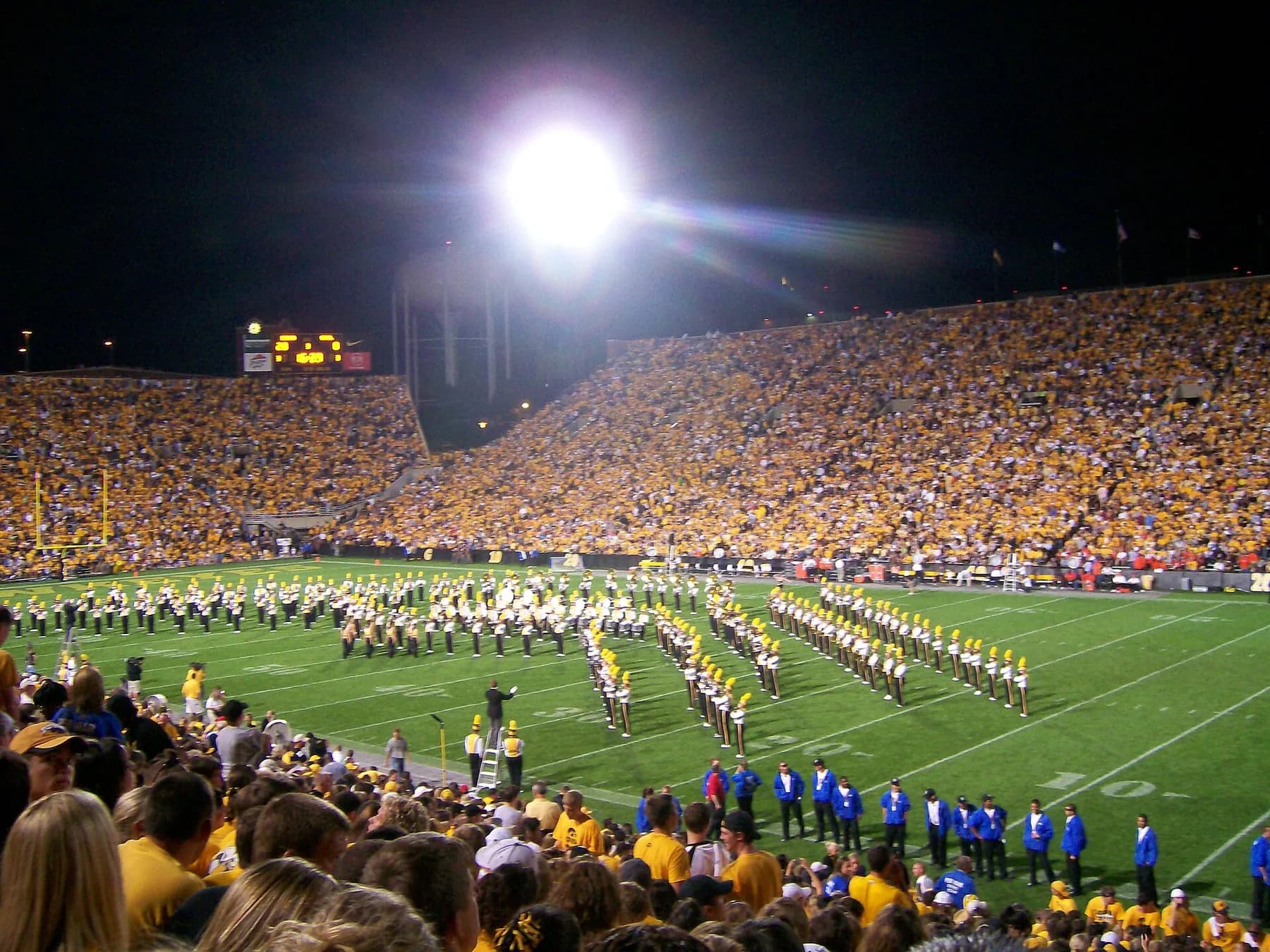
Big Ten · 2026 · Week 8

Photo: Count_de_Des_Moines ( talk ) ( Uploads ) · CC BY-SA 3.0 · Cropped for display
Up next · Week 9
Home
Hosting
Saturday, October 31 · Time TBA
The season, taking shape
Final scores show Iowa first. Oldest to newest.
at MichiganPregame 23–25
Game details vs. Ohio State
Pregame 20–30
Game details at Washington
Pregame 23–24
Game detailsOriginal full-season forecast
This forecast retains the original probabilities for the full schedule. It does not update with completed results or this week’s forecast.
2026 results
Current record, team efficiency, player production, and verified results from completed games.
Current record
5-25 wins · 2 lossesThrough 7 completed gamesLoading player usage…
2026 season preview
Iowa does not need to discover its identity in 2026. It needs a changed roster to execute it. Kirk Ferentz enters his 28th Iowa preseason with Tim Lester directing the offense and Phil Parker anchoring the defense, giving the Hawkeyes continuity at the top. The urgent work is underneath: choosing a quarterback, rebuilding an award-winning offensive line and replacing nearly an entire defensive-line rotation before the schedule applies real pressure.
That foundation matters because Iowa is following a 9-4 season that was close to becoming something more. The Hawkeyes scored 29.3 points per game, allowed 16.1 and lost four games by 15 combined points. They also won the Joe Moore Award and produced two consensus All-Americans. Ferentz’s program can carry forward its structure, and senior consultant Tom Moore has added what Ferentz described as concise offensive perspective, but last season’s line play and other veteran strengths cannot simply be assumed again.
Original season forecast
The original Big Ten forecast, retained alongside current results.
Big Ten projected standing
#5
6-3 projected · 5.8 expected conference wins · #5 of 18.
Preseason baseline
2025 percentiles retained as preseason context; current results and player production lead this page.
2025 FBS percentile scale · 50 is average
Incoming class
National and conference recruiting ranks, confirmed commitments, and the highest-ranked recruits in this class.
Top committed recruits
Iowa2026 transfer movement
Incoming and outgoing transfer activity, with rated FBS-to-FBS moves below.
Incoming Transfers
IowaOutgoing Transfers
IowaSeason schedule
Completed games show final results. Upcoming games use this week’s forecast where available; later games retain their published season outlook.
Detailed football intelligence
The full team identity, offense, defense, and supporting evidence.
Team identity
Last season, Iowa tried to lean on the running game; the approach gave the offense a dependable starting point.
Why it matters
The run game was Iowa's steadier way to stay ahead of the chains; opponents have to win early fits without handing away play action.
 at Minnesota
Pregame 28–19
Game detailsPregame comparisons use preserved published forecasts. Results include wins and losses.
At a glance
Current form leads the outlook.
2026 rates aggregate verified completed-game box scores. EPA is expected points added per play.
| Player | C/ATT | YDS | TD | INT |
|---|---|---|---|---|
| Hank Brown | 77/123 | 816 | 4 | 1 |
| Jeremy Hecklinski | 32/51 | 410 | 4 | 1 |
| Jimmy Sullivan | 2/4 | 13 | 0 | 0 |
| Player | CAR | YDS | AVG | TD |
|---|---|---|---|---|
| Kamari Moulton | 76 | 519 | 6.8 | 4 |
| Xavier Williams | 20 | 170 | 8.5 | 3 |
| Braeden Jackson | 19 | 170 | 8.9 | 2 |
| Player | REC | YDS | AVG | TD |
|---|---|---|---|---|
| Tony Diaz | 28 | 329 | 11.8 | 1 |
| Reece Vander Zee | 15 | 231 | 15.4 | 2 |
| DJ Vonnahme | 18 | 219 | 12.2 | 2 |
| Player | TOT | SOLO | TFL | SACK |
|---|---|---|---|---|
| Cam Buffington | 52 | 28 | 5 | 2 |
| Jayden Montgomery | 35 | 20 | 5 | 2 |
| Zach Lutmer | 34 | 17 | 0.5 | 0 |
Saturday, October 24 · Huntington Bank Stadium
Friday, October 9 · Husky Stadium
Saturday, October 3 · Kinnick Stadium
Quarterback is the largest variable. Ferentz said July 28 that Iowa had not selected a starter and allowed that the decision could come in August or even during the season. The spring roster included Auburn transfer Hank Brown, returning sophomore Jeremy Hecklinski and freshman Ryan Fitzgerald. Brown and Hecklinski were selected to the 17-player leadership council, placing both in visible leadership roles, but neither entered camp with sustained Iowa game production. The winner must replace Mark Gronowski’s production and leadership without being asked to carry the offense alone.
There is support around that competition. Ferentz described every offensive skill group outside quarterback as relatively experienced, which should allow Lester to build around the run game and play action rather than demand immediate transformation from the new starter. The harder question is whether the front can make that approach viable. Iowa graduated three starters from its 2025 line, and Ferentz said roughly seven to nine players could earn significant snaps while acknowledging that their positions were not settled.
Guard Kade Pieper is the clearest offensive anchor. He started all 13 games in 2025, helped Iowa outrush nine opponents and was named to the 2026 Big Ten preseason honors list. His experience gives Iowa a piece around which to arrange the rebuilt front, but identifying five starters is only the beginning. The line must develop enough cohesion to protect an inexperienced quarterback and keep the offense out of obvious passing situations. That is how the Hawkeyes preserve their physical identity rather than merely invoke it.
The defensive front presents an even larger reconstruction. Ferentz called it Iowa’s greatest focus and concern after seven of the previous season’s top eight linemen departed. Veterans Luke Gaffney and Will Hubert offer a starting point, while South Dakota State transfer Bryce Hawthorne and several other portal additions expand the options. Ferentz expects a broader rotation and did not envision one lineman playing 500 snaps. That committee could provide flexibility, but its ability to control early downs remains unproven.
Parker has more established leadership behind that front, though not a settled lineup. Ferentz said the starting four or five defensive backs remained unclear entering camp. Zach Lutmer, Deshaun Lee and Jaylen Watson all hold places on the leadership council, making them consequential figures as Iowa determines its starting combination and nickel configuration. Their communication will matter if a young defensive line produces uneven stretches. More broadly, a council spanning every offensive position group and all three defensive levels can help integrate roughly 30 January newcomers after the departure of a large senior class, although its actual impact remains to be seen.
The schedule gives Iowa three home games to begin sorting those questions. Northern Illinois, Iowa State and Northern Iowa visit Kinnick Stadium in succession, although the Sept. 12 rivalry game against Iowa State makes that opening stretch more than a gentle runway. Then the pressure spikes: Iowa travels to Michigan, hosts Ohio State and visits Washington on a Friday night before its first open week. Any uncertainty at quarterback or either line will become much more expensive during that sequence.
Home rivalry dates against Wisconsin on Oct. 31 and Nebraska on Nov. 27 add later checkpoints, but Iowa’s season may take shape well before then. The Hawkeyes have a stable coaching structure, experienced offensive skill players, Pieper at the center of the offensive rebuild and leaders in Parker’s secondary. Their ceiling depends on whether the quarterback and both lines become functional units quickly enough. Familiarity gives Iowa a foundation; resolving those urgent questions before Michigan, Ohio State and Washington will determine how much it can support.
This preview is based on the linked public reporting and official program records.
Profile high point
Big-play prevention held the profile's highest percentile position.Profile low point
Big-play creation held the lowest percentile position among the profile's strength measures.




The run game is what Iowa can trust most.
Why it matters
The offense has its best route to favorable third downs and a credible play-action menu; explosive-play creation remains the first counter an opponent should test.
Big-play creation is Iowa's biggest concern, and opponents can test it immediately.
Why it matters
Opponents can squeeze underneath space and make the offense finish long drives without chunk gains; rushing structure has to keep that stress from setting the game plan.
Iowa is at its best when it can use the running game to control early downs and finish drives; fewer possessions make every empty drive more expensive.
What matters
Iowa's run-first structure played at a deliberate pace. The run game finished top-tier, while the pass game finished below-average.
Inside the team
Open a section for the football detail and supporting numbers.
The down-to-down question that determines whether the offense can keep both the run and pass available.
Opponents have to keep Iowa's run game from turning first down into second-and-manageable.
Why it matters
If Iowa stays on schedule on the ground, the offense keeps more answers available.
The pace, play selection, and methods this offense uses to stay on schedule.
Iowa played at a deliberate pace in 2025.
What matters
Iowa worked with fewer possessions than most teams last season.
Iowa's prior passing record was below-average.
Why it matters
Iowa's offense needs protection, field position, or explosive variance when ordinary dropbacks do not create enough value.
Iowa's prior rushing record was top-tier.
Why it matters
A sustainable run game keeps Iowa's play action credible and limits obvious passing situations.
Iowa was better at preventing explosive plays than creating them.
Why it matters
The defense can keep a game on schedule, but the offense may need longer drives and more third-down conversions to separate.
How consistently the offense creates manageable situations and the defense prevents them.
Iowa won ordinary downs on both sides of the ball.
Why it matters
Iowa's success rate shows whether it can sustain drives and get stops without relying on sacks, turnovers, or isolated big plays.
Opponent-adjusted EPA identifies the run game as Iowa's stronger offensive unit.
Why it matters
Forcing longer passing situations is the clearest way to move the offense away from its stronger adjusted unit.
Where the defense can create pressure, control the run, and end drives.
Iowa's prior defense was strong overall and strongest in pass defense.
What matters
Pass defense finished top-tier, while run front still finished above-average; the latter is only the first question, not a weakness an offense can assume.
Iowa's available disruption measures finished above the national average last season; a charted pressure rate is not available.
Why it matters
Sustained disruption can create negative plays and give Iowa a better chance to end drives before third down.
Iowa created disruption more consistently than it finished sacks.
Why it matters
Iowa's disruption can hurry an offense; sacks do more by erasing field position and ending passing downs.
Iowa's prior run-defense results were above-average.
Why it matters
If Iowa's front cannot control early downs, opponents can keep every offensive option open and protect their passing game.