Week 5 · FinalW
 at Rutgers
47–15+32 margin
Pregame 36–18
Game detailsSaturday Index
Loading team intelligenceBringing the latest verified football information into focus.
Big Ten · 2026 · Week 8

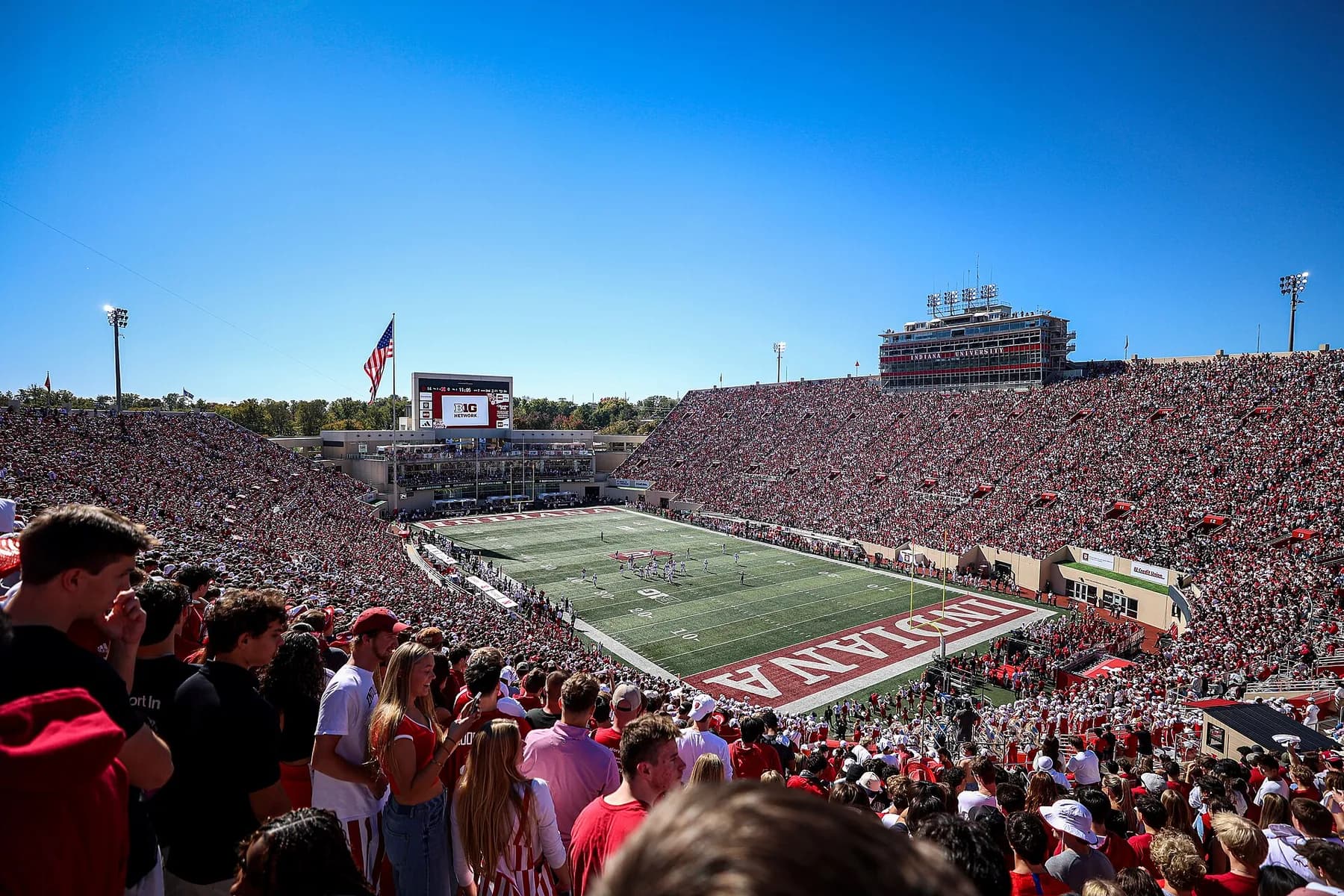
Photo: JYDecker · CC BY-SA 4.0 · Cropped for display
Up next · Week 9
Home
Hosting
Saturday, October 31 · Time TBA
The season, taking shape
Final scores show Indiana first. Oldest to newest.
at RutgersPregame 36–18
Game details at Nebraska
Pregame 29–22
Game details vs. Ohio State
Pregame 24–26
Game detailsOriginal full-season forecast
This forecast retains the original probabilities for the full schedule. It does not update with completed results or this week’s forecast.
2026 results
Current record, team efficiency, player production, and verified results from completed games.
Current record
7-17 wins · 1 lossThrough 8 completed gamesLoading player usage…
2026 season preview
Curt Cignetti enters his third season at Indiana with the program's most important form of continuity intact. Offensive coordinator Mike Shanahan and defensive coordinator Bryant Haines remain in charge of the systems that produced the 2025 national title. The challenge is no longer teaching a new blueprint. It is determining how effectively that blueprint can absorb major personnel losses.
Indiana's clearest path begins up front. The returning core is concentrated along the offensive line, at defensive tackle and at linebacker, while quarterback, the offensive skill positions, edge and the secondary have undergone the most turnover. Indiana chose offensive tackle Carter Smith, defensive tackle Tyrique Tucker and linebacker Isaiah Jones as its Big Ten media-days representatives, a fitting picture of the veteran spine Cignetti will lean on.
Original season forecast
The original Big Ten forecast, retained alongside current results.
Big Ten projected standing
#3
6-3 projected · 6.1 expected conference wins · #3 of 18.
Preseason baseline
2025 percentiles retained as preseason context; current results and player production lead this page.
2025 FBS percentile scale · 50 is average
Incoming class
National and conference recruiting ranks, confirmed commitments, and the highest-ranked recruits in this class.
Top committed recruits
Indiana2026 transfer movement
Incoming and outgoing transfer activity, with rated FBS-to-FBS moves below.
Incoming Transfers
IndianaOutgoing Transfers
IndianaSeason schedule
Completed games show final results. Upcoming games use this week’s forecast where available; later games retain their published season outlook.
Detailed football intelligence
The full team identity, offense, defense, and supporting evidence.
Team identity
Last season, Indiana tried to lean on the running game; the approach consistently kept the offense on schedule.
Why it matters
The passing game was Indiana's more dependable way to stay ahead of the chains; opponents have to interrupt that rhythm without giving the run an easy box.
 at Michigan
Pregame 27–21
Game detailsPregame comparisons use preserved published forecasts. Results include wins and losses.
At a glance
Current form leads the outlook.
2026 rates aggregate verified completed-game box scores. EPA is expected points added per play.
| Player | C/ATT | YDS | TD | INT |
|---|---|---|---|---|
| Josh Hoover | 116/187 | 1741 | 18 | 1 |
| Grant Wilson | 4/5 | 74 | 2 | 0 |
| Tyler Cherry | 1/3 | 10 | 0 | 0 |
| Player | CAR | YDS | AVG | TD |
|---|---|---|---|---|
| Turbo Richard | 106 | 711 | 6.7 | 6 |
| Lee Beebe | 119 | 636 | 5.3 | 4 |
| Josh Hoover | 30 | 52 | 1.7 | 2 |
| Player | REC | YDS | AVG | TD |
|---|---|---|---|---|
| Charlie Becker | 42 | 726 | 17.3 | 8 |
| Nick Marsh | 34 | 610 | 17.9 | 7 |
| Davion Chandler | 11 | 131 | 11.9 | 4 |
| Player | TOT | SOLO | TFL | SACK |
|---|---|---|---|---|
| Isaiah Jones | 59 | 37 | 2.5 | 0 |
| Rolijah Hardy | 58 | 35 | 5.5 | 2 |
| Amare Ferrell | 42 | 20 | 0.5 | 0 |
Saturday, October 24 · Michigan Stadium
Saturday, October 17 · Memorial Stadium (Bloomington, IN)
Saturday, October 10 · Memorial Stadium (Lincoln, NE)
TCU transfer Josh Hoover is expected to succeed Heisman winner Fernando Mendoza at quarterback. The Daily Hoosier's spring quarterback review credited Hoover with 3,472 passing yards and 29 touchdowns in 2025, and Cignetti said his spring progression compared favorably with previous portal starters at the same stage. Hoover brings substantial Power Four experience, but he must apply it in a new offense with a largely new group around him.
That supporting cast is the offense's central construction project. Leading 2025 running backs Roman Hemby and Kaelon Black departed, leaving returnee Lee Beebe Jr. and transfer Turbo Richard among the prominent options. The receiving corps lost Elijah Sarratt, E.J. Williams, Jonathan Brady and Omar Cooper; returnee Charlie Becker and transfers Nick Marsh and Shazz Preston now headline a group that must establish its roles and timing with Hoover.
Tight end is undergoing a similar reset after Riley Nowakowski, Holden Staes and James Bomba exhausted their eligibility. Blake Thiry and Andrew Barker return, Miami transfer Brock Schott joins them and three freshmen enter the room. Their development matters beyond the receiving totals: Indiana needs the group to support the running game and give Hoover dependable access to the middle of the field.
The offensive line should give those new combinations room to develop. Smith, Drew Evans and Bray Lynch return, while Wisconsin transfer Joe Brunner arrives after making 24 consecutive starts at left guard. Indiana Athletics noted that the line was a Joe Moore Award semifinalist in each of the past two seasons. That experience can protect Hoover from carrying the entire transition and help keep the offense on schedule while the backs and receivers settle into place.
On defense, Tucker is the established centerpiece after totaling 40 tackles, 12 tackles for loss and six sacks. Mario Landino also returns inside, while transfers Tobi Osunsanmi, Chiddi Obiazor and Josh Burnham join a front replacing Mikail Kamara, Kellan Wyatt and Stephen Daley. Tucker gives Haines a proven source of interior disruption; finding a productive edge rotation is the accompanying task.
Behind that front, Jones and Rolijah Hardy return as the established linebacker pair in Haines' adjustable 4-2-5 structure. Jones assumes the primary communication role after Aiden Fisher's departure, with Kaiden Turner and Jeff Utzinger supplying experienced depth. That combination gives Indiana returning production in the middle of the defense, but Jones' command will be as important as his individual play.
The secondary has a smaller returning foundation. Safety Amare Ferrell and corner Jamari Sharpe are back, but three starters from 2025 departed, including NFL-bound boundary corner D'Angelo Ponds. Byron Baldwin, Jaylen Bell and transfers A.J. Harris, Preston Zachman and Jiquan Sanks are among the leading candidates for open roles. The issue is not simply choosing starters; the rebuilt group must restore the coverage communication that prevents assignment errors and explosive plays.
Special teams also demand attention because most of the operation is being reassembled. Nico Radicic returns as a kicking option, while transfers Billy Gowers, Drew Clausen and Paddy McAteer were added after Indiana lost its primary punter, long snapper, kickoff specialist and punt returner. Those changes introduce a hidden-yardage variable that may not become clear until the new units work under game pressure.
The schedule offers an early runway, beginning with four straight home games against North Texas, Howard, Western Kentucky and Northwestern. The Northwestern game opens Big Ten play, followed by consecutive October trips to Rutgers and Nebraska. The schedule's sharpest pressure point comes next: Ohio State visits Bloomington before Indiana travels to Michigan the following week. Minnesota and USC later visit Memorial Stadium, a trip to Washington follows, and Purdue closes the regular season in Bloomington.
Indiana therefore enters 2026 with continuity in coaching, scheme and several of the positions closest to the ball, but not with a finished roster hierarchy. Hoover's transition, the distribution of touches, the edge rotation, secondary communication and the rebuilt specialist units will shape how much that veteran core can support. Fall camp still must settle those roles, and a roster listing alone does not establish health, eligibility or opening-week availability. No record prediction is warranted from what is currently known.
This preview is based on the linked public reporting and official program records.
Profile high point
Pressure held the profile's highest percentile position.Profile low point
Big-play creation held the lowest percentile position among the profile's strength measures.

Front-seven disruption is what Indiana can trust most.
Why it matters
The defense has its best route to changing protection rules before coverage must hold; explosive-play creation remains the first counter an opponent should test.
Big-play creation is Indiana's biggest concern, and opponents can test it immediately.
Why it matters
Opponents can squeeze underneath space and make the offense finish long drives without chunk gains; front-seven disruption has to keep that stress from setting the game plan.
Indiana's best path is to lean on the running game, then let the passing game finish drives; fewer possessions make every empty drive more expensive.
What matters
Indiana's run-first structure played at a deliberate pace. The pass game finished top-tier, while the run game finished top-tier.
Inside the team
Open a section for the football detail and supporting numbers.
The down-to-down question that determines whether the offense can keep both the run and pass available.
Opponents have to break Indiana's passing rhythm before it owns early downs.
Why it matters
If Indiana keeps finding routine completions, the defense cannot load the box or turn the rush loose.
The pace, play selection, and methods this offense uses to stay on schedule.
Indiana played at a deliberate pace in 2025.
What matters
Indiana worked with fewer possessions than most teams last season.
Indiana's prior passing record was top-tier.
Why it matters
A repeatable pass game can let Indiana punish loaded boxes without relying on low-frequency deep completions.
Why it matters
A sustainable run game keeps Indiana's play action credible and limits obvious passing situations.
Explosive plays were a two-way concern in Indiana's record last season.
Why it matters
That combination increases dependence on sustained drives while leaving little margin for a missed fit or coverage error.
How consistently the offense creates manageable situations and the defense prevents them.
Indiana won ordinary downs on both sides of the ball.
Why it matters
Indiana's success rate shows whether it can sustain drives and get stops without relying on sacks, turnovers, or isolated big plays.
Indiana's opponent-adjusted passing and rushing value were closely matched.
Why it matters
When the split is narrow, early-down execution matters more than steering the offense toward one obvious weakness.
Where the defense can create pressure, control the run, and end drives.
Indiana's prior defense was top-tier overall and strongest in disruption.
Why it matters
Opponents can start by using routine throws to stay out of obvious passing downs, though that unit still finished strong. Indiana's disruption can still create negative plays and end drives, so the offense has to prove the opening will hold up.
Indiana's available disruption measures ranked among the best in the country last season; a charted pressure rate is not available.
Why it matters
Sustained disruption can create negative plays and give Indiana a better chance to end drives before third down.
Indiana's disruption regularly finished at the quarterback.
What matters
Both sack production and front-seven disruption cleared the FBS midpoint.
Indiana's prior run-defense results were top-tier.
Why it matters
A dependable run front can let Indiana create obvious passing downs without committing extra bodies to the box.