Week 4 · FinalL
 at Ohio State
19–42-23 margin
Pregame 14–40
Game detailsSaturday Index
Loading team intelligenceBringing the latest verified football information into focus.
Big Ten · 2026 · Week 8

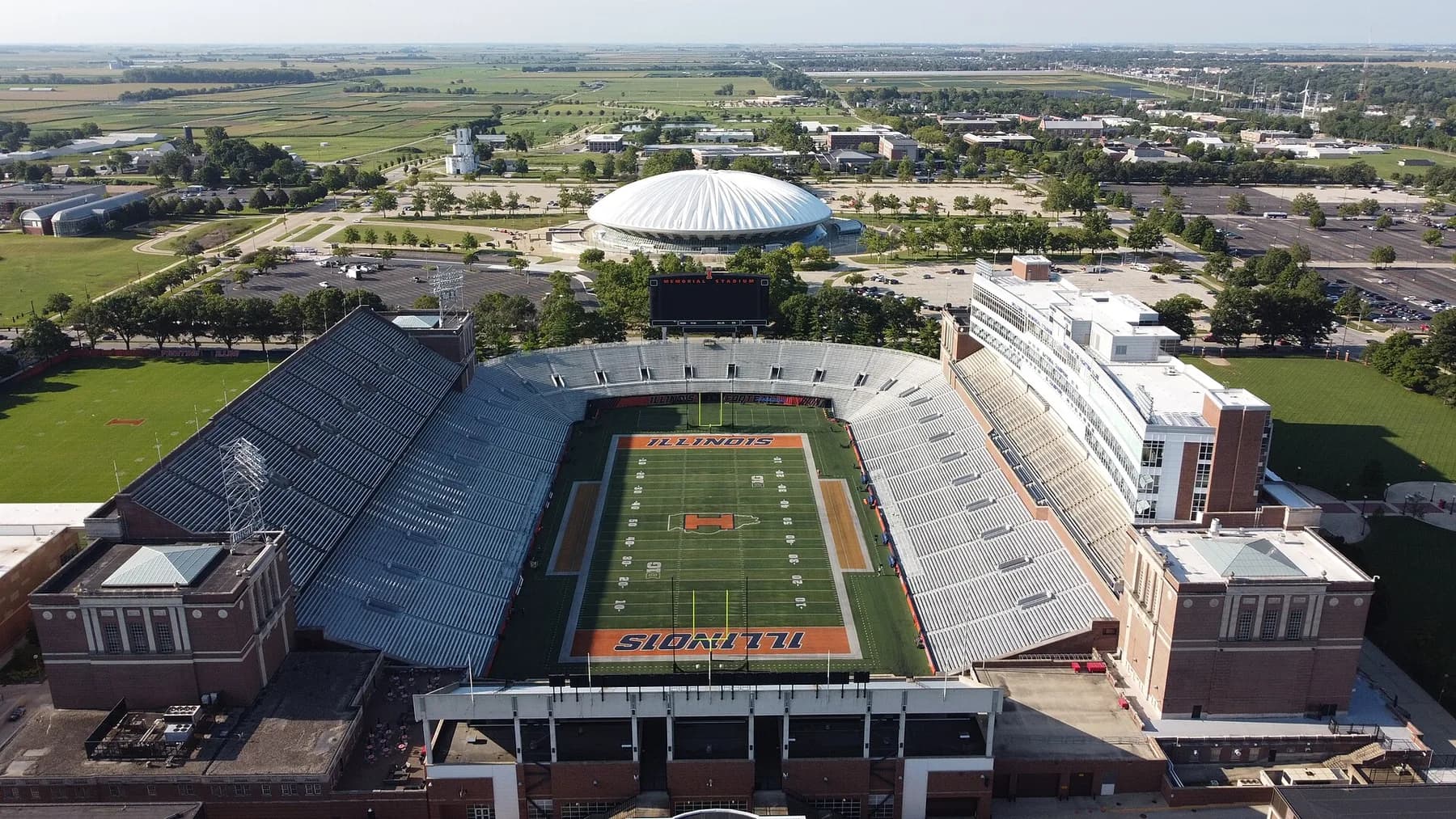
Photo: Lectrician2 · CC BY-SA 4.0 · Cropped for display
Up next · Week 9
Away
On the road at
Saturday, October 31 · Time TBA
The season, taking shape
Final scores show Illinois first. Oldest to newest.
at Ohio StatePregame 14–40
Game details vs. Purdue
Pregame 35–23
Game details at Michigan State
Pregame 25–27
Original full-season forecast
This forecast retains the original probabilities for the full schedule. It does not update with completed results or this week’s forecast.
2026 results
Current record, team efficiency, player production, and verified results from completed games.
Current record
4-34 wins · 3 lossesThrough 7 completed gamesLoading player usage…
2026 season preview
Illinois enters 2026 with a clear challenge for Bret Bielema: turn a roster full of new combinations into dependable units before the schedule tightens. The Illini retain meaningful experience at running back and in the secondary, but they must replace veteran quarterback Luke Altmyer, leading receiver Hank Beatty and NFL draft picks Gabe Jacas, J.C. Davis and Miles Scott. This is not a complete reset. It is a test of how quickly the remaining veterans and a large group of newcomers can fit together.
Bielema still has Barry Lunney Jr. directing the offense and Bobby Hauck directing the defense, but several teaching and game-planning roles have changed. Artur Sitkowski is now the quarterbacks coach, Mike Neu the pass-game coordinator, Chris Hurd the special-teams coordinator and Archie McDaniel the outside-linebackers coach. That redistribution matters because Illinois is asking its staff to establish cohesion at quarterback, along both lines and throughout the specialist operation at the same time.
Original season forecast
The original Big Ten forecast, retained alongside current results.
Big Ten projected standing
#12
4-5 projected · 3.7 expected conference wins · #12 of 18.
Preseason baseline
2025 percentiles retained as preseason context; current results and player production lead this page.
2025 FBS percentile scale · 50 is average
Incoming class
National and conference recruiting ranks, confirmed commitments, and the highest-ranked recruits in this class.
Top committed recruits
Illinois2026 transfer movement
Incoming and outgoing transfer activity, with rated FBS-to-FBS moves below.
Incoming Transfers
IllinoisOutgoing Transfers
IllinoisSeason schedule
Completed games show final results. Upcoming games use this week’s forecast where available; later games retain their published season outlook.
Detailed football intelligence
The full team identity, offense, defense, and supporting evidence.
Team identity
Last season, Illinois tried to stay balanced between the run and pass; the approach consistently kept the offense on schedule.
Why it matters
The passing game was Illinois's more dependable way to stay ahead of the chains; opponents have to interrupt that rhythm without giving the run an easy box.
 vs. Oregon
Pregame 19–34
Game detailsPregame comparisons use preserved published forecasts. Results include wins and losses.
At a glance
Current form leads the outlook.
2026 rates aggregate verified completed-game box scores. EPA is expected points added per play.
| Player | C/ATT | YDS | TD | INT |
|---|---|---|---|---|
| Katin Houser | 122/184 | 1440 | 12 | 4 |
| Michael Clayton II | 6/8 | 88 | 2 | 0 |
| Player | CAR | YDS | AVG | TD |
|---|---|---|---|---|
| Aidan Laughery | 62 | 391 | 6.3 | 1 |
| Ca'Lil Valentine | 50 | 225 | 4.5 | 1 |
| Katin Houser | 30 | 120 | 4.0 | 2 |
| Player | REC | YDS | AVG | TD |
|---|---|---|---|---|
| Collin Dixon | 47 | 608 | 12.9 | 9 |
| Hudson Clement | 27 | 404 | 15.0 | 1 |
| Brayden Trimble | 19 | 172 | 9.1 | 0 |
| Player | TOT | SOLO | TFL | SACK |
|---|---|---|---|---|
| Matthew Bailey | 41 | 25 | 1 | 0 |
| Ismael Kante | 37 | 16 | 3.5 | 0 |
| James Kreutz | 34 | 15 | 2.5 | 1 |
Saturday, October 24 · Memorial Stadium (Champaign, IL)
Saturday, October 10 · Spartan Stadium
Saturday, October 3 · Memorial Stadium (Champaign, IL)
Houser stands at the center of the offensive transition. Illinois took the veteran transfer to Big Ten Media Days with safety Matthew Bailey and corner Juice Clarke, placing him beside the defense's two most established returning backs. Sophomore Jershaun Newton and freshmen Michael Clayton II and Dane Eisenmenger complete a quarterback room with developmental options but little proven FBS production behind Houser. His command of Lunney's offense—and the development of a reliable alternative—will shape how aggressively Illinois can attack.
The backfield gives Houser the offense's firmest foundation. Ca'Lil Valentine led Illinois with 614 rushing yards in 2025, Kaden Feagin added 507 yards and seven rushing touchdowns, and Aidan Laughery averaged 5.1 yards per carry over nine games. Their experience gives Illinois multiple ways to manage early downs and reduce the burden on a new quarterback, though the order and distribution of carries remain unsettled.
Houser's targets present a different kind of competition. Returning starters Collin Dixon and Hudson Clement bring familiarity, while veteran transfers Alex Perry, Jayshon Platt and Ty Robinson widen the search for a successor to Beatty as the leading option. At tight end, returners Logan Farrell and Tanner Hollinger are joined by transfers Maurice Smith Jr. and Davin Stoffel. The group has choices, but Illinois still must determine who earns the most important receiving, inline-blocking and passing-down roles.
Everything the offense wants to become depends on the line taking shape. Illinois added Wisconsin transfer Jake Renfro, Colorado State transfer Christian Martin and junior-college linemen Maika Matelau, TJ Taylor and Alfred Washington after major departures. Those additions offer maturity and competition, but five talented individuals are not automatically a functioning line. Protection calls, center communication and run-game timing will determine whether the veteran backfield can control games and whether Houser has time to build connections with a reshaped receiving corps.
On defense, Bailey and Clarke provide the clearest continuity. Bailey has led Illinois in tackles in consecutive seasons and enters 2026 with 185 career stops, four interceptions and four forced fumbles. Clarke led the 2025 team with seven pass breakups despite missing four games because of injury. Their production and Media Days selection point to substantial leadership responsibilities as Hauck assembles the rest of the defense around them.
The front carries more uncertainty. Joe Barna returns, while Illinois added outside linebacker Will Holmes and defensive linemen Carter Janki, Darrell Prater, Connor Sullivan and Isaiah Thomison. The newcomers give Hauck experienced pieces after the losses of Jacas and Davis, but their presence also shows the scale of the reconstruction. Illinois still must establish its primary front, linebacker rotation and pressure plan before the group can be treated as a finished unit.
Special teams is another open competition under Hurd. Illinois added two transfer kickers, a transfer punter and a transfer long snapper, leaving important jobs to be sorted across every specialist phase. The broader talent pool has also grown: Illinois announced a 30-player signing class ranked No. 21 nationally by 247Sports, with nine signees receiving at least one four-star grade and eight coming from Illinois. Prominent junior-college additions could help sooner than a conventional freshman-heavy group, but their immediate roles will have to be earned.
The schedule gives Illinois a short runway. UAB, Duke and Southern Illinois visit Champaign for the first three games, offering the Illini a home-heavy opening in which to establish their combinations. A trip to Ohio State follows in Week 4. By then, the offensive line must communicate under pressure, Houser must be comfortable with his primary targets and Hauck's defense must have a workable rotation. The opportunity to experiment does not last long.
The pressure returns later with Oregon, Nebraska and Iowa visiting Illinois and a November trip to UCLA. Road games at Michigan State and Maryland and the finale at Northwestern add further demands. Those stretches will test whether the rebuilt fronts can hold up over a Big Ten season and whether the team's established strengths—the running backs and veteran secondary leaders—can steady less settled rooms.
Illinois has enough experience to avoid starting from zero and enough incoming talent to create meaningful competition. It does not yet have enough settled roles for a confident forecast. The first offensive-line combination, backup quarterback, tight-end hierarchy, defensive structure, linebacker rotation and specialist jobs remain important August questions, as do injuries and complete Week 1 availability. Bielema's 2026 team will be defined less by how many options it has than by how quickly those options become coherent units around Houser, the veteran backfield, Bailey and Clarke.
This preview is based on the linked public reporting and official program records.
Profile high point
Passing held the profile's highest percentile position.Profile low point
Big-play creation held the lowest percentile position among the profile's strength measures.




The passing game is what Illinois can trust most.
Why it matters
The opening plan has its best answer when opponents crowd the box or force obvious throwing situations; explosive-play creation remains the first counter an opponent should test.
Big-play creation is Illinois's biggest concern, and opponents can test it immediately.
Why it matters
Opponents can squeeze underneath space and make the offense finish long drives without chunk gains; passing efficiency has to keep that stress from setting the game plan.
Illinois is at its best when it can stay balanced between the run and pass, then let the passing game finish drives; fewer possessions make every empty drive more expensive.
Why it matters
Illinois's clean script uses efficient early throws to stay ahead of the sticks; defenses will attack protection and route timing before the full passing menu opens. In a slower game, one empty drive or failed early-down series carries extra weight.
Inside the team
Open a section for the football detail and supporting numbers.
The down-to-down question that determines whether the offense can keep both the run and pass available.
Opponents have to break Illinois's passing rhythm before it owns early downs.
Why it matters
If Illinois keeps finding routine completions, the defense cannot load the box or turn the rush loose.
The pace, play selection, and methods this offense uses to stay on schedule.
Illinois played at a deliberate pace in 2025.
What matters
Illinois worked with fewer possessions than most teams last season.
Illinois's prior passing record was top-tier.
Why it matters
A repeatable pass game can let Illinois punish loaded boxes without relying on low-frequency deep completions.
Illinois's prior rushing record was above-average.
Why it matters
A sustainable run game keeps Illinois's play action credible and limits obvious passing situations.
Illinois was better at preventing explosive plays than creating them.
Why it matters
The defense can keep a game on schedule, but the offense may need longer drives and more third-down conversions to separate.
How consistently the offense creates manageable situations and the defense prevents them.
Illinois's offense was more consistent down to down than its defense.
Why it matters
Illinois's success rate shows whether it can sustain drives and get stops without relying on sacks, turnovers, or isolated big plays.
Opponent-adjusted EPA identifies the pass game as Illinois's stronger offensive unit.
Why it matters
If an opponent removes the first passing answer, the run game's lower adjusted value becomes the key counter to test.
Where the defense can create pressure, control the run, and end drives.
Illinois's prior defense was weak overall and strongest in run front.
Why it matters
Opponents can use efficient throws to stay out of obvious passing downs; Illinois needs its run front to create long-yardage without overloading the box before that plan settles in.
Illinois's available disruption measures finished below the national average last season; a charted pressure rate is not available.
Why it matters
Without consistent disruption, Illinois's defense must win more snaps through coverage, leverage, and early-down prevention.
Illinois's sack production outpaced its broader disruption record.
Why it matters
Illinois's disruption can hurry an offense; sacks do more by erasing field position and ending passing downs.
Illinois's prior run-defense results were above-average.
Why it matters
If Illinois's front cannot control early downs, opponents can keep every offensive option open and protect their passing game.