
Week 5 · FinalW
 vs. UCF
27–17+10 margin
Pregame 31–21
Game detailsSaturday Index
Loading team intelligenceBringing the latest verified football information into focus.
Big 12 · 2026 · Week 8

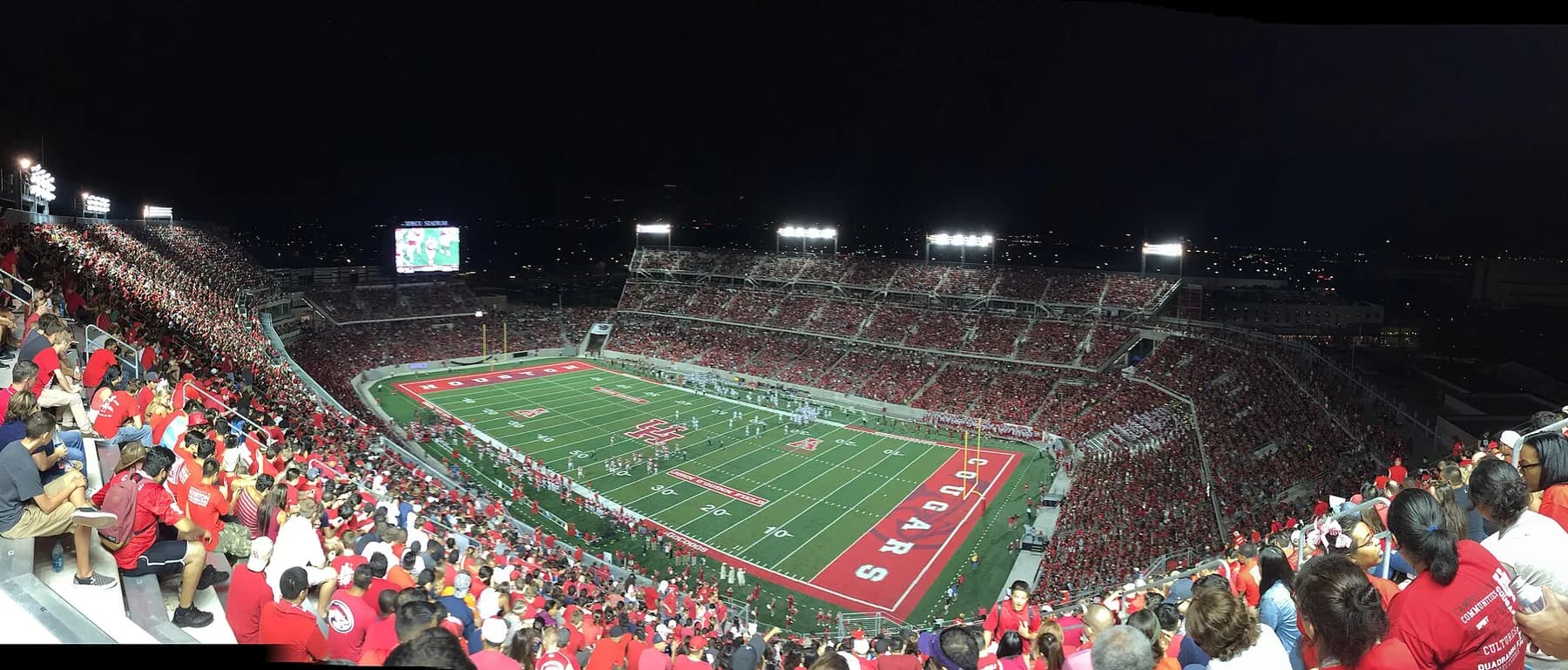
Photo: Brian Reading · CC BY-SA 4.0 · Cropped for display
Up next · Week 10
Home
Hosting
Saturday, November 7 · Time TBA
The season, taking shape
Final scores show Houston first. Oldest to newest.
vs. UCFPregame 31–21
Game details at Kansas State
Pregame 25–29
Game details vs. Oklahoma State
Pregame 37–21
Original full-season forecast
This forecast retains the original probabilities for the full schedule. It does not update with completed results or this week’s forecast.
2026 results
Current record, team efficiency, player production, and verified results from completed games.
Current record
6-26 wins · 2 lossesThrough 8 completed gamesLoading player usage…
2026 season preview
Houston enters 2026 with less need for reinvention than refinement. Willie Fritz has a proven quarterback, established skill talent and experienced defenders at every level after a 10-win season. His portal class addressed vacancies across the roster rather than replacing its foundation. The season therefore turns on a narrower question: Can a rebuilt offensive line and redistributed rushing workload support the identity Houston already established, especially when five Big 12 games take the Cougars away from home?
Everything starts with Conner Weigman. He completed 65.2 percent of his passes for 2,705 yards, 25 touchdowns and nine interceptions in 2025, then added 700 rushing yards and 11 scores. According to Joseph Duarte, Weigman started all 13 games and entered spring after his first healthy offseason in three years. That combination of production and sustained availability gives Houston certainty at the sport's most important position, but it also makes protecting him the central responsibility of the offense around him.
Original season forecast
The original Big 12 forecast, retained alongside current results.
Big 12 projected standing
#6
5-4 projected · 5.0 expected conference wins · #6 of 16.
Preseason baseline
2025 percentiles retained as preseason context; current results and player production lead this page.
2025 FBS percentile scale · 50 is average
Incoming class
National and conference recruiting ranks, confirmed commitments, and the highest-ranked recruits in this class.
Top committed recruits
Houston2026 transfer movement
Incoming and outgoing transfer activity, with rated FBS-to-FBS moves below.
Incoming Transfers
HoustonOutgoing Transfers
HoustonSeason schedule
Completed games show final results. Upcoming games use this week’s forecast where available; later games retain their published season outlook.
Detailed football intelligence
The full team identity, offense, defense, and supporting evidence.
Team identity
Last season, Houston tried to lean on the running game; too many drives still went off schedule.
Why it matters
The passing game was Houston's more dependable way to stay ahead of the chains; opponents have to interrupt that rhythm without giving the run an easy box.
 at Utah
Pregame 22–32
Game detailsPregame comparisons use preserved published forecasts. Results include wins and losses.
At a glance
Current form leads the outlook.
2026 rates aggregate verified completed-game box scores. EPA is expected points added per play.
| Player | C/ATT | YDS | TD | INT |
|---|---|---|---|---|
| Conner Weigman | 107/160 | 1488 | 17 | 2 |
| Keisean Henderson | 6/8 | 83 | 2 | 0 |
| Player | CAR | YDS | AVG | TD |
|---|---|---|---|---|
| Re'Shaun Sanford II | 79 | 410 | 5.2 | 2 |
| Makhi Hughes | 83 | 394 | 4.7 | 3 |
| Conner Weigman | 45 | 165 | 3.7 | 6 |
| Player | REC | YDS | AVG | TD |
|---|---|---|---|---|
| Amare Thomas | 29 | 412 | 14.2 | 5 |
| Patrick Overmyer | 30 | 359 | 12.0 | 6 |
| Trent Walker | 24 | 357 | 14.9 | 2 |
| Player | TOT | SOLO | TFL | SACK |
|---|---|---|---|---|
| Kentrell Webb | 39 | 35 | 0 | 0 |
| Javion White | 26 | 18 | 5.5 | 2.5 |
| Khalil Laufau | 20 | 11 | 3.5 | 1.5 |
Saturday, October 24 · Rice-Eccles Stadium
Saturday, October 17 · TDECU Stadium
Saturday, October 10 · Bill Snyder Family Stadium
The quarterback hierarchy is clear. Offensive coordinator Slade Nagle told Dave Campbell's Texas Football that Weigman had earned unquestioned-starter status, with five-star freshman Keisean Henderson expected to serve as the No. 2 while developing toward 2027. Fritz and Nagle also plan to reduce Weigman's workload after 171 rushing attempts last season. His designed runs will remain a way to stress defenses; Houston simply wants more of the routine rushing burden carried elsewhere.
Makhi Hughes is the key to that shift. The Oregon transfer reunites with Fritz and Nagle after rushing for 1,378 yards in 2023 and 1,401 in 2024 at Tulane, giving Houston a proven between-the-tackles option. Re'Shaun Sanford II returns after missing 2025 because of a preseason-camp injury, and DJ Butler is also back. Together, they give the Cougars several ways to replace Dean Connors' carries while preserving Weigman's legs for the moments when his mobility matters most.
Weigman also retains a proven lead target in Amare Thomas, who caught 67 passes for 966 yards and 12 touchdowns last season. Koby Young and Harvey Broussard III return, while Oregon State transfer Trent Walker arrives after an 823-yard season and adds size outside. That group should allow Houston to vary formations and matchups without asking one newcomer to transform the passing game. Tight end is the less settled piece: Patrick Overmyer brings experience from UTSA and freshman Jaivion Martin brings a 6-foot-4, 250-pound frame, but no clear successor to Tanner Koziol has emerged.
The offensive line carries the largest burden of proof. Houston added decorated transfers rather than relying solely on inexperienced depth: Hurst was listed by the school as a 2025 second-team All-American and two-time first-team All-AAC selection, Terrill earned second-team All-MAC honors, and Mike Craven identified Boswell as a first-team All-MAC selection at Toledo. Those credentials raise the room's floor. They do not guarantee immediate cohesion, and Houston has not established its full five-man configuration. How quickly the group communicates, protects Weigman and creates dependable carries for Hughes will shape the entire offense.
Austin Armstrong's defense has more continuity through its middle. Khalil Laufau and Brandon Mack II return on the line, with Oregon transfer Ashton Porter joining the rotation. Former Utah linebacker Sione Fotu is back after making 53 tackles, while Ole Miss transfer Jaden Yates arrives after a reported 55-tackle season in 2025 and 115 tackles in 2024. That combination gives Armstrong returning anchors and experienced additions rather than forcing him to rebuild any one level from scratch.
The secondary's identity runs through Will James and safeties Jordan Allen and Kentrell Webb. James returns with preseason All-Big 12 recognition after recording three interceptions, two forced fumbles and five pass breakups. Allen and Webb give Houston experience behind him and make safety the established strength of the unit. Losses at corner leave the rotation around James less settled, but the Cougars begin with proven playmaking at the position and continuity on the back end.
The schedule quickly tests whether those pieces fit. Oregon State visits TDECU Stadium on Sept. 5, followed by Southern on Sept. 12, before Houston goes to Texas Tech for a pivotal Friday trip and then visits Georgia Southern. The Big 12 road slate also sends the Cougars to Kansas State on Oct. 10, Utah on Oct. 24, Colorado on Nov. 13 and West Virginia on Nov. 21. Home games against UCF, Oklahoma State, Cincinnati and Baylor offer counterweights, but the trips to Texas Tech, Kansas State and Utah will reveal whether Houston's rebuilt protection and veteran defense travel.
Houston's case for building on 2025 is straightforward. Weigman supplies proven dual-threat production, Hughes can help preserve him, Thomas leads a deep receiving rotation, and Armstrong has recognizable defenders at every level. The variables are concentrated in consequential places: offensive-line cohesion, tight-end production and the corner rotation opposite James. If Fritz gets dependable answers there, Houston's veteran core has the structure to withstand a difficult Big 12 schedule. The road games will determine whether that structure is sturdy enough to support a larger step.
This preview is based on the linked public reporting and official program records.
Profile high point
Big-play prevention held the profile's highest percentile position.Profile low point
The run game held the lowest percentile position among the profile's strength measures.


Houston can lean on the passing game when a drive slips off schedule, but the run game still needs support.
Why it matters
The opening plan has its best answer when opponents crowd the box or force obvious throwing situations; rushing structure remains the first counter an opponent should test.
The run game is Houston's biggest concern, and opponents can test it immediately.
What matters
Houston's rushing structure ranked near the bottom nationally last season.
Houston is at its best when it can lean on the running game, then let the passing game finish drives; extra possessions give that plan time to build.
What matters
Houston's run-first structure played at a fast pace. The pass game finished strong, while the run game finished bottom-tier.
Inside the team
Open a section for the football detail and supporting numbers.
The down-to-down question that determines whether the offense can keep both the run and pass available.
Opponents have to break Houston's passing rhythm before it owns early downs.
Why it matters
If Houston keeps finding routine completions, the defense cannot load the box or turn the rush loose.
The pace, play selection, and methods this offense uses to stay on schedule.
Houston played at a fast pace in 2025.
Why it matters
More possessions give Houston's strengths additional chances to build, but they also leave more time to recover from mistakes.
Houston's prior passing record was strong.
Why it matters
A repeatable pass game can let Houston punish loaded boxes without relying on low-frequency deep completions.
Houston's prior rushing record was bottom-tier.
Why it matters
When Houston's run game cannot stay on schedule, protection and passing-down execution carry more of the offense.
Houston was better at preventing explosive plays than creating them.
Why it matters
The defense can keep a game on schedule, but the offense may need longer drives and more third-down conversions to separate.
How consistently the offense creates manageable situations and the defense prevents them.
Houston's down-to-down results were middle-of-the-pack overall.
Why it matters
Houston's success rate shows whether it can sustain drives and get stops without relying on sacks, turnovers, or isolated big plays.
Opponent-adjusted EPA identifies the pass game as Houston's stronger offensive unit.
Why it matters
If an opponent removes the first passing answer, the run game's lower adjusted value becomes the key counter to test.
Where the defense can create pressure, control the run, and end drives.
Houston's prior defense was above-average overall and strongest in pass defense.
What matters
Pass defense finished strong, while disruption finished middle-of-the-pack; the latter is the first place to test, not an automatic answer.
Houston's available disruption measures finished near the national middle last season; a charted pressure rate is not available.
Why it matters
Without consistent disruption, Houston's defense must win more snaps through coverage, leverage, and early-down prevention.
Houston's sack and disruption results were middle-of-the-pack.
Why it matters
Houston's disruption can hurry an offense; sacks do more by erasing field position and ending passing downs.
Houston's prior run-defense results were above-average.
Why it matters
If Houston's front cannot control early downs, opponents can keep every offensive option open and protect their passing game.