
Week 4 · FinalL
 at Stanford
27–34-7 margin
Pregame 31–22
Game detailsSaturday Index
Loading team intelligenceBringing the latest verified football information into focus.
ACC · 2026 · Week 8

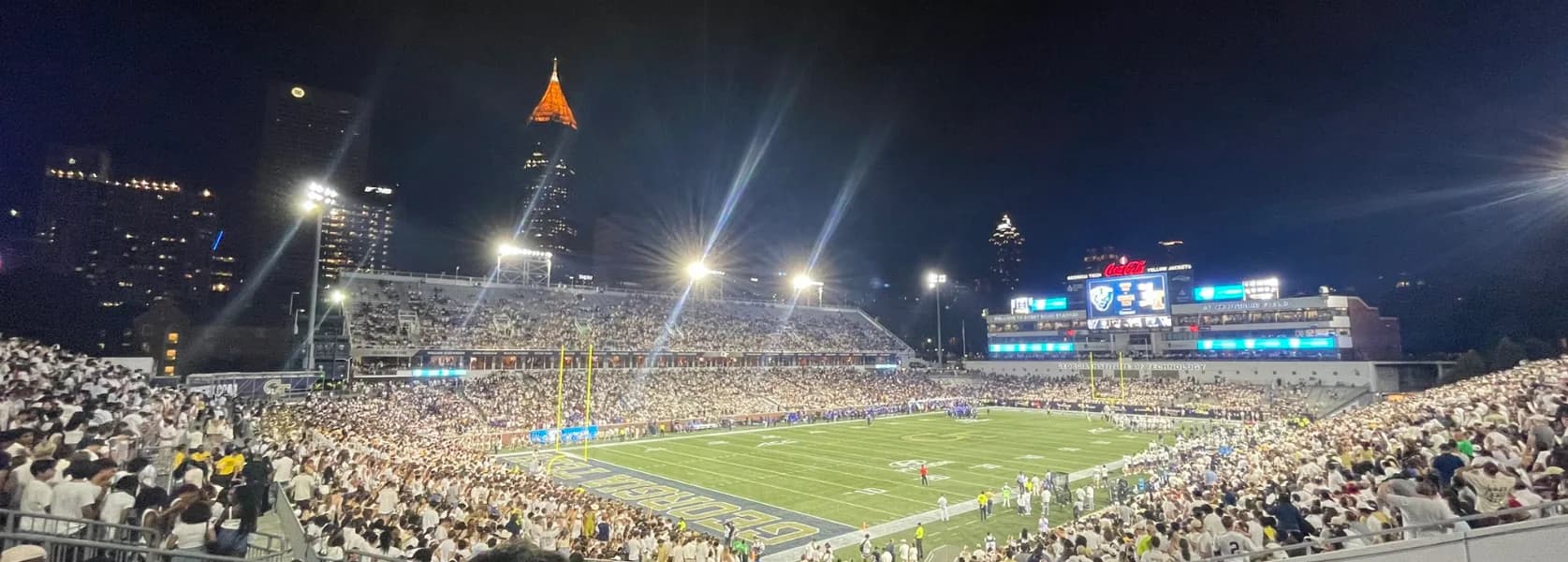
Photo: WhoIsDanielHord · CC BY-SA 4.0 · Cropped for display
Up next · Week 9
Away
On the road at
Saturday, October 31 · Time TBA
The season, taking shape
Final scores show Georgia Tech first. Oldest to newest.
at StanfordPregame 31–22
Game details vs. Duke
Pregame 25–27
Game details at Virginia Tech
Pregame 26–30
Original full-season forecast
This forecast retains the original probabilities for the full schedule. It does not update with completed results or this week’s forecast.
2026 results
Current record, team efficiency, player production, and verified results from completed games.
Current record
2-52 wins · 5 lossesThrough 7 completed gamesLoading player usage…
2026 season preview
Georgia Tech enters 2026 at a hinge point in Brent Key's tenure. The Yellow Jackets still reflect their coach's preference for size, physicality and strength in the trenches, but continuity will not define this team. With new systems on both sides of the ball and several central 2025 performers gone, the season turns on whether Key's familiar blueprint can steady a roster undergoing substantial change.
George Godsey and Chris Weinke are listed as the offensive coordinators, while Jason Semore takes charge of the defense. Four position coaches are also new following the departures of Buster Faulkner and Blake Gideon. That creates a broad installation challenge: terminology, assignments and communication must come together at the same time that new players are assuming important roles. Key has responded in character, adding bigger linemen, experienced tight ends and enough running-back depth to keep the offense from resting entirely on its quarterback.
Original season forecast
The original ACC forecast, retained alongside current results.
ACC projected standing
#9
5-3 projected · 4.5 expected conference wins · #9 of 17.
Preseason baseline
2025 percentiles retained as preseason context; current results and player production lead this page.
2025 FBS percentile scale · 50 is average
Incoming class
National and conference recruiting ranks, confirmed commitments, and the highest-ranked recruits in this class.
Top committed recruits
Georgia Tech2026 transfer movement
Incoming and outgoing transfer activity, with rated FBS-to-FBS moves below.
Incoming Transfers
Georgia TechOutgoing Transfers
Georgia TechSeason schedule
Completed games show final results. Upcoming games use this week’s forecast where available; later games retain their published season outlook.
Detailed football intelligence
The full team identity, offense, defense, and supporting evidence.
Team identity
Last season, Georgia Tech tried to lean on the running game; the approach consistently kept the offense on schedule.
Why it matters
Neither offensive unit clearly carried the other, so first-down execution decides whether Georgia Tech can stay on plan.
 vs. Boston College
Pregame 31–22
Game detailsPregame comparisons use preserved published forecasts. Results include wins and losses.
At a glance
Current form leads the outlook.
2026 rates aggregate verified completed-game box scores. EPA is expected points added per play.
| Player | C/ATT | YDS | TD | INT |
|---|---|---|---|---|
| Alberto Mendoza | 153/215 | 1714 | 10 | 6 |
| Grady Adamson | 7/10 | 73 | 1 | 0 |
| Player | CAR | YDS | AVG | TD |
|---|---|---|---|---|
| Justice Haynes | 101 | 515 | 5.1 | 4 |
| Trelain Maddox | 44 | 279 | 6.3 | 5 |
| Malachi Hosley | 16 | 61 | 3.8 | 0 |
| Player | REC | YDS | AVG | TD |
|---|---|---|---|---|
| Jordan Allen | 42 | 517 | 12.3 | 1 |
| Dalen Penson | 27 | 428 | 15.9 | 2 |
| Kevin Roche Jr. | 29 | 273 | 9.4 | 1 |
| Player | TOT | SOLO | TFL | SACK |
|---|---|---|---|---|
| Tae Harris | 45 | 26 | 1.5 | 0 |
| Taje Mccoy | 39 | 19 | 5 | 2 |
| Tawfiq Thomas | 37 | 19 | 7.5 | 2.5 |
Saturday, October 24 · Bobby Dodd Stadium
Saturday, October 17 · Lane Stadium
Saturday, October 10 · Bobby Dodd Stadium
Indiana transfer Alberto Mendoza is the leading candidate for that job. Key identified him as the leader after the spring game and later praised his processing, accuracy and ability to adjust plays. Those traits fit the demands of a new offense, but Mendoza still faces a large transition as the apparent successor to Haynes King. Behind him, Jackson Caudell identified Grady Adamson and Graham Knowles as the likely contenders for the No. 2 role, with Cole Bergeron viewed as developmental. Neither backup candidate brings an established FBS starting résumé.
The running game offers Mendoza his clearest support. Key has described Justice Haynes, Malachi Hosley and the rest of the room as complementary options capable of sharing the burden. Haynes brings the highest established production after rushing for 857 yards and 10 touchdowns at Michigan in 2025, but a foot injury interrupted that season and his current readiness for a full workload has not been publicly established. Until it is, Georgia Tech's depth matters as much as Haynes' considerable upside.
The passing game is being rebuilt around larger targets. Isaiah Fuhrmann, listed at 6-foot-4, arrives after producing 907 receiving yards and nine touchdowns at Elon in 2025, while 6-foot-3 Jaiven Plummer transfers from California. Their size and experience could give Mendoza a useful margin for error, but neither a starting rotation nor their transition to ACC competition is settled. At tight end, veterans Chris Corbo, Gavin Harris and Spencer Mermans give Godsey options in protection, run formations and the intermediate passing game without requiring one player to fill every role.
Up front, the additions of Favour Edwin, Joseph Ionata and Markell Samuel reinforce the physical profile Key wants; all three are listed at 305 pounds or more. Size alone will not replace All-American guard Keylan Rutledge, however. Edwin had not appeared in a college game through 2025, and the first-team combination remains unclear. For an offense breaking in a new quarterback and new system, the line's cohesion may matter more than the dimensions of any individual newcomer.
The same theme extends to Semore's defense. Georgia Tech added tackles Vincent Carroll-Jackson, Tim Griffin and Tawfiq Thomas, along with ends Noah Carter, Taje McCoy and Jordan Walker, in an effort to strengthen the front after losing Jordan van den Berg and other veterans. Carroll-Jackson brings the clearest cited experience after starting 11 games for UConn in 2025. The reinforcements give Semore options, but their specific roles and the front's ability to improve against the run remain open questions. At linebacker, AJC beat reporting identified Tah'j Butler as the most significant defensive transfer loss, leaving production and communication duties to be reassigned.
The secondary offers a more encouraging starting point. Key said in July that its depth was the best of his four-year tenure and that the staff intended to prepare eight defensive backs for game use instead of relying on five. A larger rotation could help absorb the losses of Ahmari Harvey, Clayton Powell-Lee and other experienced defensive backs, though it does not guarantee the new combinations will match their performance. On special teams, Aidan Birr is the clearest established piece after receiving third-team preseason recognition from Athlon and Phil Steele; long snapping and punting include newcomers Cal Keeler and Jonathan Genty.
The schedule gives Georgia Tech some time at home but not a quiet opening. Colorado, Tennessee and Mercer are set to visit Bobby Dodd Stadium before the Yellow Jackets travel to Stanford. That sequence lets a changing team begin with three home games, yet Tennessee arrives early enough to test whether the offensive line, quarterback and defensive communication have progressed beyond installation.
The later road slate applies a different kind of pressure. Trips to Virginia Tech, Pittsburgh, Clemson and Georgia will force Georgia Tech to carry its new systems into demanding environments. That stretch makes the staff's pursuit of depth especially consequential: an eight-player secondary rotation, multiple running backs and a larger defensive front only become advantages if the underlying roles are dependable by the second half of the season.
Georgia Tech's case for 2026 rests less on a single star than on whether Key can make several moving parts fit his established identity. Mendoza's transition is central, but so are Haynes' availability, the offensive line's cohesion, the receivers' adjustment, the front seven's communication and the secondary's promised depth. There are plausible answers in each room, not proven ones. That makes 2026 a test of Key's foundation rather than a season that can responsibly be reduced to a win prediction.
This preview is based on the linked public reporting and official program records.
Profile high point
Passing held the profile's highest percentile position.Profile low point
Big-play creation held the lowest percentile position among the profile's strength measures.




The passing game is what Georgia Tech can trust most.
Why it matters
The opening plan has its best answer when opponents crowd the box or force obvious throwing situations; explosive-play creation remains the first counter an opponent should test.
Big-play creation is Georgia Tech's biggest concern, and opponents can test it immediately.
Why it matters
Opponents can squeeze underneath space and make the offense finish long drives without chunk gains; passing efficiency has to keep that stress from setting the game plan.
Georgia Tech's best path is to lean on the running game, then keep both the pass and run available because neither part of the offense has to carry the plan alone; an average pace puts more weight on winning ordinary downs.
What matters
Georgia Tech's run-leaning structure played at a balanced pace. Passing finished top-tier and rushing finished top-tier, without a clear split between them.
Inside the team
Open a section for the football detail and supporting numbers.
The down-to-down question that determines whether the offense can keep both the run and pass available.
Opponents have to win first down before Georgia Tech can keep both answers available.
What matters
Neither the pass nor run separated enough to become the only priority, so first-down execution is the real target.
The pace, play selection, and methods this offense uses to stay on schedule.
Georgia Tech played at a balanced pace in 2025.
Why it matters
At that pace, Georgia Tech cannot count on extra possessions or expect to shorten the game.
Georgia Tech's prior passing record was top-tier.
Why it matters
A repeatable pass game can let Georgia Tech punish loaded boxes without relying on low-frequency deep completions.
Why it matters
A sustainable run game keeps Georgia Tech's play action credible and limits obvious passing situations.
Georgia Tech's explosive-play results were mixed rather than a defining edge.
Why it matters
A big play can still flip a possession, but last season's results do not make explosiveness something this team can rely on.
How consistently the offense creates manageable situations and the defense prevents them.
Georgia Tech's offense was more consistent down to down than its defense.
Why it matters
Georgia Tech's success rate shows whether it can sustain drives and get stops without relying on sacks, turnovers, or isolated big plays.
Georgia Tech's opponent-adjusted passing and rushing value were closely matched.
Why it matters
When the split is narrow, early-down execution matters more than steering the offense toward one obvious weakness.
Where the defense can create pressure, control the run, and end drives.
Georgia Tech's prior defense was weak overall and strongest in run front.
Why it matters
Opponents can trust normal protection and make coverage hold through the route; Georgia Tech needs its run front to create long-yardage without overloading the box before that plan settles in.
Georgia Tech's available disruption measures ranked in the lower national range last season; a charted pressure rate is not available.
Georgia Tech's sack production outpaced its broader disruption record.
Why it matters
Georgia Tech's disruption can hurry an offense; sacks do more by erasing field position and ending passing downs.
Georgia Tech's prior run-defense results were below-average.
Why it matters
If Georgia Tech's front cannot control early downs, opponents can keep every offensive option open and protect their passing game.