
Week 4 · FinalW
 vs. Oklahoma
41–13+28 margin
Pregame 29–19
Game detailsSaturday Index
Loading team intelligenceBringing the latest verified football information into focus.
SEC · 2026 · Week 8

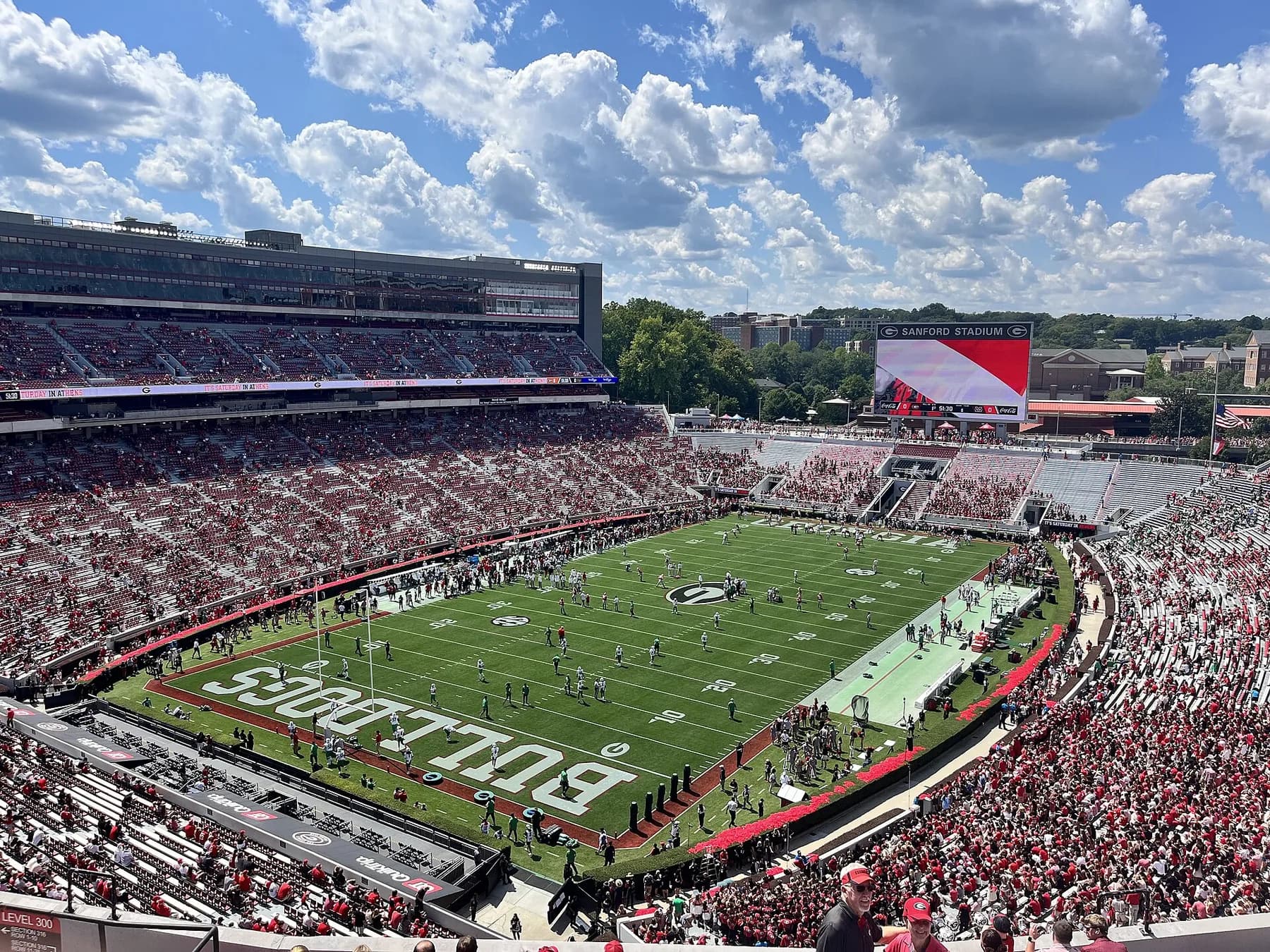
Photo: TarheelBornBred · CC0 1.0 · Cropped for display
Up next · Week 9
Neutral site
Neutral site vs.
Saturday, October 31 · 3:30 PM EDT
The season, taking shape
Final scores show Georgia first. Oldest to newest.
vs. OklahomaPregame 29–19
Game details vs. Vanderbilt
Pregame 34–17
Game details at Alabama
Pregame 25–28
Original full-season forecast
This forecast retains the original probabilities for the full schedule. It does not update with completed results or this week’s forecast.
2026 results
Current record, team efficiency, player production, and verified results from completed games.
Current record
6-16 wins · 1 lossThrough 7 completed gamesLoading player usage…
2026 season preview
Georgia enters 2026 carrying two realities at once. SEC Media Days voters picked the Bulldogs to finish first in the conference, gave them a league-high 87 championship votes and selected 12 Georgia players across the three preseason All-SEC teams. Kirby Smart, meanwhile, said this team entered spring with the fewest returning starters of his tenure. The central question is not whether Georgia has decorated players; it is how quickly a less experienced supporting cast can become dependable around them.
Smart remains the program's defining figure, with Mike Bobo coordinating the offense and Glenn Schumann and Travaris Robinson leading the defense. The coordinator structure offers continuity, but several position rooms have new direction. Phil Rauscher is coaching the offensive line, Josh Crawford the running backs and Kirk Benedict the special teams. Their influence could be most visible in technique, rotation choices and the development of roles that were not settled in spring.
Original season forecast
The original SEC forecast, retained alongside current results.
SEC projected standing
#1
7-2 projected · 6.4 expected conference wins · conference favorite.
Preseason baseline
2025 percentiles retained as preseason context; current results and player production lead this page.
2025 FBS percentile scale · 50 is average
Incoming class
National and conference recruiting ranks, confirmed commitments, and the highest-ranked recruits in this class.
Top committed recruits
Georgia2026 transfer movement
Incoming and outgoing transfer activity, with rated FBS-to-FBS moves below.
Incoming Transfers
GeorgiaOutgoing Transfers
GeorgiaSeason schedule
Completed games show final results. Upcoming games use this week’s forecast where available; later games retain their published season outlook.
Detailed football intelligence
The full team identity, offense, defense, and supporting evidence.
Team identity
Last season, Georgia tried to lean on the running game; the approach consistently kept the offense on schedule.
Why it matters
The passing game was Georgia's more dependable way to stay ahead of the chains; opponents have to interrupt that rhythm without giving the run an easy box.
 vs. Auburn
Pregame 36–16
Game detailsPregame comparisons use preserved published forecasts. Results include wins and losses.
At a glance
Current form leads the outlook.
2026 rates aggregate verified completed-game box scores. EPA is expected points added per play.
| Player | C/ATT | YDS | TD | INT |
|---|---|---|---|---|
| Gunner Stockton | 117/158 | 1570 | 16 | 4 |
| Ryan Puglisi | 19/30 | 246 | 2 | 0 |
| Ryan Montgomery | 3/6 | 66 | 1 | 0 |
| Player | CAR | YDS | AVG | TD |
|---|---|---|---|---|
| Dwight Phillips Jr. | 47 | 348 | 7.4 | 2 |
| Nate Frazier | 35 | 230 | 6.6 | 5 |
| Bo Walker | 29 | 198 | 6.8 | 0 |
| Player | REC | YDS | AVG | TD |
|---|---|---|---|---|
| Craig Dandridge | 17 | 310 | 18.2 | 1 |
| Talyn Taylor | 19 | 283 | 14.9 | 3 |
| Lawson Luckie | 11 | 184 | 16.7 | 2 |
| Player | TOT | SOLO | TFL | SACK |
|---|---|---|---|---|
| Raylen Wilson | 43 | 27 | 6 | 4 |
| Chris Cole | 40 | 27 | 8 | 2.5 |
| Rasean Dinkins | 30 | 20 | 0 | 0 |
Saturday, October 17 · Sanford Stadium
Saturday, October 10 · Bryant-Denny Stadium
Saturday, October 3 · Sanford Stadium
Gunner Stockton gives Georgia returning experience at quarterback. The redshirt senior finished seventh in 2025 Heisman voting, according to Mike Griffith's SEC Media Days account, and received preseason third-team All-SEC recognition. His experience matters because the receiving group has changed substantially. Georgia's passing-game ceiling could depend less on Stockton learning the offense than on new targets separating themselves and developing timing with him.
Running back Nate Frazier and tight end Lawson Luckie, both preseason second-team All-SEC selections, offer established options while the receiver rotation takes shape. Frazier could support early-down stability, and Luckie gives Stockton a potential middle-of-field target. Behind Stockton, Smart said Ryan Montgomery showed improved mobility after shedding his knee brace, along with accuracy and sound decisions in spring. Freshman Bryson Beaver was receiving developmental work while adjusting to the speed and information demands of college football. Those spring comments did not establish a final backup order.
The offensive line presents a similar blend of individual recognition and collective uncertainty. Tackle Earnest Greene III and center Drew Bobo made the preseason All-SEC first team, while Dontrell Glover made the second team. Smart nevertheless described real spring competition, including returning starters being pushed. The important camp question is how those pieces fit under Rauscher, both in the first five and in a possible seven- or eight-man rotation. Until that combination emerges, honors alone do not establish cohesion.
The clearest concentration of defensive recognition is in the secondary. Cornerback Ellis Robinson IV and safety KJ Bolden received first-team preseason All-SEC honors, and transfer safety Khalil Barnes made the third team. Smart praised Robinson's cover and ball skills while also emphasizing discipline within the called defense. That distinction matters for a younger unit: the back end has playmaking ability, but its value could depend on communication and consistent execution.
Inside linebacker Raylen Wilson occupies a central role in that communication. Smart identified him as a returning leader expected to take on greater responsibility after CJ Allen's NFL departure, with Justin Williams and Chris Cole alongside him. Sophomore defensive lineman Elijah Griffin, a preseason second-team All-SEC selection, gives the front an interior building block. The larger uncertainty sits on the edge. According to Connor Riley, Auburn transfer Amaris Williams tore an ACL in one of Georgia's final spring practices, increasing the development burden on Chase Linton, Isaiah Gibson and others.
Health and availability require restraint beyond that confirmed injury. Smart said Drew Bobo, Jordan Hall, Gabe Harris Jr., Carter Luckie and Zayden Walker were expected to miss most or all of spring, while Kyron Jones was managing an ankle injury. Those spring descriptions do not establish their August condition or Week 1 availability, and no return timetable for Amaris Williams was stated. Georgia also had not publicly settled its first-unit kicker, punter and returner roles, leaving special teams as another meaningful unknown.
The schedule offers only a brief opening stretch before conference pressure rises. Home games against Tennessee State and Western Kentucky could provide opportunities to organize rotations and give developing players meaningful work. Georgia then opens SEC play at Arkansas, hosts Oklahoma and visits Alabama for a night game. That three-game sequence could test whether the receivers have developed around Stockton, whether the offensive line is communicating cleanly and whether the defense can create pressure from the edge.
The pressure does not end there. Florida awaits at Mercedes-Benz Stadium, while later road trips to Ole Miss and South Carolina surround a home game against Missouri before Georgia Tech visits Athens. Those games place different demands on a roster still establishing depth. The unresolved special-teams roles could also matter more once conference games narrow the margin for error.
Georgia has experienced centerpieces in Stockton, Frazier and Luckie, decorated linemen and a defensive spine led by Griffin, Wilson, Robinson and Bolden. Smart's challenge is connecting those strengths before the schedule compresses the time available for experimentation. If the receiving group develops, the line finds cohesion and the edge rotation produces reliable pressure, Georgia could resemble the conference favorite selected by SEC media. Until those roles and health questions become clearer, that is a plausible path rather than a settled outcome.
This preview is based on the linked public reporting and official program records.
Profile high point
Big-play prevention held the profile's highest percentile position.Profile low point
Big-play creation held the lowest percentile position among the profile's strength measures.




The offense's down-to-down consistency is what Georgia can trust most.
What matters
Georgia's offensive efficiency ranked among the best in the country last season.
Big-play creation is Georgia's biggest concern, and opponents can test it immediately.
Why it matters
Opponents can squeeze underneath space and make the offense finish long drives without chunk gains; offensive efficiency has to keep that stress from setting the game plan.
For Georgia, the cleanest script is to lean on the running game, then let the passing game finish drives; an average pace puts more weight on winning ordinary downs.
What matters
Georgia's run-first structure played at a balanced pace. The pass game finished top-tier, while the run game finished strong.
Inside the team
Open a section for the football detail and supporting numbers.
The down-to-down question that determines whether the offense can keep both the run and pass available.
Opponents have to break Georgia's passing rhythm before it owns early downs.
Why it matters
If Georgia keeps finding routine completions, the defense cannot load the box or turn the rush loose.
The pace, play selection, and methods this offense uses to stay on schedule.
Georgia played at a balanced pace in 2025.
Why it matters
At that pace, Georgia cannot count on extra possessions or expect to shorten the game.
Georgia's prior passing record was top-tier.
Why it matters
A repeatable pass game can let Georgia punish loaded boxes without relying on low-frequency deep completions.
Georgia's prior rushing record was strong.
Why it matters
A sustainable run game keeps Georgia's play action credible and limits obvious passing situations.
Georgia was better at preventing explosive plays than creating them.
Why it matters
The defense can keep a game on schedule, but the offense may need longer drives and more third-down conversions to separate.
How consistently the offense creates manageable situations and the defense prevents them.
Georgia won ordinary downs on both sides of the ball.
Why it matters
Georgia's success rate shows whether it can sustain drives and get stops without relying on sacks, turnovers, or isolated big plays.
Opponent-adjusted EPA identifies the pass game as Georgia's stronger offensive unit.
Why it matters
If an opponent removes the first passing answer, the run game's lower adjusted value becomes the key counter to test.
Where the defense can create pressure, control the run, and end drives.
Georgia's prior defense was above-average overall and strongest in run front.
Why it matters
Opponents can trust normal protection and make coverage hold through the route; Georgia needs its run front to create long-yardage without overloading the box before that plan settles in.
Georgia's available disruption measures ranked in the lower national range last season; a charted pressure rate is not available.
Why it matters
Without consistent disruption, Georgia's defense must win more snaps through coverage, leverage, and early-down prevention.
Georgia's sack and disruption results were weak.
Why it matters
Georgia's disruption can hurry an offense; sacks do more by erasing field position and ending passing downs.
Georgia's prior run-defense results were top-tier.
Why it matters
A dependable run front can let Georgia create obvious passing downs without committing extra bodies to the box.