Week 3 · FinalL
 at Alabama
36–50-14 margin
Pregame comparison unavailable
Game detailsSaturday Index
Loading team intelligenceBringing the latest verified football information into focus.
ACC · 2026 · Week 8
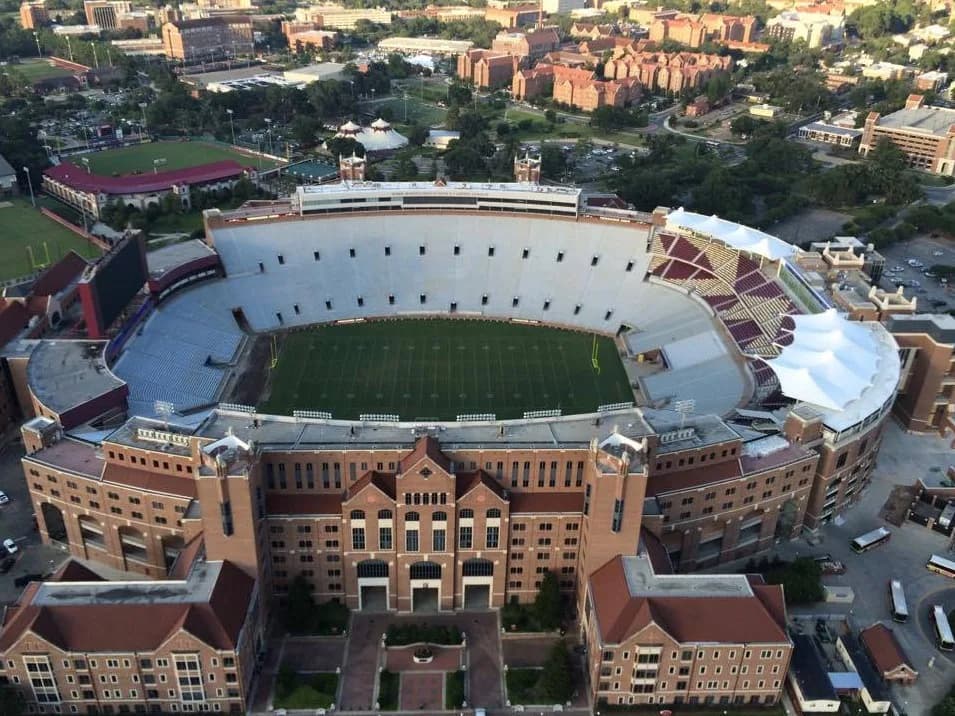
Photo: SeminoleNation · CC BY-SA 4.0 · Cropped for display
Up next · Week 9
Home
Hosting
Saturday, October 31 · Time TBA
The season, taking shape
Final scores show Florida State first. Oldest to newest.
at AlabamaPregame comparison unavailable
Game details vs. Virginia
Pregame 26–27
Game details at Louisville
Pregame 27–30
Game detailsOriginal full-season forecast
This forecast retains the original probabilities for the full schedule. It does not update with completed results or this week’s forecast.
2026 results
Current record, team efficiency, player production, and verified results from completed games.
Current record
3-43 wins · 4 lossesThrough 7 completed gamesLoading player usage…
2026 season preview
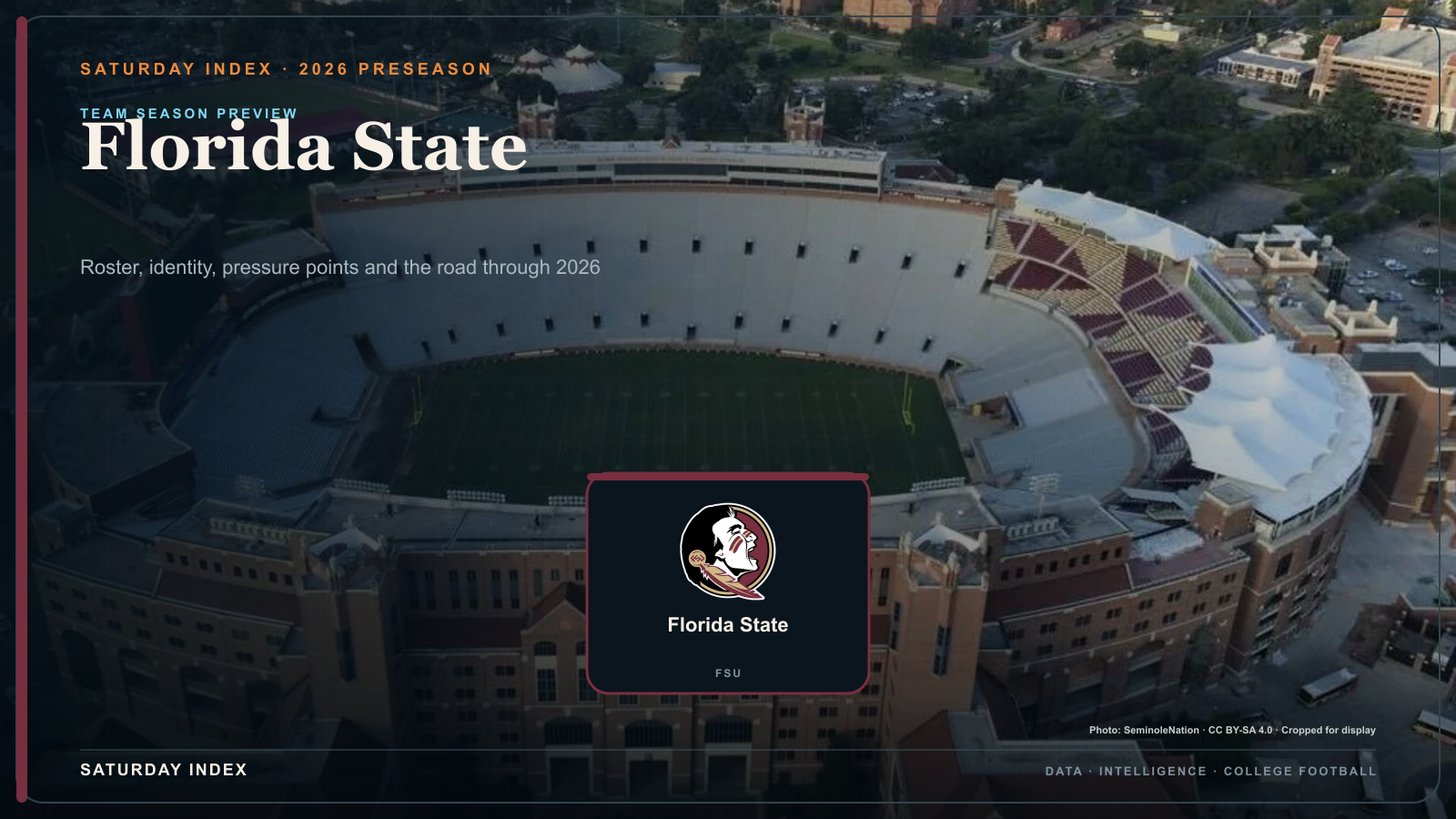
The mandate Florida State's 2026 season is not another exercise in selling a reset. It is a test of whether Mike Norvell can turn sweeping reconstruction into stable football quickly enough to change the program's direction. According to Warchant, Florida State retained Norvell after a 5-6 start and 17 losses in 24 games, with university leadership calling for fundamental performance changes. Every promising piece on this roster therefore carries an immediate standard: it must help produce dependable Saturdays.
The scale of the rebuild is unmistakable. Florida State's spring notes listed 50 newcomers—24 true freshmen and 26 transfers—and credited its 23 NCAA transfers with 586 career games and 279 starts. That experience matters only if it becomes coordination. Tim Harris Jr. moves into the offensive coordinator role while continuing to coach receivers, while Tony White returns for a second season overseeing the defense and its 3-3-5. The offense has new leadership; the defense has schematic continuity but extensive personnel change.
Original season forecast
The original ACC forecast, retained alongside current results.
ACC projected standing
#12
3-5 projected · 3.4 expected conference wins · #12 of 17.
Preseason baseline
2025 percentiles retained as preseason context; current results and player production lead this page.
2025 FBS percentile scale · 50 is average
Incoming class
National and conference recruiting ranks, confirmed commitments, and the highest-ranked recruits in this class.
Top committed recruits
Florida State2026 transfer movement
Incoming and outgoing transfer activity, with rated FBS-to-FBS moves below.
Incoming Transfers
Florida StateOutgoing Transfers
Florida StateSeason schedule
Completed games show final results. Upcoming games use this week’s forecast where available; later games retain their published season outlook.
Detailed football intelligence
The full team identity, offense, defense, and supporting evidence.
Team identity
Last season, Florida State tried to lean on the running game; the approach consistently kept the offense on schedule.
Why it matters
The run game was Florida State's steadier way to stay ahead of the chains; opponents have to win early fits without handing away play action.
 at Miami
Pregame 17–38
Game detailsPregame comparisons use preserved published forecasts. Results include wins and losses.
At a glance
Current form leads the outlook.
2026 rates aggregate verified completed-game box scores. EPA is expected points added per play.
| Player | C/ATT | YDS | TD | INT |
|---|---|---|---|---|
| Ashton Daniels | 93/162 | 1392 | 10 | 7 |
| Kevin Sperry | 1/3 | 7 | 0 | 0 |
| Player | CAR | YDS | AVG | TD |
|---|---|---|---|---|
| Ousmane Kromah | 103 | 527 | 5.1 | 3 |
| Ashton Daniels | 75 | 314 | 4.2 | 11 |
| Tre Wisner | 30 | 163 | 5.4 | 0 |
| Player | REC | YDS | AVG | TD |
|---|---|---|---|---|
| Duce Robinson | 20 | 356 | 17.8 | 3 |
| Micahi Danzy | 17 | 278 | 16.4 | 2 |
| Jayvan Boggs | 13 | 228 | 17.5 | 0 |
| Player | TOT | SOLO | TFL | SACK |
|---|---|---|---|---|
| Chris Jones | 34 | 19 | 3 | 1.5 |
| Ashlynd Barker | 30 | 13 | 0 | 0 |
| CJ Richard Jr. | 26 | 14 | 0 | 0 |
Saturday, October 17 · Hard Rock Stadium
Friday, October 9 · L&N Federal Credit Union Stadium
Saturday, October 3 · Doak Campbell Stadium
Daniels and the offense Harris begins with a settled quarterback. NoleGameday identified Auburn transfer Ashton Daniels as the winner of the job after spring. Daniels brings 37 career appearances, 4,783 passing yards and 1,397 rushing yards from Stanford and Auburn, giving Florida State an experienced dual-threat starter. Instead of spending the preseason on an extended QB1 contest, the offense can concentrate on Daniels' command, protection calls and timing with his receivers.
The depth behind him is less settled. Kevin Sperry entered camp favored for QB2, with junior-college transfer Malachi Marshall providing the principal challenge. Neither has established Power Four production, so the competition matters both as immediate insurance and as an early look at Florida State's options beyond Daniels.
Daniels also inherits the roster's clearest established strength. Tomahawk Nation identified receiver as Florida State's best-known asset, led by Duce Robinson after 56 catches for 1,081 yards and six touchdowns in 2025. Robinson gives Daniels a proven vertical and contested-catch target. Florida State did not add a transfer receiver, a choice that suggests confidence in Micahi Danzy, Jayvan Boggs, Devin Carter and the room's development. Daniels and Robinson also joined cornerback Ja'Bril Rawls as the team's representatives at ACC Kickoff.
The backfield has a more basic assignment: keep difficult downs from depending entirely on Daniels' legs or Robinson's ability to win downfield. Florida State replaces its top two rushers from 2025, with Texas transfer Tre Wisner and sophomore Ousmane Kromah positioned as the primary pairing. Kromah produced 408 yards at 5.7 per carry as a freshman. If that duo can supply dependable inside and red-zone production, Harris will have more ways to keep the offense on schedule.
Everything depends on a new offensive line making those pieces functional. Florida State is replacing all five starters, with Auburn transfer Xavier Chaplin the clearest expected fixture at left tackle and the three interior jobs still unsettled entering the preseason. Daniels' mobility can rescue some broken plays, but it cannot substitute for protection chemistry or short-yardage movement. No position group has more influence over whether the offense becomes steady rather than merely dangerous in flashes.
White's defensive rebuild The defense's best starting point is a young front with disruptive potential. NoleGameday identified sophomore Darryll Desir as a focal point after an All-America freshman season, with Rylan Kennedy and Mandrell Desir among the major rotation options. If the front can create pressure without constant schematic assistance, White can protect the rebuilt levels behind it. The counter is that opposing protections will enter the season prepared to devote extra attention to Darryll Desir.
Linebacker is central to making White's 3-3-5 work. Florida State reworked the room under Ernie Sims and added Chris Jones and Mikai Gbayor after the 2025 group was repeatedly isolated in coverage and worn down against the run, according to Tomahawk Nation. Better range and disciplined fits would keep backs and interior runs from dictating matchups. If those problems persist, the strain will spread quickly to a secondary already replacing significant experience.
That secondary suffered the defense's greatest offseason attrition. Rawls returns after seven starts in 2025, but the opposite corner and multiple back-end roles still need answers. White's pressure and disguise package asks coverage players to hold up while the rush develops; missed communication can turn an aggressive call into an explosive gain. Rawls gives the unit a key returner, but much of the group must establish its reliability together.
Availability adds another qualification. Rawls' 2025 season ended because of injury, Quindarrius Jones missed the final seven games, Deamontae Diggs is returning from a season-ending neck injury and Jaden LaVallee remained limited in spring, according to NoleGameday. There is not yet a definitive opening-camp clearance list for those players, so their Week 1 availability and roles should not be assumed.
Where the schedule tightens Florida State opens at home against New Mexico State on August 29, then hosts SMU nine days later on Labor Day. After its first open date, it visits Alabama. That sequence gives a roster with 50 newcomers little time to settle before two more demanding checkpoints. Another concentrated test arrives in October with consecutive trips to Louisville and Miami, followed later by home games against Clemson and Florida.
The case for Florida State begins with Daniels, Robinson and a defensive front capable of disruption. The concern begins with five new offensive-line starters and rebuilt second and third levels on defense. That tension defines Norvell's evaluation year: Florida State has added experience and settled its most important position, but the season will turn on how quickly a heavily changed roster learns to play like a coherent team.
This preview is based on the linked public reporting and official program records.
Profile high point
The run game held the profile's highest percentile position.Profile low point
Down-to-down defense held the lowest percentile position among the profile's strength measures.


The run game is what Florida State can trust most.
Why it matters
The offense has its best route to favorable third downs and a credible play-action menu; defensive control remains the first counter an opponent should test.
Florida State did not show one unit opponents could treat as an automatic target; the defense's control of ordinary downs is only the first place to look.
What matters
Florida State's lowest-rated unit still finished near the national middle last season, so opponents do not have an obvious weakness to attack.
For Florida State, the cleanest script is to use the running game to control early downs and finish drives; an average pace puts more weight on winning ordinary downs.
What matters
Florida State's run-first structure played at a balanced pace. The run game finished top-tier, while the pass game finished middle-of-the-pack.
Inside the team
Open a section for the football detail and supporting numbers.
The down-to-down question that determines whether the offense can keep both the run and pass available.
Opponents have to keep Florida State's run game from turning first down into second-and-manageable.
What matters
Early run success keeps play action alive and prevents the defense from dictating obvious passing downs.
The pace, play selection, and methods this offense uses to stay on schedule.
Florida State played at a balanced pace in 2025.
Why it matters
At that pace, Florida State cannot count on extra possessions or expect to shorten the game.
Florida State's prior passing record was middle-of-the-pack.
Why it matters
Florida State's offense needs protection, field position, or explosive variance when ordinary dropbacks do not create enough value.
Florida State's prior rushing record was top-tier.
Why it matters
A sustainable run game keeps Florida State's play action credible and limits obvious passing situations.
Florida State both created and limited explosive plays at a strong prior-season level.
Why it matters
That combination can change a game without forcing the offense to trade efficiency for low-percentage shots.
How consistently the offense creates manageable situations and the defense prevents them.
Florida State's offense was more consistent down to down than its defense.
Why it matters
Florida State's success rate shows whether it can sustain drives and get stops without relying on sacks, turnovers, or isolated big plays.
Opponent-adjusted EPA identifies the run game as Florida State's stronger offensive unit.
Why it matters
Forcing longer passing situations is the clearest way to move the offense away from its stronger adjusted unit.
Where the defense can create pressure, control the run, and end drives.
Florida State's prior defense was middle-of-the-pack overall and strongest in disruption.
What matters
Disruption finished above-average, while run front finished below-average; the latter is the first place an offense should test.
Florida State's available disruption measures finished above the national average last season; a charted pressure rate is not available.
Why it matters
Sustained disruption can create negative plays and give Florida State a better chance to end drives before third down.
Florida State's disruption regularly finished at the quarterback.
What matters
Both sack production and front-seven disruption cleared the FBS midpoint.
Florida State's prior run-defense results were below-average.
Why it matters
If Florida State's front cannot control early downs, opponents can keep every offensive option open and protect their passing game.