
Week 4 · FinalW
 vs. Ole Miss
52–28+24 margin
Pregame 25–30
Game detailsSaturday Index
Loading team intelligenceBringing the latest verified football information into focus.
SEC · 2026 · Week 8
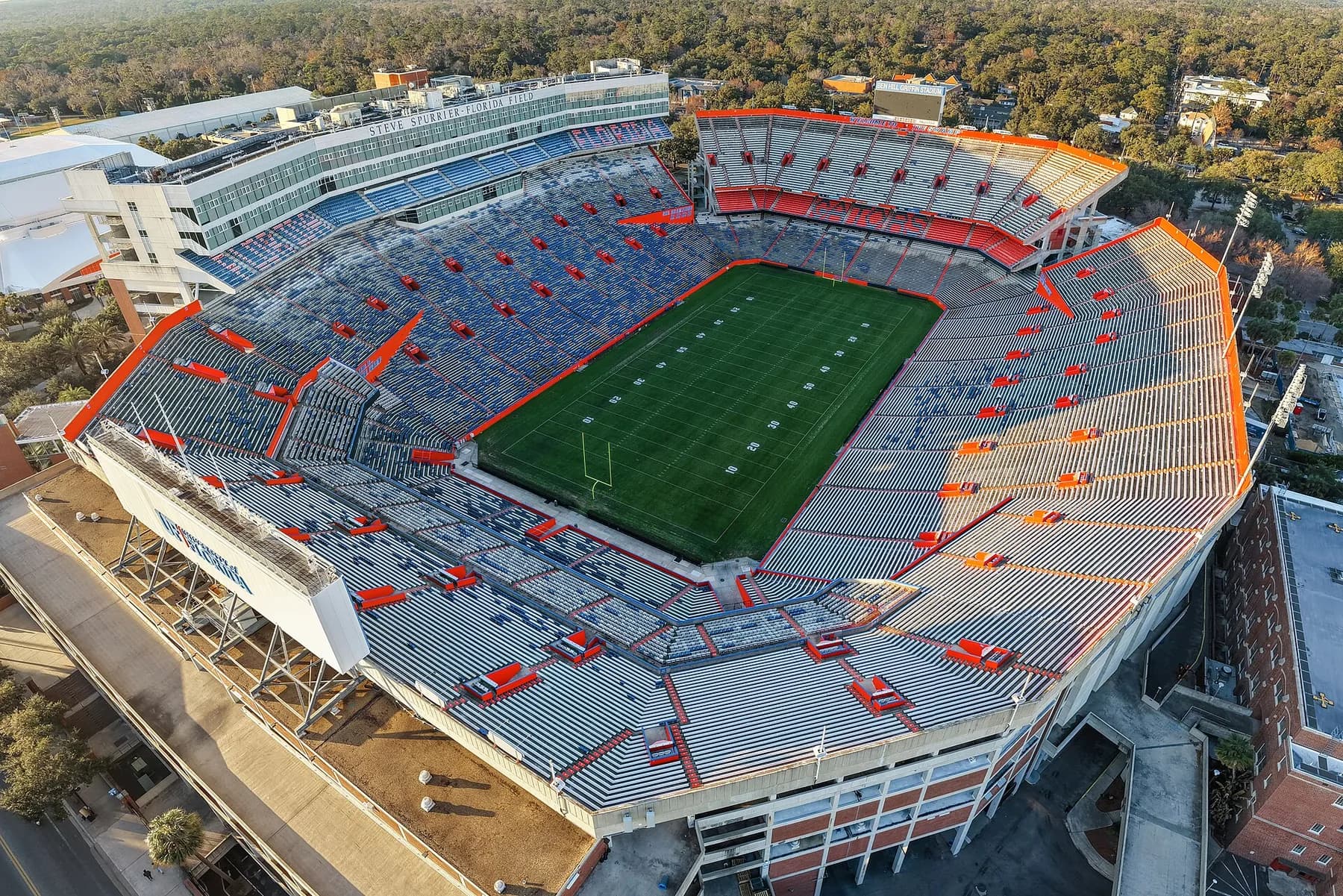
Photo: Quintin Soloviev · CC BY 4.0 · Cropped for display
Up next · Week 9
Neutral site
Neutral site vs.
Saturday, October 31 · 3:30 PM EDT
The season, taking shape
Final scores show Florida first. Oldest to newest.
vs. Ole MissPregame 25–30
Game details at Missouri
Pregame 26–27
Game details vs. South Carolina
Pregame 29–27
Original full-season forecast
This forecast retains the original probabilities for the full schedule. It does not update with completed results or this week’s forecast.
2026 results
Current record, team efficiency, player production, and verified results from completed games.
Current record
5-25 wins · 2 lossesThrough 7 completed gamesLoading player usage…
2026 season preview
Florida has proven building blocks, but its first season under Jon Sumrall will hinge on quarterback separation, offensive-line cohesion and the rapid integration of a dramatically changed roster.
Florida enters 2026 in the kind of transition that can reveal progress without producing immediate consistency. First-year head coach Jon Sumrall inherits a program that went 23-27 over its previous 50 games, and he has framed the job as restoring championship standards. With Buster Faulkner directing the offense and Brad White the defense, Florida must install new systems while deciding which players can be trusted in the moments that define SEC games.
Original season forecast
The original SEC forecast, retained alongside current results.
SEC projected standing
#13
3-6 projected · 3.5 expected conference wins · #13 of 16.
Preseason baseline
2025 percentiles retained as preseason context; current results and player production lead this page.
2025 FBS percentile scale · 50 is average
Incoming class
National and conference recruiting ranks, confirmed commitments, and the highest-ranked recruits in this class.
Top committed recruits
Florida2026 transfer movement
Incoming and outgoing transfer activity, with rated FBS-to-FBS moves below.
Incoming Transfers
FloridaOutgoing Transfers
FloridaSeason schedule
Completed games show final results. Upcoming games use this week’s forecast where available; later games retain their published season outlook.
Detailed football intelligence
The full team identity, offense, defense, and supporting evidence.
Team identity
Last season, Florida tried to lean on the passing game; too many drives still went off schedule.
Why it matters
The run game was Florida's steadier way to stay ahead of the chains; opponents have to win early fits without handing away play action.
 at Texas
Pregame 19–32
Game detailsPregame comparisons use preserved published forecasts. Results include wins and losses.
At a glance
Current form leads the outlook.
2026 rates aggregate verified completed-game box scores. EPA is expected points added per play.
| Player | C/ATT | YDS | TD | INT |
|---|---|---|---|---|
| Aaron Philo | 105/149 | 1341 | 9 | 3 |
| Tramell Jones Jr. | 45/64 | 407 | 4 | 2 |
| Kahleil Jackson | 1/1 | 48 | 0 | 0 |
| Player | CAR | YDS | AVG | TD |
|---|---|---|---|---|
| Jadan Baugh | 135 | 763 | 5.7 | 13 |
| Duke Clark | 36 | 265 | 7.4 | 3 |
| Aaron Philo | 44 | 104 | 2.4 | 3 |
| Player | REC | YDS | AVG | TD |
|---|---|---|---|---|
| Dallas Wilson | 29 | 403 | 13.9 | 3 |
| Bailey Stockton | 27 | 289 | 10.7 | 2 |
| Vernell Brown III | 17 | 271 | 15.9 | 2 |
| Player | TOT | SOLO | TFL | SACK |
|---|---|---|---|---|
| Myles Graham | 49 | 24 | 4.5 | 3.5 |
| Aaron Chiles | 37 | 16 | 3 | 0 |
| Jayden Woods | 27 | 16 | 7 | 4.5 |
Saturday, October 17 · DKR-Texas Memorial Stadium
Saturday, October 10 · Ben Hill Griffin Stadium
Saturday, October 3 · Memorial Stadium
That challenge extends well beyond a coaching change. Florida announced 50 newcomers in February: 29 four-year transfers, 20 high-school recruits and one junior-college transfer. Sumrall said freshmen and transfers make up more than half the scholarship roster. The overhaul creates room for immediate improvement, but it also makes communication, role clarity and cohesion central to the season. The essential question is how quickly a collection of new and returning players can become a dependable team.
No decision carries more weight than quarterback. Sumrall described Aaron Philo and Tramell Jones Jr. as two starter-level options at SEC Media Days and offered no timetable for naming one. Philo arrived from Georgia Tech with prior familiarity with Faulkner, an advantage that could shorten his adjustment to the offense. Jones offers a different kind of continuity as Florida’s returning quarterback. Neither had publicly separated by late July, leaving leadership, ball security, command and explosive-play creation to determine more than simply who takes the first snap.
Whoever wins the job will have one established ally in running back Jadan Baugh. He rushed for 1,170 yards at better than 5.3 yards per carry in 2025, giving Florida a proven way to stay on schedule and reduce the burden on a new starter. Transfers Micah Mays Jr. and Eric Singleton Jr. also supplied an encouraging spring glimpse, combining for 10 catches, 214 yards and three touchdowns in the Orange & Blue Game. That performance suggested useful receiver depth, although it did not settle their fall roles.
The offensive line remains the room most capable of raising or lowering the entire operation. Sumrall sharply criticized the group after spring, then said in July that its strength and body composition had improved. He credited transfer center Harrison Moore and guard TJ Shanahan Jr. with improving accountability. Those are meaningful summer developments, but they do not yet show whether the rebuilt unit can create lanes for Baugh or protect either quarterback against SEC fronts. Until it does, Florida’s offensive upside will remain conditional.
White’s defense has a sturdier starting point in the front seven. Linebacker Myles Graham returns after leading Florida with 76 tackles in 2025, and his selection as one of the program’s SEC Media Days representatives points to his leadership value during the transition. Retained edge Jayden Woods is another anchor for a group in which Sumrall saw potential after spring. A dependable front would help Florida control early downs and shield a secondary still trying to identify its best combination.
That back end carries both experience and uncertainty. Baylor transfer safety DJ Coleman arrived with 84 career tackles, nine pass breakups and two interceptions, along with a reputation as a vocal presence. He could help organize a remade secondary, but one experienced addition cannot settle every alignment or communication issue. Health also complicates the broader roster picture: Dallas Wilson, Graham and Dijon Johnson were among several players limited during spring. Those spring circumstances do not establish their August participation or opening-week availability.
The schedule gives Sumrall two home games to begin the season, against Florida Atlantic on September 5 and Campbell on September 12, before the pressure rises. Florida visits Auburn on September 19, hosts Ole Miss the next week, then travels to Missouri, hosts South Carolina and visits Texas. Georgia follows on October 31 at Mercedes-Benz Stadium. That sequence rewards a team that resolves its quarterback competition, blocking combinations and defensive communication quickly.
November brings Oklahoma to Gainesville, a trip to Kentucky, a home game against Vanderbilt and the finale at Florida State. Florida has enough established production to give its new staff a foundation: Baugh in the backfield, Graham in the middle of the defense and experienced additions throughout the roster. It does not yet have enough settled answers to support a firm prediction. Sumrall’s first season will be measured by whether those pieces become coherent before the schedule repeatedly tests every unresolved issue.
This preview is based on the linked public reporting and official program records.
Profile high point
The run game held the profile's highest percentile position.Profile low point
Big-play creation held the lowest percentile position among the profile's strength measures.



Florida can lean on the run game when a drive slips off schedule, but big-play creation still needs support.
What matters
Florida's rushing structure ranked in a strong national range last season.
Big-play creation is Florida's biggest concern, and opponents can test it immediately.
Why it matters
Opponents can squeeze underneath space and make the offense finish long drives without chunk gains; rushing structure has to keep that stress from setting the game plan.
For Florida, the cleanest script is to lean on the passing game, then let the run game finish drives; fewer possessions make every empty drive more expensive.
What matters
Florida's pass-leaning structure played at a deliberate pace. The run game finished strong, while the pass game finished bottom-tier.
Inside the team
Open a section for the football detail and supporting numbers.
The down-to-down question that determines whether the offense can keep both the run and pass available.
Opponents have to keep Florida's run game from turning first down into second-and-manageable.
Why it matters
If Florida stays on schedule on the ground, the offense keeps more answers available.
The pace, play selection, and methods this offense uses to stay on schedule.
Florida played at a deliberate pace in 2025.
What matters
Florida worked with fewer possessions than most teams last season.
Florida's prior passing record was bottom-tier.
Why it matters
Florida's offense needs protection, field position, or explosive variance when ordinary dropbacks do not create enough value.
Florida's prior rushing record was strong.
Why it matters
A sustainable run game keeps Florida's play action credible and limits obvious passing situations.
Florida's explosive-play results were mixed rather than a defining edge.
Why it matters
A big play can still flip a possession, but last season's results do not make explosiveness something this team can rely on.
How consistently the offense creates manageable situations and the defense prevents them.
Florida's down-to-down results were below-average overall.
Why it matters
Florida's success rate shows whether it can sustain drives and get stops without relying on sacks, turnovers, or isolated big plays.
Opponent-adjusted EPA identifies the run game as Florida's stronger offensive unit.
Why it matters
Forcing longer passing situations is the clearest way to move the offense away from its stronger adjusted unit.
Where the defense can create pressure, control the run, and end drives.
Florida's prior defense was weak overall and strongest in run front.
Why it matters
Opponents can use efficient throws to stay out of obvious passing downs; Florida needs its run front to create long-yardage without overloading the box before that plan settles in.
Florida's available disruption measures ranked in the lower national range last season; a charted pressure rate is not available.
Why it matters
Without consistent disruption, Florida's defense must win more snaps through coverage, leverage, and early-down prevention.
Florida's sack production outpaced its broader disruption record.
Why it matters
Florida's disruption can hurry an offense; sacks do more by erasing field position and ending passing downs.
Florida's prior run-defense results were above-average.
Why it matters
If Florida's front cannot control early downs, opponents can keep every offensive option open and protect their passing game.