Week 4 · FinalW
vs. William & Mary
62–7+55 margin
Pregame comparison unavailable
Game detailsSaturday Index
Loading team intelligenceBringing the latest verified football information into focus.
ACC · 2026 · Week 8

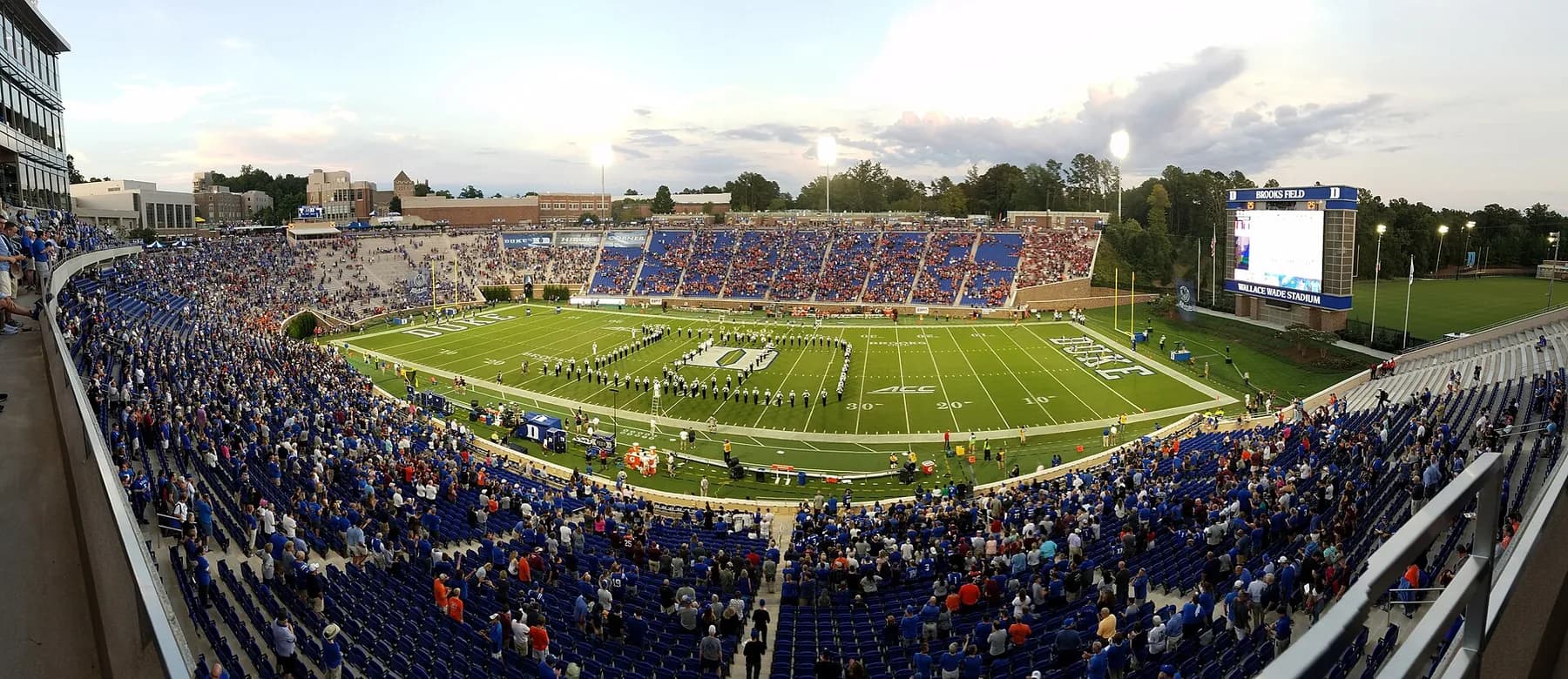
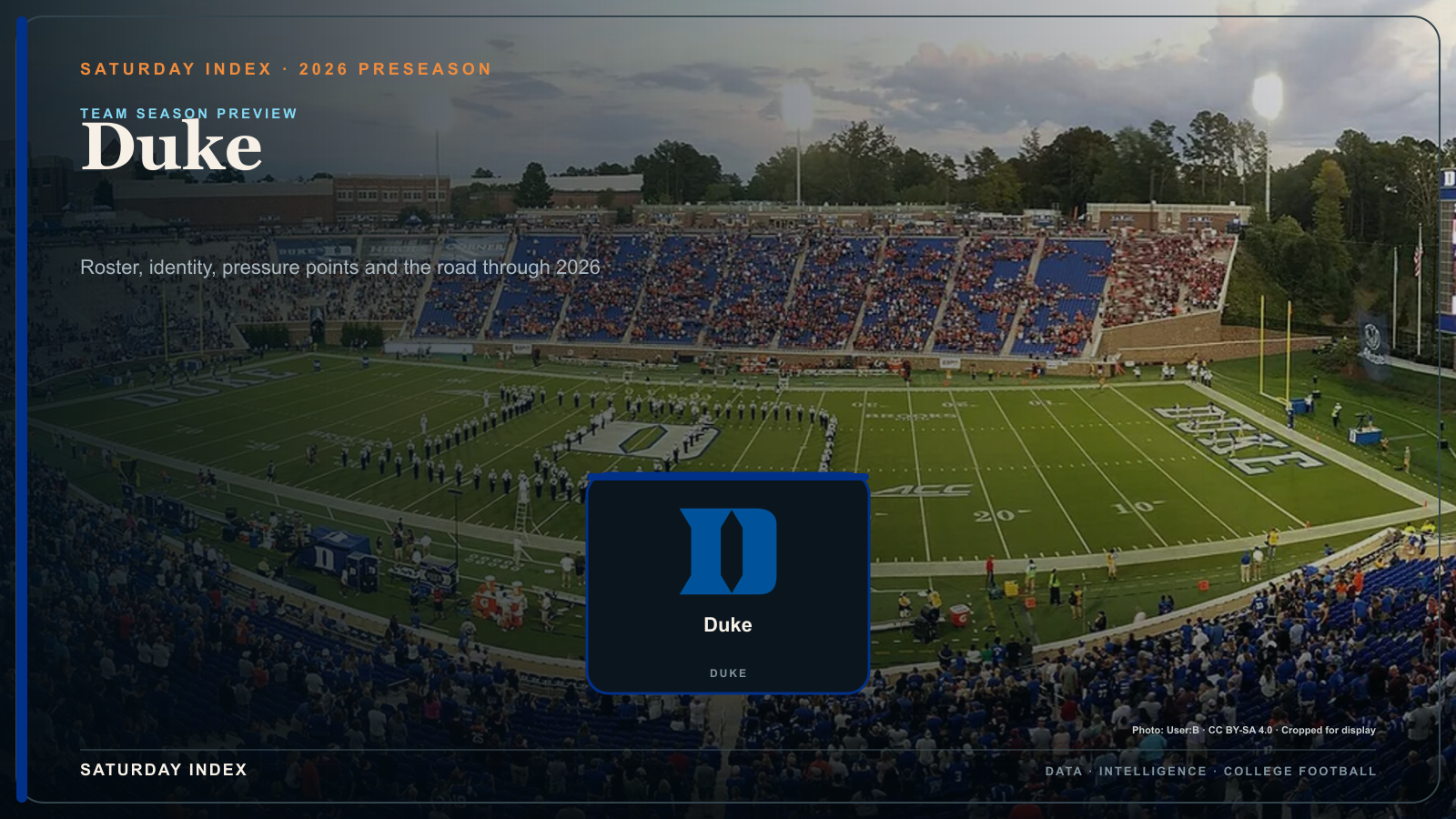
Photo: User:B · CC BY-SA 4.0 · Cropped for display
Up next · Week 9
Home
Hosting
Saturday, October 31 · Time TBA
The season, taking shape
Final scores show Duke first. Oldest to newest.
Pregame comparison unavailable
Game details at Georgia Tech
Pregame 27–25
Game details vs. North Carolina
Pregame 28–22
Game detailsOriginal full-season forecast
This forecast retains the original probabilities for the full schedule. It does not update with completed results or this week’s forecast.
2026 results
Current record, team efficiency, player production, and verified results from completed games.
Current record
5-25 wins · 2 lossesThrough 7 completed gamesLoading player usage…
2026 season preview
Manny Diaz retains important anchors and staff continuity, but Duke’s title defense hinges on resolving quarterback and rebuilding consequential rooms on both sides of the ball.
Duke enters 2026 as the defending outright ACC champion, but the path to another conference race will look less like a continuation than a reconstruction. Manny Diaz retains the coordinators who shaped the title team, and several proven players return through the middle of the roster. Yet the Blue Devils are replacing their quarterback while remaking the receiver group, defensive front and secondary. The season turns on whether coaching continuity and a handful of anchors can steady those high-leverage transitions before a demanding schedule exposes them.
Original season forecast
The original ACC forecast, retained alongside current results.
ACC projected standing
#7
5-4 projected · 4.8 expected conference wins · #7 of 17.
Preseason baseline
2025 percentiles retained as preseason context; current results and player production lead this page.
2025 FBS percentile scale · 50 is average
Incoming class
National and conference recruiting ranks, confirmed commitments, and the highest-ranked recruits in this class.
Top committed recruits
Duke2026 transfer movement
Incoming and outgoing transfer activity, with rated FBS-to-FBS moves below.
Incoming Transfers
DukeOutgoing Transfers
DukeSeason schedule
Completed games show final results. Upcoming games use this week’s forecast where available; later games retain their published season outlook.
Detailed football intelligence
The full team identity, offense, defense, and supporting evidence.
Team identity
Last season, Duke tried to lean on the passing game; the approach consistently kept the offense on schedule.
Why it matters
The passing game was Duke's more dependable way to stay ahead of the chains; opponents have to interrupt that rhythm without giving the run an easy box.
 at Virginia
Pregame 24–25
Game detailsPregame comparisons use preserved published forecasts. Results include wins and losses.
At a glance
Current form leads the outlook.
2026 rates aggregate verified completed-game box scores. EPA is expected points added per play.
| Player | C/ATT | YDS | TD | INT |
|---|---|---|---|---|
| Walker Eget | 122/197 | 1440 | 8 | 3 |
| Dan Mahan | 8/15 | 143 | 3 | 0 |
| Terry Walker III | 2/4 | 44 | 0 | 0 |
| Player | CAR | YDS | AVG | TD |
|---|---|---|---|---|
| Nate Sheppard | 153 | 875 | 5.7 | 9 |
| CJ Campbell | 52 | 258 | 5.0 | 0 |
| Jayvian Tanelus | 16 | 90 | 5.6 | 2 |
| Player | REC | YDS | AVG | TD |
|---|---|---|---|---|
| Jonah Burton | 20 | 289 | 14.4 | 1 |
| Nate Sheppard | 30 | 270 | 9.0 | 4 |
| Jeremiah Hasley | 21 | 250 | 11.9 | 0 |
| Player | TOT | SOLO | TFL | SACK |
|---|---|---|---|---|
| Nick Morris Jr. | 44 | 20 | 3 | 0 |
| Andrew Pellicciotta | 33 | 21 | 0 | 0 |
| DaShawn Stone | 33 | 20 | 1 | 0 |
Friday, October 23 · Scott Stadium
Saturday, October 17 · Wallace Wade Stadium
Saturday, October 10 · Bobby Dodd Stadium
Diaz’s staff provides a coherent starting point. Jonathan Brewer remains offensive coordinator and quarterbacks coach, Jonathan Patke remains defensive coordinator and linebackers coach, and Gabe Infante oversees special teams and the defensive line. The most urgent decision belongs to Brewer. AP reported that Darian Mensah reversed an announced return after leading Duke to the ACC title and that Duke sued in January over a two-season NIL agreement; Mensah is not on the current roster. Duke has not publicly named a successor. Veteran transfers Walker Eget and Ari Patu join Blaine Hipa and freshman Terry Walker III in a competition that must identify not merely the oldest option, but the player best able to command the offense while new receiving roles take shape.
Whoever wins the job will have credible support at running back, tight end and center. Sophomore Nate Sheppard, one of Duke’s three representatives at ACC Kickoff, was placed on Phil Steele’s preseason All-ACC second team and offers the offense an established skill-position centerpiece. Redshirt senior Jeremiah Hasley also represented Duke at the event and received first-team preseason All-ACC recognition from Phil Steele. His experience and production in the ACC championship game’s red zone make him a useful target between the numbers and near the goal line. Graduate center Matt Craycraft, listed at 6-foot-3 and 305 pounds and selected to Phil Steele’s third team, can help organize protections and communication. The rest of the line combination and receiver rotation have not been publicly settled, keeping cohesion central to the offense’s ceiling.
Duke did not wait until summer to begin the rebuild. Eleven early-enrollee signees and 13 transfers participated in spring, with additions at quarterback, offensive line, receiver, running back and tight end and across all three levels of the defense. That gave the staff time to teach its systems and evaluate combinations, but the volume of turnover carries a cost: options are not the same as answers. Diaz and his coordinators must convert broad competition into defined responsibilities, especially in rooms where communication matters snap after snap. The retained systems can shorten that process; they cannot eliminate it.
Linebacker Luke Mergott is the defense’s clearest returning reference point. He entered 2026 on the Lott IMPACT Trophy watch list after recording at least 85 tackles in 2025 and sealing both the ACC title game and Sun Bowl with late interceptions. Around him, Patke is rebuilding the structure. Defensive tackles Owen Wafle and Dakota Quiñonez arrived for spring, as did early-enrollee freshmen Ayden Cain and Chadwicke Cannon Jr., expanding a rotation whose dependable disruptors have not yet emerged publicly. At cornerback, spring participants Dylan Flowers, Kyon Loud and Evan Smith joined a group that retains younger defensive backs Landan Callahan and Kolbe Harmon. Those choices matter together: if the front cannot create disruption consistently, a secondary with an unconfirmed starting combination will face greater strain.
Punter Kade Reynoldson gives Duke one clearly established special-teams advantage. He earned Phil Steele preseason second-team All-America recognition after averaging 44.61 yards in 2025, putting 21 of 44 punts inside the 20 with only two touchbacks. For a team introducing a quarterback and integrating new defensive pieces, that field-position work can reduce the number of long fields the offense must navigate and give the defense more margin. Duke’s placekicking, kickoff and return responsibilities have not been publicly confirmed, so the certainty belongs to Reynoldson and the punting operation.
There is little room for a slow start. Duke opens at home against 2025 CFP participant Tulane, travels to nine-win Illinois in Week 2 and begins ACC play at home against Stanford before an October 3 open date. That sequence puts immediate pressure on the quarterback decision and on rebuilt units to communicate cleanly under game conditions. September will not decide every question, but it can shape the terms of the season: early instability would make conference contention harder, while competent play around the returning anchors could give the new combinations time to mature.
The closing stretch compounds the pressure. Duke visits NC State and 2025 national runner-up Miami on consecutive November weekends, then hosts Clemson on a Friday before finishing at nine-win Wake Forest. All four opponents enter off winning seasons, creating a sustained test of depth and durability. Duke’s title gives Diaz a standard, not a shortcut. To stay in the ACC race, the Blue Devils need a quarterback who can operate Brewer’s system, an offensive supporting cast that can settle around Sheppard, Hasley and Craycraft, and a defense that can develop reliable answers around Mergott. The returning anchors are substantial; whether they are enough depends on how quickly the unsettled rooms become functional units.
This preview is based on the linked public reporting and official program records.
Profile high point
Passing held the profile's highest percentile position.Profile low point
Big-play prevention held the lowest percentile position among the profile's strength measures.




The passing game is what Duke can trust most.
Why it matters
The opening plan has its best answer when opponents crowd the box or force obvious throwing situations; defensive control remains the first counter an opponent should test.
The defense's control of ordinary downs is the concern opponents should keep testing while the passing game tries to steady Duke.
What matters
Duke's defensive control finished below the national average last season.
For Duke, the cleanest script is to use the passing game to stay on schedule and finish drives; extra possessions give that plan time to build.
What matters
Duke's pass-first structure played at a fast pace. The pass game finished top-tier, while the run game finished below-average.
Inside the team
Open a section for the football detail and supporting numbers.
The down-to-down question that determines whether the offense can keep both the run and pass available.
Opponents have to break Duke's passing rhythm before it owns early downs.
Why it matters
If Duke keeps finding routine completions, the defense cannot load the box or turn the rush loose.
The pace, play selection, and methods this offense uses to stay on schedule.
Duke played at a fast pace in 2025.
Why it matters
More possessions give Duke's strengths additional chances to build, but they also leave more time to recover from mistakes.
Duke's prior passing record was top-tier.
Why it matters
A repeatable pass game can let Duke punish loaded boxes without relying on low-frequency deep completions.
Duke's prior rushing record was below-average.
Why it matters
When Duke's run game cannot stay on schedule, protection and passing-down execution carry more of the offense.
Duke's explosive-play upside came with real defensive volatility.
Why it matters
That mix can produce fast scoring swings in either direction and makes missed tackles or coverage busts especially expensive.
How consistently the offense creates manageable situations and the defense prevents them.
Duke's offense was more consistent down to down than its defense.
Why it matters
Duke's success rate shows whether it can sustain drives and get stops without relying on sacks, turnovers, or isolated big plays.
Opponent-adjusted EPA identifies the pass game as Duke's stronger offensive unit.
Why it matters
If an opponent removes the first passing answer, the run game's lower adjusted value becomes the key counter to test.
Where the defense can create pressure, control the run, and end drives.
Duke's prior defense was below-average overall and strongest in disruption.
Why it matters
Opponents can use efficient throws to stay out of obvious passing downs; Duke needs its disruption to change protection and erase drives with negative plays before that plan settles in.
Duke's available disruption measures ranked among the best in the country last season; a charted pressure rate is not available.
Why it matters
Sustained disruption can create negative plays and give Duke a better chance to end drives before third down.
Duke created disruption more consistently than it finished sacks.
Why it matters
Duke's disruption can hurry an offense; sacks do more by erasing field position and ending passing downs.
Duke's prior run-defense results were above-average.
Why it matters
A dependable run front can let Duke create obvious passing downs without committing extra bodies to the box.