Week 4 · FinalL
 at Baylor
13–23-10 margin
Pregame 23–32
Game detailsSaturday Index
Loading team intelligenceBringing the latest verified football information into focus.
Big 12 · 2026 · Week 8

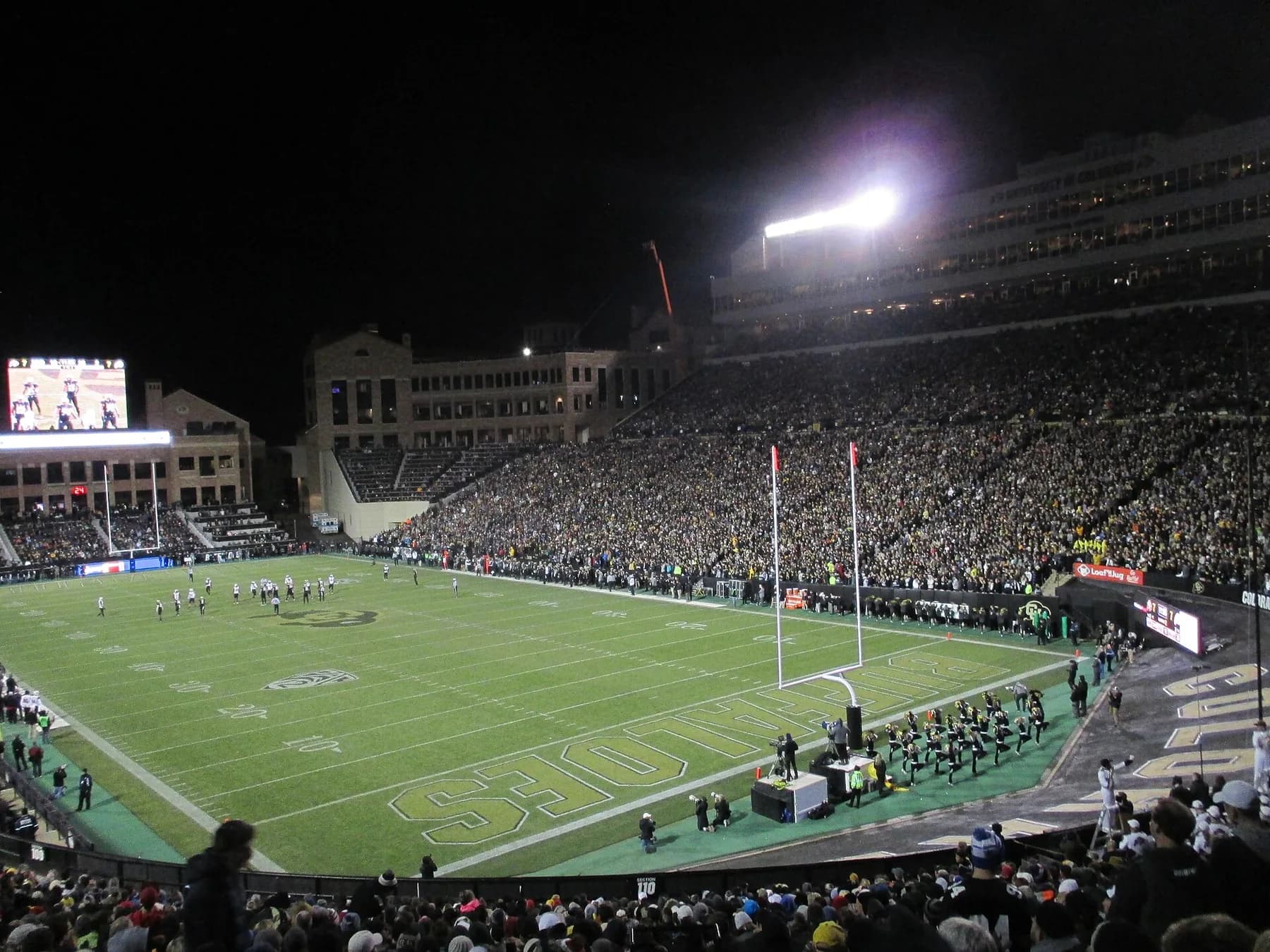
Photo: Thelastcanadian · CC BY-SA 4.0 · Cropped for display
Up next · Week 9
Home
Hosting
Saturday, October 31 · Time TBA
The season, taking shape
Final scores show Colorado first. Oldest to newest.
at BaylorPregame 23–32
Game details vs. Texas Tech
Pregame 16–36
Game details vs. Utah
Pregame 17–34
Game detailsOriginal full-season forecast
This forecast retains the original probabilities for the full schedule. It does not update with completed results or this week’s forecast.
2026 results
Current record, team efficiency, player production, and verified results from completed games.
Current record
2-52 wins · 5 lossesThrough 7 completed gamesLoading player usage…
2026 season preview
New coordinators, a genuine quarterback competition and sweeping roster turnover give Colorado several paths forward—and little time to choose among them.
Colorado’s 2026 season is less about finding another splash than making all the new pieces function together. After a 3-9 finish, Deion Sanders has installed a new coordinator structure, reshaped the roster again and handed the offense to Brennan Marion, whose system is designed to play quickly and create stress with formation and backfield variety. The Buffaloes’ central question is whether that change can become cohesion soon enough. Quarterback, offensive tackle and the defensive front all demand answers, and the schedule offers little room for a prolonged adjustment.
Original season forecast
The original Big 12 forecast, retained alongside current results.
Big 12 projected standing
#14
3-6 projected · 2.9 expected conference wins · #14 of 16.
Preseason baseline
2025 percentiles retained as preseason context; current results and player production lead this page.
2025 FBS percentile scale · 50 is average
Incoming class
National and conference recruiting ranks, confirmed commitments, and the highest-ranked recruits in this class.
Top committed recruits
Colorado2026 transfer movement
Incoming and outgoing transfer activity, with rated FBS-to-FBS moves below.
Incoming Transfers
ColoradoOutgoing Transfers
ColoradoSeason schedule
Completed games show final results. Upcoming games use this week’s forecast where available; later games retain their published season outlook.
Detailed football intelligence
The full team identity, offense, defense, and supporting evidence.
Team identity
Last season, Colorado tried to stay balanced between the run and pass; it rarely provided an easy foundation.
Why it matters
The passing game was Colorado's less difficult offensive option, but it did not provide a dependable way to stay ahead of the chains; the offense must prove that rhythm before opponents have to widen their structure.
 at Oklahoma State
Pregame 27–29
Game detailsPregame comparisons use preserved published forecasts. Results include wins and losses.
At a glance
Current form leads the outlook.
2026 rates aggregate verified completed-game box scores. EPA is expected points added per play.
| Player | C/ATT | YDS | TD | INT |
|---|---|---|---|---|
| Julian Lewis | 61/95 | 733 | 6 | 2 |
| Isaac Wilson | 58/101 | 701 | 4 | 5 |
| Joseph Williams | 2/3 | 49 | 0 | 1 |
| Player | CAR | YDS | AVG | TD |
|---|---|---|---|---|
| Jaquail Smith | 51 | 259 | 5.1 | 0 |
| Micah Welch | 43 | 220 | 5.1 | 2 |
| Damian Henderson II | 27 | 130 | 4.8 | 0 |
| Player | REC | YDS | AVG | TD |
|---|---|---|---|---|
| Joseph Williams | 37 | 508 | 13.7 | 5 |
| DeAndre Moore Jr. | 23 | 312 | 13.6 | 2 |
| Quanell Farrakhan Jr. | 15 | 175 | 11.7 | 0 |
| Player | TOT | SOLO | TFL | SACK |
|---|---|---|---|---|
| Randon Fontenette | 50 | 33 | 2.5 | 1 |
| Gideon Lampron | 48 | 31 | 7 | 1 |
| Naeten Mitchell | 44 | 32 | 3 | 0 |
Saturday, October 24 · Boone Pickens Stadium
Saturday, October 17 · Folsom Field
Saturday, October 3 · Folsom Field
Marion, Colorado’s offensive coordinator and quarterbacks coach, said the Buffaloes completed 14 spring practices with their base offense, situational packages and special plays installed. That shifts the next phase toward execution and personnel: who can process the system at speed, and which combinations give it the best chance to work? Sanders has publicly described 30 points per game as the offense’s threshold for winning. Reaching that mark will require more than tempo. Colorado must pair the system’s multiplicity with reliable quarterback decisions, coordinated blocking and a backfield rotation that can stay organized while moving fast.
Julian Lewis begins with the strongest recent Colorado production in the quarterback room. He completed 52 of 94 passes for 589 yards, four touchdowns and no interceptions in four appearances, including two starts, during 2025. He also led the spring game’s only touchdown drive and finished it with a scoring pass to Danny Scudero. Isaac Wilson brings prior Power Four starting experience, making this a genuine competition rather than a ceremonial challenge. Lewis has familiarity and recent production; Wilson offers experience from another major-conference setting. Colorado has not named a starter, and Marion’s eventual choice will shape how much of the offense can be used immediately.
The skill-position rooms give either quarterback options. Scudero previously played for Marion at Sacramento State, a connection that could help translate the new system for the rest of the receiving corps. Sanders has described that group as fast enough to threaten defenses vertically and sustain drives. The backfield is even more crowded, combining returners DeKalon Taylor, Micah Welch, Titus Bautista and Leonardo Valle with newcomers Damian Henderson, Bryce Hicks, JaQuail Smith and Richard Young. Henderson also played for Marion at Sacramento State. The depth suits an offense built around multiple backfield combinations, but Colorado still has to turn eight options into a dependable rotation.
Up front, veteran transfer center Demetrius Hunter may be the offense’s most important stabilizer. Colorado’s staff has presented him as a communicator, while Yahya Attia emerged as another leadership voice during spring. Their command matters when the offense is changing pictures and making calls at tempo. The larger concern sits at tackle, where All-American Jordan Seaton’s January transfer-portal entry removed the line’s established cornerstone. Colorado has not publicly settled on a replacement at left tackle or a best five. Until those combinations take shape, protecting a young quarterback and creating clean movement for Marion’s run game will remain intertwined challenges.
Chris Marve’s first defense will lean heavily on communication. During spring, Colorado expanded its coverage versatility while emphasizing pursuit, aggression and assignment discipline across the secondary. Veteran defensive back Ben Finneseth called that secondary the team’s best room, citing its depth, playmaking and buy-in. His assessment carries the optimism of a player inside the program, but Finneseth, Naeten Mitchell and Cree Thomas also represented Colorado at Big 12 media day, reflecting their expected prominence. If that group becomes the defense’s anchor, it can give Marve flexibility while he sorts the defensive-front and linebacker rotations.
That sorting process extends across a roster with 42 incoming and 38 outgoing transfers. Colorado has added extensive prior-school experience at running back, along both lines and throughout the secondary, giving Sanders and his coordinators mature options without guaranteeing immediate continuity. Special teams presents a smaller version of the same challenge. Josh McCormick made two field goals in the 7-6 spring game, Sanders identified the unit as a major area of spring growth, and Kansas transfer Damon Greaves is listed at punter. Replacing established kicker Alejandro Mata still makes specialist consistency an important camp storyline.
Colorado will have to grow up quickly. The Buffaloes open at Georgia Tech, host Weber State and visit Northwestern before beginning Big 12 play at Baylor and returning home for Texas Tech. That is three road games in the first four FBS matchups for a team choosing a quarterback and integrating new systems. A later run against Utah, Oklahoma State, Kansas State and Arizona State applies another sustained test. The talent and schematic ambition offer a plausible route out of last season’s struggles, but the path runs through ordinary, demanding football work: protect the quarterback, define the rotations and communicate well enough for a rebuilt roster to play as one.
This preview is based on the linked public reporting and official program records.
Profile high point
Big-play creation held the profile's highest percentile position.Profile low point
The run game held the lowest percentile position among the profile's strength measures.



Big-play creation is what Colorado can trust most.
Why it matters
The offense has its best route to changing field position without requiring flawless drive efficiency; rushing structure remains the first counter an opponent should test.
The run game is Colorado's biggest concern, and opponents can test it immediately.
What matters
Colorado's rushing structure ranked near the bottom nationally last season.
Colorado's best path is to stay balanced between the run and pass, then let the passing game finish drives; fewer possessions make every empty drive more expensive.
Why it matters
Colorado's clean script uses efficient early throws to stay ahead of the sticks; defenses will attack protection and route timing before the full passing menu opens. In a slower game, one empty drive or failed early-down series carries extra weight.
Inside the team
Open a section for the football detail and supporting numbers.
The down-to-down question that determines whether the offense can keep both the run and pass available.
Before defenses have to adjust, Colorado must prove routine throws can keep first down on schedule.
What matters
Last season's passing results did not establish a dependable way to stay out of long-yardage.
The pace, play selection, and methods this offense uses to stay on schedule.
Colorado played at a deliberate pace in 2025.
What matters
Colorado worked with fewer possessions than most teams last season.
Colorado's prior passing record was weak.
Why it matters
Colorado's offense needs protection, field position, or explosive variance when ordinary dropbacks do not create enough value.
Colorado's prior rushing record was bottom-tier.
Why it matters
When Colorado's run game cannot stay on schedule, protection and passing-down execution carry more of the offense.
Colorado's explosive-play upside came with real defensive volatility.
Why it matters
That mix can produce fast scoring swings in either direction and makes missed tackles or coverage busts especially expensive.
How consistently the offense creates manageable situations and the defense prevents them.
Colorado's defense was more consistent down to down than its offense.
Why it matters
Colorado's success rate shows whether it can sustain drives and get stops without relying on sacks, turnovers, or isolated big plays.
Colorado's opponent-adjusted passing and rushing value were closely matched.
Why it matters
When the split is narrow, early-down execution matters more than steering the offense toward one obvious weakness.
Where the defense can create pressure, control the run, and end drives.
Colorado's prior defense was weak overall and strongest in run front.
Why it matters
Opponents can use efficient throws to stay out of obvious passing downs; Colorado needs its run front to create long-yardage without overloading the box before that plan settles in.
Colorado's available disruption measures finished below the national average last season; a charted pressure rate is not available.
Why it matters
Without consistent disruption, Colorado's defense must win more snaps through coverage, leverage, and early-down prevention.
Colorado created disruption more consistently than it finished sacks.
Why it matters
Colorado's disruption can hurry an offense; sacks do more by erasing field position and ending passing downs.
Colorado's prior run-defense results were below-average.
Why it matters
If Colorado's front cannot control early downs, opponents can keep every offensive option open and protect their passing game.